
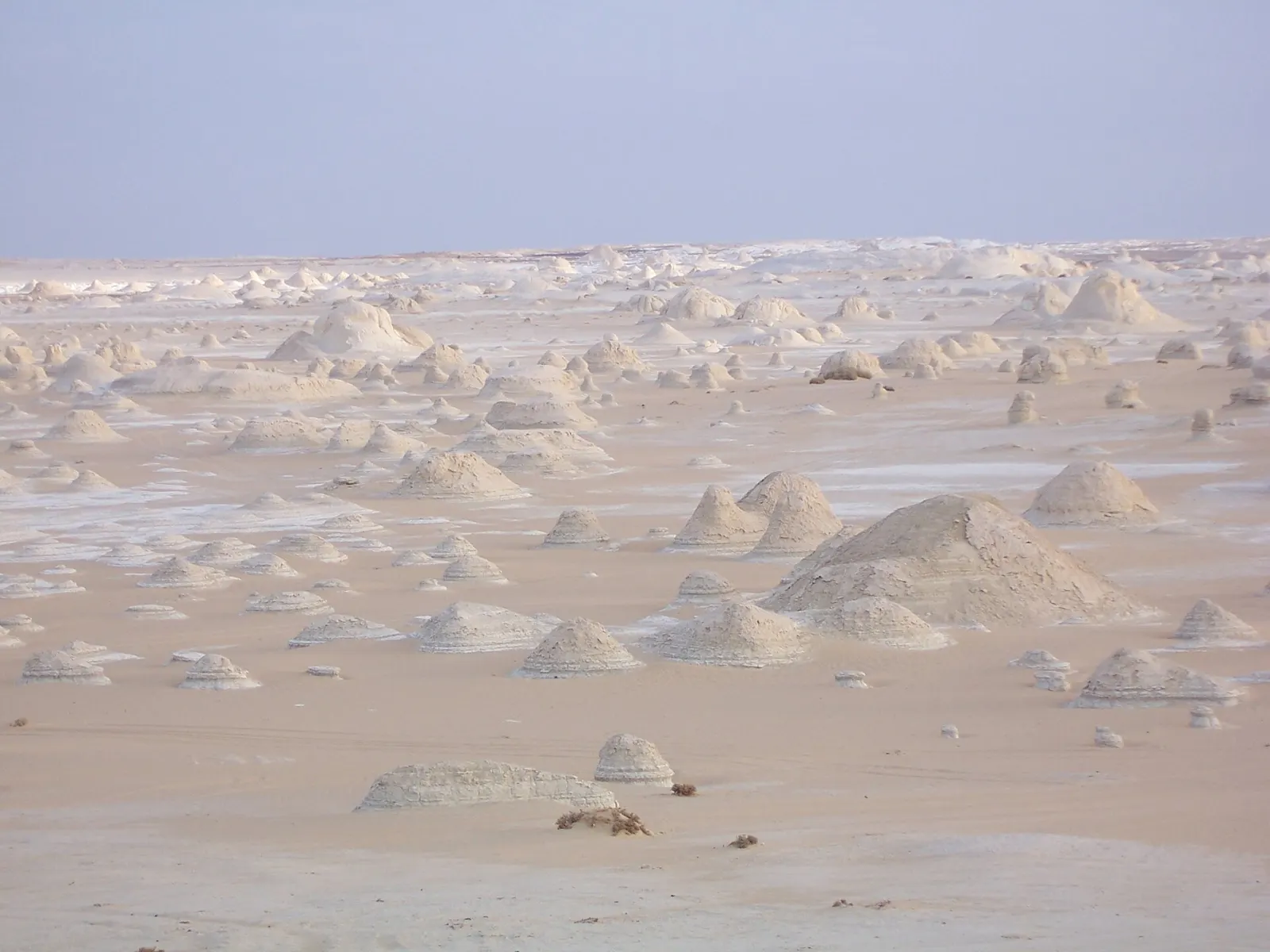
The short answer
White Desert National Park covers about 3,133.5 km² of New Valley Governorate under Prime Minister's Decree No. 1220 of 2002. Foreigners go in by 4x4 with a permit and licensed guide. Our standard way in is the 2-day, 1-night camping trip from Cairo: About US$185 to 230 shared · US$360 to 460 private, per person. Send your dates: message us on WhatsApp.
Ask us on WhatsAppThe usual way into White Desert National Park is our overnight camping trip from Cairo: two days and one night, with the Black Desert, Crystal Mountain and Agabat on the way in, and sunset, a campfire dinner and sunrise among the chalk. Its price guide reads About US$185 to 230 shared · US$360 to 460 private, per person, permit and protected-area fee both in the quote. Tell us how many of you are coming and when: message us on WhatsApp, and a written plan comes back from Bawiti.
Our trips into the park, side by side
Short answer: One night is the usual choice; three days reaches the New White Desert towers and Ain Khadra; the day trip suits travellers with only one free day.
| Trip | Length | Starts from | Price guide | What you see in and near the park | Who it suits |
|---|---|---|---|---|---|
| Overnight camping from Cairo | 2 days, 1 night | Cairo or Giza hotel | About US$185 to 230 shared · US$360 to 460 private, per person | Agabat and the Old White Desert inside the park, with the Black Desert and Crystal Mountain on the way | Most first-time visitors |
| Day trip from Cairo | 1 day (about 15 hours) | Cairo or Giza hotel | About US$220 to 280 per person for two travellers, private | Two to three hours among the chalk, picnic lunch included, after the Black Desert stop | Anyone who cannot spare a night |
| Three days with Farafra | 3 days, 2 nights | Cairo or Giza hotel | About US$495 to 660 per person for two travellers, private | The deep park: Ain Khadra spring, the New White Desert towers, then the mushroom field; Bawiti museum first | Those with two nights to spare; private, shared on request |
| White Desert and Djara cave | 4 days, 3 nights | Cairo or Giza hotel | About US$605 to 825 per person for two travellers, private | A night in the chalk, two 4x4s east over the dune belts to the cave's stalactites and engravings, then a last chalk camp | Experienced travellers after remote camps |
| Private comfort camping | 2 or 3 days | Cairo or Giza hotel | Ask us | Your own camp in the chalk; the 3-day version adds Ain Khadra and the northern towers | Guests who want camp beds and a shower tent on request |
| Family private trip | 3 days, 2 nights | Cairo or Giza hotel | Ask us | Shapes to spot in the chalk after a Bawiti lodge night and a warm spring | Parents travelling with young children |
| Full-moon camping | 2 days, 1 night | Cairo or Giza hotel | About US$185 to 230 shared · US$360 to 460 private, per person | Moonlit chalk on a guided night walk, plus sunset and sunrise | Couples and walkers who like the desert by moonlight |
| Geminids meteor camp | 2 days, 1 night | Cairo or Giza hotel (or meet in Bawiti) | About US$185 to 230 shared · US$360 to 460 private, per person | Dark-sky chalk camp for the 13–14 December 2026 meteor peak | Night-sky fans |
| Eclipse 2027 camp | 3 days, 2 nights | Cairo or Giza hotel (or meet in Bawiti) | Ask us | Moonless night in the park, then totality north of it on 2 August 2027 | Eclipse chasers, in a small group or private |
| Siwa and the White Desert | 7 days | Cairo or Giza hotel | Ask us | One night in the park, then the coast, Siwa and the Great Sand Sea | A week to spend on both deserts |
The UK government advises against all but essential travel on the desert road from Bahariya west to Siwa; we route via Cairo and don't use it. Every quote names the permit and the protected-area fee. Message us on WhatsApp for dates, or compare everything on all our White Desert tours and what a trip costs.
Why book with us
Short answer: A Bawiti team with our own crew, permits handled and bookings through a licensed agency.
- Based in Bawiti. We run the trips from Bawiti, the main town of Bahariya Oasis and the gateway to the White Desert.
- Our own crew. Your drivers, guide and camp cook are our own people from Bahariya.
- Paperwork handled. The permit and a licensed guide are arranged by us. We need your passport details one day before the trip.
- Licensed booking. Bookings are made with Intercontinental Travel, a Ministry of Tourism licensed agency (Category A, No. 2436). See about us and booking terms.
- In writing. Pick-up point, meals, camp kit, the park fee and what's extra are listed before you pay.
At a glance
Short answer: About 3,133.5 km² of New Valley Governorate, declared in 2002, about 500 km from Cairo by road and visited only by 4x4 with a licensed operator.
| Key fact | White Desert National Park |
|---|---|
| Area | About 3,133.5 km² (EEAA protectorate table); 3,010 km² in the World Database on Protected Areas |
| Declared | 2002, Egypt's 23rd protected area, under Prime Minister's Decree No. 1220 of 2002 and Law No. 102 of 1983 |
| Official category | Landscape Protected Area ("national park" is the usual English name); the 2007 draft management plan proposed IUCN category II (checked 19 November 2026) |
| Managed by | Nature Conservation Sector, Egyptian Environmental Affairs Agency (Ministry of Environment) |
| Highest and lowest points | About 353 m at El Qess Abu Said and about 32 m at Wadi Hennis (2007 draft plan) |
| Distance from Cairo | About 370 km to Bawiti, about 500 km to the formations by road |
| From Farafra | Main formations about 40 km north of Qasr Farafra (Farafra Oasis) |
| How to visit | By 4x4 with a licensed operator; permit and official guide required for foreigners |
| Entrance fee | A government protected-area fee for foreign visitors, collected through the operator and shown as its own line in your quote |
| Facilities inside | None among the formations |
| Best season | October to April |
How big is the park?
Short answer: The park covers about 3,133.5 km² of New Valley Governorate under Prime Minister's Decree No. 1220 of 2002 (source: EEAA protectorate table).
The EEAA's table lists the White Desert as protectorate number 23, a "Landscape Protected Area" of 3,133.5 km². The World Database on Protected Areas gives 3,010 km²; we haven't found a source that explains the gap, so we use the EEAA figure. The 300 km² in the English Wikipedia entry has no cited source and is about a tenth of both. The park's 2007 management plan writes the decree as 1120; the EEAA's current table gives 1220.
The part visitors see, from the Agabat valley to the Old White Desert near the Farafra road, is a stretch of a few dozen kilometres.
How it compares with Egypt's other desert protectorates
| Protectorate | Declared | Area (EEAA) | Governorate | EEAA type | Visiting from Cairo |
|---|---|---|---|---|---|
| White Desert | 2002 (Decree 1220) | 3,133.5 km² | New Valley | Landscape Protected Area | 4x4 trip, best with one or more nights |
| Siwa | 2002 (Decree 1219) | 7,731 km² | Matrouh | National Park | A separate trip via the coast |
| Gilf Kebir | 2007 (Decree 10) | 48,524 km² | New Valley | National Park | Long expedition only |
| Bahariya Oasis | 2010 (Decree 2656) | 102.6 km² | Giza | Natural Monument protected area | In Bahariya; the table doesn't say which sites it covers |
| Gebel Kamil Meteorite | 2012 (Decree 271) | 17 km² | New Valley | Natural Monument protected area | Remote, not on tourist routes |
| Wadi El-Rayan | 1989 (Decree 943) | 1,757.9 km² | Faiyum | Sustainable use of natural resources | Day trip |
Source: the EEAA protectorate table, which lists 31 protectorates (checked 19 November 2026). For the trade-offs, see White Desert vs Siwa and White Desert vs Fayoum.
What is inside the park, and what is not
Short answer: Agabat, the New White Desert, the Old White Desert with the Mushroom and Chicken, and Ain Khadra spring are inside. The Black Desert and Crystal Mountain are outside, to the north.
Driving south from Bawiti you pass the Black Desert and Crystal Mountain, then drop through Agabat, roughly 120 km south of Bawiti, into chalk country. The Mushroom and Chicken are about 135 km south of Bawiti. Our Old and New White Desert page explains the two halves.
| Place | Inside the park? | What it is | On the overnight trip? |
|---|---|---|---|
| Black Desert | No, to the north | Golden hills strewn with dark rock fragments | Yes, a short stop and climb |
| Crystal Mountain | No, to the north | A low ridge of quartz crystals | Yes, a short stop |
| Agabat valley | Yes, the northern entry | Cliffs and sand slopes where the chalk begins | Yes |
| New White Desert | Yes, northern part | Chalk mountains, towers and long cliffs | No; the big towers are on the three-day trip |
| Old White Desert | Yes, southern part | The field of mushrooms and animal shapes | Yes, for sunset and camp |
| Ain Khadra | Yes | A small spring with palms among the chalk cliffs | No; three-day or private trips |
| Wadi Hennis, Ain El Maqfi, Ain El Wadi | Yes, per the 2007 plan | A vegetated wadi and small uninhabited oases | No |
The plan also takes in dunes from the Great Sand Sea, which, like the wadi and small oases, are off normal tourist routes (2007 draft management plan (checked 19 November 2026)). Bahariya's own 102.6 km² natural monument, declared in 2010, is separate from the park.
Why your driver can't go everywhere
Short answer: Some areas are open for tourism and camping on established tracks; others are off-limits to vehicles to protect fragile formations, springs and wildlife.
Checkpoint and ranger instructions can change from season to season, and a good driver knows where the lines are. If an operator promises to take you "anywhere you like" inside the park, treat it as a warning sign.
The zones in the 2007 plan
We haven't found a later, published zoning map, so treat this as background, not a map of what is allowed tonight.
| Zone (2007 draft plan) | Vehicles | Camping | Purpose |
|---|---|---|---|
| Strict Nature Zone | None; access on foot only | Not allowed | Wildlife refuges and corridors |
| Premium Wilderness Zone | None; on foot or by camel | Only for trekkers and camel users | Small numbers of visitors in remote wilderness |
| Recreational Zone | Designated, marked tracks only | Designated sites; trekkers and camel users anywhere in the zone | Easy-access tourism that brings income to local people |
Source: White Desert Protected Area management plan, draft 2007 (checked 19 November 2026). The plan names patrolling as the main management tool and proposed a visitor centre; there is still none among the formations. In practice, 4x4 trips stay on established tracks, and a crew may refuse a short cut that looks harmless.
White Desert entrance fee (2026)
Short answer: The entrance fee is a government protected-area fee for foreign visitors, collected through the operator and shown as its own line in your quote. We don't publish a figure because we haven't found a current, dated official schedule.
Why the figures online don't agree
- Most are undated. A blog or forum figure may be years old, and protected-area fees in Egypt have changed.
- They count different things. Some are per person, some per vehicle, and many don't say which.
- They mix rates. Egyptians and foreigners pay different rates.
- Some aren't about the White Desert. A 2019 report on a new fee decision, for example, names only Red Sea reserves.
So the fee goes in every quote as its own line, at the rate charged on the day, before you pay anything.
What a fair quote shows
- The desert permit, arranged before you travel.
- The protected-area fee as its own line, for each foreign guest, and whether it is in the total.
- Bahariya antiquities tickets listed separately, marked in or out.
- The total from your Cairo hotel and back, not only the desert part.
- No cash fee "at the start of the desert" that the quote didn't mention.
Not the same as Bahariya's antiquities ticket
Bahariya's antiquities tickets are for the museum and tombs in Bawiti, such as the Golden Mummies, and you pay them only if you visit: About EGP 400 for foreigners since 1 October 2026 (was about EGP 100); check on the day. The three-day trip includes the Bawiti museum; see Bahariya Oasis for the rest.
Checked November 2026: the FCDO still names the White and Black deserts, Bahariya and Farafra as exceptions to its Western Desert warning, and our permits and safety page quotes its off-road advice word for word. We found no dated official fee schedule for the White Desert published online.
What the park protects
Short answer: Chalk landscapes, marine fossils, prehistoric campsites, gazelles, foxes and the small springs that keep them alive.
- Landscape: chalk formations, karst, inselbergs and cliffs at the northern edge of the Farafra depression. The chalk is Late Cretaceous sea-floor sediment, some 70 to 80 million years old.
- Fossils: marine fossils in the chalk and older plant and animal remains in the surrounding rocks.
- Archaeology: prehistoric tools and campsites from the wetter Holocene, roughly 10,000 to 5,000 years ago.
- Springs: small water sources such as Ain Khadra that sustain birds and mammals.
Wildlife you may see
The 2007 draft plan records at least 12 mammal species and about 24 resident bird species (2007 draft management plan (checked 19 November 2026)), and notes that the slender-horned gazelle and Barbary sheep may be locally extinct.
| Animal | Status | Chance of seeing it |
|---|---|---|
| Fennec, red and Rüppell's foxes | Recorded in the park | Good: foxes often visit camp after dark |
| Dorcas gazelle | Vulnerable (Wikipedia (checked 19 November 2026)) | Low; tracks are more likely |
| Slender-horned (rhim) gazelle | Endangered (same source) | Very low |
| Barbary sheep | Recorded; may be locally extinct | Very low |
| Golden jackal, sand cat | Recorded in the park | Low; mostly active at night |
| Gerbils and jerboas | Recorded in the park | Tracks round camp at dawn |
| Birds | About 24 resident species; the Eurasian thick-knee is the most widespread | Best near springs |
How a visit inside the park works
Short answer: You enter from the north by 4x4 with a licensed crew, cross the chalk on existing tracks and camp in a permitted area.
Trips from Cairo start with a hotel pick-up and about 370 km, 4.5–5 hours, to Bawiti; see the Cairo to Bahariya drive. After the Black Desert and Crystal Mountain, Agabat is where the chalk begins and the driver leaves the tarmac. Checkpoints on the Farafra road check passports against the permit, so keep yours with you.
We choose each night's spot with a light-pollution map for the darkest sky; more on camping in the White Desert and where we camp. One night versus two is weighed up in how many days and day trip or overnight; for a quick visit, the private day trip from Cairo gives two to three hours among the formations, mostly in midday light.
Foreign visitors can't go in alone: the permit requires an official guide and a licensed operator. Our guide to choosing an operator lists questions worth asking.
Facilities inside the park
Short answer: None among the formations. Everything for the night comes in the 4x4s.
| Need | Inside the park | What we do |
|---|---|---|
| Toilets | None | Toilets at lunch stops in Bawiti and Farafra; a toilet tent on request on any trip |
| Drinking water | No water point; don't drink from the springs | We carry plenty and never run out |
| Food | No shop or café | Meals, water and tea come with the crew |
| Phone signal | Patchy; mostly none at camps away from the road | Tell family you'll be offline |
| Shade | Almost none | A windbreak at camp |
| Rubbish bins | None | All rubbish goes back to Bawiti in our car |
When to visit the park
Short answer: October to April. Winter camp nights can fall to 0–4°C; summer middays reach about 38°C with no shade.
| Season | Days at Farafra | Nights at camp | What it means |
|---|---|---|---|
| October–November | 26–31°C | 7–16°C | Warm days, mild nights |
| December–February | 20–22°C | 0–6°C | Clear, cold nights; frost possible in January |
| March–May | 26–35°C | 6–18°C | Warmer; khamaseen dust, worst in April |
| June–September | 35–38°C | 17–22°C | Very hot middays; warm, clear nights |
Figures are from our weather and night temperatures guide; month by month, see best time to visit and the packing list. The park is inside the path of the 2 August 2027 eclipse. Totality lasts 6 minutes 24 seconds in the northern Black Desert, close to the centre line, and 2 minutes 5 seconds at the Mushroom and Chicken in the White Desert, according to timeanddate's calculations for those points. The peak is around 12:53 local time; see the 2027 eclipse.
Rules that keep it white
Short answer: Stay on used tracks, don't climb or carve the formations, take nothing and leave nothing.
Tyre tracks on the chalk crust last for years, and the formations are soft enough to scratch with a fingernail.
- No climbing on the mushrooms and towers; a stem can be thinner than your waist, and once a cap falls it's gone.
- No carving names or initials.
- No fossils, crystals, iron nodules or stones as souvenirs.
- All rubbish, including tissues and food scraps, goes back to Bawiti.
- Fires only in the crew's fire pit, with wood we bring.
- Don't feed the foxes; human food harms them.
Drones need official permission in Egypt and can be confiscated, so we advise leaving yours at home; see permits and safety.
Plan the rest of your trip
Start with our White Desert trips from Cairo, then read about camping in the White Desert and Bahariya Oasis, the town where every trip changes into a 4x4. When you have dates, message us on WhatsApp and we'll send a written plan for the overnight camping trip or whichever trip fits.
Map: Bahariya to Farafra
Schematic map, not to scale: positions are approximate, and the desert sites spread over many kilometres. The road runs about 180 km from Bawiti to Farafra; shaded areas show roughly where the black hills and the white chalk are.
Questions people ask
How much does a trip into White Desert National Park cost?+
Overnight camping from Cairo: About US$185 to 230 shared · US$360 to 460 private, per person. Cairo and back in one day: About US$220 to 280 per person for two travellers, private. With Farafra over 3 days: About US$495 to 660 per person for two travellers, private. Four-day Djara cave trip: About US$605 to 825 per person for two travellers, private. Comfort, family, eclipse and Siwa trips: ask us. Every quote is in writing before you pay.
What is included in the overnight trip?+
Hotel pick-up and drop-off in Cairo or Giza; the road transfer to Bahariya and a 4x4 with an experienced desert driver; the desert permit and protected-area fees; lunch on day 1, dinner, breakfast and lunch on day 2, with tea and plenty of drinking water; a mattress, blankets and windbreak, with a tent or sleeping bag on request; and sandboards at Agabat, free to use. Not included: tips, drinks other than water and tea, Bahariya antiquities tickets, rest-house snacks, travel insurance, comfort extras or a lodge night if you ask for them, and the supplement for the week from 20 December to early January.
Is the White Desert entrance fee included in a tour?+
With us, yes, and you see it. It is a government protected-area fee for foreign visitors, collected through the operator and shown as its own line in your quote. We don't publish a figure because we haven't found a current, dated official schedule. With any operator, ask in writing whether the fee is in the total.
Do I need a permit to visit the park?+
Yes. Every foreign visitor to the White and Black deserts needs an advance permit, and a licensed guide must travel with the group. We apply for the permit in your name, so we need your passport details one day before the trip. You cannot visit the park independently as a foreign visitor.
Is it safe to visit White Desert National Park?+
For most travellers, yes. The UK FCDO lists the White Desert and Black Desert, Bahariya and Farafra as exceptions to its warning on the area west of the Nile Valley, and adds: "If you're travelling off road, use a qualified guide and get a permit from the Ministry of Interior." The full wording is on our permits and safety page. The day-to-day risks are heat, cold, sun and a long drive, and we plan the trip around them.
What is the best month to visit?+
October to April. October and November have warm days and mild nights; December to February bring clear skies and camp nights of about 0 to 6°C; March to May get warmer, with dusty khamaseen winds most likely in April. June to September middays reach about 38°C with no shade.
Should I book a shared or a private trip?+
Shared costs less: you ride, eat and camp alongside other travellers, and we never put more than four guests in one 4x4. Private means the car, crew, timing and camp spot are yours, and we pitch away from other groups. Solo travellers tend to like shared. Families and photographers usually prefer private.
Does a one-night trip see the whole park?+
No. One night covers Agabat and the Old White Desert's mushroom field for sunset and sunrise. The tall towers of the New White Desert and Ain Khadra spring need the three-day trip or a private trip with a second night.
How big is White Desert National Park?+
About 3,133.5 km² of New Valley Governorate under Prime Minister's Decree No. 1220 of 2002. That is the EEAA figure. The World Database on Protected Areas gives 3,010 km². The 300 km² seen on some sites has no source. Visitors see a stretch of a few dozen kilometres along the Bahariya–Farafra road.
Is the White Desert a UNESCO World Heritage Site?+
No. It's a national protected area managed by Egypt's environment agency. Egypt's natural UNESCO site in the Western Desert is Wadi el-Hitan, the Valley of the Whales, in Fayoum.
Can I camp anywhere inside the park?+
No. Camping is allowed only in permitted areas, and checkpoint or ranger instructions can change where groups may stay on a given night. If that happens we tell you why before we drive on, and we still aim to put you among the chalk for sunset or sunrise.
Is the Black Desert part of White Desert National Park?+
No. The Black Desert and Crystal Mountain lie north of the park, on the road down from Bawiti. Bahariya has its own, much smaller protected area, declared in 2010 as a natural monument. Our trips from Cairo stop at both on the drive from Bawiti to the chalk.
Go with us
Trips that include this
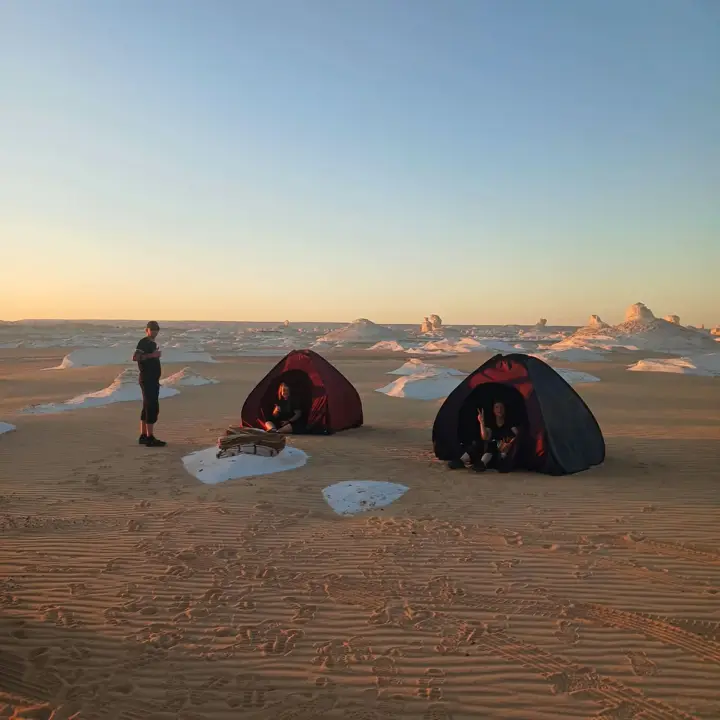
2 days, 1 night
White Desert overnight camping trip from Cairo (2 days, 1 night)About US$185 to 230 shared · US$360 to 460 private, per person
Check dates
3 days, 2 nights
3-day White Desert tour: Bahariya, the White Desert and two nights outAbout US$495 to 660 per person for two travellers, private
Check dates