
The short answer
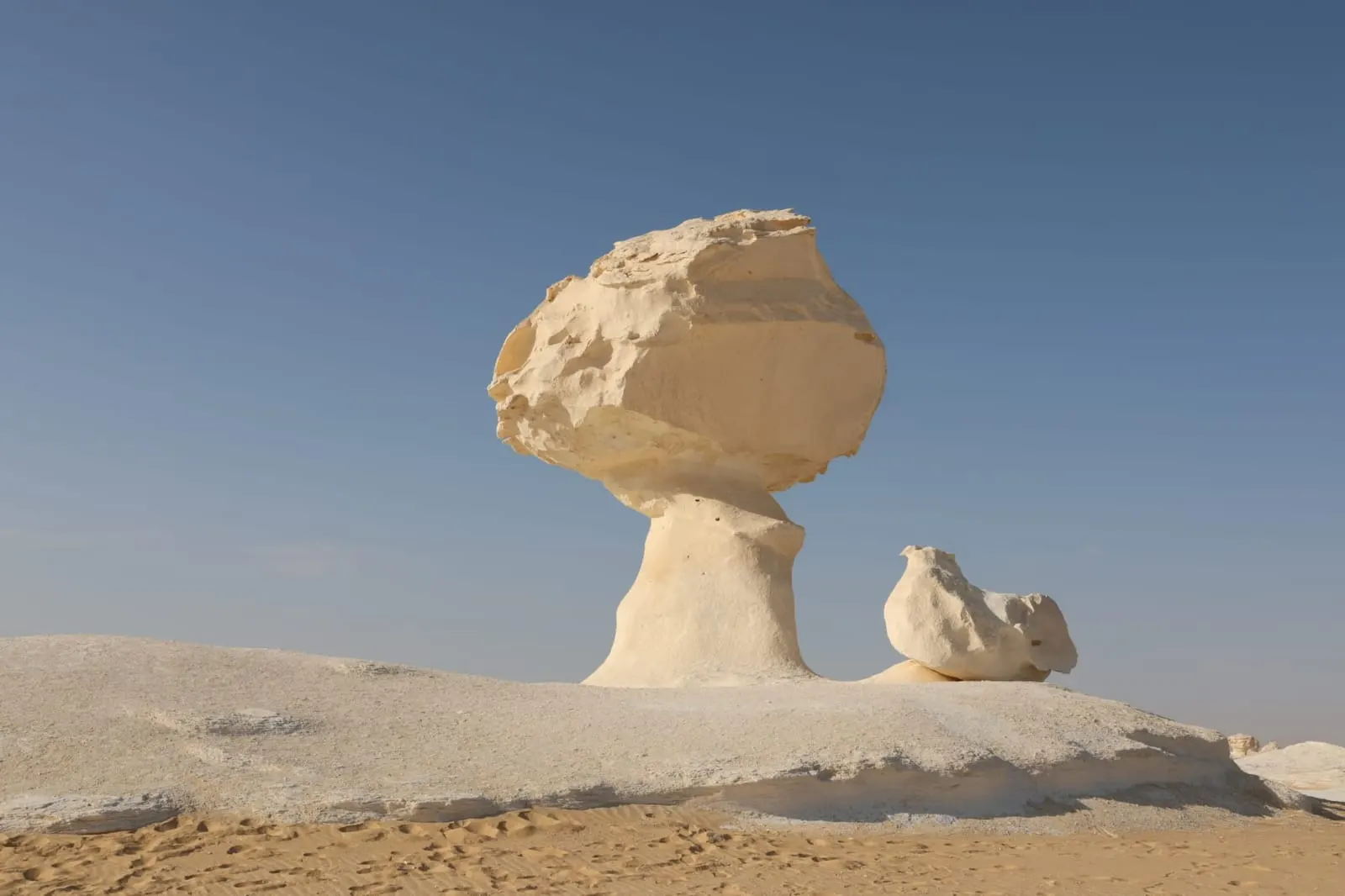
The Mushroom and the Chicken are two chalk formations standing side by side in the Old White Desert, about 40 km north of Qasr Farafra: a tall white cap on a narrow stem, and a smaller rock shaped like a sitting bird. They are the most photographed rocks in Egypt's Western Desert, and almost every White Desert trip stops there, ideally in the late afternoon.
Ask us on WhatsAppWhat you see
Short answer: A tall white cap on a thin stem, and beside it a rounder rock shaped like a sitting hen, on a flat plain full of smaller shapes.
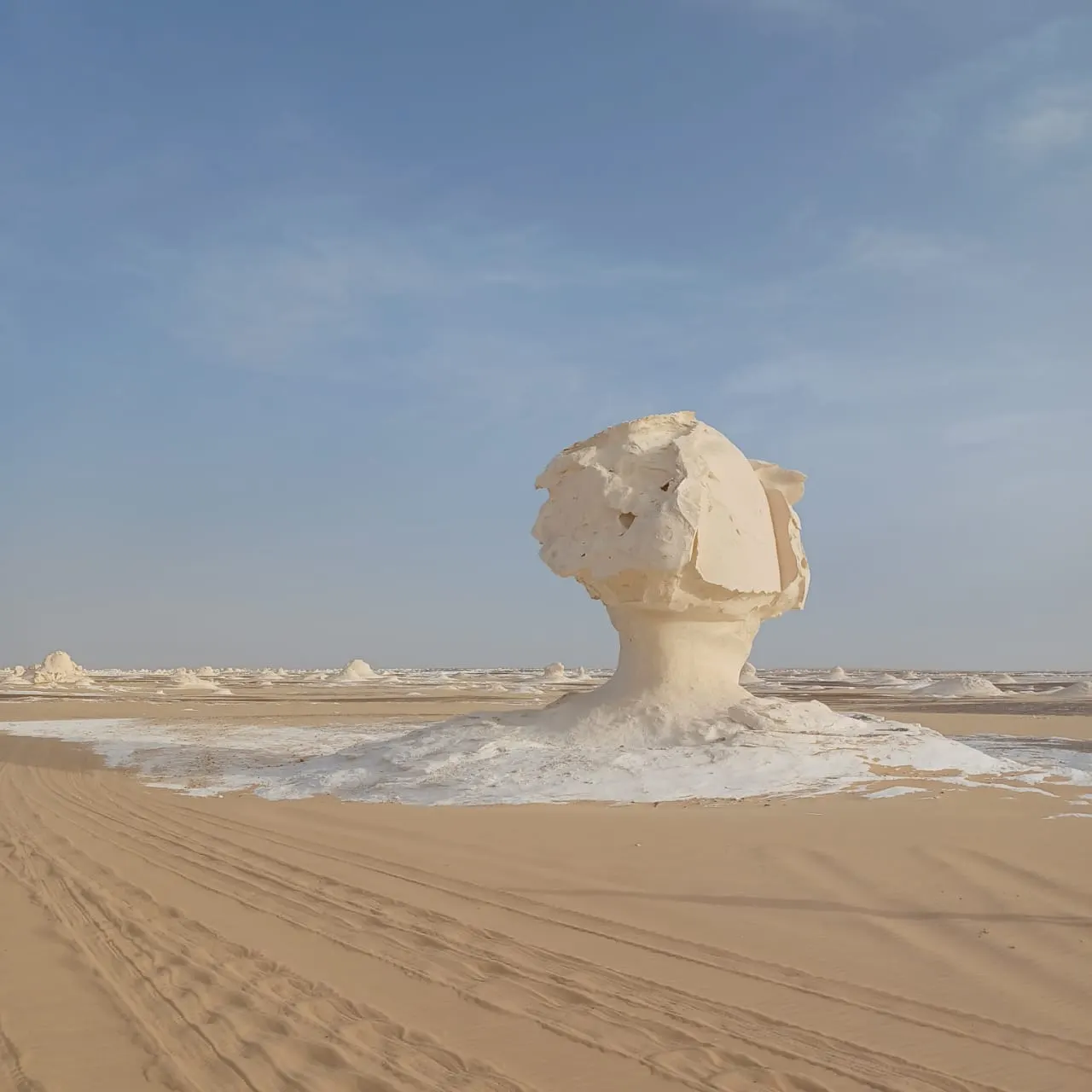
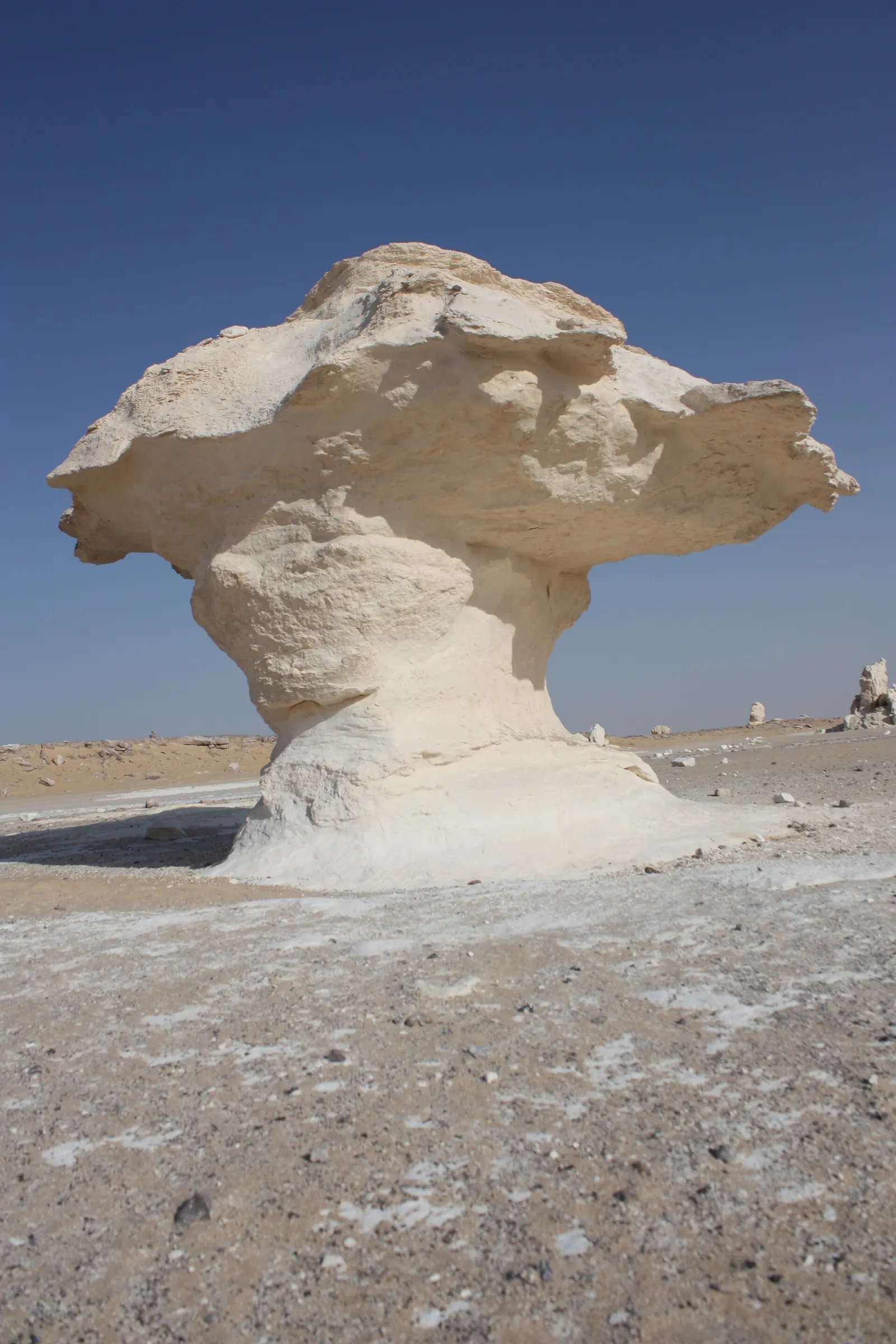
On a flat, pale plain stand two white rocks a few metres apart. The taller has a broad, rounded cap balanced on a thin neck: the classic desert mushroom. Next to it, a lower, rounder rock with a pointed "head" looks remarkably like a hen settled on a nest. Around them, dozens of smaller formations dot the plain to the horizon, from low domes to slender pillars.
The pair are not the biggest rocks in the park. The northern chalk mountains of the New White Desert are far larger. What makes these two famous is their clean, almost cartoon-like shapes and the way they stand alone on an open plain, easy to frame against the sky.
How they formed
Short answer: Wind-blown sand eroded the soft lower chalk faster than the harder top, carving a stem under a cap.
The chalk was laid down on the floor of an ancient sea in the Late Cretaceous, roughly 70 to 80 million years ago. When the land rose and dried, the wind went to work. Sand blown close to the ground sandblasts the base of each rock harder than the top. Layers of slightly harder chalk or limestone resist longer and form the caps. Over thousands of years, this carves the stems ever thinner, until the cap balances on a narrow neck. Rare rain and the daily swing between hot days and cold nights also crack the surface.
Geologists call this kind of shape a mushroom rock or pedestal rock. Sand abrasion by the wind is strongest within about 0.9 m of the ground, which is why the narrowest part of each rock sits low down. The same article lists the White Desert's Chicken and Mushroom among its examples (Wikipedia: Mushroom rock, checked 19 November 2026). Our guide to the Old and New White Desert explains why the south broke up into small pedestals while the north kept its big hills.
The other shapes on the plain
Short answer: Every driver has names for the shapes around them: camel, rabbit, sphinx, ice-cream cone and more.
| Name drivers use | What it looks like |
|---|---|
| The Mushroom | A cap on a thin stem |
| The Chicken | A hen sitting on her nest |
| The Camel | A long body with a hump and head |
| The Rabbit | Two upright "ears" |
| The Sphinx | A crouching head and body |
| The Ice-cream cone | A swirl on a narrow base |
The names vary from crew to crew, and part of the fun is finding your own.
How the Mushroom compares with other White Desert stops
Short answer: The Mushroom field is the postcard view and the busiest at sunset; the northern chalk mountains and Agabat are bigger and quieter.
| Stop | What you see | Scale | Crowds | Best time |
|---|---|---|---|---|
| Mushroom and Chicken (Old White Desert) | Small, separate wind-carved shapes on a flat plain | Human scale | Busiest at sunset in high season | Last hour before sunset, sunrise, full moon |
| New White Desert | Chalk mountains, long cliffs and towers | Tens of metres high | Far fewer visitors | Early to mid-afternoon |
| Agabat | Cliffs and sand ramps at the entry to chalk country | Large | Quieter; sometimes used for camp | Sunrise on the cliffs |
| Black Desert | Dark-capped hills on orange sand | Hills you can walk up | Short stop on most trips | Any time on the way south |
| Crystal Mountain | A small ridge of quartz crystals | Small | Short stop | On the way south |
For the famous photo, the Mushroom is enough. For silence and scale, make sure your trip also spends real time in the north.
When to visit
Short answer: The last hour before sunset for colour, sunrise for calm and quiet.
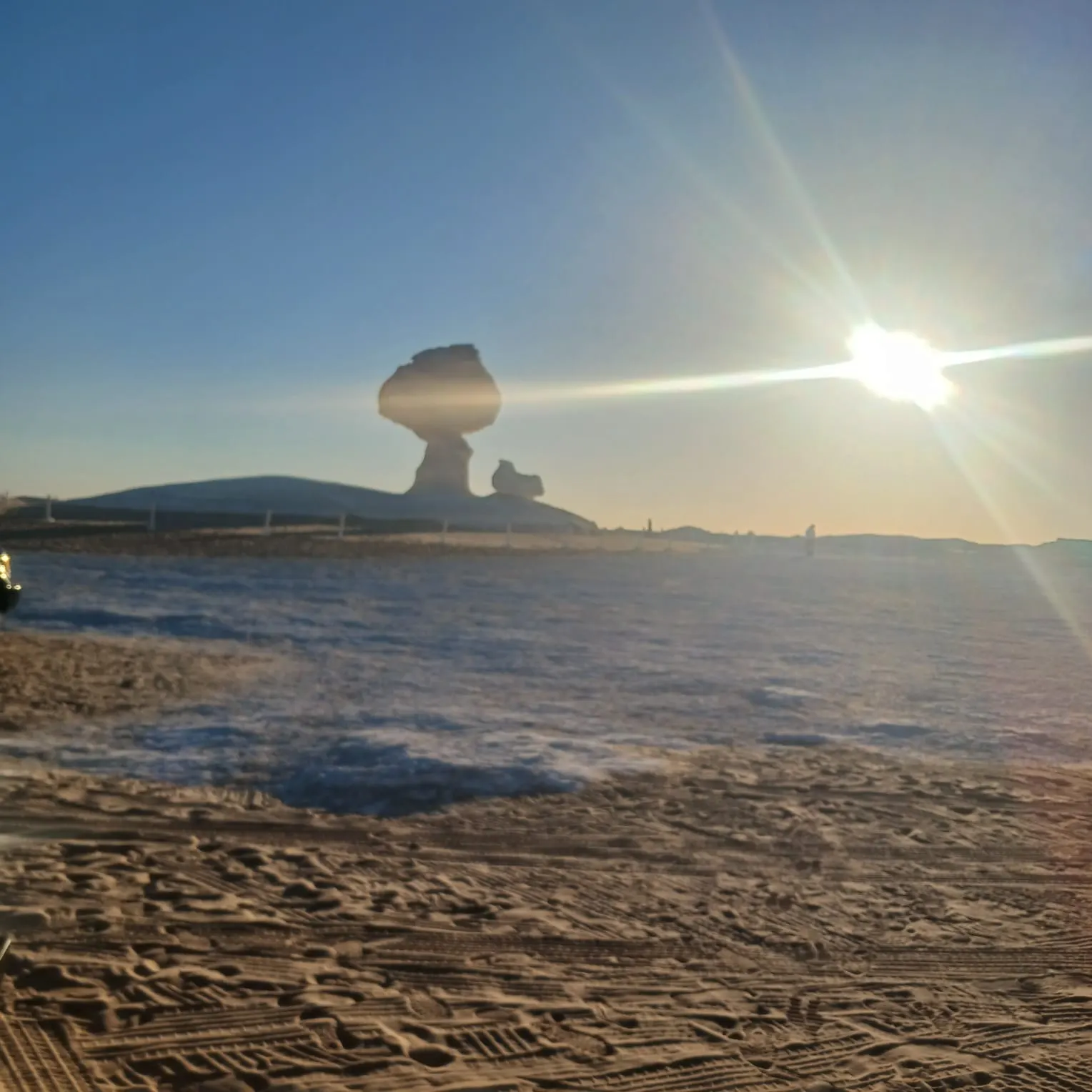
Every White Desert trip stops at the Mushroom and the Chicken, usually on the afternoon of the first day. The light is best in the last hour before sunset, when the chalk turns gold and pink and long shadows give the shapes depth. Sunrise is just as beautiful and much quieter. At night, under a full moon, the chalk glows silver; see full moon.
Season matters too. From October to April the days are pleasant; January days reach about 20°C, but nights at camp fall to about 0–4°C. Spring brings the khamaseen, a dusty wind whose season begins in March and is worst in April. Month-by-month detail is in weather and night temperatures, and our pick of months is on the best time to visit.
Photography tips
Short answer: Shoot low, walk away from the car tracks, and try both side light and silhouettes.
- Shoot from a low angle to make the formations tower over you.
- With the sun behind you, the chalk glows with colour; with the sun behind the rocks, you get silhouettes.
- Walk a little away from the car tracks for a clean foreground.
- A wide lens fits both rocks and the plain; a longer lens isolates the Mushroom against the sky.
- At night, try the Mushroom against the stars with a tripod and a torch for gentle light.
- Keep a cloth and a bag over your camera when you change lenses; fine chalk dust gets everywhere when the wind picks up.
More in photographing the White Desert.
Look after them
Short answer: Don't climb, lean on or carve the formations; they're soft, fragile and protected.
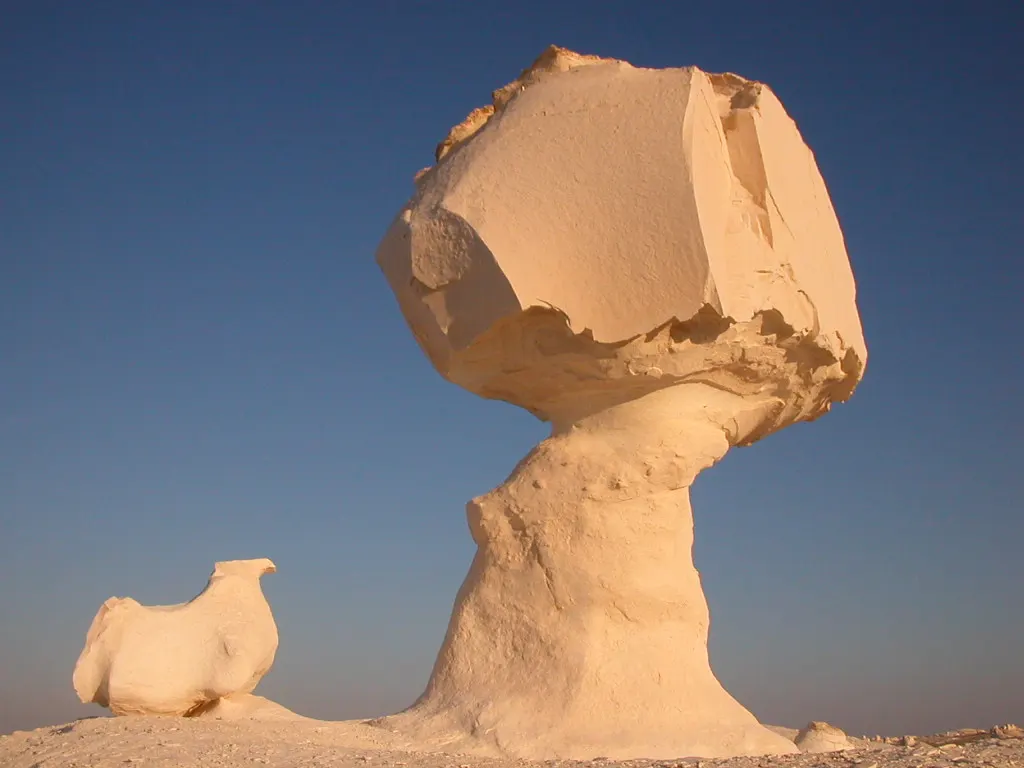
The Mushroom's stem is soft chalk, and every hand, foot and carved initial speeds up its collapse. Climbing on the formations is prohibited in the protected area. Stay off them, keep vehicles at a distance and take nothing away. That includes fossils, crystals and the dark iron nodules people call desert flowers. Read the national park rules.
Getting there and how long it takes
Short answer: The Mushroom and the Chicken are about 500 km from Cairo and about 135 km south of Bawiti, roughly six to seven hours from a Cairo hotel with stops.
| From | Distance | Time |
|---|---|---|
| Cairo or Giza hotel | about 500 km | 6–7 hours with stops |
| Bawiti, Bahariya Oasis | about 135 km | 2–2.5 hours with the Black Desert, Crystal Mountain and Agabat |
| Agabat | about 20 km | 20–30 minutes |
| Qasr Farafra | about 40 km | 40–45 minutes |
The first leg, Cairo to Bawiti, is about 370 km and takes 4.5–5 hours by car with a stop; see the Cairo to Bahariya drive. The last stretch leaves the tarmac and crosses the plain by 4x4. There is no signpost, no car park and no facilities, which is part of the appeal. The rocks lie inside White Desert National Park, a protected area since 2002. Entry carries a government protected-area fee for foreign visitors, collected through the operator and shown as its own line in your quote. Keep your passport with you, because checkpoints on the Farafra road check it against your permit; see permits and safety.
Day trip or overnight?
Short answer: A day trip gets you the photo; one night gets you sunset, stars and sunrise at the same rocks.
| Day trip from Cairo | One night camping | |
|---|---|---|
| Time on the road | About ten hours in total | The same drive, split over two days |
| Light at the Mushroom | Often midday or early afternoon | Late afternoon, sunset and sunrise |
| Stars and moonlight | No | Yes |
| Who it suits | People with no spare night | Almost everyone else |
Our day trip from Cairo is for people who can't stay, but the trade-off is a very long day for a short stop in harsh light. Our full comparison is on day trip or overnight.
Checked November 2026: sunset times at the Mushroom
Short answer: Sunset at the Mushroom is around 17:10–17:45 from November to January and just after 20:00 in late June, so plan to arrive an hour before.
| Month | Approximate sunset (Egypt time) | Arrive by |
|---|---|---|
| November | 17:15–17:25 | 16:15 |
| December | 17:15–17:25 | 16:15 |
| January | 17:25–17:45 | 16:30 |
| March | 18:05–18:25 | 17:05 |
| May (summer time) | 19:40–19:55 | 18:40 |
| June (summer time) | 20:00–20:05 | 19:00 |
These are our own calculations for the Old White Desert, rounded to five minutes. Egypt switches to summer time (UTC+3) at the end of April and back at the end of October, which moves sunset by an hour, so April and October straddle the change. Check the date of your trip in sunrise and sunset.
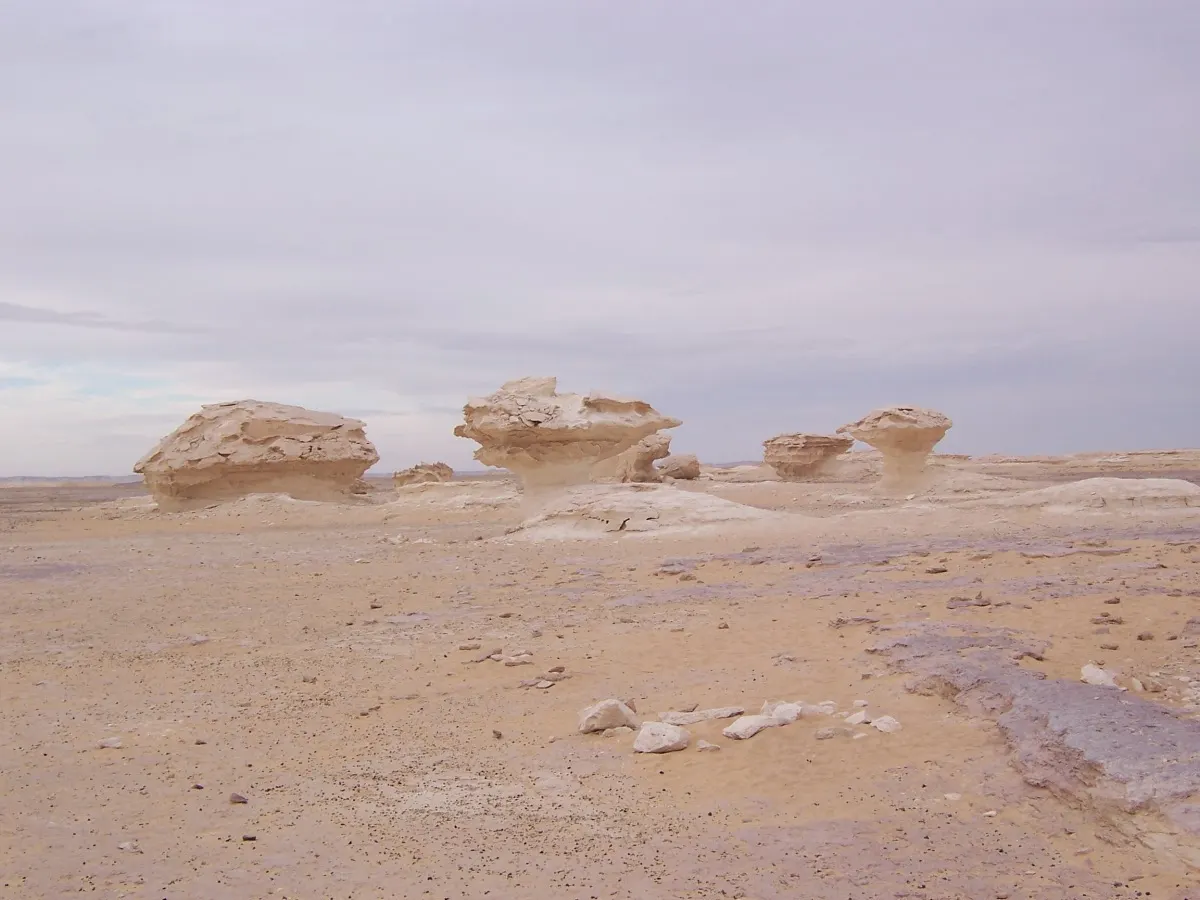
The Mushroom during the 2027 eclipse
Short answer: The rocks are inside the path of totality on 2 August 2027, but close to its southern edge, so totality here is short.
Totality lasts 6 minutes 24 seconds in the northern Black Desert, close to the centre line, and 2 minutes 5 seconds at the Mushroom and Chicken in the White Desert, according to timeanddate's calculations for those points. The peak comes around 12:53 local time.
| Where | Totality (timeanddate) | Trade-off |
|---|---|---|
| Mushroom and Chicken | 2 minutes 5 seconds | The famous rocks in the eclipse light, but short totality |
| Agabat | 4 minutes 38 seconds | More than twice as long, with cliffs instead of mushrooms |
| Bawiti | 6 minutes 19 seconds | Near the centre line, in town |
| Qasr Farafra town | None (about 99.7% partial) | Outside the path |
The Mushroom sits only about 7 km inside the southern edge of the path. A few kilometres further south, totality drops quickly. Choose the Mushroom if you want the chalk shapes in your eclipse photographs. Go north if the sky matters most. August is one of the hottest months, and the peak falls in the hottest part of the day. Everything else is on our 2027 eclipse guide and the eclipse camp.
Avoiding the crowds
Short answer: Come at sunrise, camp a few kilometres away, or arrive an hour before sunset and move on to a quieter formation for the final light.
The question we get most from photographers is how to get the Mushroom without other people in the frame. A few things work:
- Sunrise. Few groups drive here at dawn. If you ask, we can usually camp a short drive away and bring you over at first light.
- Weekdays. Groups from Cairo tend to bunch on Thursday and Friday afternoons, at the start of the Egyptian weekend.
- Two passes. Arrive early, photograph the pair while the light is warm, then move to a quieter part of the plain for the actual sunset.
- Full moon. After dinner, under a full moon, the plain is almost empty and the chalk glows. See full-moon camping.
What to expect on the ground
Short answer: Flat, firm ground, no shade and no facilities; bring layers, water and a headlamp.
| Practical point | What to expect |
|---|---|
| Walking | Short and easy on firm sand and chalk; fine for most ages |
| Shade | None at the formations |
| Toilets and water | None; the crew carries water. Ask us about a toilet tent |
| Footwear | Closed shoes or trainers are easiest on chalk and sand |
| After sunset | It cools fast in winter; bring a warm layer and a headlamp |
| Phone signal | Patchy; don't rely on it for maps or messages |
See the packing list and the White Desert with kids.
See them with us
Short answer: All our White Desert camping trips stop here, timed for the best light we can manage on the day.
On our overnight trip, we reach the Mushroom and the Chicken in the late afternoon and camp nearby. On a private trip, we can usually time your visit for sunrise or a full-moon night. Message us on WhatsApp with "Mushroom" and your dates.
Our advice
Short answer: Give the Mushroom 30–45 minutes in good light, then walk the plain around it; the smaller shapes are often more rewarding than the famous pair.
Most visitors take their photo of the two rocks and leave. Walk 300–500 m in any direction and you find hundreds of smaller mushrooms, domes and pillars, often with fossil shells in the chalk and fox tracks in the sand. Bring water and a headlamp if you stay past sunset, and walk back to the car with the crew. For the wider context, read Old and New White Desert and where we camp.
Where it is
Schematic map, not to scale: positions are approximate, and the desert sites spread over many kilometres. The road runs about 180 km from Bawiti to Farafra; shaded areas show roughly where the black hills and the white chalk are.
Questions people ask
Can you climb on the Mushroom rock?+
No. The narrow stem is soft chalk and the formations are protected. Climbing, leaning on or carving them speeds up their collapse.
When is the best light at the Mushroom and Chicken?+
The last hour before sunset, when the chalk turns gold and pink and the shadows give the shapes depth. Sunrise is also beautiful and quieter.
Where exactly are the Mushroom and the Chicken?+
In the Old White Desert, the southern part of the protected area, a short drive off the Bahariya–Farafra road and roughly 40 km north of Farafra town. There's no signpost; the crew drives you across the plain to them.
Will the Mushroom collapse?+
One day, yes. The wind keeps wearing away its narrow stem. Nobody can say when, but it could be in years or centuries. Many older mushroom formations on the plain have already fallen, leaving their caps lying beside them.
Are there other famous shapes nearby?+
Yes. Drivers point out shapes they call the camel, the rabbit, the sphinx, the ice-cream cone and many more. The names vary from driver to driver, and finding your own is part of the fun.
Is it crowded at the Mushroom?+
At sunset in high season, several groups may stop there at once. Come at sunrise, or go private, since on private trips we camp away from other groups, and you'll often have them almost to yourself.
How long do I need at the Mushroom and Chicken?+
Allow 30–45 minutes in good light for the pair itself, and longer if you want to walk the plain around them. On an overnight trip you usually get the late afternoon there and can come back at sunrise.
Can I see the Mushroom and Chicken on a day trip from Cairo?+
Yes, but it's a long day. The rocks are about 500 km from Cairo, so a day trip means about ten hours on the road for a short stop, often in flat light. If you can spare one night, you get sunset, the stars and sunrise as well.
Will the Mushroom and Chicken be in totality during the 2027 eclipse?+
Yes, but only just. Totality lasts 6 minutes 24 seconds in the northern Black Desert, close to the centre line, and 2 minutes 5 seconds at the Mushroom and Chicken in the White Desert, according to timeanddate's calculations for those points. The rocks sit about 7 km inside the southern edge of the path.
Are there toilets or shade at the Mushroom?+
No. There are no buildings, toilets, water points or shade at the formations. The crew carries water. If a toilet tent matters to you, ask us before you book.
Go with us
Trips that include this

2 days, 1 night
White Desert overnight camping trip from Cairo (2 days, 1 night)About US$185 to 230 shared · US$360 to 460 private, per person
Check dates
3 days, 2 nights
3-day White Desert tour: Bahariya, the White Desert and two nights outAbout US$495 to 660 per person for two travellers, private
Check dates