
The short answer
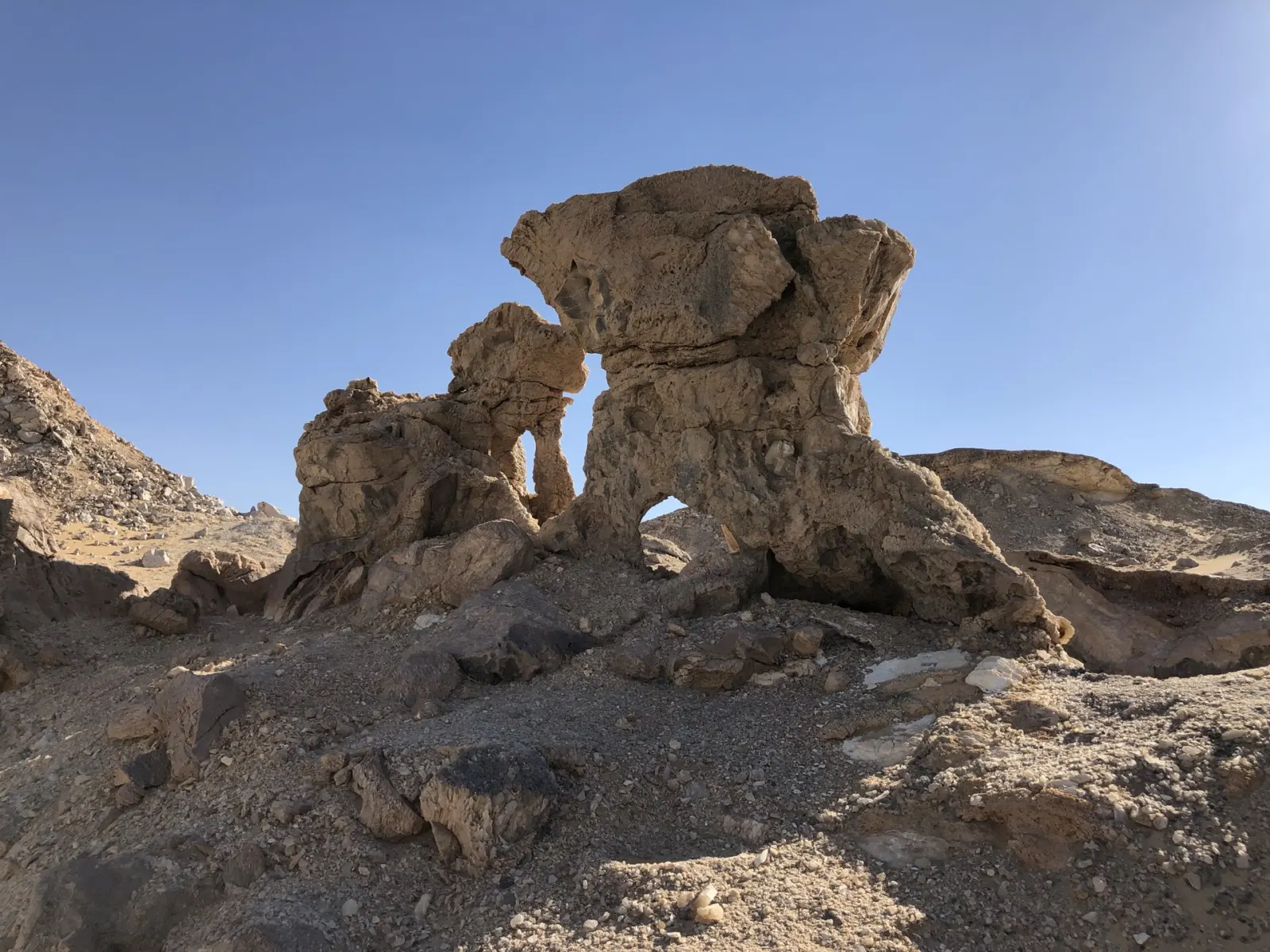
Crystal Mountain is a low limestone ridge beside the Bahariya–Farafra road, about 100 km south of Bawiti, laced with glittering crystals, mostly calcite, and ending in a small natural arch. Almost every White Desert trip stops here for twenty to thirty minutes, between the Black Desert and the Agabat valley. Enjoy it as a short geology stop, not a mountain of crystal.
Ask us on WhatsAppWhat you see
Short answer: a small rocky ridge beside the road whose surface sparkles with embedded crystals, ending in a natural arch that frames the desert.
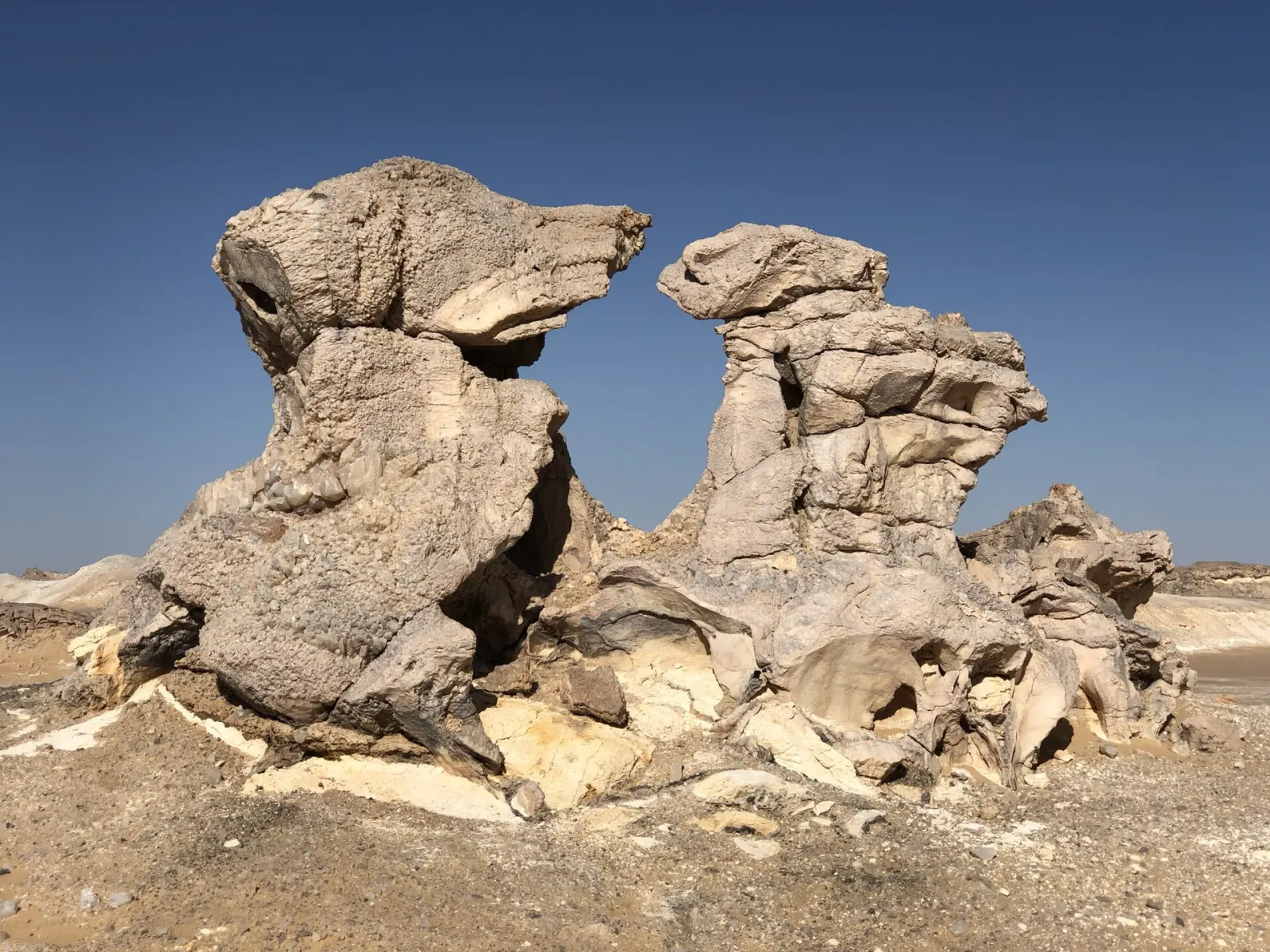
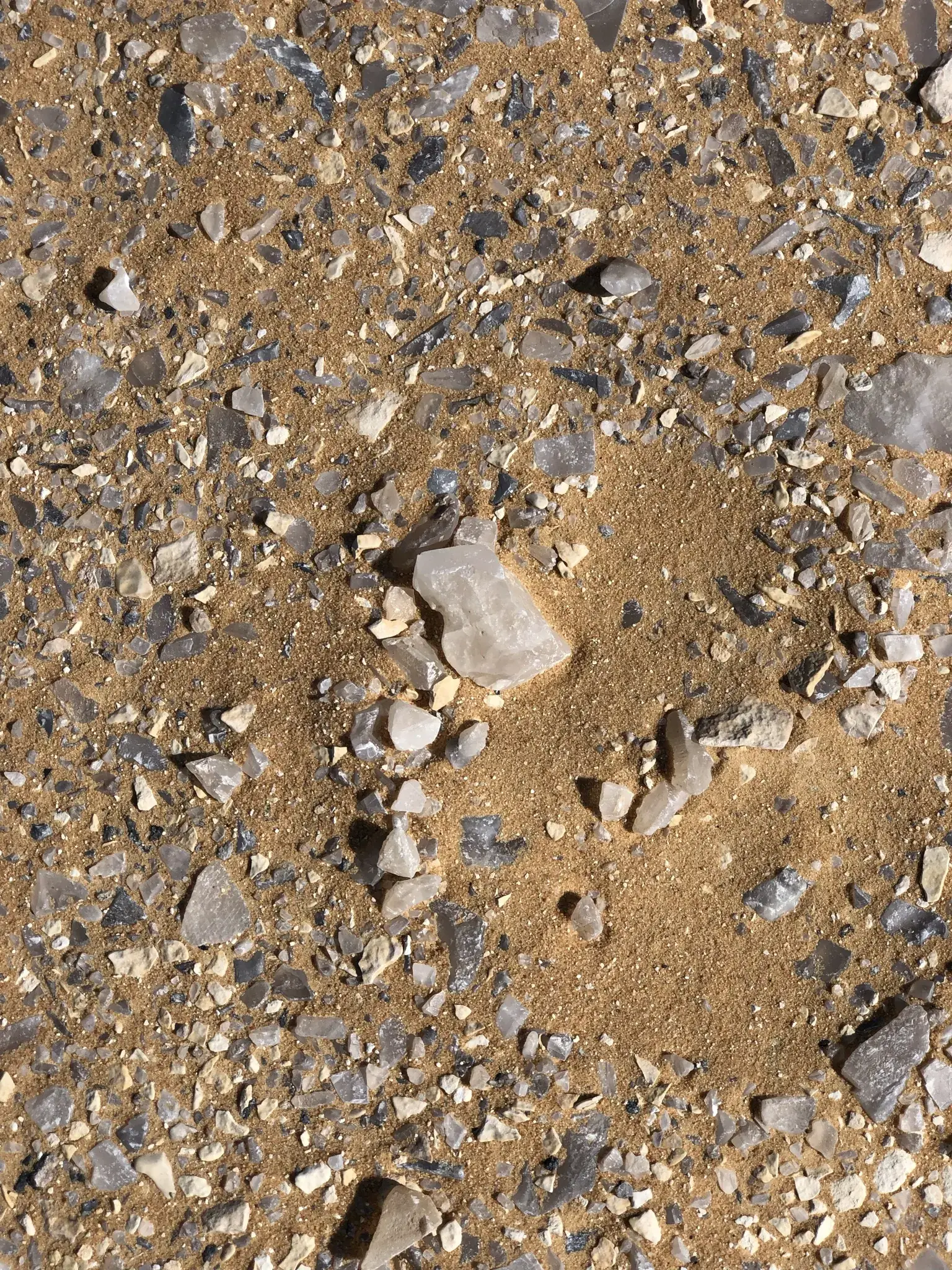
At first it looks unremarkable: a low, rough ridge a few metres high just off the road. Walk up to it and the surface sparkles. Chunks of clear and milky crystal are embedded throughout, and broken fragments glint on the ground. At the end of the ridge a natural arch frames the desert beyond, which is the classic photograph.
- Clear and milky crystals in the rock surface, some the size of a fingernail, a few as large as a fist
- A rough, sparkling texture that is at its best in low sun
- The small arch, framing the open desert beyond
- Wide views over the plain towards the cliffs of Agabat
Where it is
Short answer: on the Bahariya–Farafra road, about 100 km south of Bawiti and roughly 470 km from Cairo, between the Black Desert and the Agabat valley, so every trip south passes it.
The ridge sits just off the main road through the middle of the route, after the Black Desert and the long climb out of the Bahariya depression, and before the road drops through the cliffs at Agabat towards the White Desert. Your driver will pull off onto the gravel and park a few minutes' walk from the arch. See our map and distances for the whole route.
| From | Distance | Drive |
|---|---|---|
| Cairo (hotel) | about 470 km | 6–7 hours with lunch and stops |
| Bawiti | about 100 km | about 1 hour 15 minutes, plus the Black Desert stop |
| Black Desert | about 60 km | about 45 minutes |
| Agabat valley | about 20 km | about 20 minutes |
| White Desert camps | about 30 km | 30 to 45 minutes |
Distances are approximate and match our map and distances page. Bawiti itself is about 370 km and 4.5–5 hours from central Cairo by car. For a map pin, Wikipedia places the ridge at about 27°39′N, 28°25′E (checked 19 November 2026).
Is it inside the national park?
Short answer: it lies just north of the park's main chalk area, at its edge; the same no-collecting rules apply in practice.
White Desert National Park covers about 3,133.5 km² of New Valley Governorate under Prime Minister's Decree No. 1220 of 2002. The famous formations start at Agabat, about 20 km further south. The Black Desert and Crystal Mountain sit just to the north, outside or on the edge of the protected core. That makes no difference to how you should behave: leave every crystal where it is. See White Desert National Park for the rules and the fee.
What the crystals are made of
Short answer: mostly calcite, possibly with barite; often called quartz, but the crystals are too soft to be quartz.
Most travel writing calls them quartz. The evidence points mainly elsewhere. Wikipedia's entry describes the ridge as made mainly of barite and calcite crystals in eroded chalk limestone, and notes that studies put the crystals' hardness at about 3.0 to 3.5 (checked 19 November 2026). The same entry says many websites wrongly call them quartz.
Hardness shows why it matters. On the Mohs scale, calcite is 3, glass about 5.5 and quartz 7 (checked 19 November 2026).
| Mineral | Mohs hardness | What it means at the ridge |
|---|---|---|
| Calcite | 3 | Soft enough to scratch with steel; the likely main crystal here |
| Barite | about 3–3.5 (Wikipedia's figure for these crystals) | Similar softness to calcite |
| Quartz | 7 | Hard enough to scratch glass; far harder than the crystals measured here |
None of this changes the view. The faces still catch the sun, and the crystals still glitter. But it explains why they break and dull easily, and why a ridge this small loses its sparkle fast when people chip at it. Please don't test any of them with a knife or a coin.
How Crystal Mountain formed
Short answer: mineral-rich groundwater grew calcite and other crystals in cracks and cavities; when the softer rock around them eroded, the crystal-filled ridge was left standing.
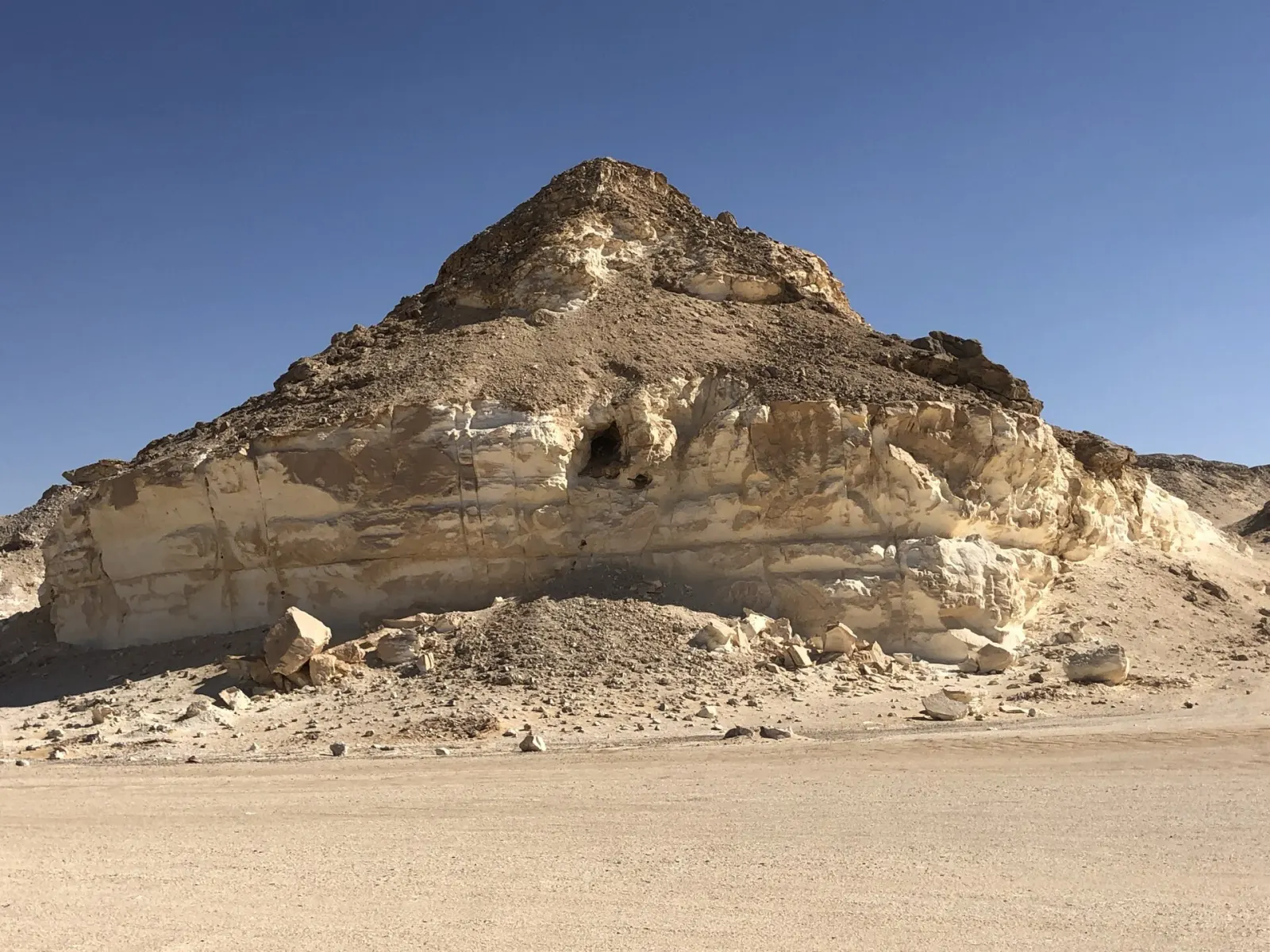
Despite the name, the ridge is not a mountain of solid crystal. It's a ridge of rock in which mineral-rich groundwater, long ago, filled cavities and fractures and slowly grew crystals. As the softer rock around it eroded, the harder, crystal-filled parts were left standing and exposed. The exact geological history of this particular ridge is less well documented than the chalk of the White Desert, so treat any precise age you hear on site with caution.
One recent study adds a useful idea. Torab and Fayad (2024), in the Egyptian Journal of Environmental Change, map the area as an eroded, "unroofed" cave in a limestone hill between the Bahariya and Farafra depressions (checked 19 November 2026). Caves like this form as water slowly dissolves limestone. In plain terms, you may be walking through what was once the inside of a cave whose roof has worn away. Others have proposed different origins, and the debate is open. That is a good reason to be wary of confident one-line explanations.
The natural arch at the end of the ridge is the result of differential erosion: harder, crystal-cemented rock survives while softer rock beneath it wears away. Wind carrying sand does most of the work today. Our geology guide covers the wider story of the rocks on this route.
Is it worth stopping? How it compares
Short answer: yes, as a short break on a long drive; it is the smallest of the four classic stops, and it shouldn't shape your plans.
| Stop | What it is | Usual time | Why go |
|---|---|---|---|
| Black Desert | Orange sand and hills capped with dark stone | 30–60 minutes | A climb and a wide view |
| Crystal Mountain | A low crystal ridge with a small arch | 20–30 minutes | A leg-stretch and a geology close-up |
| Agabat | Chalk towers above steep sand slopes | 30–60 minutes | The first big view and the dunes |
| White Desert | Chalk formations on a wide plain | Sunset, night and sunrise | The main event |
The honest trade-off: if you want more time anywhere, Agabat and the chalk repay it far more than Crystal Mountain does. On the other hand, the stop costs you almost nothing, because it is beside the road you are already driving.
How long to stay
Short answer: twenty to thirty minutes on most trips, and usually less on a day trip.
On a two-day trip from Cairo you usually reach Crystal Mountain in the early to mid afternoon of day one, after the Black Desert. The stop is short, because the aim is to reach camp in the White Desert before sunset. If you want longer, say so when you book. On a three-day trip, or on the way back north, we may be able to come at a quieter time of day. The question we get most here is whether there is time to climb: the ridge is a short scramble, and ten minutes is enough to reach the top and look south.
| Trip | When you usually arrive | Time at the ridge |
|---|---|---|
| Day trip from Cairo | Late morning | A brief stop; ask us |
| Overnight from Cairo | Early to mid afternoon, day one (later in summer) | 20–30 minutes |
| Three days with Farafra | Mid-morning, day two | 20–30 minutes; ask us about longer |
| Private trip | Your choice, within the day's driving | As long as the day allows |
In winter, sunset is around 17:15 to 17:30, so an early-afternoon stop is in fairly high sun. In summer, trips start about two hours later to avoid the heat, and the light is softer by the time you arrive. See sunrise and sunset for month-by-month times.
Respect the site
Short answer: don't take crystals, don't climb on the arch, and carry out anything you bring.
Decades of visitors pocketing crystals have stripped much of the surface. The less people take, the longer it remains worth the stop. The arch is thin in places, so please photograph it rather than stand on it. There is no bin here, so hand any rubbish to your driver; our crew carries it out with the rest.
A few more habits help:
- Walk where others have already walked, rather than across the crystal-crusted slopes.
- Don't pile loose fragments into displays for photos; leave them where they lie.
- Don't chip, scratch or knock crystals to see them shine. Calcite breaks easily.
Practical details
Short answer: no facilities, no shade except the arch, sharp ground and little or no phone signal; a few minutes of preparation in the 4x4 makes the stop easy.
| What | The situation |
|---|---|
| Toilets | None at the ridge. Use the stop in Bawiti before you get into the 4x4. |
| Shade | Only the arch itself |
| Ground | Broken, sharp rock and gravel; uneven underfoot |
| Phone signal | Weak to none on this stretch, sometimes a bar near the highway |
| Weather | Pleasant in the cool season; in summer, middays average 37–38°C, and August averages about 37°C at Farafra |
| Climbing | A short scramble to the crest; nothing technical |
If you have mobility concerns, you can see the crystals and the arch from the base without climbing. Ask us before the trip if you'd like the driver to park as close as possible. For month-by-month temperatures see weather and night temperatures, and for families our guide to the White Desert with kids. Our guide to phone signal and internet covers which stretches of the route get a bar.
Photography
Short answer: get low and shoot through the arch with a wide lens; photograph the crystals close up with the sun to one side.
A wide lens helps for the arch. The crystals photograph best close up with the sun to the side, so their faces catch the light. A small reflector or even a white notebook can bounce light into the shaded side of a rock. In the hour before sunset the whole ridge turns warm and the shadows give the rock shape, but on most trips you will be here earlier than that. In harder afternoon light, go close: macro shots of crystal faces work at any hour. See our photography guide.
Visiting in 2026–27: what to know
Short answer: Crystal Mountain sits in the path of totality for the 2 August 2027 eclipse, with about 5 minutes 27 seconds of totality; in the cool season it is simply a short, pleasant stop.
Checked November 2026: the total solar eclipse of 2 August 2027 passes over this road, with mid-totality around 12:53 local time (UTC+3). Totality lasts 6 minutes 24 seconds in the northern Black Desert, close to the centre line, and 2 minutes 5 seconds at the Mushroom and Chicken in the White Desert, according to timeanddate's calculations for those points. Bawiti gets 6 minutes 19 seconds. Crystal Mountain sits between them: timeanddate's calculation for the ridge gives 5 minutes 27 seconds, from about 12:50:48 to 12:56:15 (checked 19 November 2026). For the longest totality we prefer the Black Desert, about 60 km north. Expect a midday temperature near 37°C, with the sun almost overhead and no shade. See the 2027 eclipse guide.
Our advice
Short answer: stop, enjoy it for what it is, and save your energy and memory card for Agabat and the White Desert.
- Wear closed shoes; broken rock is sharp.
- Bring water and a hat even for twenty minutes; there is no shade apart from the arch.
- Combine it with the Black Desert climb earlier and the viewpoint over Agabat just after.
- Don't expect a glittering mountain. Expect a geology lesson in miniature on the way to the main event.
- If geology is your thing, tell us when you book, and think about a longer trip so the stop isn't rushed; see how many days.
Where it is
Schematic map, not to scale: positions are approximate, and the desert sites spread over many kilometres. The road runs about 180 km from Bawiti to Farafra; shaded areas show roughly where the black hills and the white chalk are.
Questions people ask
Is Crystal Mountain made of genuine crystal?+
Yes. The ridge is studded with genuine crystals that grew where mineral-rich water filled cracks and cavities in the rock. They are mostly calcite, possibly with barite, though many guides call them quartz. It is not one solid block of crystal, but a ridge studded with them.
Can I take a crystal home?+
Please don't. The site has been heavily picked over, and it sits at the edge of a protected area where collecting crystals, fossils and stones is not allowed. Taking rocks can also cause trouble at checkpoints and at the airport. Take photographs instead.
How far is Crystal Mountain from Cairo?+
Roughly 470 km by road: about 370 km to Bawiti in Bahariya, then about 100 km south on the Farafra road. From a Cairo hotel, allow six to seven hours including lunch and the Black Desert stop.
Why is Crystal Mountain disappointing to some visitors?+
Because it's a low ridge with crystals in the rock, not a mountain of crystal. Most of the large crystals have been taken by visitors over the years. It's best enjoyed as a short stop on the way, with the right expectations.
Is there an entrance fee for Crystal Mountain?+
There is no separate ticket at the ridge itself. The White Desert has a government protected-area fee for foreign visitors, collected through the operator and shown as its own line in your quote. Ask for it to be listed in writing.
Is Crystal Mountain in the path of the 2027 eclipse?+
Yes. The total solar eclipse of 2 August 2027 crosses this stretch of road, with totality around 12:53 local time. On timeanddate's calculation for the ridge, totality lasts 5 minutes 27 seconds, shorter than Bawiti's 6 minutes 19 seconds but much longer than the 2 minutes 5 seconds at the Mushroom and Chicken.
Are the crystals quartz or calcite?+
Mostly calcite, and possibly barite, on the evidence of their hardness. Many guides call them quartz, but Wikipedia notes that studies put their hardness at about 3 to 3.5, far softer than quartz at 7. Either way, they glitter the same in the sun.
Do day trips from Cairo stop at Crystal Mountain?+
Yes. On our private day trip it is a stop on the way south, in the late morning, between the Black Desert and Agabat. Time in the chalk is already short on a day trip, so the stop is usually brief. If it matters to you, ask us how long we can allow on your date.
Is Crystal Mountain suitable for children and older travellers?+
Mostly, yes. The arch is a few minutes' walk from where the 4x4 parks, over uneven, sharp, broken rock. You can enjoy it from the base without climbing. Children need closed shoes and a hand on the scramble. If anyone in your group walks with difficulty, ask us and we'll plan the stop around them.
Can we stop at Crystal Mountain on the way back north instead?+
Sometimes. On the standard two-day trip it is usually on the way south, and day two is spent getting back to Cairo. On a three-day or private trip there is often more room. Ask us when you book and we'll say what fits your dates.
Go with us
Trips that include this
2 days, 1 night
White Desert overnight camping trip from Cairo (2 days, 1 night)About US$185 to 230 shared · US$360 to 460 private, per person
Check dates
3 days, 2 nights
3-day White Desert tour: Bahariya, the White Desert and two nights outAbout US$495 to 660 per person for two travellers, private
Check dates
2 or 3 days
Private White Desert camping in comfortOn request (depends on group size and nights)
Check dates