
The short answer
To photograph the White Desert, shoot RAW and add +0.7 to +1 EV so the camera does not turn the white chalk grey; on a phone, tap the rock and pull exposure down slightly. At night, on a tripod, 15–20 seconds at f/2.8 and ISO 3200 captures the Milky Way. Change lenses inside the car, and leave the drone at home.
Ask us on WhatsAppThe light, in brief
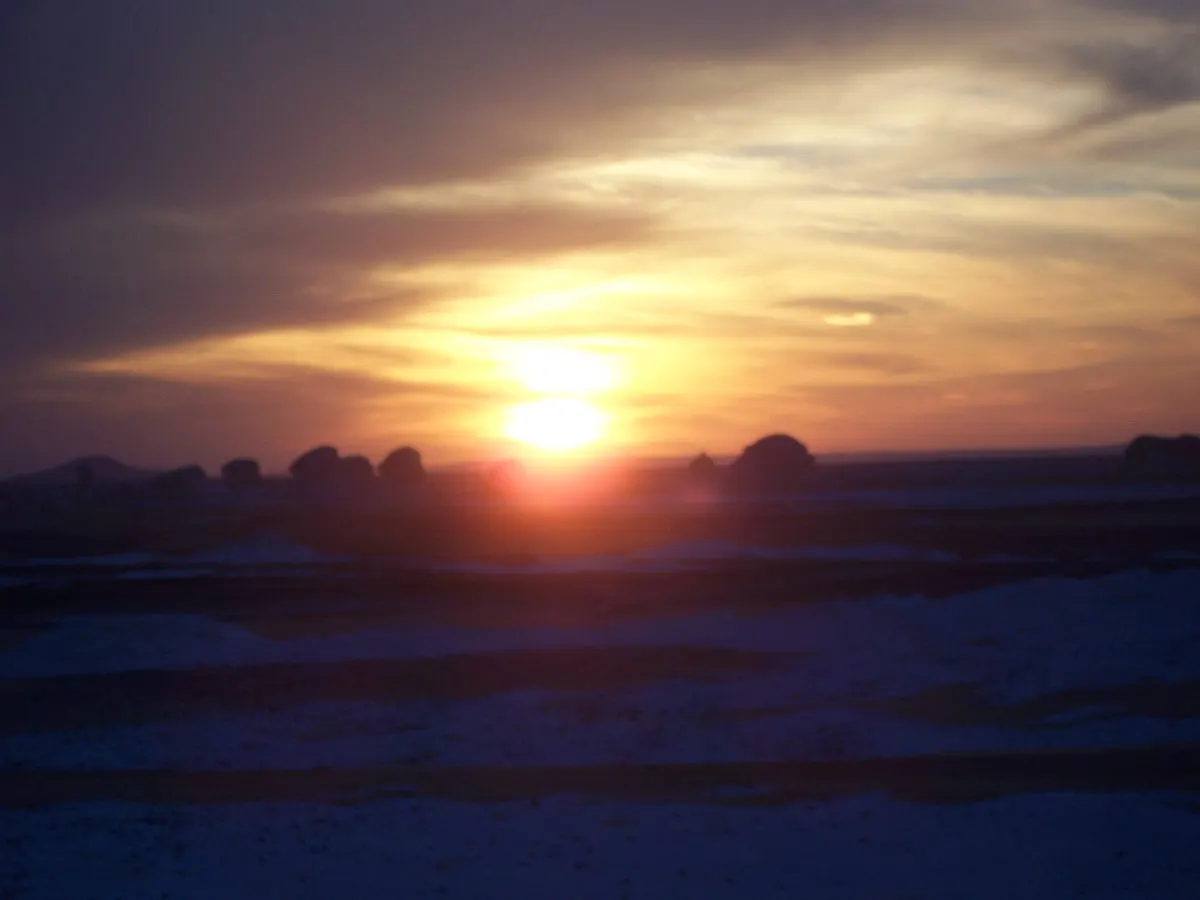
Short answer: Shoot in the hour before sunset and the hour after sunrise; between about 11:00 and 15:00 the white chalk turns into flat glare.
Low side-light is what gives the formations their shape, and the blue hour just after sunset is often the best frame of the evening. Sunset and sunrise times by month, the hour-by-hour colour and how the season changes the light are all in sunrise and sunset.
Where to stand
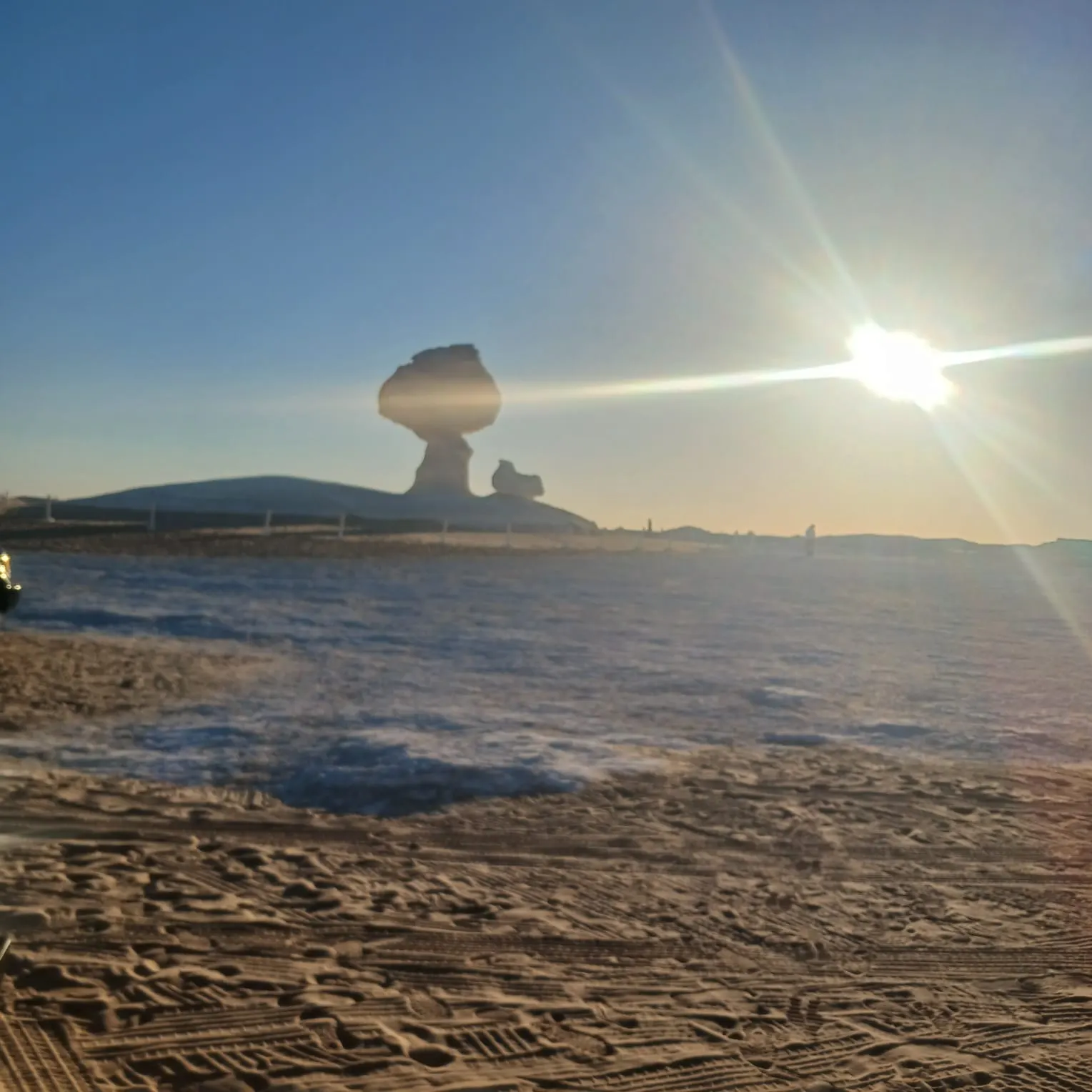
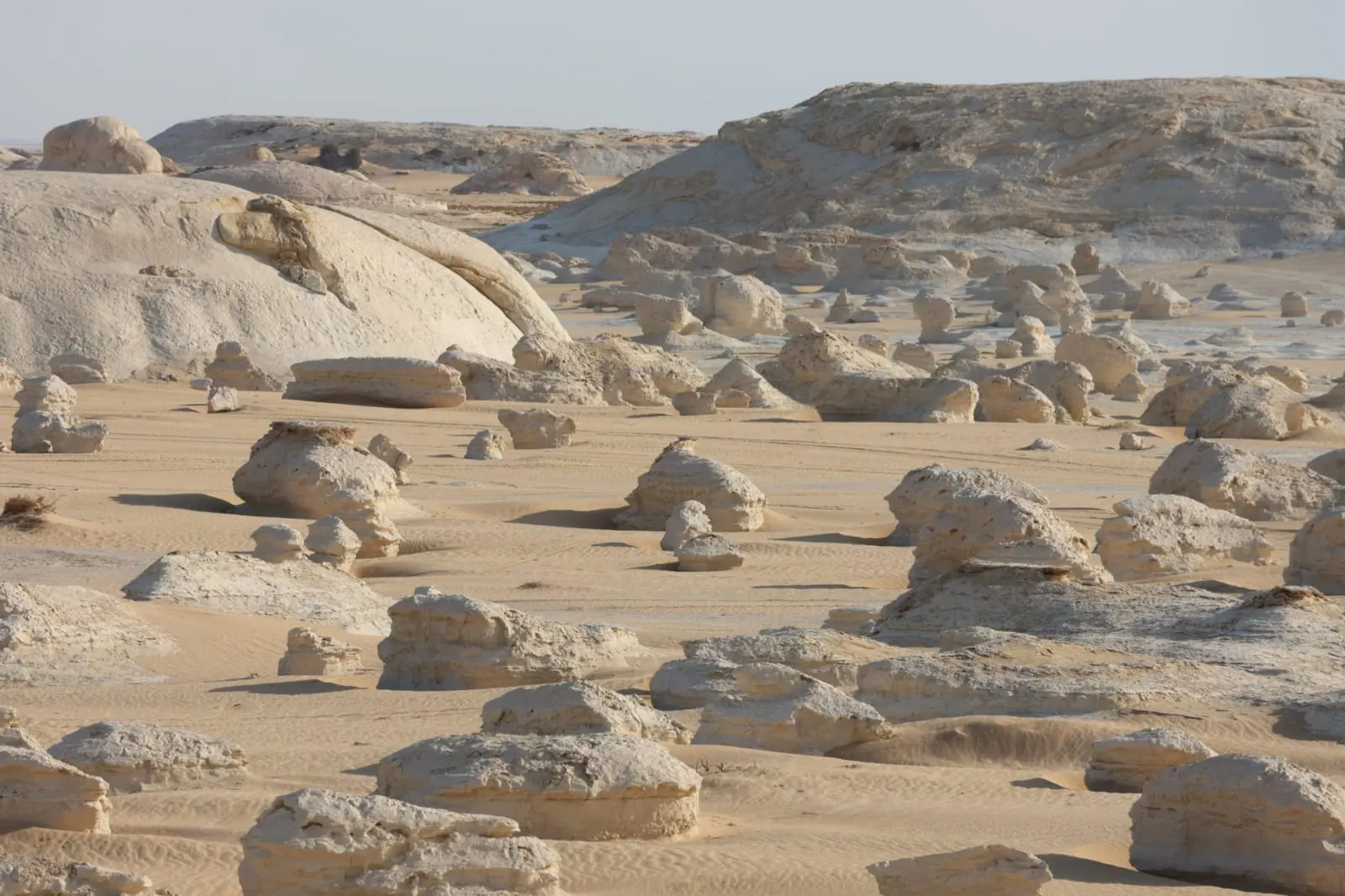
Short answer: The Old White Desert's mushroom field for sunset and sunrise, the New White Desert's towers for scale in the afternoon.
The full list of spots, with the best light for each, is in sunrise and sunset. For photographers, the one rule is to walk 300 to 500 m away from the Mushroom and Chicken at sunset, where most groups gather, and find a formation of your own.
Camera settings for white chalk
Short answer: Shoot RAW, add +0.7 to +1 EV of exposure compensation so the chalk stays white, and watch the histogram so the brightest rock does not clip.
A camera meter assumes the world is mid-grey. Point it at a field of white chalk and it underexposes, so the rock comes out a dull grey. These are the settings we suggest to guests with a camera:
| Situation | Starting settings | Why |
|---|---|---|
| Chalk in daylight | Aperture priority, f/8–f/11, base ISO, +0.7 to +1 EV | Keeps the rock white and the whole scene sharp |
| Golden hour | f/8, base ISO, 0 to +0.3 EV, white balance "daylight" | Auto white balance cancels the warm colour you came for |
| Backlit sunset | Expose for the sky, lift the shadows later in RAW | The sun will clip; protect the chalk's highlights instead |
| Blue hour | Tripod, f/8, ISO 100–400, 1–10 seconds | Clean files, even tone on the rock |
| People among the towers | 1/250 s or faster, f/5.6–f/8 | Wind and moving people stay sharp |
- RAW. Desert light has a huge range between bright chalk and deep shadow. RAW files give you room to pull both back.
- Highlights. Turn on the highlight warning ("blinkies"). If the tops of the formations flash, dial the exposure down a third of a stop.
- Lens hood. Shooting towards a low sun brings flare. A hood, or a hand held above the lens, helps.
- Polariser. Use it gently. On a wide lens it makes one part of the clear desert sky much darker than the rest.
Phone photography
Short answer: Tap on the chalk, slide the exposure down slightly, keep HDR on, and for night mode prop the phone on a rock or a small tripod.
Most of our guests shoot on phones, and modern phones do well here if you help them a little.
- Exposure. Tap the brightest formation to focus, then drag the brightness slider down a touch. Phones tend to overexpose white rock and lose its texture.
- HDR. Leave it on for sunsets; it holds the sky and the shadowed side of the rock together.
- Lenses. The ultra-wide (0.5x) is great for the towers of the New White Desert but stretches anything near the edge of the frame. The 2x or 3x lens compresses a row of mushrooms against the sunset sky.
- Night mode. On a rock, a bean bag or a small tripod, phones can hold 10–30 second exposures and pick up stars and moonlit chalk. Turn the flash off.
- Sand and cold. Wipe the lens often with a soft cloth, and keep the phone in an inside pocket on winter nights, because cold drains the battery fast.
- Portraits. Portrait mode struggles with blowing hair and scarves against a bright sky. Standard mode with the person off-centre usually looks better.
Composition ideas that work here
Short answer: Use a person for scale, get low over clean sand, and walk away from the tyre tracks for untouched foregrounds.
- The Chicken and Mushroom with the sun just setting behind them, shot low to separate them from the horizon.
- A person standing beside the big towers of the New White Desert. Without scale, a 10 m tower looks like a pebble.
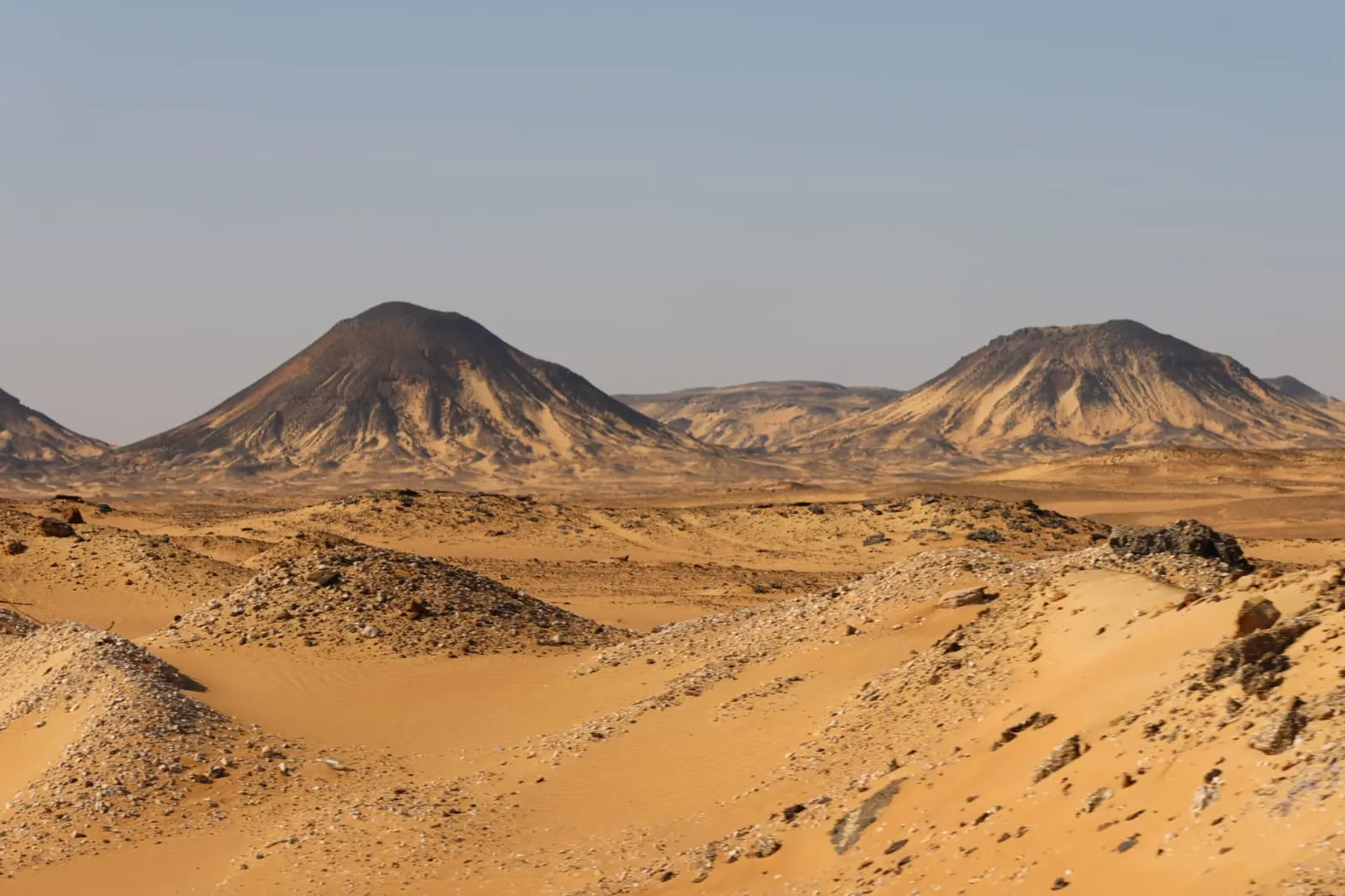
- Low angles across the Black Desert's dark pebbles toward the pale sand.
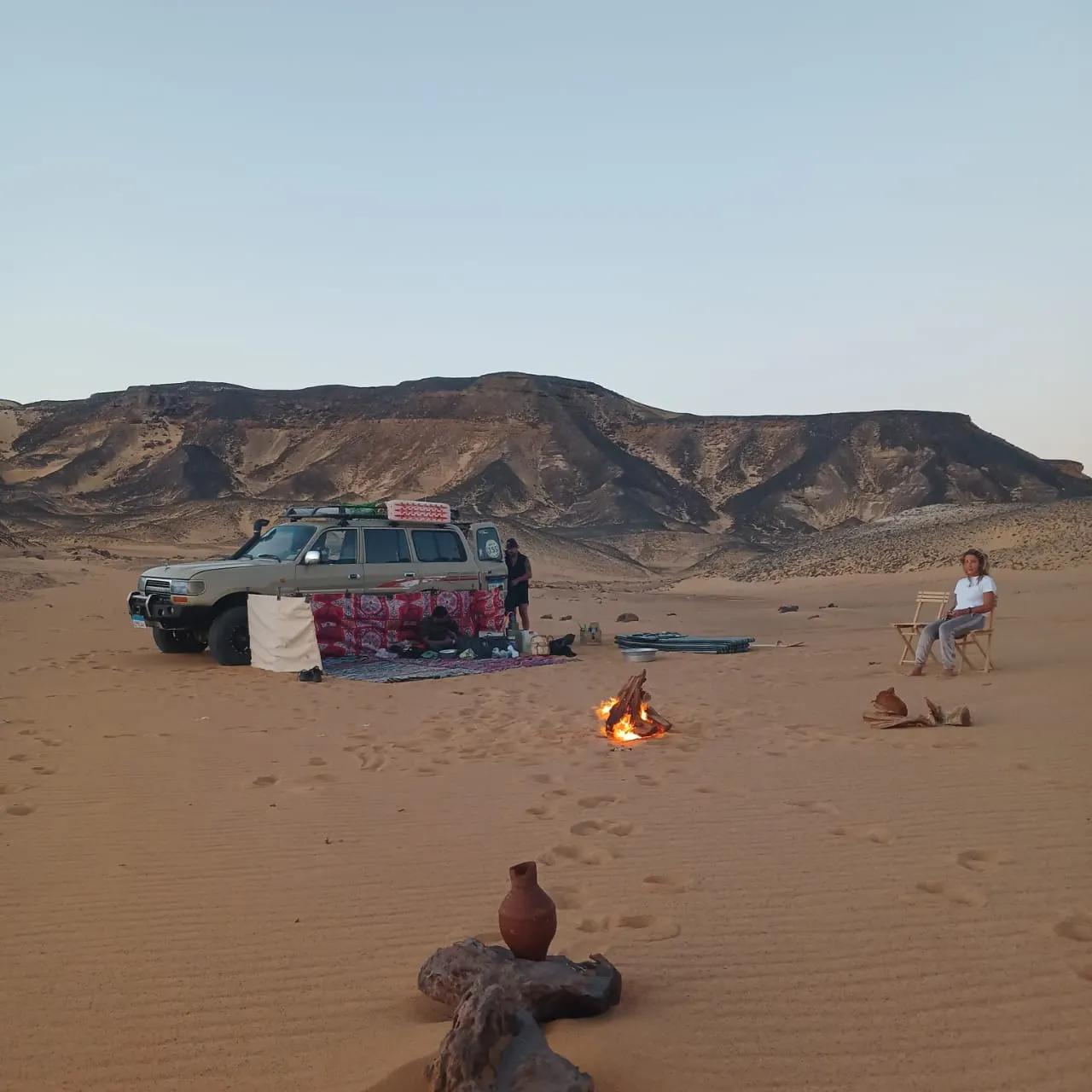
- Ripples on the sand in side-light; walk 100 m from the camp to find tyre-free ground.
- The campfire and tents with the formations behind and stars above, at blue hour.
- Details: fossil shells in the chalk, quartz at Crystal Mountain, fox tracks around camp in the morning.
Night photography: Milky Way, moonlight, meteors and star trails
Short answer: On a tripod, start at 15–20 seconds, f/2.8 and ISO 3200 with manual focus on a bright star. Go on nights close to the new moon if stars are the goal, and near the full moon for silver chalk.
The White Desert is roughly 500 km from Cairo and well away from any town glow, so the sky is genuinely dark, and we choose our camp spots with a light-pollution map to find the darkest patch of it. This is our one place for night technique; the stargazing, meteor showers and full-moon camping pages cover when to go. A few practical points from our nights out:
- Focus. Switch to manual, zoom in on a bright star on the rear screen and turn the ring until it is a pin-point. Tape the ring if your lens drifts.
- Exposure. The "500 rule" (500 ÷ focal length) is a rough limit before stars trail: about 35 seconds at 14 mm, 20 seconds at 24 mm on full frame, and shorter on crop sensors. On today's high-resolution sensors that is generous; around 20–25 seconds at 14 mm keeps stars sharper.
- When the Milky Way is up. The bright core is up in the late evening from about May to September, and in the hours before dawn from about February to April. In winter you get the fainter outer arm and Orion.
- Foreground. Paint a formation for one or two seconds with a dim torch, or shoot a separate blue-hour frame and blend later. Ask us to park the 4x4 away from your frame; we are happy to switch lights off.
- Moonlit chalk. Around the full moon the chalk shines like snow and the Milky Way disappears. Use ISO 400–1600 and exposures of a few seconds; with the moon to the side the formations keep their texture and shadows. Phones in night mode do surprisingly well.
- Meteors. The method is volume. Use your widest, fastest lens (14–24 mm, f/2.8 or faster), ISO 1600–3200 and 15–20 second exposures shot continuously with an intervalometer. Aim about 45 degrees away from the radiant with a formation low in the frame. Two hours can mean 400 frames and a handful of meteors, which you can later stack onto one background.
- Star trails. Stack 100–200 frames of 30 seconds. Polaris sits low, about 27° up at this latitude, so north-facing trails circle close to the horizon.
- Dew and cold. On still winter nights a lens can mist over. A lens heater, or a hand warmer held to the barrel with a hair band, keeps it clear.
- The eclipse. For 2 August 2027 you need certified solar filters for the partial phases; the eclipse kit and settings are in total solar eclipse 2027.
Dated sky notes
Short answer: Checked November 2026, the best nights for sky photography in the coming year are the Geminids on 13–14 December 2026 and the Eta Aquariids before dawn on 5–6 May 2027.
For the full list of dates and moon conditions, see meteor showers and stargazing.
Protecting your gear from sand, cold and heat
Short answer: Change lenses inside the car or a bag, keep the camera sealed when not shooting, and keep spare batteries warm on cold nights.
Fine sand is the main enemy. It is light enough to hang in the air even on calm evenings, and the afternoon wind lifts it easily.
- Change lenses with your back to the wind, inside the 4x4 or a bag.
- Carry a blower brush and a microfibre cloth. Blow before you wipe, or you grind grit into the coating.
- Avoid zooming a lens with sand on the barrel; it can work into the mechanism.
- Use a UV or clear filter on your main lens as a cheap sacrificial layer.
- In winter, nights drop to around 4°C (sometimes near 0°C in the open desert). Batteries can lose half their charge. Keep spares inside your jacket.
- When you bring a cold camera into a warm car in the morning, leave it in its bag for 20 minutes to stop condensation.
- In summer, with days near 38°C, keep bodies out of direct sun and never leave them on the dashboard.
If a sandstorm or khamsin wind blows through, mostly in March to May, pack everything away and wait. See sandstorms and wind.
Our advice before you go
Short answer: Tell us photography is a priority when you book, so we can plan stops around the light, choose a camp with a good sunrise view and give you time at each stop.
- Choose two nights if you can. One evening can be clouded by dust; two gives you a second chance. Our three-day trip gives a full afternoon in the New White Desert.
- Bring a headlamp with a red-light mode so you do not spoil others' night vision.
- Pack a 14–24 mm lens for the sky and a 70–200 mm for compressing formations at sunset.
- Ask before photographing people in Bawiti and Farafra, especially women. Our crew are usually happy to pose at camp.
- Respect the formations. Do not climb fragile chalk or carve anything, and leave no trace of your shoot.
Guests are often surprised by how much the place changes hour to hour. The same rock can look like snow at noon, gold at five and silver under the moon.
Map: Bahariya to Farafra
Schematic map, not to scale: positions are approximate, and the desert sites spread over many kilometres. The road runs about 180 km from Bawiti to Farafra; shaded areas show roughly where the black hills and the white chalk are.
Questions people ask
Can I fly a drone in the White Desert?+
Not without a permit arranged well in advance. Drones need prior permission in Egypt and are often confiscated at the airport or at desert checkpoints on the Bahariya road. Unless you have the paperwork in hand before you fly, leave the drone at home.
Is a phone good enough to photograph the White Desert?+
Yes, for most people. Tap the brightest rock and pull the exposure down slightly so the chalk keeps its texture, leave HDR on at sunset, and use night mode with the phone propped on a rock for stars and moonlit chalk. A camera only pulls ahead for the Milky Way and meteors.
What camera settings work for the Milky Way over the chalk?+
Start at 15–20 seconds, f/2.8 and ISO 3200 on a wide lens, with manual focus set on a bright star. Check the histogram, then adjust. On a 14 mm lens on full frame you can go to about 25 seconds before stars start to trail.
When is the Milky Way visible from the White Desert?+
The bright core of the Milky Way is up in the late evening from about May to September, and in the hours before dawn from about February to April. In winter you get the fainter outer arm and Orion. Either way, aim for nights within a few days of the new moon.
Can I charge camera batteries at camp?+
Usually from the 4x4's charger while driving. There is no mains power at camp, though power at camp is available on request. Bring at least three charged batteries and a power bank, and on winter nights, when it drops to 4–6°C, keep spares in an inside pocket or under your blankets.
Do I need a tripod?+
For night shots, yes. For sunset and sunrise a steady hand is usually enough. A light travel tripod is fine, but spread the legs wide on sand and hang your bag from the centre hook, because evening wind in the desert can shake a long exposure.
Go with us
Trips that include this

2 days, 1 night
White Desert overnight camping trip from Cairo (2 days, 1 night)About US$185 to 230 shared · US$360 to 460 private, per person
Check dates
3 days, 2 nights
3-day White Desert tour: Bahariya, the White Desert and two nights outAbout US$495 to 660 per person for two travellers, private
Check dates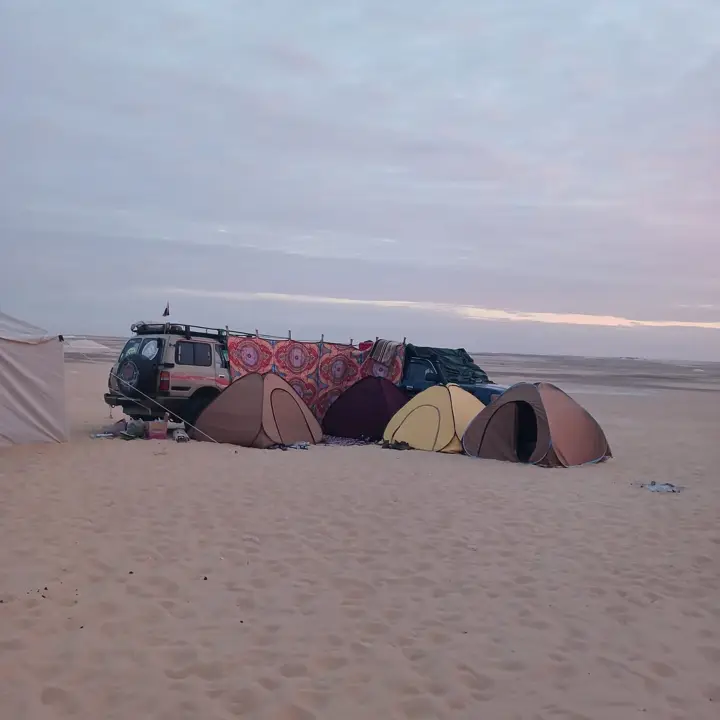
2 or 3 days
Private White Desert camping in comfortOn request (depends on group size and nights)
Check dates