
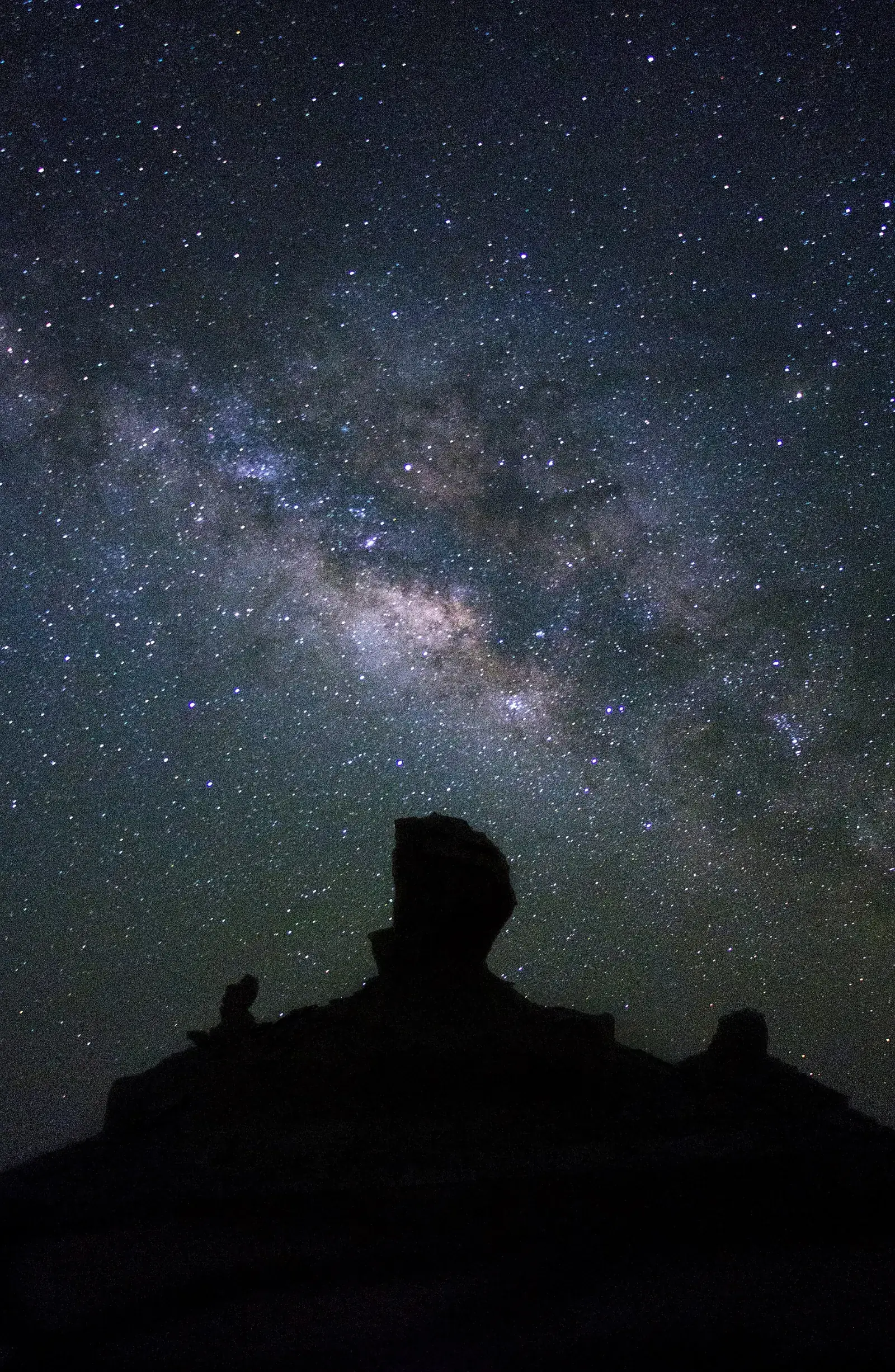
- Duration
- 2 days, 1 night
- Starts from
- Cairo or Giza hotel
- Style
- Private or shared
- Price per person
- About US$185 to 230 shared · US$360 to 460 private, per person
This is our standard overnight trip timed for the full moon, when the White Desert's chalk glows silver and you can walk among the formations at night without a torch. You still get the Black Desert, Crystal Mountain, sunset, a campfire dinner and sunrise. The next full moons are 24 November and 24 December 2026; full-moon weekends in the cool months fill fast.
Check dates on WhatsAppHighlights
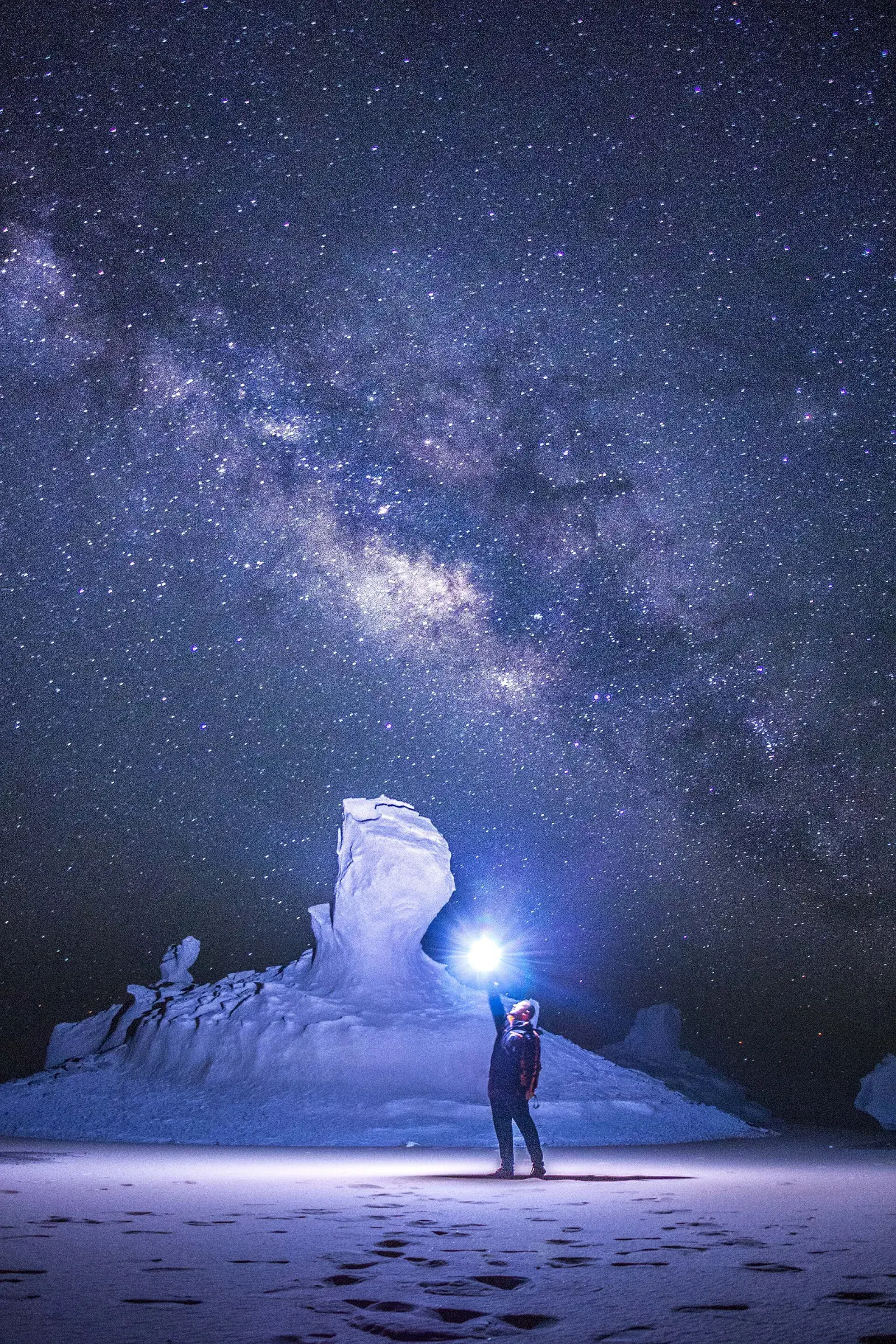
- ✦A night walk among moonlit chalk formations
- ✦Sunset and moonrise over the Old White Desert
- ✦Campfire dinner and sunrise
Day by day
Day 1
Cairo to the White Desert
Early pick-up, lunch in Bahariya, then by 4x4 through the Black Desert and Crystal Mountain. Sunset in the Old White Desert, then the moon rises and the chalk begins to glow. Dinner by the fire and a guided night walk.
Day 2
Sunrise and back to Cairo
Sunrise over the formations, breakfast at camp, and the drive back to Cairo.
Included
- ✓ Hotel pick-up and drop-off in Cairo or Giza, or wherever suits you
- ✓ Transport and 4x4 with desert driver
- ✓ Permit and protected-area fee
- ✓ Meals, tea and camping kit
- ✓ Plenty of drinking water; we never run out
- ✓ Sleeping bag and toilet tent on request
Not included
- – Tips
- – Drinks other than water and tea
- – Travel insurance
- – Bahariya antiquities tickets: about EGP 400 for foreigners since 1 October 2026 (was about EGP 100); check on the day
Choosing between a moonlit and a starry night? Read full moon or new moon first.
Why the full moon?
Short answer: Under a full moon the white chalk reflects so much light that the desert glows silver and you can walk among the formations without a torch.
The White Desert is pale limestone and chalk. On a moonless night it's a dark world under a blaze of stars. On the nights around the full moon it changes completely. The formations shine like snow, shadows are sharp enough to photograph, and walking out among the towers after dinner feels unreal. For a first desert night it is also the gentlest introduction: you can see where you are walking.
Who this trip suits
Short answer: First-time campers, couples, photographers and anyone uneasy in the dark. Pick a new-moon date if the Milky Way is the point.
| You are... | Full moon? | Why |
|---|---|---|
| Camping in the desert for the first time | Yes | You can see the camp, the ground and the formations without a torch |
| A couple marking an occasion | Yes | A moonlit walk is the memorable part; a private camp keeps it quiet |
| Here mainly for the Milky Way | No | Moonlight washes it out; choose dates near the new moon |
| A very light sleeper | Think twice | The glow is strong all night; bring an eye mask or ask for a walk-in tent |
What the two days look like
Short answer: A long first day on the road and in the desert, ending with sunset and moonrise; a slow sunrise morning, then the drive home.
Day 1. An early hotel pick-up in Cairo or Giza. The drive to Bawiti is about 370 km and takes 4.5–5 hours with a stop. After lunch in Bahariya a 4x4 takes you through the Black Desert and Crystal Mountain to the Old White Desert before sunset; the evening then follows the timetable below. See the Cairo to Bahariya drive for the road itself.
Day 2. The moon sets in the west as the sun rises in the east. Breakfast at camp, then the drive back to Cairo.
Full-moon dates
Short answer: The best nights are the full moon and the one or two nights before it, when the moon is already up at sunset; the moon looks full for two or three nights around each date.
The moon is brightest on the night of the full moon. On that night it rises close to sunset, opposite the sun, then about 50 minutes later each following night, so after the full moon the early evening is dark. The night before is often our favourite: the moon is high when the sun goes down, the chalk is lit from dusk, and it sets before dawn, leaving a short dark spell for stars. Message us and we'll give you the exact dates for your month and the moonrise time at camp. In the cool season, from October to April, full-moon weekends book out first, so plan a few weeks ahead.
Checked November 2026: full moons for the coming seasons
Dates are in Egypt time, from published lunar tables; the exact hour varies.
| Month | Full moon | Notes |
|---|---|---|
| November 2026 | 24 November | Mild nights, around 9–11°C; the next full moon |
| December 2026 | 24 December | A supermoon on Christmas Eve; book early |
| January 2027 | 22 January | Coldest nights of the year, and the brightest glow |
| February 2027 | 20–21 February | Full just after midnight; cold, clear and quieter |
| March 2027 | 22 March | Mild nights; khamsin winds possible |
| April 2027 | 20–21 April | Warm nights; dust most likely; spoils the Lyrids |
| May–September 2027 | 20 May, 19 June, 18 July, 17 August, 16 September | Private trips only; hot days, warm nights |
| October 2027 | 15 October | Our favourite: warm evenings, cool dawn |
| November 2027 | 14 November | Ideal temperatures; the moon is full before dawn on the 14th, so the night of 13–14 is best |
| December 2027 | 13 December | Spoils the Geminids that year |
| Early 2028 | 12 January, 10 February, 11 March, 9 April | Ask us for availability |
We skip the hottest months for shared full-moon departures, but run them privately. Sunset times and new-moon dates are on our sun and moon calendar.
How the night unfolds
Short answer: Sunset in the Old White Desert, moonrise over the plain, dinner by the fire, then a guided night walk.
| Time (winter) | What happens |
|---|---|
| 16:30 | Arrive in the Old White Desert, walk among the cliffs |
| 17:00 | Sunset turns the chalk orange and pink |
| 17:15 | The moon rises opposite, huge and orange on the horizon |
| 18:30 | Camp set, fire lit, tea poured |
| 19:30 | Dinner of grilled chicken, rice and vegetables |
| 21:00 | Night walk among the moonlit formations |
| Midnight | The moon is high in the south, shadows are shortest and the plain glows brightest |
| 06:30 | Sunrise, with the moon setting in the west |
Moonlight photography
Short answer: Bring a tripod: moonlit chalk at a few seconds' exposure looks like daylight with stars.
A full moon makes this the easiest night of the year to photograph the desert after dark. Put your camera on a tripod or a steady rock and use a wide lens, ISO 400 to 1600 and exposures of a few seconds. Moonlight is just reflected sunlight, so the chalk comes out bright against a deep blue sky with a scattering of stars. With the moon behind you the chalk is at its brightest; with the moon to the side the formations show texture and long shadows. Phones in night mode do surprisingly well. For deeper technique, see photography.
Full moon or new moon?
Short answer: Full moon for glowing chalk and night walks; new moon for the Milky Way.
If stars are your priority, a full moon is the wrong night. The comparison, with quarter moons and the best compromise dates, is in our stargazing guide.
What catches people out on full-moon nights
Short answer: The glow can keep light sleepers awake, winter nights still bite, and full-moon weekends fill up and get busier.
- Sleeping in moonlight. The glow is strong. Bring an eye mask if you sleep lightly, or ask for a tent.
- Winter cold. December and January full moons are the brightest, as the moon rides high, but nights fall to about 4–6°C. Bring a warm hat and layers for the moonlit walk. See our guide to the White Desert in January.
- Weekends. A full moon on a Thursday or Friday brings groups out from Cairo to the popular spots. A weekday full moon is quieter.
- Clouds and dust. Rare, but a khamsin between March and May can veil the moon. We watch the forecast and tell you if it looks doubtful.
Our advice for a moonlit night
Short answer: Arrive in time for sunset, eat early, and do the night walk between 21:00 and midnight when the moon is high and the shadows are short.
What surprises guests most on a full-moon trip is how far you can see. The chalk plain stretches to the horizon in silver and grey, and the formations throw shadows you can stand in. With luck you may spot a desert fox trotting along the edge of the firelight. Please do not feed them. A few things make the night better:
- Walk about 500 m from the fire with the guide; the glow is far stronger away from firelight.
- Keep your head torch on red, or off, so your eyes adapt; it takes about 20 minutes.
- Use your phone's night mode rather than the flash.
- Walk with the crew, not alone. Formations look alike at night and it is easy to lose the camp behind a ridge.
- Wear closed shoes for the walk; the chalk has sharp edges.
- Bring a warm layer even on mild nights; the hour before dawn is the coldest.
For the wider picture of camp life, read camping in the White Desert and where we camp.
What to bring for a moonlit night
Short answer: The usual overnight kit, plus an eye mask, a tripod if you shoot, and a warm layer for the walk.
Start from our packing list, then add:
- An eye mask. The single most useful extra for this trip.
- A small tripod. Even a pocket one keeps exposures of a few seconds sharp.
- A spare battery or power bank. Cold drains batteries fast.
- A warm hat and a down or fleece layer. The night walk is slow, and you stand still a lot.
For clothing by month, see night temperatures.
Full moon compared with our other trips
Short answer: Same route and price as the classic overnight; choose it for the light, not for extra sights.
| Trip | Length | Price per person | Best for |
|---|---|---|---|
| Full-moon camping (this trip) | 2 days, 1 night | About US$185 to 230 shared · US$360 to 460 private | Glowing chalk and an easy night walk |
| Overnight camping from Cairo | 2 days, 1 night | About US$185 to 230 shared · US$360 to 460 private | Stars on dark nights; any date |
| Private comfort camping | 2 or 3 days | On request | Walk-in tents, beds and your own camp |
| Three days with Bahariya and Farafra | 3 days, 2 nights | About US$495 to 660 for two travellers, private | Less rush; two nights out |
A full-moon night shows you the landscape after dark; a dark night shows you the sky. If you can come only once, pick the one you would regret missing.
The park charges a government protected-area fee for foreign visitors, collected through the operator and shown as its own line in your quote; see cost.
Private or shared
Short answer: Shared departures on popular full-moon weekends, or a private camp for couples and photographers.
On a shared trip you join a small group with the same plan and split the cost, with never more than four guests in a 4x4. On a private trip, the camp is yours: we camp away from other groups and the crew times dinner around the moonrise. A walk-in tent and a toilet tent are available on request; for a honeymoon, ask us about lanterns and a sunrise breakfast and we'll tell you what's possible. See private comfort camping.
Book your full-moon night
Short answer: Message us with the month you want; we'll send the moon dates and a price.
Send a WhatsApp message with "full moon" and your month. We'll come back with the best nights, the moonrise time and the choice of shared or private.
Questions people ask
Will I see stars on a full-moon night?+
Only the brightest ones, plus planets such as Venus or Jupiter. The Milky Way disappears in the moonlight. If stars are your priority, choose a date near the new moon instead, and if you want both, come a few days after the full moon, when it rises late.
When are the full moons in the 2026–27 season?+
The next full moons fall on 24 November and 24 December 2026, then 22 January, 20–21 February, 22 March and 20–21 April 2027, followed by 15 October, 14 November and 13 December 2027. The best camping night is usually the full-moon date or the night before.
Is the full moon good for a first visit?+
Yes, especially if you are nervous about the dark. You can see the formations, the camp and the ground around you without a torch, which makes the toilet walk and a night stroll far easier. You trade the Milky Way for it.
Is it colder on a full-moon night?+
Not because of the moon. The cold comes from clear skies and the season: around 4 to 6°C on average in January and about 9 to 11°C in November or March. Clear full-moon nights in winter can feel sharp, so bring the same warm layers.
Can we combine the full moon with a meteor shower?+
Generally not; a full moon drowns most meteors. In the 2026–27 season the Lyrids in April and the Geminids in December 2027 both fall near a full moon. For meteors, come for the Geminids on 13–14 December 2026, which have a dark sky.
Do you run full-moon trips in summer?+
Yes, privately. Summer days reach about 37 to 38°C, so we usually leave Cairo later, reach the chalk towards sunset and spend the cooler night out. Warm summer nights of about 21°C under a full moon are pleasant, but daytime stops are short.
Will the moonlight keep me awake?+
It can if you sleep lightly. Around the full moon the chalk is bright enough to see your shadow at midnight. Bring an eye mask, or ask for a walk-in tent (on request), which blocks most of the glow while leaving the walk and the fire under the open sky.
Is there a lunar eclipse on any of these full moons?+
Two are on our list. [timeanddate's eclipse table for Cairo](https://www.timeanddate.com/eclipse/in/egypt/cairo) (checked 19 November 2026) shows a penumbral lunar eclipse on 20 February 2027 (the night of 20–21 February in Egypt) and a partial lunar eclipse on 12 January 2028. A penumbral eclipse is faint and easy to miss; the partial one is a clearer sight. Ask us about timing at camp.
Does the full-moon trip cost more than the standard overnight?+
It runs in the same range as our overnight trip from Cairo: about US$185 to 230 shared or US$360 to 460 private, per person. Your written quote shows the exact figure for your date, and the protected-area fee as its own line. Ask us if your date falls on a public holiday.
Can I stay two nights around the full moon?+
Yes, as a private trip. Two nights let you see the moon on two evenings, the night before the full moon and the night itself. Our three-day Bahariya and Farafra trip is the usual base; ask us to time it for the full moon.
What if cloud or dust hides the moon?+
It is rare. The main risk is a khamsin wind between March and May. We watch the forecast in the days before and tell you if it looks doubtful. Ask us what your options are for changing the date, and read our booking terms.
Go with us
Trips that include this
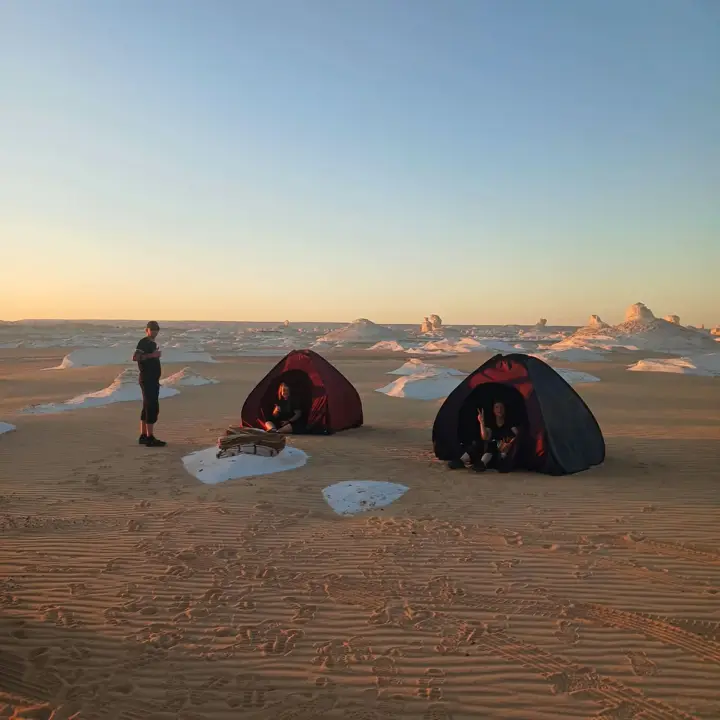
2 days, 1 night
White Desert overnight camping trip from Cairo (2 days, 1 night)About US$185 to 230 shared · US$360 to 460 private, per person
Check dates
3 days, 2 nights
3-day White Desert tour: Bahariya, the White Desert and two nights outAbout US$495 to 660 per person for two travellers, private
Check dates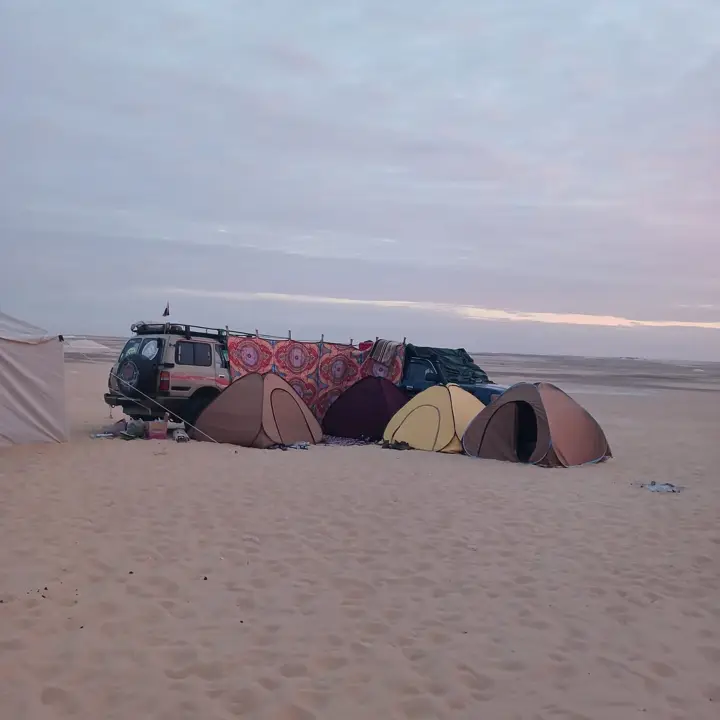
2 or 3 days
Private White Desert camping in comfortOn request (depends on group size and nights)
Check datesHow booking works
Free written quote
Message us on WhatsApp. We reply with the plan and a total price in writing, with no obligation.
50% deposit
To confirm, you usually pay 50% of the tour price; the balance is due before you arrive.
Permits handled
We arrange the desert permits; we just need a passport copy for each traveller.
Clear cancellation
Charges rise from 35% to 100% as your date gets closer. If weather spoils a camp night, we move it where we can or refund that night's camp portion.