
The short answer
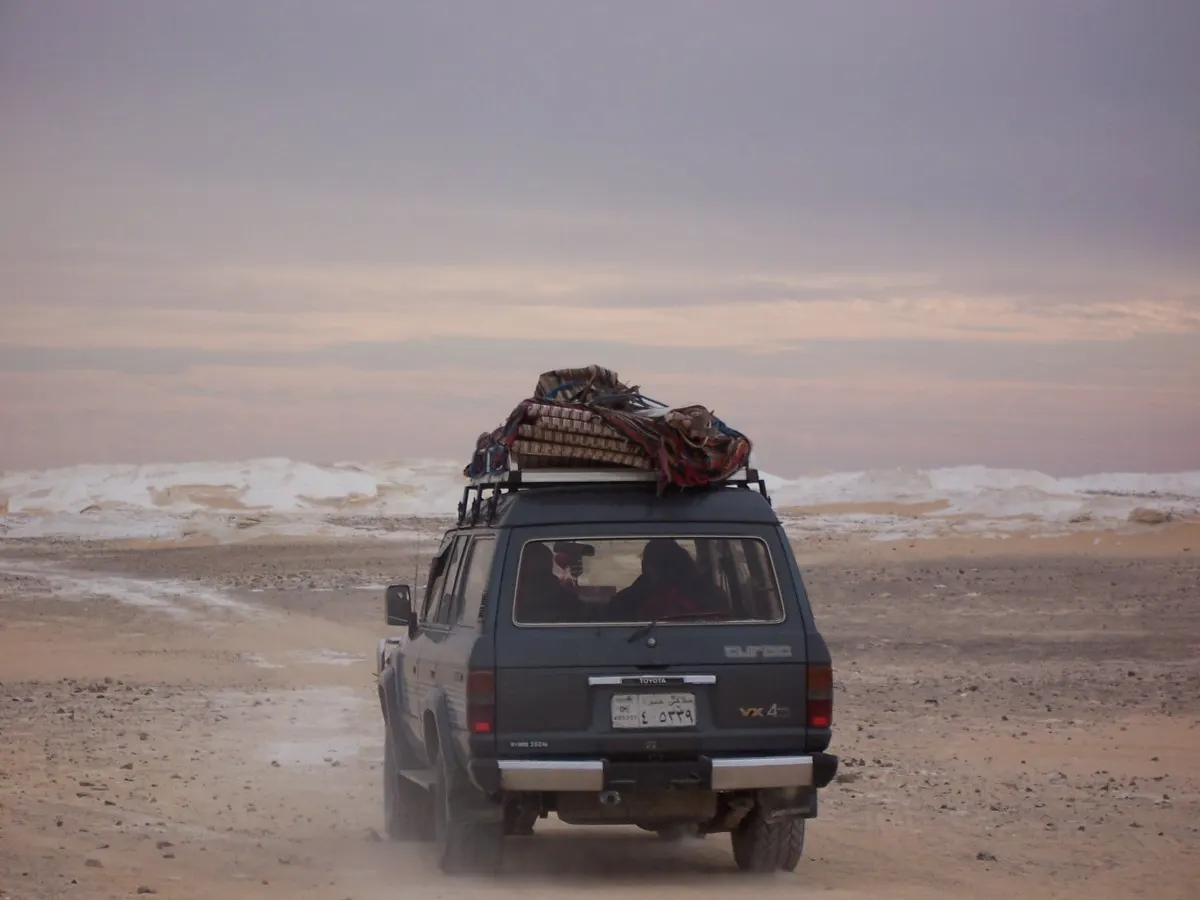
Bring your passport, Egyptian pound cash, a head torch, a 10,000–20,000 mAh power bank, toilet paper, wet wipes, opaque bags to carry rubbish out, sunscreen and your medicines, plus warm layers for the night. Our crew brings mattresses, blankets, meals and plenty of bottled water, with sleeping bags on request. A soft medium bag fits the 4x4 best.
Ask us on WhatsAppThe essentials
Short answer: Passport, Egyptian pound cash, a head torch, a power bank, toilet paper with wet wipes and a bag to carry it out, and your own medicines.
These are the things you cannot buy or borrow once we leave Bawiti.
- Passport (needed at the police checkpoints on the Bahariya road)
- Cash in Egyptian pounds for tips and small purchases in Bahariya, in small notes
- Head torch or small torch
- Power bank and charging cable
- Wet wipes, hand sanitiser, toilet paper and a small bag to carry used paper out
- Any medicines you take, plus something for an upset stomach
For how much cash, where the ATMs are and what our quote covers, see money and ATMs. Bahariya's antiquities ticket is about EGP 400 for foreigners since 1 October 2026 (was about EGP 100); check on the day. The park fee is a government protected-area fee for foreign visitors, collected through the operator and shown as its own line in your quote, so you do not need separate cash for it.
Typical values for the White Desert and Bahariya, matching our month guides. Open desert nights can be a few degrees colder; individual days vary.
Packing for a day trip, one night or three days
Short answer: A day trip needs a daypack and a warm layer. One night adds sleepwear, toiletries and a power bank. Three days add a second base layer, socks and a swimsuit for the springs, but still fit in one soft bag.
Most people overpack. Passport, cash, sunglasses and sun cream come on every trip; this is what changes with its length.
| Item | Day trip | 2 days, 1 night | 3 days, 2 nights |
|---|---|---|---|
| Warm layer | Yes, for the drive back | Yes, plus a night jacket from November to March | Yes, plus a night jacket from November to March |
| Head torch | Useful after dark | Essential | Essential |
| Power bank | Helpful | Essential | Essential |
| Sleepwear and thermals | No | Yes | Yes |
| Toiletries and opaque bags | Wipes and sanitiser | Full kit | Full kit, with extra bags |
| Spare socks and base layer | No | One pair of socks | One full change |
| Swimsuit | Only if a spring is on your route | If a spring is on your route | Yes, the itinerary includes a hot spring |
Read day trip or overnight? and how many days if you are still choosing. The three-day trip is the one where a spare base layer earns its place.
Clothes
Short answer: Pack one outfit for the day, warm layers for the night from October to April, sleepwear, a hat and closed shoes. Our what to wear guide covers layering, footwear and dress in the oasis towns month by month.
On the packing list, clothes are just one group: long sleeves and light trousers, a fleece, a warm jacket in winter, thermals to sleep in from December to February, a beanie, a sun hat, a buff, trainers and sandals, and a swimsuit for the hot springs. Nobody changes outfits at camp, so two days need very little.
Two small additions make a big difference. A clean, dry pair of socks kept only for sleeping is warmer than anything you have worn all day. And a buff does three jobs: sun on the neck by day, dust on a windy track and a warm layer over the ears at night.
Toiletries and hygiene
Short answer: There are no buildings, showers or toilets in the White Desert, so bring paper, wipes, sanitiser, opaque bags for rubbish and a head torch, and carry everything out.
The White Desert National Park has been a protected area since 2002, and every group brings in what it needs and takes everything out. The last proper toilets are at the halfway rest house and in Bawiti; there are none at the Black Desert, Crystal Mountain or Agabat.
- Toilet paper and a pack of wet wipes per person
- Hand sanitiser
- Three or four opaque bags for used paper and sanitary products
- Toothbrush and toothpaste (rinse with a little bottled water)
- Lip balm and moisturiser; the air is very dry
- Glasses if you wear contact lenses, for the dusty evening
- Your usual period products, plus extra bags
On any trip you can ask for a toilet tent, which makes the night much easier. Our toilets and hygiene guide has the full picture, and camping explains how the night works.
A small zip bag inside an opaque bag keeps used paper sealed and stops smells in the car. Carry biodegradable wipes out too: nothing breaks down quickly in a place this dry.
Electronics and power
Short answer: Charge everything in Cairo, carry a 10,000–20,000 mAh power bank, charge from the 4x4 while driving if it has a socket, and keep batteries warm inside your jacket or bedding at night.
There is no mains power at camp. Some of our 4x4s have a USB socket, but not every car does, so the power bank is your real supply. Cold drains batteries fast, so on winter nights put your phone, camera batteries and power bank inside your sleeping bag or jacket.
- Power bank of 10,000–20,000 mAh, fully charged
- Phone cable, and a car adapter if you have one
- Spare camera battery and memory card
- Offline maps and anything you want to read, downloaded before you leave Cairo
Signal is good in Bawiti, patchy on the highway and mostly absent in the White Desert, so plan for an offline night and save battery for sunset and sunrise. Our phone signal and internet guide covers where the networks reach.
For your hotel in Cairo or Bawiti, Egypt uses plug types C and F at 220 V and 50 Hz, according to Wikipedia's table of mains electricity by country (checked 19 November 2026). A two-pin European adapter fits both.
A 10,000 mAh bank covers most phones for one night with plenty of photos. Take 20,000 mAh, or two smaller banks, for three days, a camera that charges by USB or a cold winter trip. Put your phone in airplane mode once the signal goes, so it stops searching for a network all night.
Flying in with your kit
Short answer: Power banks and spare batteries go in hand luggage, never in the hold. Keep medicines in their original packs with a doctor's letter.
Power banks. The UK Civil Aviation Authority says to keep power banks in the cabin and never in checked luggage, allows two per person, and requires airline approval for anything between 100 and 160 Wh, according to CAA Pack Right (checked 19 November 2026). Its formula is volts times amp-hours. At the usual 3.7 V, a 20,000 mAh bank works out at about 74 Wh, under the 100 Wh line. The CAA also says to check with your airline before you fly, so do.
Medicines. Egypt restricts certain prescription and pharmacy medicines, and some may need Ministry of Health approval before you land. Carry a letter from your doctor giving the condition, the quantity you carry and that it is for your personal use only, according to GOV.UK Egypt travel advice: health (checked 19 November 2026). Check your own government's advice too.
A small health kit
Short answer: Rehydration salts, an anti-diarrhoea remedy, painkillers, plasters, motion-sickness tablets for the off-road stretch and any personal prescriptions cover nearly everything we see.
The desert air is very dry, so lip balm, moisturiser and eye drops help if you wear contact lenses; many guests switch to glasses for the night. The 4x4 sections into the formations are bumpy, and if you are prone to car sickness take a tablet in Bawiti before you change cars, not in Cairo. Mosquitoes are not usual, but on still, warm nights near the formations they can appear, so a small repellent is worth its weight; our mosquitoes and insects guide has more. Our health and first aid guide covers the rest, and permits and safety explains travel insurance.
For sunscreen, the NHS recommends a sun protection factor of at least 30 with at least 4-star UVA protection, reapplied every 2 hours and after sweating, according to NHS: sunscreen and sun safety (checked 19 November 2026). The pale chalk reflects light upwards, so cover your ears and under your chin too.
Protecting your gear from sand
Short answer: Fine dust gets into everything. Zip bags for your phone and spare batteries, a lens cloth and a cover for your main bag keep the worst out.
Put your phone in a zip bag when you are not using it, change camera lenses inside the car and wipe sand off screens rather than blowing it in. A bin liner over your main bag keeps it clean on the roof rack. If the forecast is windy, read our sandstorms and wind guide.
Nice to have
Short answer: A camera with a spare battery and small tripod, a daypack, earplugs and binoculars make the trip better but are not essential.
- Camera with a spare battery (cold drains batteries fast) and a small tripod for night photos; see photographing the White Desert
- A small daypack
- Earplugs, if you share a sleeping area
- Binoculars for the stars and the morning fox tracks
- Favourite snacks from Cairo; Bawiti's shops are basic and road-stop snacks are overpriced
- A refillable water bottle
- A head torch with a red mode, so you don't dazzle others under the stars; see stargazing
What we provide
Short answer: Mattresses, thick blankets, the windbreak, meals, plenty of bottled water, tea and cooking kit; sleeping bags and a toilet tent on request.
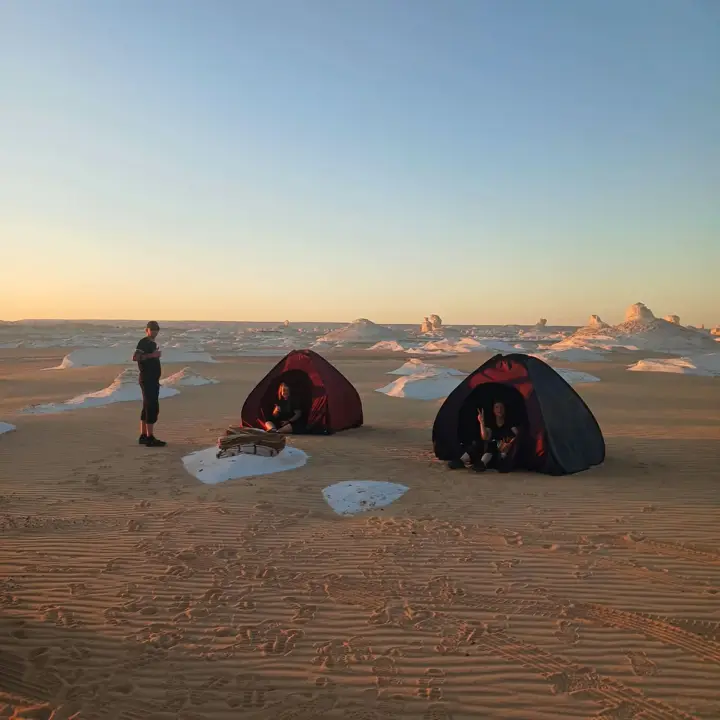
On our trips, the crew brings the camping kit: mattresses, thick blankets, the windbreak, the cooking kit and all meals and water. Bottled water is included, and we carry plenty, so we never run out of water. Sleeping bags, spare blankets, tents and a toilet tent are available on request, and so are comfort extras such as walk-in tents and duvets. Ask for a sleeping bag when you book and you don't need to bring one, though some travellers like their own liner. Read camping and comfort camping.
Bags and packing the 4x4
Short answer: One soft medium bag per person plus a small daypack; the main bags ride on the roof rack or in the back, so keep what you need on the road in the daypack.
Soft bags squeeze in around the camping kit; hard suitcases do not stack well and get scratched on the roof rack. In your daypack keep the passport, cash, sunglasses, sun cream, water, a warm layer for the evening and your phone, because the main bags are not easy to reach between stops. If you are carrying on to Siwa or the Nile, leave the big case with your Cairo hotel and take only the soft bag.
Pack night clothes, head torch and toiletries on top, because you open the bag at camp in fading light.
Leave in Cairo
Short answer: Leave large suitcases, drones and valuables you will not use at your Cairo hotel; drones in particular can be confiscated without a permit.
Large suitcases (most hotels will store them), drones (they need permission in Egypt and can be confiscated) and anything valuable you won't need.
Packing by season
Short answer: What changes through the year is the night: from November to March add a proper warm jacket, hat and gloves; from May to September a light layer is enough. Our what to wear guide has the clothes by month.
The coldest camping nights fall from mid-December to early February, when frost is possible in camp. For the numbers by month, see weather and night temperatures; our camping in winter guide explains how we set up camp on cold nights. In summer, the gear that matters is a refillable bottle, extra sun cream and rehydration salts.
A one-page checklist
Short answer: The short version to tick off the night before.
| Category | Items |
|---|---|
| Documents | Passport, cash in Egyptian pounds (small notes), doctor's letter for prescriptions |
| Clothes | Day outfit, warm layers for night, hat, closed shoes, sandals; see what to wear |
| Health | Sunscreen, lip balm, medicines, rehydration salts, plasters, motion-sickness tablets |
| Kit | Head torch, power bank, cables, plug adapter, sunglasses, small daypack |
| Hygiene | Toilet paper, wet wipes, hand sanitiser, opaque bags for rubbish |
| Optional | Camera, tripod, binoculars, earplugs, snacks, refillable bottle, zip bags |
What guests forget most
Short answer: A warm hat, a head torch, a power bank and sandals for camp are the four things we lend or improvise most often.
After years of trips from Bawiti, the pattern is clear. Guests remember the sun cream and forget the cold. They bring a phone torch and then find that one hand is not enough when you are walking behind a rock to the loo at 2:00. They charge the phone fully, take 400 photos of the sunset and have nothing left for sunrise. And they wear walking boots all evening because sandals did not seem worth the space. Spare blankets are available on request, and our drivers usually have a cable, but we cannot promise a beanie in your size.
Travelling with children? Pack one small bag per child; the White Desert with kids has the family list.
Message us on WhatsApp with "packing" and your dates if you'd like a list for your month.
Questions people ask
Do I need to bring a sleeping bag?+
Not if you ask us: sleeping bags are available on request, and mattresses and blankets are provided on every trip. Tell us when you book. If you feel the cold, bring a liner or your own warm bag for December and January.
Can I charge my phone in the desert?+
Not reliably. Some 4x4s have a USB socket, but bring a charged power bank, and switch to airplane mode to save battery in areas without signal.
Can I bring a drone to the White Desert?+
We advise against it. Drones need official permission in Egypt and can be confiscated at the airport or at police checkpoints on the Bahariya road. Leave yours at home and bring a small tripod instead for low-light shots.
What bag should I bring?+
A soft duffel or backpack of medium size, which fits easily in the 4x4, plus a small daypack for the day. Leave large hard suitcases at your Cairo hotel.
How much cash should I bring?+
Enough Egyptian pounds for snacks, drinks and the crew tip, which many travellers set at around US$10–20 per person per day. Add about EGP 400 per person for Bahariya's antiquities sites, the foreigner price since October 2026. Bawiti ATMs sometimes run dry, so bring cash from Cairo.
Do I need to bring drinking water?+
No. Bottled water is included on our trips, and we carry plenty: we never run out of water, even in summer. A refillable bottle of your own is handy in the 4x4 and saves opening a new bottle at every stop.
What toiletries do I need for a night in the desert?+
Toilet paper, wet wipes, hand sanitiser, a few opaque bags for used paper and products, lip balm and moisturiser for the dry air, and a toothbrush with a little bottled water. There are no showers or toilets in the White Desert itself, so keep it simple.
What do people most often forget to pack?+
A warm hat, a head torch, a power bank and sandals for camp. Guests remember the sun cream and forget how cold the night gets. Spare blankets are available on request and the drivers usually have a cable, but we cannot promise a beanie in your size.
Can I take a 20,000 mAh power bank on my flight to Egypt?+
Usually yes, in your hand luggage only. The UK Civil Aviation Authority says power banks must never go in checked luggage, and that anything between 100 and 160 Wh needs airline approval. A 20,000 mAh bank at 3.7 V works out at about 74 Wh. Check your airline's own rules before you fly.
Do I need a letter for my prescription medicines?+
It is wise to carry one. GOV.UK warns that Egypt restricts certain medicines, which can need Ministry of Health approval before you land. It suggests a letter from your doctor giving the condition, the quantity and that the medicine is only for you. Keep medicines in their original packs in your daypack.
What plug adapter do I need for Egypt?+
Egypt uses two-pin European plugs, types C and F, at 220 V and 50 Hz. Most phone and camera chargers handle that voltage, but check the label. You only need the adapter in Cairo and at your Bawiti hotel, because there is no mains power at camp.
Go with us
Trips that include this
2 days, 1 night
White Desert overnight camping trip from Cairo (2 days, 1 night)About US$185 to 230 shared · US$360 to 460 private, per person
Check dates
3 days, 2 nights
3-day White Desert tour: Bahariya, the White Desert and two nights outAbout US$495 to 660 per person for two travellers, private
Check dates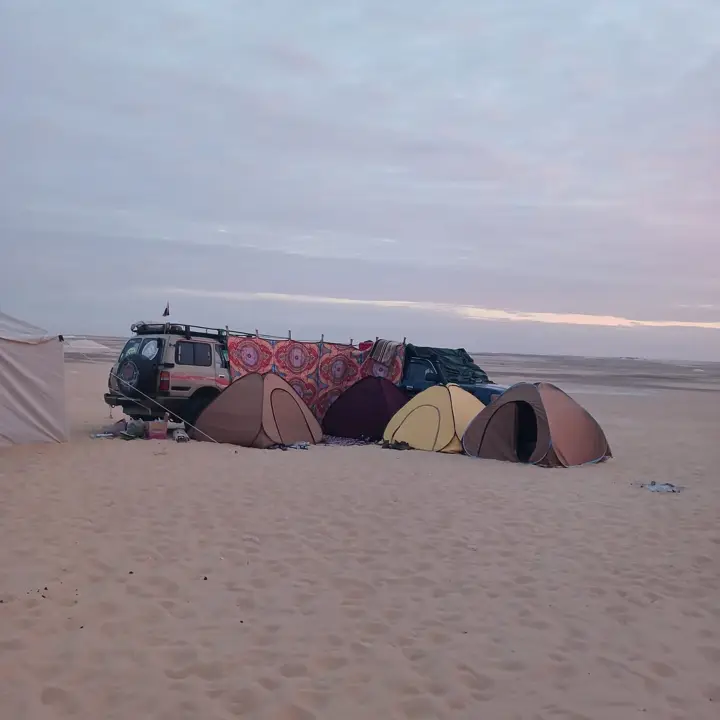
2 or 3 days
Private White Desert camping in comfortOn request (depends on group size and nights)
Check dates