
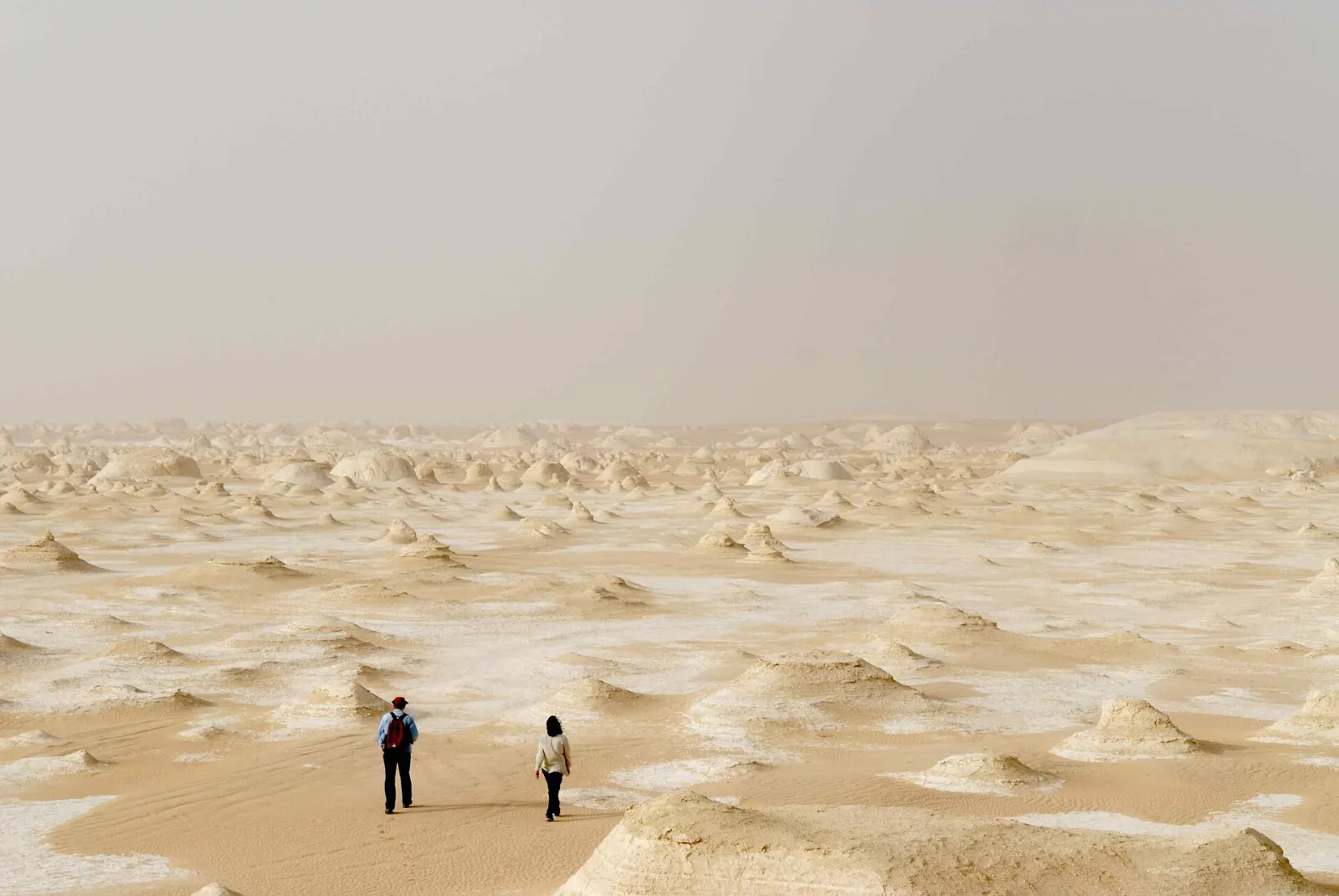
The short answer
Wear light, loose layers that cover shoulders and knees, a hat and sunglasses by day, and warm layers at night from October to April. Trainers or light boots work best on sand and loose rock. Women don't need to cover their hair, but modest clothes are appreciated in Bahariya's villages. At camp, comfort is all that matters.
Ask us on WhatsAppMonth-by-month temperatures and clothing
Short answer: Days range from about 20°C in winter to nearly 40°C in summer; nights from near freezing to the low 20s. Dress in layers you can add and remove.
| Months | Typical day | Typical night | Wear by day | Wear at night |
|---|---|---|---|---|
| Dec–Jan | 19–22°C | 2–8°C | Long sleeves, light fleece | Down jacket, thermals, hat, gloves |
| Feb, Nov | 21–26°C | 4–12°C | T-shirt plus light layer | Warm fleece or down jacket, hat |
| Mar, Oct | 25–31°C | 8–17°C | Light shirt, trousers | Fleece or light jacket |
| Apr, May, Sep | 30–36°C | 12–20°C | Loose, light long sleeves | Light jumper |
| Jun–Aug | 36–39°C | 20–23°C | Loose, light, full cover from sun | T-shirt |
These are typical ranges, and cold snaps or warm spells happen. Check the forecast for Bahariya and Farafra the week before. See best time to visit.
Typical values for the White Desert and Bahariya, matching our month guides. Open desert nights can be a few degrees colder; individual days vary.
The layering system
Short answer: A base layer, a warm mid-layer and a windproof outer layer, plus hat and gloves in winter.
Desert temperatures often swing 15–20 degrees between afternoon and night, and the wind makes cold feel colder. The easiest approach is layers. Wear a breathable T-shirt or long-sleeved top by day. Keep a fleece or wool jumper in your day bag for the evening. Add a down or synthetic insulated jacket for the night from November to March, and a windproof shell on top if you have one. For sleeping in winter, pack thermal leggings, a long-sleeved thermal top, warm socks and a beanie. Our camping guide covers the rest of the sleep system.
Footwear
Short answer: Trainers or light hiking shoes for walking, sandals or slides for camp; boots only if you plan long hikes.
The ground in the desert is sand, gravel and broken rock, sometimes with sharp chalk edges. Closed trainers or light hiking shoes are ideal. They protect your feet, grip on slopes and let sand out easily. Sandals, slides or slip-ons are handy around camp and at hot springs, and much easier to get in and out of when you leave your bed at night. Heavy boots aren't needed unless you're hiking for hours. In summer, the sand gets hot enough to burn, so never walk barefoot at midday. Gaiters are a luxury on dune walks.
Dress in the oasis towns
Short answer: Cover shoulders and knees in Bawiti and Farafra; loose trousers or a long skirt and a T-shirt are perfect.
Bahariya and Farafra are conservative farming communities. In town, both men and women should cover shoulders and knees; shorts and vests feel out of place. Women don't need to cover their hair. At hot springs, a T-shirt and shorts or leggings over a swimsuit are the respectful choice. In the desert and at camp, wear what's comfortable. Our hot springs guide has the full etiquette for the public pools.
What to wear on the drive and in the 4x4
Short answer: Comfortable, loose clothes with a layer on top, slip-on shoes, and your warm things in a small bag at your feet rather than in the main luggage.
The trip starts with a long road. Cairo to Bawiti is about 370 km, and the drive takes 4.5–5 hours from central Cairo with a stop (five to six hours if you come by bus). See the Cairo to Bahariya drive. Early departures in winter are cold, and car air conditioning can feel chilly by midday, so start in long trousers and a light jumper you can take off.
In Bawiti you change to a 4x4 for the desert. The tracks are bumpy and dusty, and the doors open and close at every stop. A few habits make the day easier:
- Keep a day bag with you. Fleece, hat, sunglasses, buff, sun cream and water should be in reach, not under the camp kit.
- Wear shoes you can slip on and off. You will get in and out of the car many times and shake sand out of your shoes at each stop.
Fabrics: what works and what doesn't
Short answer: Cotton is fine for a dry afternoon; for the night, wool or synthetic next to the skin and fleece or down on top keep you far warmer.
| Fabric | Good for | Weak point | Our view |
|---|---|---|---|
| Cotton | Hot, dry afternoons; cheap and comfortable | Holds sweat and feels cold after dark | Fine by day; don't sleep in a damp cotton T-shirt |
| Linen | Summer days; loose and cool | Creases, little warmth | Good for June to September |
| Merino wool | Base layer and socks; warm, slow to smell | Costs more, slower to dry | The best night base layer if you have it |
| Synthetic thermal | Base layer; light, quick to dry | Can smell after two days | A good, cheaper alternative to merino |
| Fleece | Evening mid-layer; warm even if damp | Lets wind through | Pair it with a windproof layer |
| Down or synthetic jacket | Night warmth from November to March | Bulky; down loses warmth when wet | Worth packing for any winter date |
You do not need technical outdoor gear. A wool jumper from home works as well as a branded fleece. For children, the same system applies in small sizes; see the White Desert with kids.
Dressing for summer heat
Short answer: In the hot months, cover up rather than strip off: loose, light-coloured long sleeves, a wide hat and sunglasses protect you better than a vest.
Middays in the hot months reach 37–38°C on average, and there is no shade among the formations. Our weather guide explains how summer trips avoid walking in the open between about 11:00 and 16:00. When you are out in the sun, loose clothes that cover your arms and legs keep it off your skin and let air move.
The World Health Organization's guidance on the UV index says that at levels of 8 and above, shirt, sunscreen and hat are a must, and that protection should combine clothing, hat, sunglasses, shade and sunscreen (WHO UV index Q&A, checked 19 November 2026). In the White Desert the chalk reflects light upwards, so a cap alone leaves your neck and face exposed. A wide brim or a cap with a buff over the neck is better.
Light colours stay cooler than black in direct sun, and closed shoes matter more in summer than in winter (see Footwear above).
Clothes for each part of the trip
Short answer: Closed shoes for climbs and sand, modest clothes for the museum and town, a cover-up for the hot springs and every warm layer you own for the night.
| Stop or activity | What to wear | Why |
|---|---|---|
| Black Desert climb | Closed shoes with grip, trousers | Loose, sharp volcanic stones on a steep slope |
| Crystal Mountain | Closed shoes | Broken quartz and rock edges underfoot |
| Agabat and sandboarding | Long trousers, closed shoes, sunglasses | Sand gets everywhere; hidden stones; glare |
| Golden Mummies museum and Temple of Alexander | Shoulders and knees covered, comfortable shoes | Public sites in a conservative town; sand and broken stone at the temple |
| Hot springs | Dark swimsuit with a T-shirt and shorts or leggings over it, flip-flops | Public farm pools; iron can stain pale swimwear |
| Sunset among the formations | Fleece on before the sun goes | The drop is fast once the light fades |
| Sunrise walk | Down jacket, hat, gloves in winter | The coldest moment of the night is just before dawn |
If a camel ride or a long walk is part of your plan, ask us what is on your route and we will tell you what to wear for it.
Mosques and Ramadan
Short answer: Take off your shoes before entering a mosque, keep arms and legs covered in town, and during Ramadan avoid eating or drinking in public in daylight.
You may pass a mosque in Bawiti or Qasr Farafra. Wikivoyage's Egypt guide says you should not enter a mosque wearing any kind of shoes or sandals, though socks are fine; it also advises long trousers or long shorts rather than short shorts, and says women do not need to cover their hair (Wikivoyage: Egypt, checked 19 November 2026). If you want to look inside a mosque, a scarf in your day bag lets women cover their hair if asked.
Ramadan in 2027 runs from about 8 February to 9 March. The same Wikivoyage guide notes that non-Muslims are not expected to fast but should not eat or drink in public during the day, as this is considered very impolite. Clothes matter in the same spirit: in town during Ramadan, err on the covered side. In the desert and at camp, nothing changes.
Sun and dust protection
Short answer: A wide-brimmed hat, good sunglasses, a buff or scarf for wind-blown sand, and high-factor sun cream.
The sun is strong all year, and the white chalk reflects it back up at you. A wide-brimmed hat and sunglasses with good UV protection make a big difference. A buff or light scarf protects your face and neck from wind and sand, and doubles as a warm layer at night. Bring lip balm, and sun cream of at least SPF 30. Contact-lens wearers often prefer glasses in the dust.
What to wear for photographs
Short answer: Earthy colours or strong single colours stand out against white chalk; avoid all-white outfits.
If you're planning photos among the formations, red, blue, orange or deep green look striking against white chalk and blue sky. Pure white blends in. Flowing scarves and dresses look beautiful in the wind at sunset, but layer underneath for the evening chill. See photography.
Checked November 2026: the climate behind this advice
Short answer: The advice above rests on Farafra and Bahariya climate averages, with January lows around 4°C and July lows around 21–22°C; full figures are in our weather and night temperatures guide.
Two points matter for clothes. Rain is almost unknown, about 2–4 mm a year, so you never need waterproofs. Wind is what matters: it can make a 6°C December night feel like 0°C, and some mornings bring frost on the windbreak, so a windproof outer layer earns its place.
Dressing for a night under the stars
Short answer: On a meteor shower or stargazing night, dress for January whatever the month says, because sitting still outside for hours is colder than sleeping.
If you are joining us for the Geminid meteor shower on the night of 13–14 December 2026, or any long session watching the sky, the usual layers are not quite enough. Wear the thermal base layer under your clothes from sunset, not just for bed. Add a down jacket, a beanie, gloves and two pairs of socks, and keep a blanket over your legs. Feet and hands go first, so warm socks and gloves matter more than an extra fleece. See meteor showers and stargazing.
What catches people out
Short answer: Dressing for the afternoon and not the night, wearing sandals on the Black Desert climb, and forgetting a hat for sleeping.
- The temperature drop. It can fall 15°C between 16:00 and 22:00. Put your fleece on at sunset, before you feel cold.
- Sandals on loose stone. The Black Desert and Crystal Mountain are sharp underfoot. Wear closed shoes for the stops.
- No hat at night. A beanie makes a surprising difference on a winter night.
- Damp clothes. Sweat from the day turns cold at night. Change into a dry base layer before sleeping.
A clothes checklist
Short answer: Two days need very little: one outfit for the day, warm layers for night, sleepwear, a hat and good shoes.
- Comfortable trousers and a long-sleeved shirt or T-shirt
- Fleece or wool jumper
- Down or warm jacket (Nov–Mar)
- Thermal top and leggings for sleeping (Dec–Feb)
- Beanie, gloves and warm socks (Dec–Feb)
- Sun hat, sunglasses, buff or scarf
- Trainers or light hiking shoes, plus sandals
- Swimsuit for the hot springs
For everything that is not clothing, such as the head torch, power bank, toiletries and health kit, see our White Desert packing list. Questions about your dates? Message us on WhatsApp with "what to wear".
Our advice
Short answer: Pack light but pack for the night: one warm layer more than you think you need matters more than spare day clothes.
You will not need a change of clothes every day on a two-day trip; nobody dresses up at camp. What you will need is warmth after dark from October to April. If in doubt, bring the extra fleece. Spare blankets and sleeping bags are available on request, but your own warm layers are what make the evening by the fire comfortable. For the rest of your kit, read first-time desert camping.
Questions people ask
Can I wear shorts in the White Desert?+
In the desert itself, yes, though long trousers protect better from sun, sand and sharp chalk. In Bawiti, Farafra and the villages, knee-length or longer is more respectful for both men and women, so keep a pair of light trousers handy for lunch stops.
What should women wear in Bahariya and the White Desert?+
In town, loose trousers or a long skirt and a top that covers the shoulders. Women don't need to cover their hair. At camp, wear whatever is comfortable. At hot springs, leggings and a T-shirt over a swimsuit are the respectful choice.
How cold does it get at night in the White Desert?+
From December to February, average lows are about 4–6°C, and still, clear nights in the open desert can drop close to 0°C; the record at Farafra is −3.3°C. From June to August nights stay around 20–22°C. Pack for the night, not the day.
Do I need hiking boots for the White Desert?+
No. Trainers or light hiking shoes are ideal on sand, gravel and chalk, and let sand out easily. Bring sandals or slides for camp. Heavy boots only make sense if you plan long walks in the New White Desert or the Black Desert hills.
What should I sleep in on a winter night in the desert?+
A dry thermal top and leggings, thick socks and a beanie, changed into just before bed so the day's sweat does not chill you. Our crew provides the bedding; what keeps you warm inside it is your own clothing. If you sleep very cold, wear a light down jacket too.
What should I wear for a meteor shower or stargazing night?+
Dress as for the coldest night of January, even in December. You will sit still outside for hours, which feels far colder than sleeping. A thermal layer, a down jacket, a hat, gloves and thick socks are the minimum for the Geminids on 13–14 December 2026.
What should I wear on the drive from Cairo?+
Loose trousers, a T-shirt and a light layer you can take off, plus slip-on shoes. The drive to Bawiti is about 370 km and takes 4.5–5 hours, the car air conditioning can feel cool, and winter mornings are cold. Keep your fleece, hat and sunglasses in a small bag with you, not packed away in the main luggage.
Is cotton or wool better for the desert?+
Cotton is fine for a hot, dry afternoon, but it stays damp once you sweat and then feels cold after dark. For the night layer next to your skin, merino wool or a synthetic thermal works better. Fleece and down are the warm layers on top.
What should I wear in the White Desert in summer?+
Loose, light-coloured long sleeves and long trousers, a wide-brimmed hat, sunglasses and closed shoes, because the sand gets hot enough to burn. Nights from June to August stay around 20–22°C, so a T-shirt is enough after dark. Summer trips avoid walking in the open in the middle of the day.
Do I need special clothes for sandboarding?+
No special kit, just long trousers, closed shoes and sunglasses. Sand gets into every pocket, so wear clothes you don't mind shaking out, leave anything delicate in the car and empty your shoes before you get back in. If sandboarding matters to you, mention it when you book.
Go with us
Trips that include this

2 days, 1 night
White Desert overnight camping trip from Cairo (2 days, 1 night)About US$185 to 230 shared · US$360 to 460 private, per person
Check dates
3 days, 2 nights
3-day White Desert tour: Bahariya, the White Desert and two nights outAbout US$495 to 660 per person for two travellers, private
Check dates
2 or 3 days
Private White Desert camping in comfortOn request (depends on group size and nights)
Check dates