
The short answer
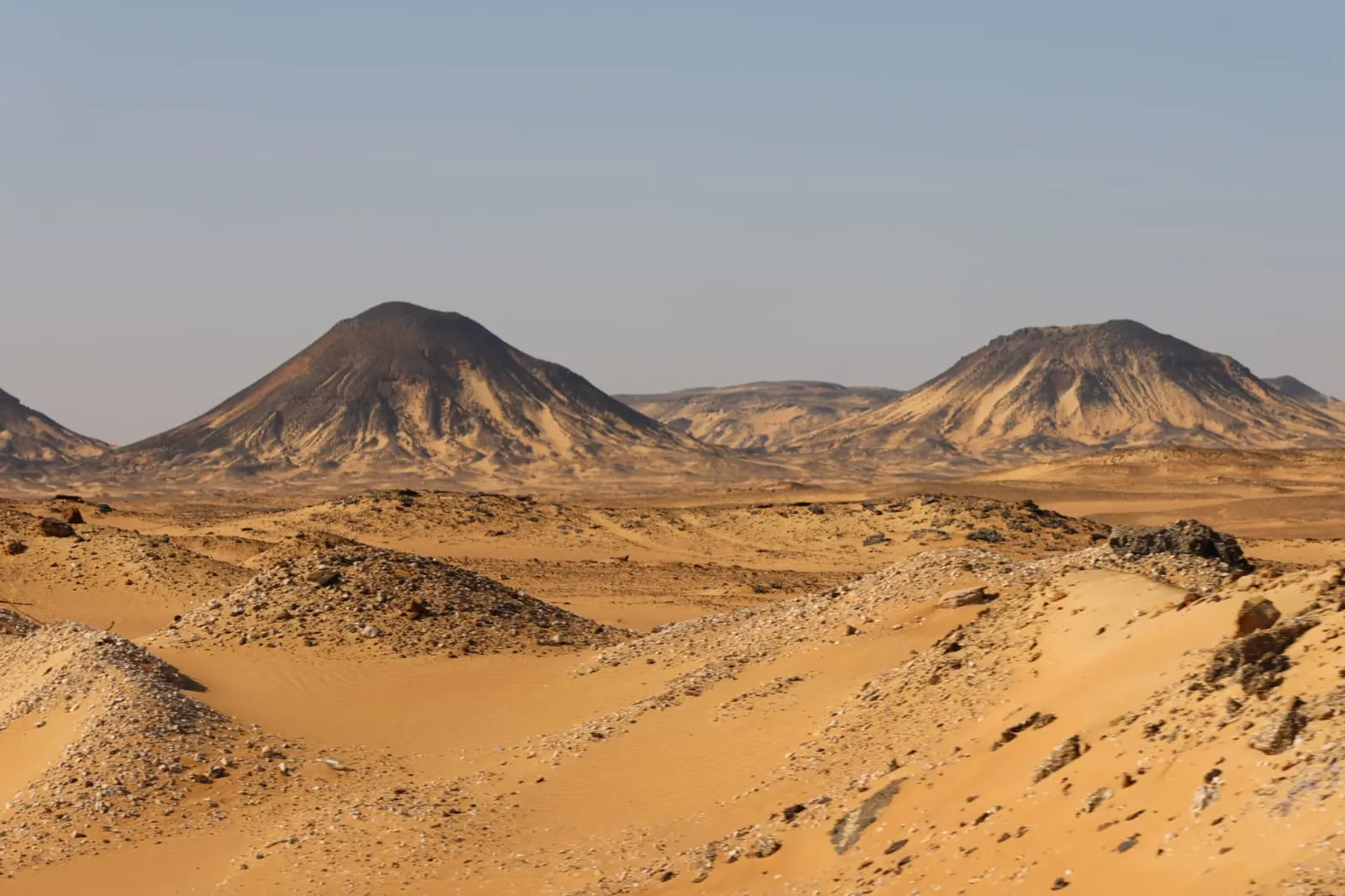
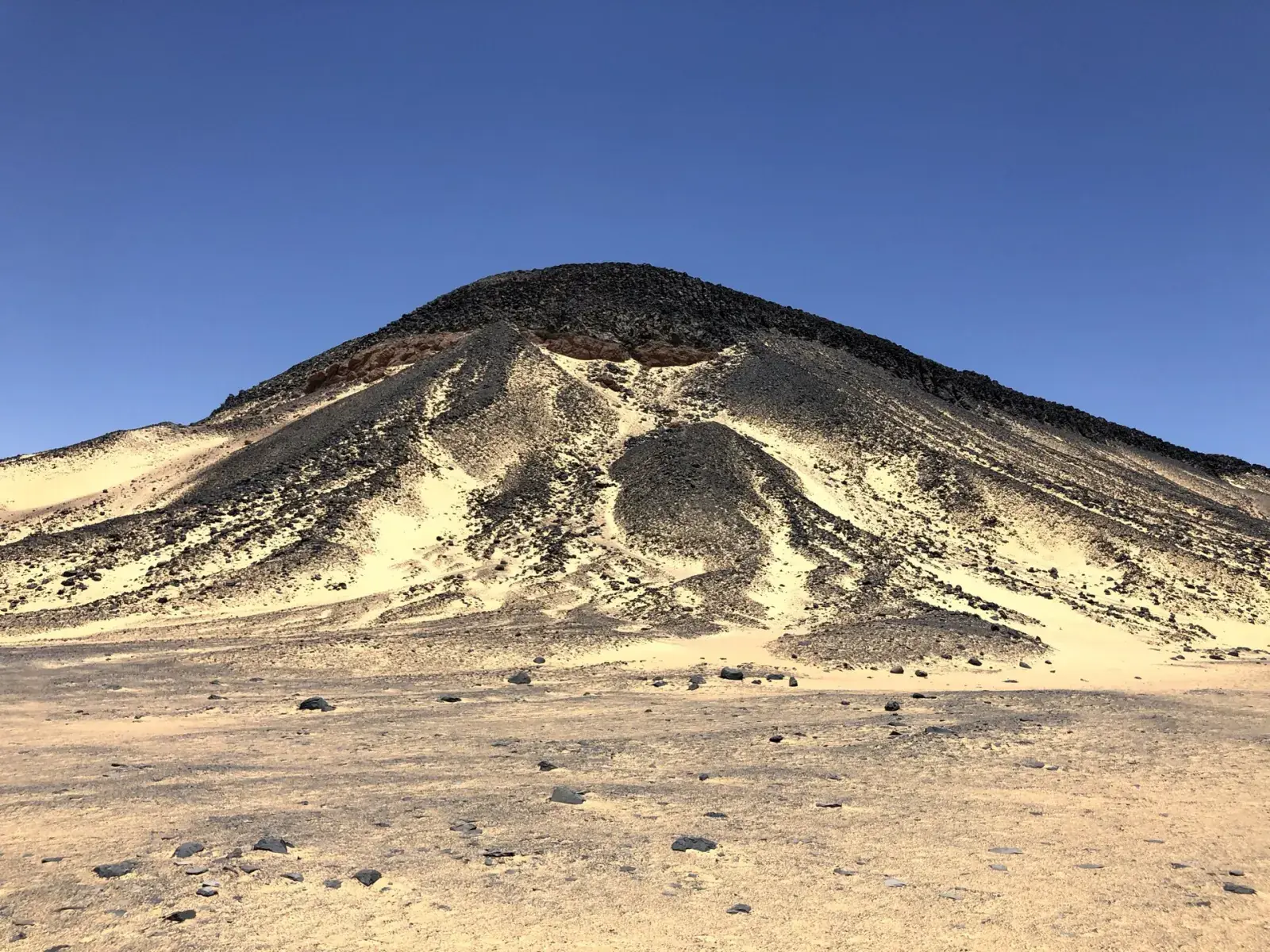
The Black Desert is a stretch of orange-brown hills starting about 40 km south of Bawiti in Bahariya Oasis, capped and scattered with dark stone that makes them look volcanic. It's the first big stop on almost every White Desert trip, about 90 km before the chalk. Most visitors climb one of the hills, which takes about 15 minutes, for a wide view over the dark-dotted plain.
Ask us on WhatsAppWhat you see
Short answer: The Black Desert is a field of orange-sand hills covered in loose, glossy black stones, many shaped like cones or flat-topped tables, stretching for kilometres either side of the road.
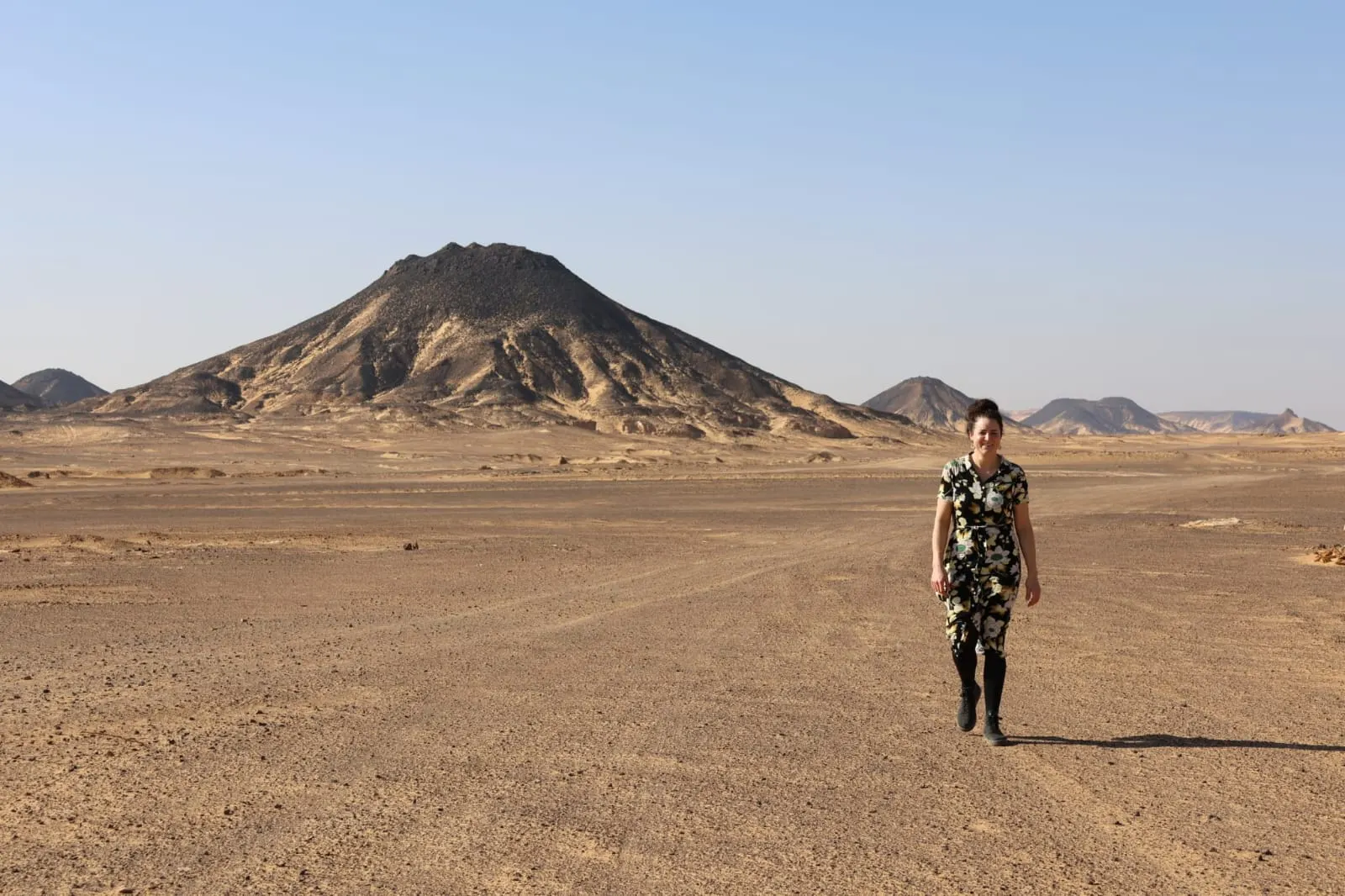
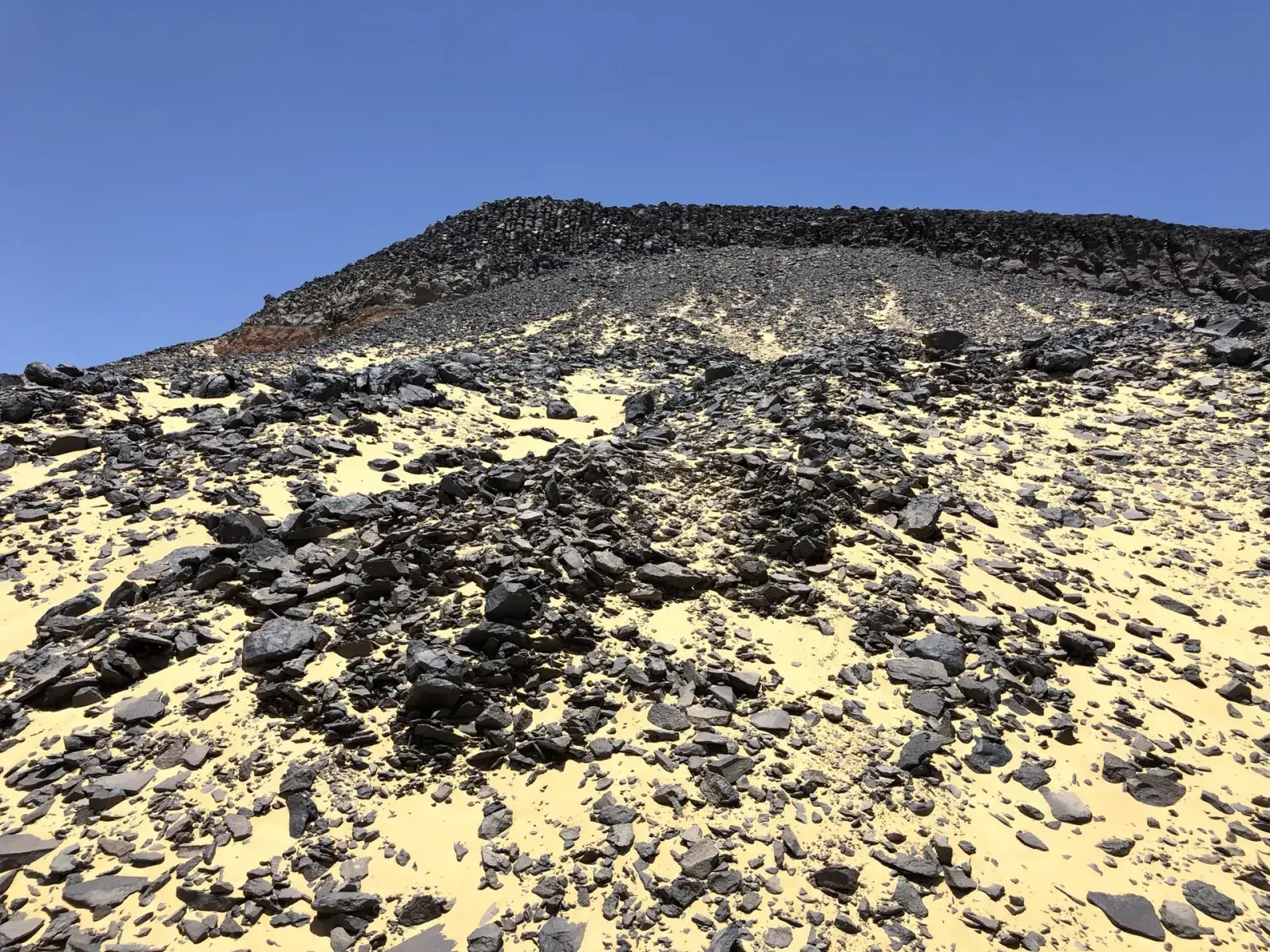
Seen from the road, the hills look as if someone sprinkled them with coal dust. Close up, the ground is golden sand covered with a loose layer of black, glossy stones. Many hills are cone-shaped, a few have flat dark tops, and from the summit you look out over dozens of them in every direction.
Where it is
Short answer: The Black Desert starts about 40 km south of Bawiti on the Bahariya–Farafra road, about 410 km from Cairo, and is the first stop heading south, roughly 90 km before the White Desert's chalk.
It lies between Bahariya and Farafra, along and just off the main road, on the southern edge of the Bahariya depression, about half an hour south-west of Bawiti by 4x4. The main White Desert formations are around 130 km south of Bawiti, so the two sit on the same road rather than being alternatives. It's usually visited on the way south on the first afternoon of a trip, before Crystal Mountain.
What's the difference between the White and Black Desert?
Short answer: They are neighbours on one road but opposites in rock: the Black Desert is orange sand under shattered dark iron-rich and volcanic stone, a short stop; the White Desert is wind-carved chalk from an ancient sea, where you spend the sunset, the night and sunrise.
People often search "Black Desert or White Desert" as if they had to pick one. You don't: every standard trip drives through the Black Desert on the way to camp in the White. The real question is how much time to give each.
| Black Desert | White Desert | |
|---|---|---|
| Colours | Black, orange, gold | White, cream, pink at sunset |
| Rock | Iron-rich quartzite, dolerite over sandstone | Chalk and limestone |
| Shapes | Cone and table hills | Mushrooms, towers, animal shapes |
| Main activity | One hill climb with a view | Walks among the formations, sunset, camp, stars |
| Best light | Afternoon, on the way in | Sunset and sunrise |
| Time spent | 30–60 minutes | Afternoon, night and morning |
| Distance from Bawiti | ~40 km | ~130 km |
| Protected status | Outside the park | White Desert National Park, protected since 2002 |
| Entry fee | None of its own | A park entry fee, listed in your quote |
| Night camping | Occasionally | The classic camp |
Which is more impressive? The White Desert is the headline: its scale, its shapes and the night are unlike anywhere else. But the Black Desert is a superb prelude. After an hour among dark stones and orange sand, the white chalk feels even brighter when you arrive.
Who prefers which:
- First-time visitors: the White Desert, for the shapes, sunset and the night.
- Photographers: both. The Black Desert gives graphic, high-contrast scenes; the White Desert gives the iconic ones. See photography.
- Walkers and geology fans: they often linger longest in the Black Desert, where the hills give a short, satisfying climb; the New White Desert has longer walks among towers.
- Families with young children: the White Desert's flat chalk plains are easier to explore than loose black slopes.
- Older travellers: the Black Desert view from the base of the hill is enough, and the White Desert formations can be reached on flat ground.
Gebel el-Dist and the dinosaurs
Short answer: Gebel el-Dist is a lone cone near Bawiti in an area famous for dinosaur finds, including Spinosaurus, described by Ernst Stromer, and Paralititan, found in 2000.
Just outside Bawiti stands Gebel el-Dist, a solitary cone-shaped hill. The area around Bahariya is one of the world's important dinosaur sites. In the early twentieth century the German palaeontologist Ernst Stromer described Spinosaurus from fossils found here; the originals were destroyed when Munich was bombed in 1944. In 2000 an American team found the giant plant-eater Paralititan near Bahariya. See our geology guide.
What to do there
Short answer: Climb one cone-shaped hill, about 15 minutes, for a 360-degree view, then walk the ridge and photograph the black-and-gold contrast.
Most trips stop at one of the classic viewpoints just off the road. The usual plan:
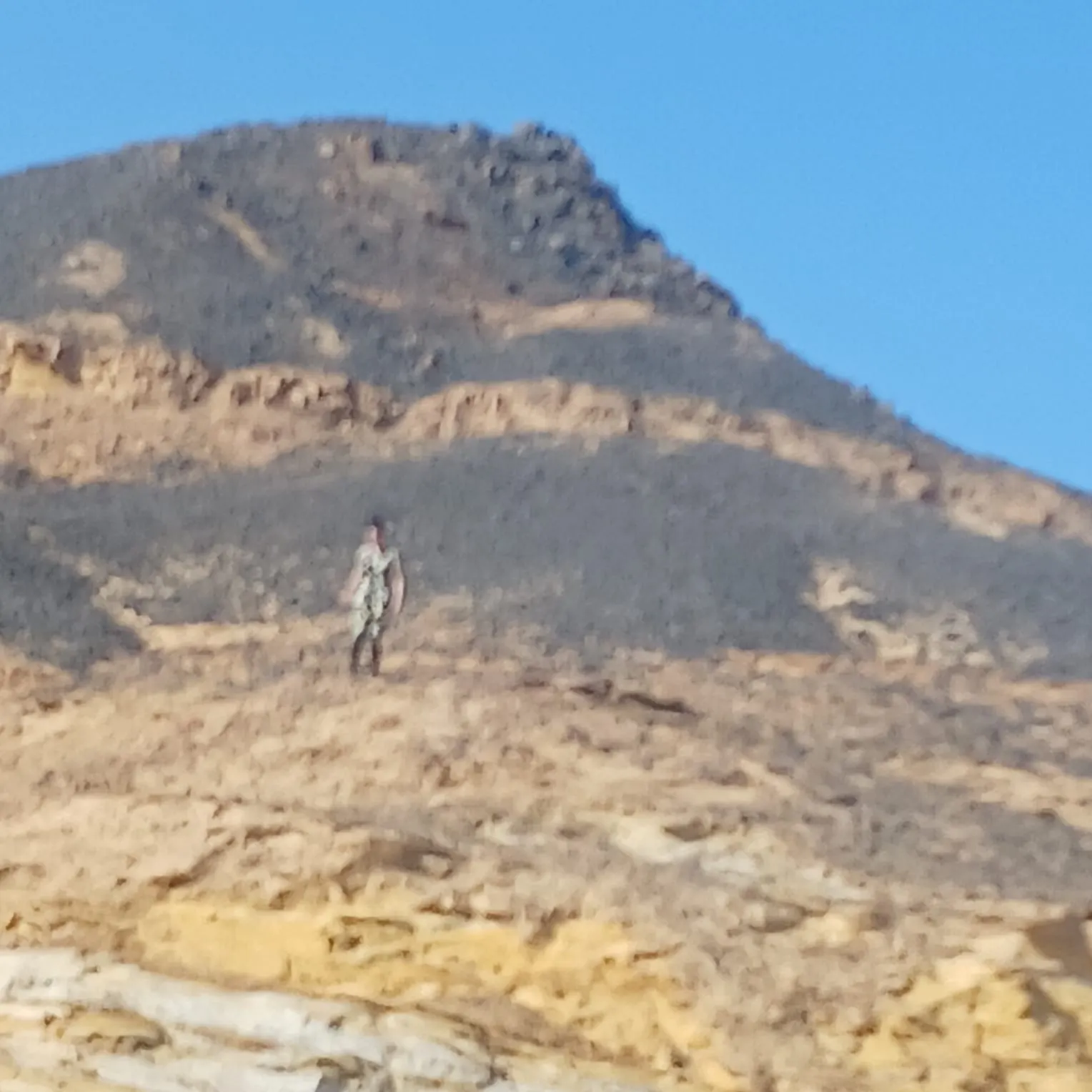
- Climb a cone-shaped hill, about 15 minutes up loose stone, for a 360-degree view.
- Walk along the ridge to see the dark cap rock close up.
- Look for patterns: lines of black stones running down the orange slopes like spilled ink.
- Photograph the contrast between the dark hills and the golden sand.
On a three-day trip you can also camp in the Black Desert on the first night, which is much quieter than the main White Desert camping areas and has excellent stars.
Why it looks volcanic
Short answer: The hills are erosional, not volcanoes: hard dark caps of iron-rich quartzite and dolerite broke up and scattered over softer sandstone slopes.
The Black Desert sits on the southern edge of the Bahariya depression. Its hills are made of softer sandstones and clays, capped by harder dark layers: iron-rich quartzite and, in places, dolerite, a dark volcanic rock that intruded as molten rock millions of years ago. As wind and occasional water wore away the soft rock, the hard caps broke up and their fragments slid and rolled down the slopes, coating them in black.
The result looks like a field of small volcanoes, but they are erosional hills, not volcanic cones. A few dark hills around Bahariya do contain genuine volcanic rock, which adds to the confusion.
The White Desert, 90 km on, is different rock altogether: chalk and limestone laid down on the floor of a shallow sea, full of the shells of tiny creatures. When the sea retreated, sand-laden wind sculpted the soft chalk into mushrooms and towers, cutting fastest near the ground. See why it's called the White Desert.
From black to white in two hours
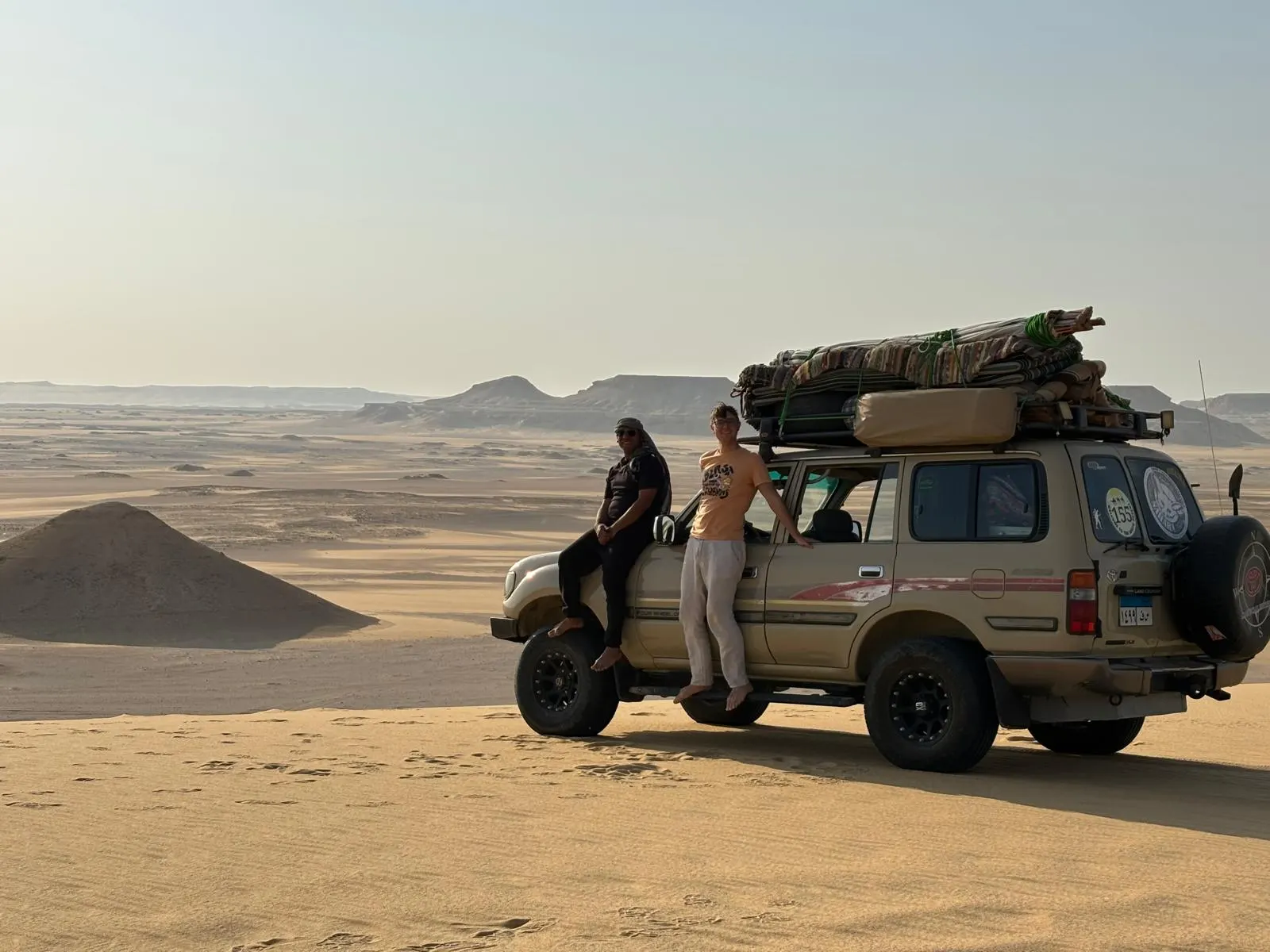
Short answer: Driving south from Bawiti you pass from black hills to crystal ridge to white chalk in about two hours, like turning the pages of a geology book.
After the Black Desert come the quartz ridge of Crystal Mountain, the pale towers of Agabat and finally the chalk of the White Desert. For the full route, stops and timings, see the Black and White Desert tour.
Practical details
Short answer: About 40 km from Bawiti, 30–60 minutes on site, an easy short climb, no facilities and no separate fee.
| Distance from Bawiti | about 40 km |
| Distance from Cairo | about 410 km |
| Distance to the White Desert formations | about 90 km |
| Time to spend | 30–60 minutes |
| Typical arrival on an overnight trip | Around 13:00 on day one |
| Best light | Late afternoon |
| Difficulty | Easy, short steep climb |
| Fee | No separate fee; same permit as the White Desert |
| Facilities | None; toilets in Bawiti |
Mistakes to avoid
Short answer: Don't climb in sandals, don't go at midday in summer, don't linger so long you miss the White Desert sunset, and don't take stones home.
- Climbing in sandals: the dark stones are sharp and loose.
- Visiting at midday in summer: the black stone absorbs heat and the hills are scorching.
- Staying too long on a one-night trip: what catches people out is arriving at the White Desert with the sun already low. We keep an eye on the clock for you.
- Taking stones as souvenirs: it's part of a protected landscape and checkpoints can search bags.
Checked November 2026: timings and conditions
Short answer: On a trip from Cairo you usually reach the Black Desert in the early or mid afternoon of day one. In winter the hill is pleasant all afternoon, but from May to September the stones can be too hot to touch by midday.
| Month | Typical afternoon temperature | Best time to climb | White Desert at night |
|---|---|---|---|
| December–February | 20–22°C | Any time, late afternoon best for light | 4–7°C, close to 0°C on still nights |
| March–April | 25–31°C | Before 11:00 or after 15:00 | 9–14°C |
| May–September | 34–38°C | Early morning or the last hour before sunset | 18–22°C |
| October–November | 25–30°C | Afternoon | 10–16°C |
These are the Bahariya and Farafra normals; both deserts share the same climate, but the black stone itself gets much hotter than the air. In spring the khamsin wind can blow dust across the plain and spoil the view for a day or two. See sandstorms and wind and weather and night temperatures.
Camping in the Black Desert
Short answer: Camping here is quiet, sheltered and dark, a good first night on a three-day trip; it is not a substitute for a night among the white chalk.
We camp in the Black Desert for two reasons. On three-day trips it breaks the journey and gives you a morning climb in soft light. And, now and then, a checkpoint asks groups not to continue to the White Desert that evening. When that happens we tell you straight away, explain why, and wherever we can we get you among the chalk the next day. If a checkpoint changes your route, ask us what that means for your trip. Read where we camp.
At night the Black Desert is very dark. The stones hold the day's warmth for an hour or two after sunset, which is welcome in winter.
Our advice
Short answer: Give the Black Desert one good climb and 45 minutes, wear closed shoes, carry water, and save your energy for sunset in the White Desert.
- One hill is enough. The view from the classic viewpoint is the best you will get.
- Use the zigzag path. Going straight up the loose stones is tiring and slippery.
- Hold back on the way down. Most slips happen descending. Tell our guide if you are unsure on your feet and they can walk down with you.
- Bring a scarf or buff if it is windy; the fine sand stings.
- Photograph from the top looking south, where the cones line up toward the horizon.
- Want more time here? The fix is a three-day trip, with a longer climb, a morning visit or a night among the black hills, not a longer first stop on the overnight trip. Message us on WhatsApp with "Black Desert".
For older travellers or anyone with bad knees, there are good views from the base too; see older travellers and accessibility.
Where it is
Schematic map, not to scale: positions are approximate, and the desert sites spread over many kilometres. The road runs about 180 km from Bawiti to Farafra; shaded areas show roughly where the black hills and the white chalk are.
Questions people ask
Is the Black Desert volcanic?+
Partly. The dark cover is a mix of iron-rich quartzite and dolerite, a dark igneous rock, broken into pieces and spread over the slopes as the softer layers beneath wore away. Some hills are capped with harder dark rock, which gives them their cone and table shapes.
What's the difference between the White and Black Desert?+
Different rock and a different role on the trip. The Black Desert is orange sand and hills capped with dark iron-rich quartzite and dolerite, a 30–60 minute stop. The White Desert is chalk from an ancient sea floor, carved by wind into mushrooms and towers, where you watch sunset, camp and wake for sunrise.
Which is better, the White or Black Desert?+
The White Desert is the star and where you camp, with its chalk formations, sunset and night sky. The Black Desert is a fascinating hour on the way, about 40 km south of Bawiti. You don't have to choose; every standard trip visits both on the same road.
How far apart are the Black Desert and the White Desert?+
About 90 km. The Black Desert starts roughly 40 km south of Bawiti, and the main White Desert formations are around 130 km south of Bawiti, so the drive between them takes about an hour and a half with stops at Crystal Mountain and Agabat.
Can you camp in the Black Desert?+
Yes. Some trips camp here on the first night, especially on three-day routes, and occasionally a checkpoint asks groups to camp here instead of the White Desert. It is less striking at night than the chalk, but quieter and well sheltered.
How long do you spend in the Black Desert?+
Usually 30 to 60 minutes on a standard trip: enough to climb one hill and take photographs. On three-day trips we come back in the morning light, and some groups camp there.
Is the Black Desert inside White Desert National Park?+
No. The Black Desert lies north of the White Desert protected area, closer to Bahariya, but it is visited on the same permit and route and has no separate entry fee. Treat it as protected anyway and leave the stones where they are.
How hard is the climb in the Black Desert?+
Easy for most people. The usual hill takes about 15 minutes up a slope of loose stones, with a short steep section near the top. Wear closed shoes and bring water. From April to October, avoid midday, when the black stone gets very hot.
Where is the Black Desert?+
About 40 km south of Bawiti in Bahariya Oasis, along the main road to Farafra, and about 410 km from Cairo. It is the first big stop after you switch to the 4x4, around 30–40 minutes' drive from town.
Go with us
Trips that include this

2 days, 1 night
White Desert overnight camping trip from Cairo (2 days, 1 night)About US$185 to 230 shared · US$360 to 460 private, per person
Check dates
3 days, 2 nights
3-day White Desert tour: Bahariya, the White Desert and two nights outAbout US$495 to 660 per person for two travellers, private
Check dates