
The short answer
Agabat is a valley at the northern edge of the White Desert, about 1.5 hours' drive south of Bawiti, where tall chalk and limestone towers rise out of steep, smooth sand slopes. Its name refers to the difficult passes that once slowed camel caravans. Today it's one of the best photo stops on the route and where most trips let you run or slide down the dunes.
Ask us on WhatsAppWhat it's like
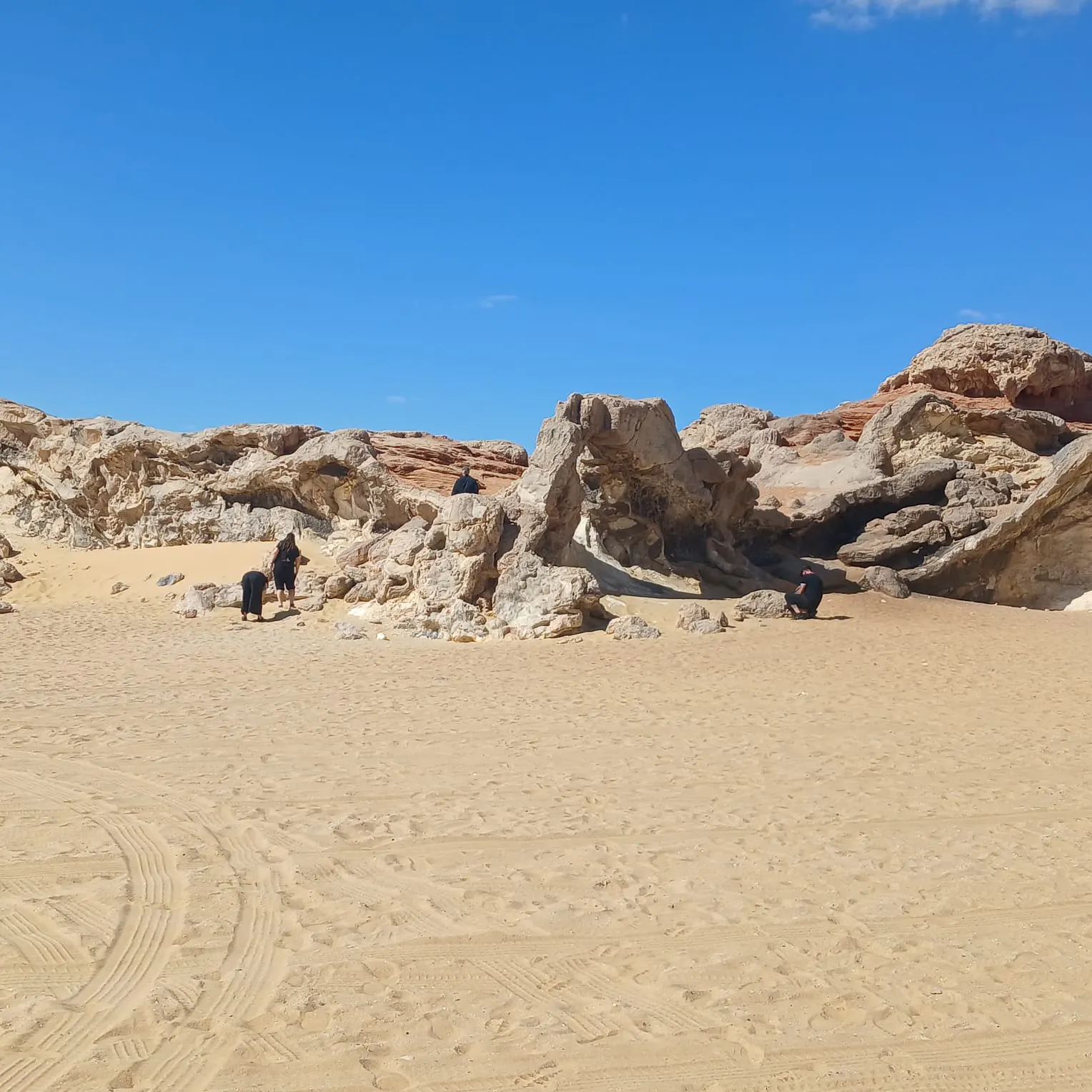
Short answer: Agabat is a valley of pale sand ramps banked against tall rock towers, a sudden change of colour after the dark Black Desert.
The tops of the cliffs stay dark against the sky while the sand below them is yellow-white. The 4x4 usually stops on a ridge above the valley so you can look down, then drives into it. It's often the moment when guests go quiet for the first time on the trip. Up to here the scenery has been impressive; from here on it starts to look like another planet.
Where exactly is Agabat?
Short answer: Agabat is just off the Bahariya–Farafra road at the northern edge of White Desert National Park, about 20 km and 20 minutes south of Crystal Mountain.
Agabat sits at the northern edge of the White Desert protected area, where the road from Bawiti, Bahariya Oasis descends from the plateau into the Farafra depression. Just off the main road, the valley opens up below you. It's the gateway between the darker landscapes of the north and the white world to the south. See the map and distances for how it fits on the route.
The park covers about 3,133.5 km² of New Valley Governorate under Prime Minister's Decree No. 1220 of 2002, according to the EEAA protectorate table. From Cairo to Bawiti is about 370 km and 4.5–5 hours by car; Agabat is then roughly 120 km further south.
The name
Short answer: Agabat means roughly "obstacles" or "difficult passes", a name from the caravan era.
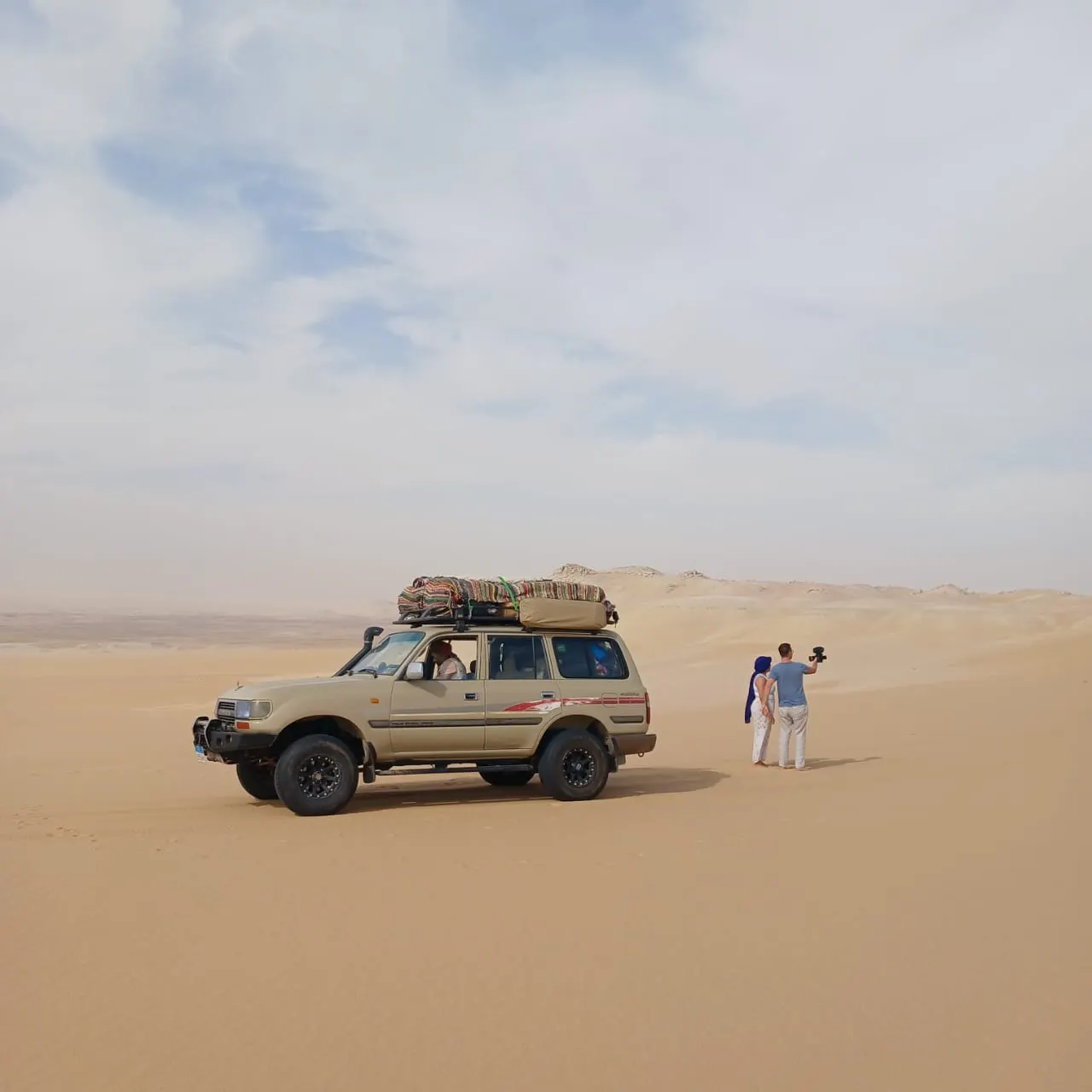
The name dates from the caravan era, when the steep descent and soft sand made this section hard going for camels and, later, early motor cars. Today it's the place where the off-road part of a White Desert trip begins. Our drivers still talk about which ramp is "easy" and which isn't, so the name has kept its meaning.
Agabat is a local spelling of the Arabic 'aqabat, a plural of 'aqaba. The Wiktionary entry for عقبة (checked 19 November 2026) gives two meanings for the word: an obstacle or hurdle, and a pass or steep mountain road. Both fit the place.
How the valley formed
Short answer: The road drops off a limestone plateau through eroded cliffs into the chalk; sand lies banked against the foot of the cliffs, and wind has worn the towers.
Agabat is a step in the landscape. To the north is the limestone plateau you cross after Crystal Mountain. To the south is the softer chalk of the White Desert. The cliffs and towers at Agabat are limestones from the Late Cretaceous to early Tertiary, laid down in shallow seas. The White Desert chalk beyond is Late Cretaceous, roughly 70–80 million years old, from a warm sea full of plankton. Our geology guide covers the full sequence.
The shapes are far younger than the rock. The prevailing wind here blows from the north and north-west, according to our geology guide. Wind-blown sand wears the base of the rock, which is why many towers are narrower at the bottom than the top. That is a preview of the mushroom shapes further south.
What to see and do
Short answer: Look down from the overlook, drive or run the dunes, and explore the first wind-carved rock shapes.
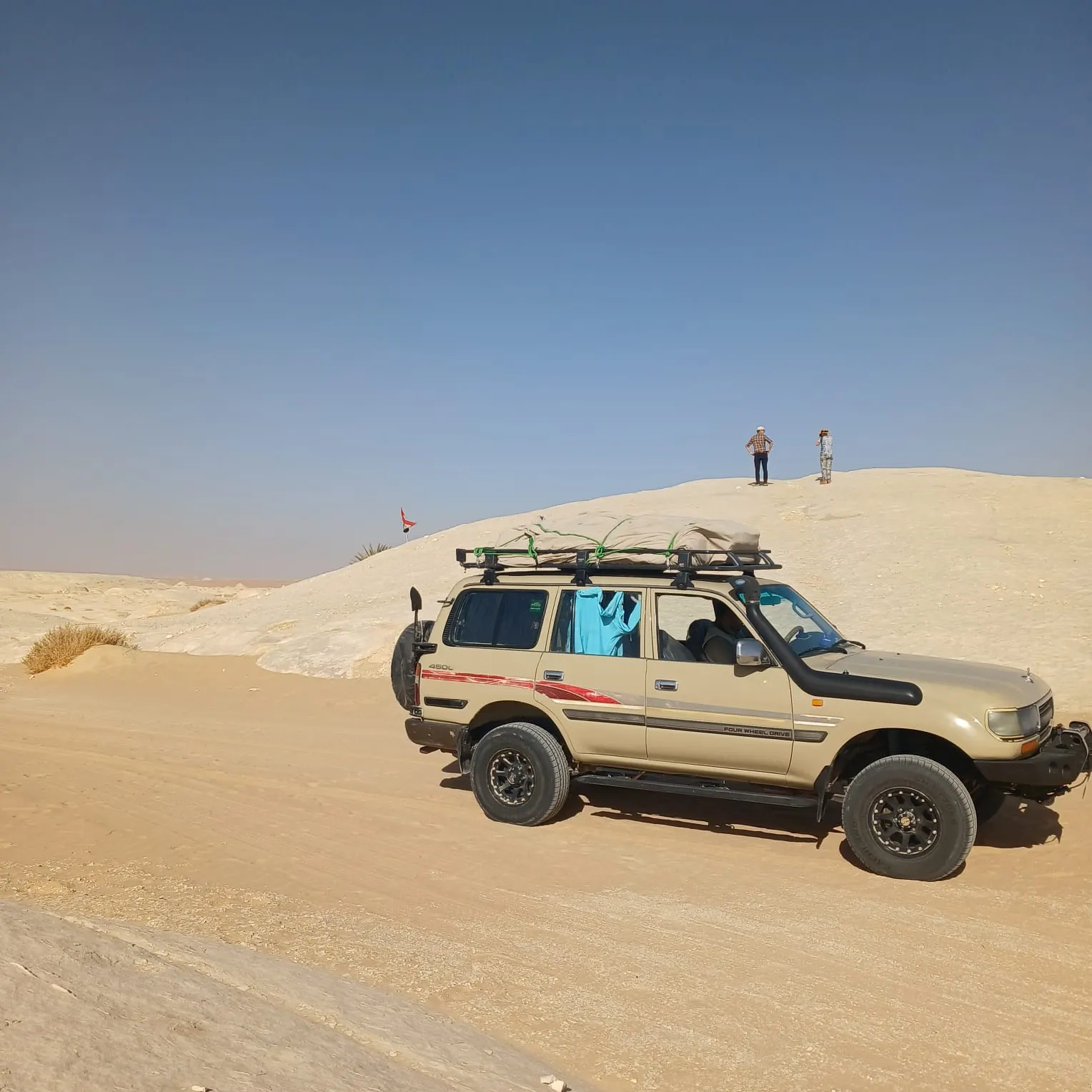
- The overlook: most drivers stop on a ridge above the valley so you can look down over the towers and sand. It's the classic photograph.
- Running the dunes: the slopes are steep and soft, perfect for running down, rolling or sandboarding. Our boards are free.
- Dune driving: the 4x4s take the slopes on the way into the valley; see 4x4 dune driving.
- Rock shapes: towers, overhangs and the first wind-carved formations, a preview of what's coming.
- Rock shelters: shallow overhangs in the cliffs give shade for a tea stop.
Sandboarding and running the slopes
Short answer: Expect two to five runs in a 30–60 minute stop; sit down for the first one, and pick a slope with a long flat run-out and no rocks at the bottom.
Free sandboards at Agabat are included on the 2-day and 3-day trips from Cairo. On other trips, ask us whether boards come along. You don't need experience. Most people ride sitting or lying down first, then try standing sideways like a snowboard. Children can ride sitting down, like a sled, with an adult waiting at the bottom.
The hard part is the walk back up. Soft sand gives way under every step, so two to five runs is plenty for most people. A few simple rules keep it fun:
- Choose a slope with a long, flat run-out and stay well away from rocks at the bottom.
- Go one at a time, and wait until the last rider is clear.
- Drink water between climbs, even in winter.
More detail is on our sandboarding page.
When to go
Short answer: Late afternoon, roughly one to two hours before sunset, when the shadows are long and the sand is cooler.
Late afternoon is best, with long shadows across the sand. On a two-day trip you usually pass here an hour or two before sunset, on your way to camp. In winter that means arriving around 3:30–4 pm; in June and July, on summer time, closer to 6:45 pm. At midday the light is flat and the sand is hot enough in May to September to make running the dunes unpleasant.
How each season feels at Agabat, using the day highs and sunset times on our weather and sunrise and sunset pages:
| Season | Typical day high | Sunset (roughly) | What it means at Agabat |
|---|---|---|---|
| December–February | 20–22°C | about 17:15–18:00 | Comfortable for running the slopes; sunset comes early, so a long lunch in Bawiti costs you light |
| March–April | 26–32°C | about 18:15–18:30 | Pleasant, but spring khamaseen winds can bring dust and blowing sand |
| May–September | 35–38°C | about 19:15–20:05 | Sand is very hot at midday; come in the last two hours before sunset and keep the stop short |
| October–November | 26–31°C | about 18:40 in October, 17:15 in November | Warm afternoons, clear air and good light |
Egypt has used summer time (UTC+3) in recent years from late April to late October, which is why summer sunsets are so late. In the cool months, carry a fleece in the car: once the sun drops behind the cliffs, the valley floor cools quickly.
Driving in
Short answer: Agabat is where the off-road part of the trip properly begins; tell your driver if you'd like it gentle.
Our drivers often take the sand slopes with some enthusiasm, because that is part of the fun for most guests. If you would prefer a gentler ride, say so and they'll pick a slower line. Wear your seat belt, keep cameras in a bag on the steep sections, and hold on to the grab handle rather than the door.
If you get carsick, sit in the front, look at the horizon, keep lunch in Bawiti light and take a motion-sickness tablet beforehand. From Agabat it is 10 to 20 km off-road into the chalk formations, which takes 20 to 40 minutes.
Agabat on each of our trips
Short answer: Every trip south of Bawiti passes Agabat, but how long you get depends on the trip: a short look on the day trip, a proper stop with boards on the overnight and three-day trips.
| Trip | When you reach Agabat | What you get there |
|---|---|---|
| Day trip from Cairo | around 12:00 | A short stop, then on into the chalk; midday light |
| Overnight camping from Cairo | mid-afternoon (about 14:45 on the sample timetable) | Overlook, sand slopes, free sandboards, then camp |
| Three days: Bahariya, White Desert, Farafra | mid-morning of day 2 (about 10:45) | Morning light and boards; ask us for a longer stop |
| Family private trip | day 2 | Dunes to run down at a child's pace |
| Eclipse 2027 camp | late afternoon, after a rest through the heat in Bawiti | A short stop on the way to the formations for sunset |
On a private trip the timing is yours. If Agabat matters to you, tell us when you book and we will plan the day around it.
Agabat as a camp spot
Short answer: We camp near Agabat when it's busier further south or when checkpoint rules move the camp, and it's a fine place to wake up.
Some nights we camp in the Agabat area, especially when the main White Desert spots are crowded or when the police at the checkpoint ask groups to stay further north. It's a beautiful place to wake up, with the cliffs catching the first light. If you'd like to camp here rather than the Old White Desert, ask; the trade-off is fewer of the classic mushroom formations at sunset. On a private trip we pick a spot away from other groups, and we check a light-pollution map to find the darkest sky. If the plan does change on the day, we'll explain why. More on this in where we camp.
How Agabat compares with the other stops
Short answer: Agabat is the stop for movement and big views; the Old White Desert is the stop for the famous shapes. Don't trade one for the other if you can avoid it.
| Stop | Best for | Time usually spent | Honest trade-off |
|---|---|---|---|
| Black Desert | A short climb and a wide view over dark-capped hills | 30–45 minutes | Little shade; the climb is steep near the top |
| Crystal Mountain | A quick geology stop and the small arch | 20–30 minutes | Most large crystals have gone; a low ridge, not a mountain |
| Agabat | Sand slopes, sandboarding, the first towers | 30–60 minutes | Fewer chalk shapes; the bumpiest drive of the day |
| Old and New White Desert | Chalk towers, mushrooms, sunset and camp | The rest of the day and the night | Busiest at sunset, especially around the Mushroom and Chicken |
If you only have a day, Agabat will be short. That is the main reason we suggest at least one night: see day trip or overnight.
Timing
Short answer: Agabat is roughly 120 km south of Bawiti, about 1.5 hours with stops at the Black Desert and Crystal Mountain, and a short off-road drive from the first chalk formations. Plan 30–60 minutes there on a two-day trip; longer on a private one.
| From Bawiti | about 1.5 hours with stops |
| From Crystal Mountain | about 20 km, 20 minutes |
| To the first chalk formations | about 15–30 minutes, off-road; longer to the Old White Desert |
| Time to spend | 30–60 minutes |
| Best light | Late afternoon |
Agabat and the 2027 eclipse
Short answer: Agabat is inside the path of totality for the 2 August 2027 eclipse, with about 4 minutes 38 seconds of totality, shorter than Bawiti or the Black Desert.
Totality lasts 6 minutes 24 seconds in the northern Black Desert, close to the centre line, and 2 minutes 5 seconds at the Mushroom and Chicken in the White Desert, according to timeanddate's calculations for those points. Bawiti gets 6 minutes 19 seconds, with the peak around 12:53 local time.
Agabat sits between the two. At the point we use (27.50°N, 28.31°E), timeanddate gives 4 minutes 38 seconds of totality, from 12:51:11 to 12:55:49. That is a fair compromise if you want towers and sand in the frame and still more than four minutes of darkness. Expect a midday temperature near 37°C in early August, with little shade except the cliff overhangs. For the longest totality we watch from the Black Desert or near Bawiti. See the 2027 eclipse guide.
Park rules and the fee
Short answer: Agabat is inside the protected area, so stay on existing tracks, leave rocks and fossils where they are, and carry everything out.
The same rules apply here as in the rest of White Desert National Park. Drivers keep to existing tracks. Don't climb on the towers or carve anything into them. Leave rocks, fossils and sand where they are. The park fee is a government protected-area fee for foreign visitors, collected through the operator and shown as its own line in your quote. There are no toilets or bins at Agabat, so use the facilities in Bawiti before you set off.
Our advice
Short answer: Keep cameras bagged, go up a ramp for the view, and drink often when running the dunes; we carry plenty of water in the car.
- Keep your camera in a bag when people are running down the dunes; sand flies.
- The sand is cooler and firmer in the late afternoon.
- Walk to the top of a ramp for a view back over the valley; it's harder work than it looks, so pace yourself.
- Change camera lenses inside the car, never out on the slopes. For more, see our photography guide.
- Take everything back to the car: the park has no bins, and the wind carries litter for kilometres.
Next stop
Short answer: From Agabat it's a short off-road drive into the New and Old White Desert, where the big chalk formations begin.
From Agabat it's a short drive into the New and Old White Desert, where the chalk formations begin. Before Agabat, most trips stop at Crystal Mountain.
Where it is
Schematic map, not to scale: positions are approximate, and the desert sites spread over many kilometres. The road runs about 180 km from Bawiti to Farafra; shaded areas show roughly where the black hills and the white chalk are.
Questions people ask
Can you sandboard at Agabat?+
Yes, the slopes are some of the best on the route for it, and our sandboards are free to use. Just tell us you'd like to try. Many people also simply run or roll down the dunes, which is half the fun and needs no kit.
What does Agabat mean?+
It's generally translated as "obstacles" or "difficult passes", a reminder of how hard the steep, sandy descent from the plateau was for camel caravans and, later, for the first motor cars crossing between Bahariya and Farafra.
Can you camp at Agabat?+
Yes, and we sometimes do, especially on busy nights or when checkpoint instructions limit where groups can camp. It's quieter, with dramatic cliffs catching the sunrise, but has fewer of the famous mushroom formations than the Old White Desert.
How long do you spend at Agabat?+
On a two-day trip, usually 30 to 60 minutes: the overlook, a drive down into the valley and time on the dunes. On a private trip we can stay longer or come back for sunrise if you're camping nearby.
Is Agabat inside White Desert National Park?+
Yes. Agabat sits at the northern edge of White Desert National Park, a protected area since 2002, so the same rules apply: no collecting rocks or fossils, no driving over the formations, and everything you bring in goes back out with you.
Is the drive into Agabat rough?+
It's the first proper off-road section, with soft sand and steep ramps. It feels exciting rather than dangerous with an experienced driver. If you suffer from motion sickness or back pain, tell your driver and he'll take a gentler line.
How long does the 2027 eclipse last at Agabat?+
About 4 minutes 38 seconds, from 12:51:11 to 12:55:49 local time on 2 August 2027, on timeanddate's figures for the point we use at Agabat. That is longer than the Mushroom and Chicken further south and shorter than Bawiti or the northern Black Desert.
Are there toilets at Agabat?+
No. There are no buildings, toilets or bins at Agabat. The last proper toilets on the way south are at the halfway rest house and in Bawiti, so use them before you get into the 4x4.
Is Agabat suitable for children and older travellers?+
Yes, with some care. Children love running and sliding down the soft slopes, but keep an eye on them near the drops at the top. The overlook needs very little walking. The drive in is the bumpiest part of the day, so ask for the front seat and a gentle line if you have back or neck trouble.
Do day trips stop at Agabat?+
Yes, but briefly. Our day trip from Cairo reaches Agabat around midday and stops for a short look before heading into the chalk. For time on the dunes and the late-afternoon light, an overnight trip works far better.
Go with us
Trips that include this

2 days, 1 night
White Desert overnight camping trip from Cairo (2 days, 1 night)About US$185 to 230 shared · US$360 to 460 private, per person
Check dates
3 days, 2 nights
3-day White Desert tour: Bahariya, the White Desert and two nights outAbout US$495 to 660 per person for two travellers, private
Check dates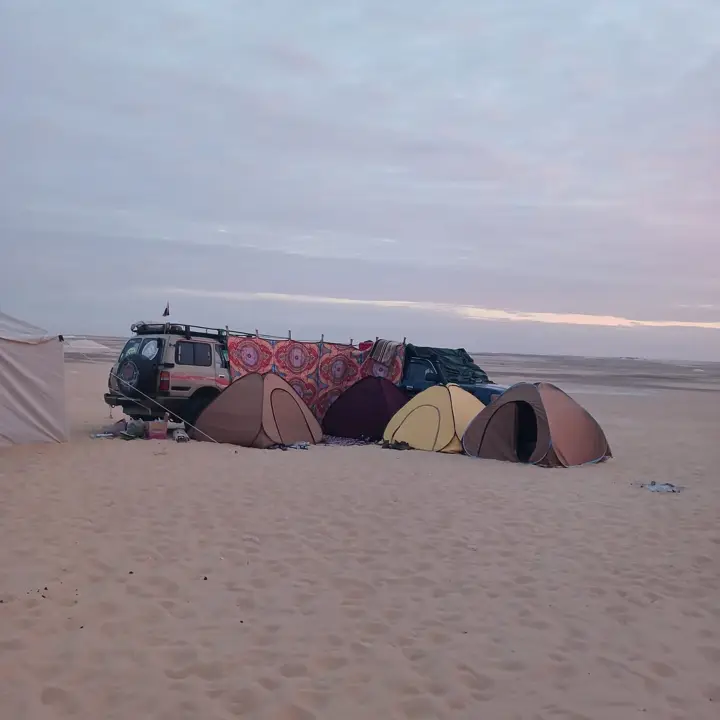
2 or 3 days
Private White Desert camping in comfortOn request (depends on group size and nights)
Check dates