
The short answer
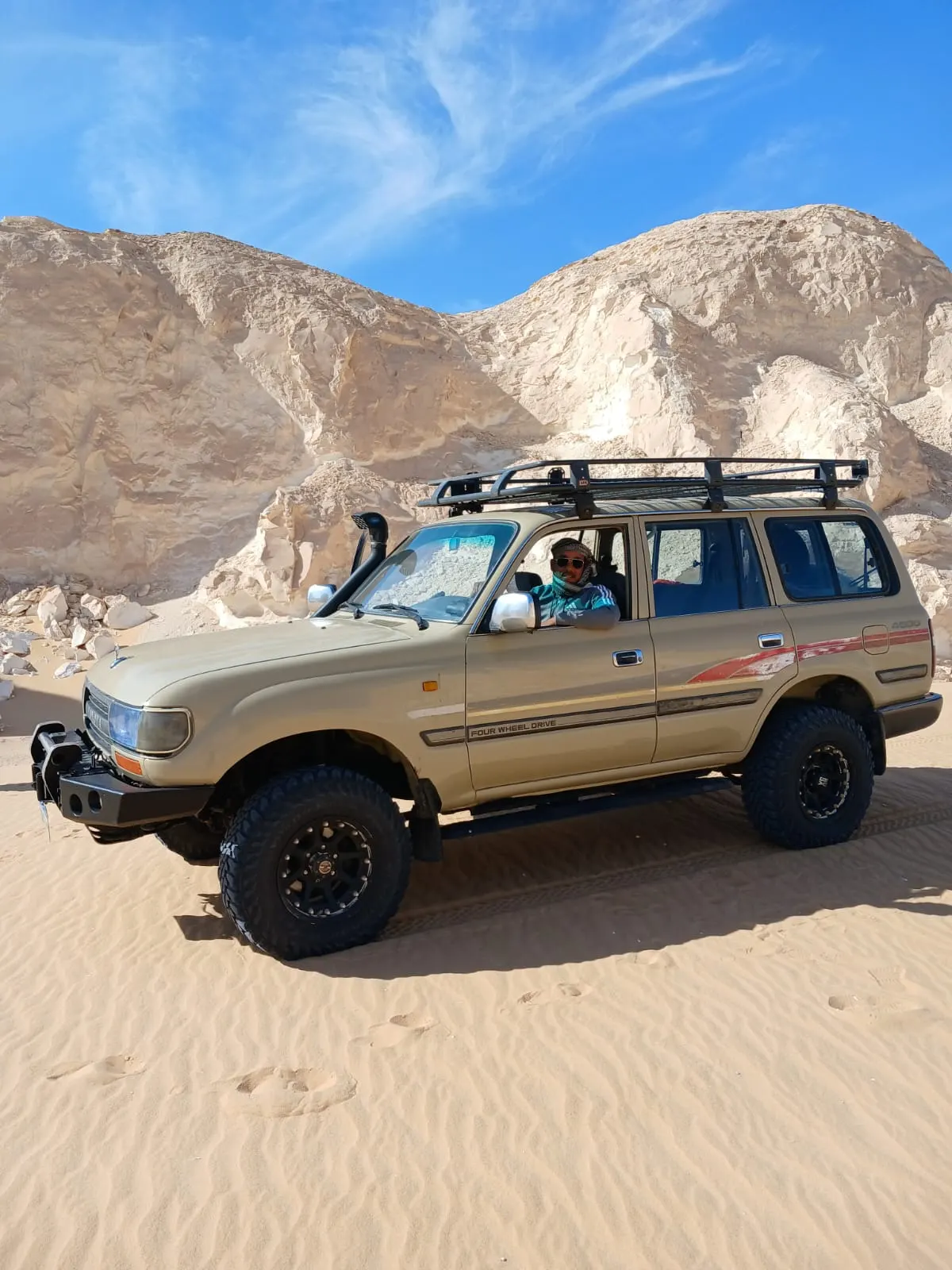
4x4 dune driving on a White Desert trip starts at the Agabat valley, about 120 km and 1.5 hours' drive south of Bawiti. On the 2-day trip from Cairo it is about 1–2 hours off-road in total, in a Toyota Land Cruiser, and it is included. Most school-age children enjoy it. For longer days on the dunes, take the 4-day Djara Cave trip.
Ask us on WhatsAppWhere it starts and how long it lasts
Short answer: The main off-road starts at Agabat, about 120 km south of Bawiti, roughly 1.5 hours' drive with the stops on the way.
Bawiti, the main town of Bahariya Oasis, is about 370 km from Cairo. From there the trip runs south on the Farafra road past the Black Desert and Crystal Mountain. At Agabat the track drops between rock towers and sand slopes, and from there it is 10 to 20 km off-road into the chalk formations.
A typical off-road afternoon, stage by stage
Short answer: Tarmac to the Black Desert and Crystal Mountain, short sandy detours, then the main off-road from Agabat into the chalk and on to camp.
| Stage | Surface | What it feels like |
|---|---|---|
| Bawiti to the Black Desert | Main road, short sandy detours | Smooth, with a few bumps off the road |
| Crystal Mountain | Roadside stop | A break to stretch your legs |
| Agabat, about 20 km south of Crystal Mountain | Sand slopes between rock towers | The first proper off-road; the bumpiest part of the day |
| Agabat into the chalk | Sand and gravel, 10 to 20 km | Gentle rolling for 20 to 40 minutes, with stops for photos |
| Camp | Among the formations | The day's driving ends |
The off-road part is broken up by stops: the overlook at Agabat, a run down the dunes, the Mushroom and Chicken.
How much off-road
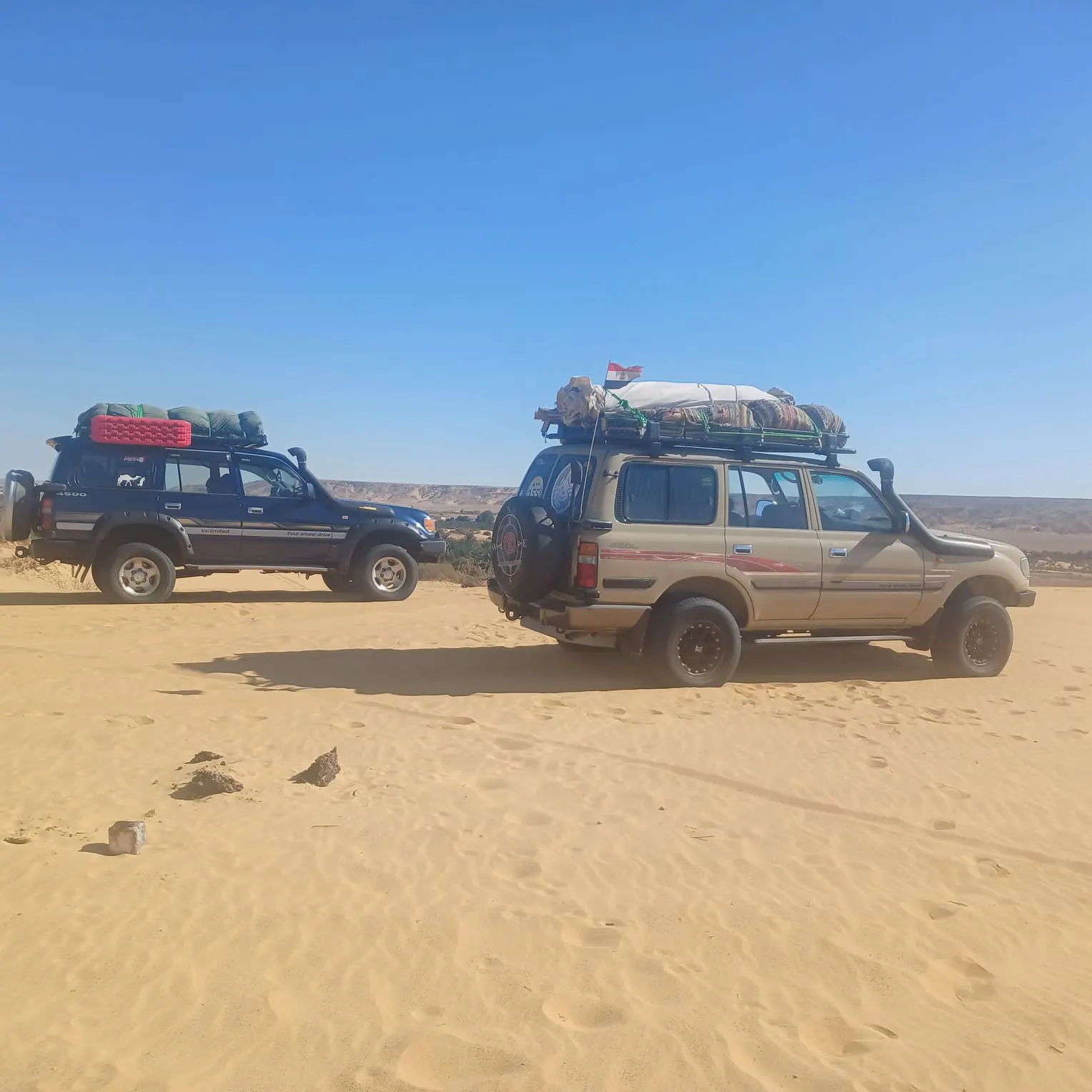
Short answer: About 1–2 hours of off-road in total on the overnight trip, a few hours on three days, and several hours a day on the Djara route.
| Trip | Off-road time |
|---|---|
| 2-day camping | About 1–2 hours in total |
| 3-day trip | A few hours, including Ain Khadra |
| Djara cave | Several hours a day over dunes |
Thrill or calm
Short answer: Drivers like a little drama on the dunes, which most guests love, but they will drive calmly if you ask.
Drivers like to show off a little on the dunes: steep drops, quick turns. Families, older travellers or anyone prone to motion sickness should simply ask for calm driving.
How a desert driver handles sand
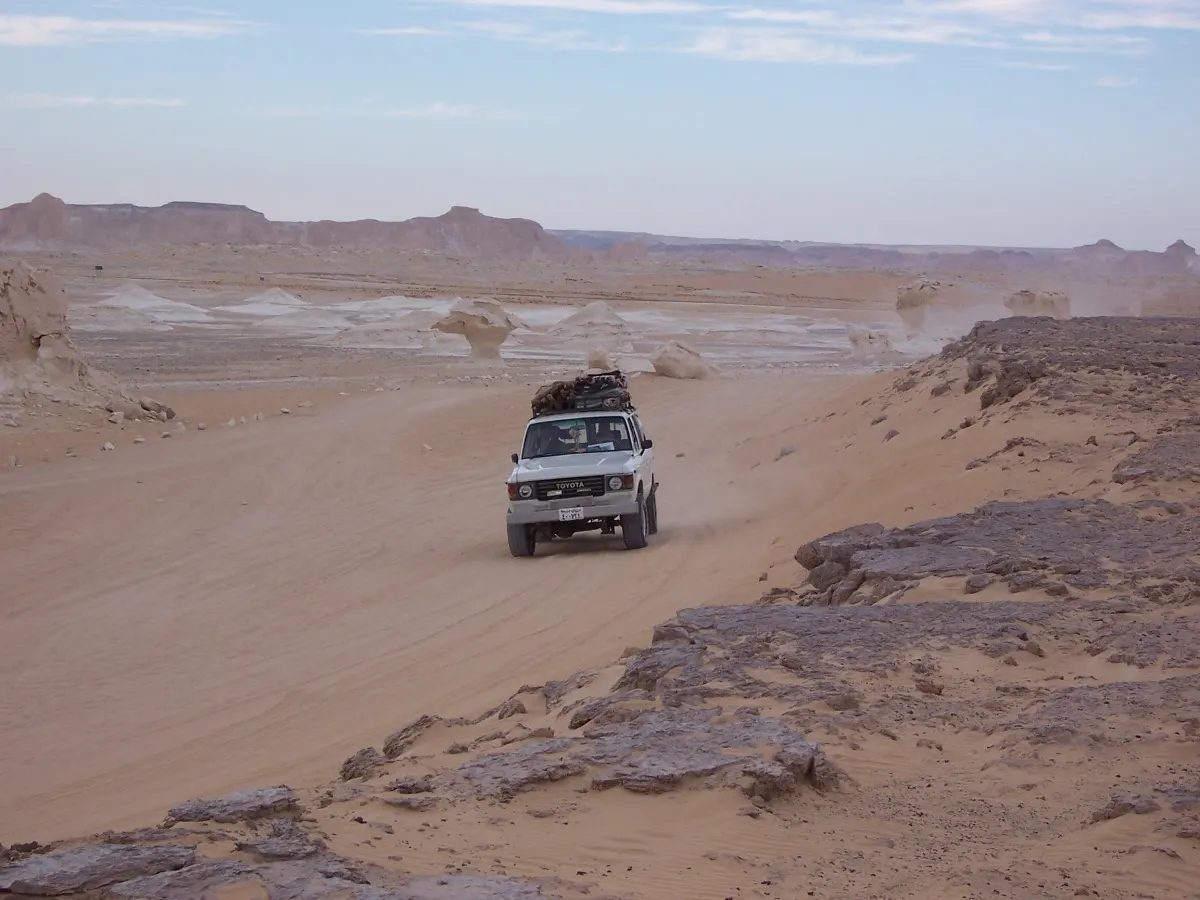
Short answer: Lower tyre pressure, steady momentum, the right gear and a lifetime of reading the ground.
Driving in the desert is a skill learned over years. Before leaving the tarmac, drivers let air out of the tyres to spread the vehicle's weight and grip the soft sand. On dunes, they keep momentum up hills and choose the line carefully over crests, where a steep slip face may lie hidden. On the chalk plains, they avoid the fragile crust and follow established tracks. If a vehicle gets stuck, the crew digs, uses sand ladders or tows with the second car. It's part of the adventure.
Reading a dune from the passenger seat
Short answer: Dunes have a gentle side and a steep side. Drivers keep momentum up the gentle side and ease off at the crest, where a steep drop may be hidden.
A dune has a gentle upwind side and a steeper downwind side, the slip face, as Wikipedia's dune article explains (checked 19 November 2026). Dry sand settles at about 34° at its steepest, according to Wikipedia's angle of repose article (checked 19 November 2026). From inside a car, that feels much steeper than it is.
That shape explains most of what the driver does:
- The slow approach to a crest. From the gentle side you cannot see what is beyond the top. A good driver eases off just before the crest, so the car does not fly over an unseen drop.
- No braking in soft sand. Wikivoyage's off-road driving guide (checked 19 November 2026) notes that braking builds small hills of sand in front of the tyres, which makes it hard to move off again. Drivers roll to a stop on firm or level ground instead.
- Letting the tyres down. The same guide says the right sand pressure depends on load and tyre type, anywhere from 2.0 bar down to 0.7 bar. Softer tyres make a wider footprint that floats on the sand. They go back up with the compressor before the tarmac.
Dune driving here or a Red Sea desert safari?
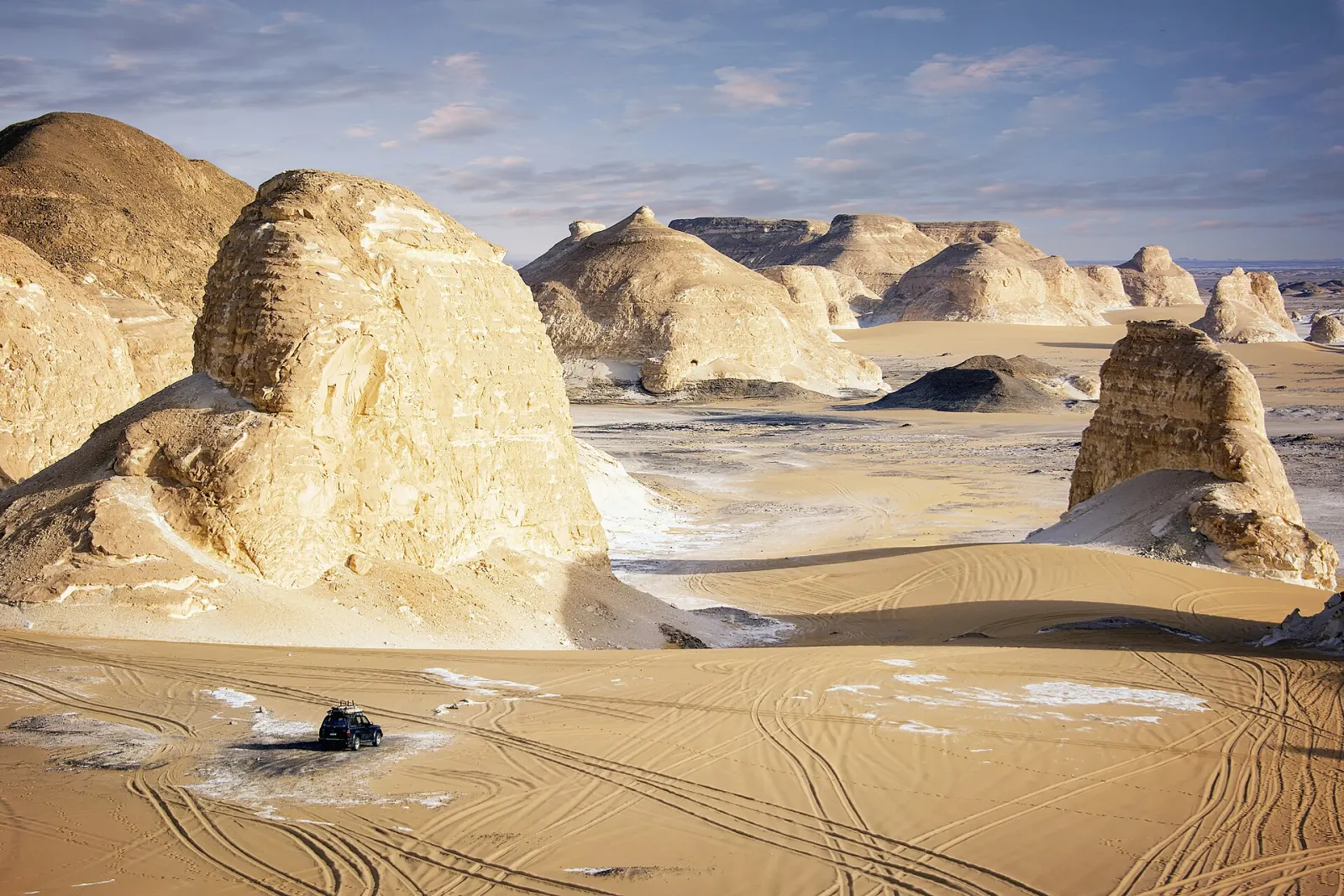
Short answer: Here, the dunes are part of a journey to the chalk, and you ride as a passenger. A coast safari is a few hours of quad biking near your hotel.
Some people expect something like the desert safaris sold in Hurghada or Sharm el-Sheikh. It is a different kind of trip.
| White Desert trip | Red Sea coast safari | |
|---|---|---|
| Purpose of the driving | Getting to the formations and camp | The ride is the activity |
| Who drives | A licensed driver; you ride as a passenger | You, on a quad or buggy |
| Length | 1–2 hours off-road on the 2-day trip | 3 to 6 hours in all |
| Ground | Sand slopes, chalk plains, black hills | Gravel and stony tracks |
| Night in the desert | Yes, on overnight trips | Back at your hotel by bedtime |
If adrenaline is the point, say so when you book and ask us whether a livelier dune session fits your route. Our guide to the White Desert versus a Hurghada desert safari compares the two in full.
Djara: what the long dune days are really like
Short answer: Several hours a day off-road, two 4x4s, tyres let down and the occasional dig-out. Rewarding, but tiring.
The route to the Djara cave crosses gravel plains and then belts of dunes, including the edge of the Abu Muharrik belt. It is the most prominent dune belt in Egypt's Western Desert, about 800 km long and up to about 50 km wide (Arabian Journal of Geosciences, 2022 (checked 19 November 2026)). You cross only a small part of it.
There is no road and no fixed track; the sand moves, and the route is read from landmarks. Expect stops to let tyres down, the occasional dig-out and short walks up dune ridges for the view. Two cars travel together so one can help the other. We don't push a dune crossing in strong wind; if the weather or a checkpoint says no, we change the order of days or the route.
If you like the idea but worry about long days in a car, the 3-day trip is a middle ground.
The vehicles
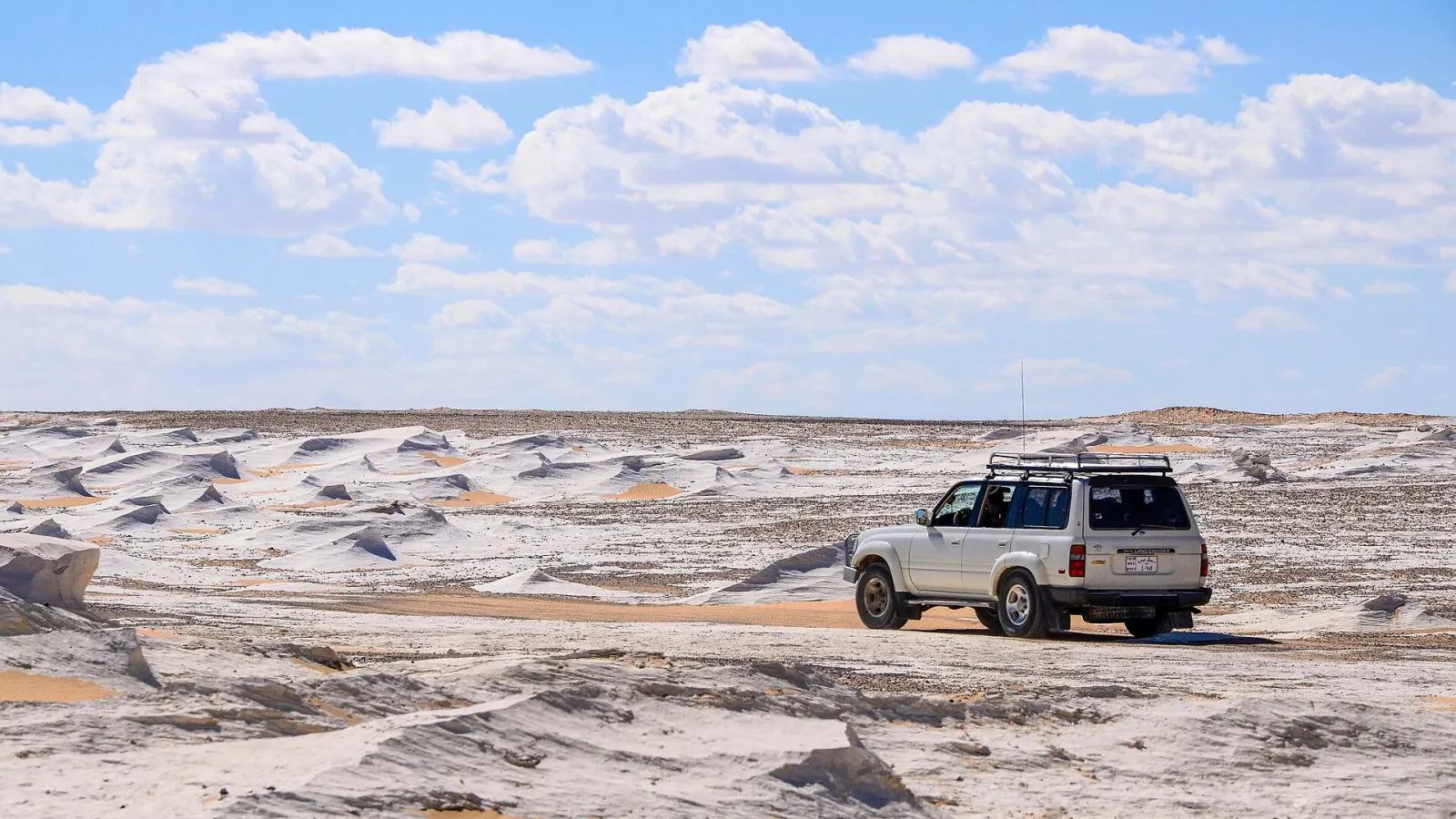
Short answer: Mostly Toyota Land Cruisers: tough, simple and easy to repair far from a garage.
Toyota began building the first Land Cruiser in 1951, and its reliability and long life have made it hugely popular, according to Wikipedia's Toyota Land Cruiser article (checked 19 November 2026). In the Western Desert, what matters most is that it is simple to repair far from a garage.
| Feature | Why it matters |
|---|---|
| Four-wheel drive with low range | Climbing soft sand and steep slopes |
| Roof rack | Carries camp kit, water and firewood |
| Spare tyres and tools | Punctures and repairs in the desert |
| Simple mechanics | Easy to fix far from a garage |
| Room inside for a small group | Camp kit rides on the roof, so the seats stay free; ask us how many guests share each car |
Who it suits
Short answer: Most people in normal health, including most school-age children, on the 2-day trip; the Djara route suits adventurous adults and older children.
| Who | Our view |
|---|---|
| School-age children | Fine on the 2-day trip; ask for calm driving. See the White Desert with kids |
| Young children | Choose the family trip, where the speed is low and the driver adapts |
| Bad back or motion sickness | Ask for gentle driving and the front seat; avoid the Djara route |
| Older travellers | Mention it when booking; the driver keeps it calm |
| Adventurous adults and older children | The Djara Cave trip, with several hours a day over dunes |
What the off-road sections feel like
Short answer: Mostly gentle rolling over sand and gravel, with a few bumpy stretches and the occasional exciting dune.
From Bawiti to the Black Desert and Crystal Mountain, you're mostly on the main road with short off-road detours. The main off-road driving starts around Agabat, where the track descends through sand between limestone towers. It continues among the formations of the White Desert. On some trips, drivers add a dune session with climbs, crests and slides. It's exciting, not dangerous, in the hands of a skilled driver. Tell your driver if you'd prefer a calm ride.
Can I drive myself?
Short answer: Not on our trips: the White Desert requires a licensed guide and driver for foreign visitors.
Foreign visitors need a permit and a licensed guide to enter the protected area, and self-drive desert trips aren't permitted. We arrange the permit and need your passport details one day before the trip. Experienced off-roaders who want more time on the dunes, as passengers, can ask us about longer trips such as Djara. See permits and safety.
Motion sickness and comfort
Short answer: Sit in front, look at the horizon, eat lightly and tell the driver to take it easy.
If you're prone to motion sickness, sit in the front seat, keep your eyes on the horizon, eat a light lunch and take tablets beforehand. Ask the driver for a smooth ride; a good one will adjust immediately. Older travellers and families with small children should mention it when booking.
Photos and filming from the car
Short answer: Keep a strap on your camera or phone inside the car; the best shots of a 4x4 on a dune are taken from outside it.
- Use a wrist or neck strap. A phone dropped on a slip face is hard to find in soft sand.
- Shoot from outside. A car on a dune looks best from the bottom of the slope. Ask us whether the driver can drop you there and drive the slope while you shoot. See photography in the White Desert.
Respecting the desert
Short answer: Good drivers stay on existing tracks among the formations and never drive on the fragile chalk crust.
Tyre tracks on chalk last for years, and careless driving has damaged parts of the park. White Desert National Park has been a protected area since 2002. The park fee is a government protected-area fee for foreign visitors, collected through the operator and shown as its own line in your quote. Responsible drivers follow existing tracks, keep away from formations and leave camps clean. See White Desert National Park.
What a well-run desert vehicle carries
Short answer: Spare tyres, a compressor, sand ladders, a shovel, a tow rope, plenty of water, a first-aid kit and a second car on remote routes.
| Item | Why |
|---|---|
| Two spare tyres and a compressor | Punctures, and re-inflating tyres before the tarmac |
| Sand ladders and shovel | Getting unstuck in soft sand |
| Tow strap | Pulling out with the second car |
| Plenty of drinking water, plus a reserve | Heat and delays |
| First-aid kit | Cuts, blisters, heat |
| A plan for calling for help | Phone signal is patchy south of Bawiti |
Before you book with anyone, ask what they carry. A good crew answers without hesitating. See how to choose an operator and our guide to phone signal and internet.
Our advice
Short answer: Say how you like to ride before you set off, wear your seat belt, keep cameras in a bag and enjoy the dunes.
- Tell the driver at the start whether you want excitement or calm; it is much easier than asking halfway down a dune.
- Wear your seat belt on every off-road section, front and back.
- Hold cameras and phones in a bag on your lap, not loose on the seat.
- If you would rather walk up a steep dune than ride it, ask; the driver can usually meet you at the top.
- If you are curious, ask the driver to explain tyre pressure and reading sand. Most love to talk about it.
Which trip includes it
Short answer: Dune driving is included on the trips below; for the most dune driving, take the 4-day Djara Cave trip.
| Trip | Dune driving |
|---|---|
| 2-day camping | Included: Agabat and the run into the chalk |
| 3-day trip | Included, with Ain Khadra and the New White Desert |
| White Desert and Djara | Included: two 4x4s over the dune belts |
Tell us if you want extra dune driving and we'll say what fits your route. Message us on WhatsApp with "dune driving". See the overnight trip and the Djara Cave trip.
Questions people ask
Is dune driving safe?+
With an experienced driver and a well-kept vehicle, yes. Wear your seat belt, keep loose items stowed, and travel with two cars on long off-road routes such as the Djara cave. Choose an operator whose drivers know the Bahariya tracks, and ask what recovery gear they carry.
Is it suitable if I have back problems?+
Ask for gentle driving and the front seat. The standard overnight route has only 1–2 hours of off-road in total, mostly gentle; the Djara route has several hours a day over dunes and is not a good choice for a bad back.
Can I drive the 4x4 myself in the White Desert?+
No. Foreign visitors need a permit arranged in advance and a licensed guide to enter the protected area, and self-drive desert trips are not allowed. Experienced off-roaders can talk to us about specialist expeditions with more time on the dunes as passengers.
What car do you use in the White Desert?+
Mostly Toyota Land Cruisers with four-wheel drive and low range, roof racks for the camp kit, spare tyres and recovery gear. They are simple to repair far from a garage, which matters more in the desert than air conditioning or leather seats.
Will I get car-sick off-road?+
Some people do on the bumpier stretches around Agabat. Sit in the front, look at the horizon, eat a light lunch in Bawiti and take a motion-sickness tablet beforehand if you are prone to it. Ask the driver to take it easy; a good driver will.
What happens if the 4x4 gets stuck in the sand?+
It happens in soft sand and is part of the adventure. The crew digs, lays sand ladders or, on remote routes such as Djara, tows with the second car. Step out if the crew asks you to, and keep clear of the tow strap.
Is dune driving an extra charge?+
No. On the 2-day, 3-day and Djara trips the off-road driving is part of the trip, not an add-on. If you want more time on the dunes than your route allows, ask us what fits and whether it changes the quote.
Can I do it if I am pregnant or recovering from an injury?+
Check with your doctor first. Off-road driving jolts, even when it is gentle. If you come, tell us when you book and ask us what a gentler version of your trip looks like. The Djara route, with several hours a day over dunes, is not a good choice.
Go with us
Trips that include this

2 days, 1 night
White Desert overnight camping trip from Cairo (2 days, 1 night)About US$185 to 230 shared · US$360 to 460 private, per person
Check dates
4 days, 3 nights
4-day White Desert and Djara cave tripAbout US$605 to 825 per person for two travellers, private
Check dates