
The short answer
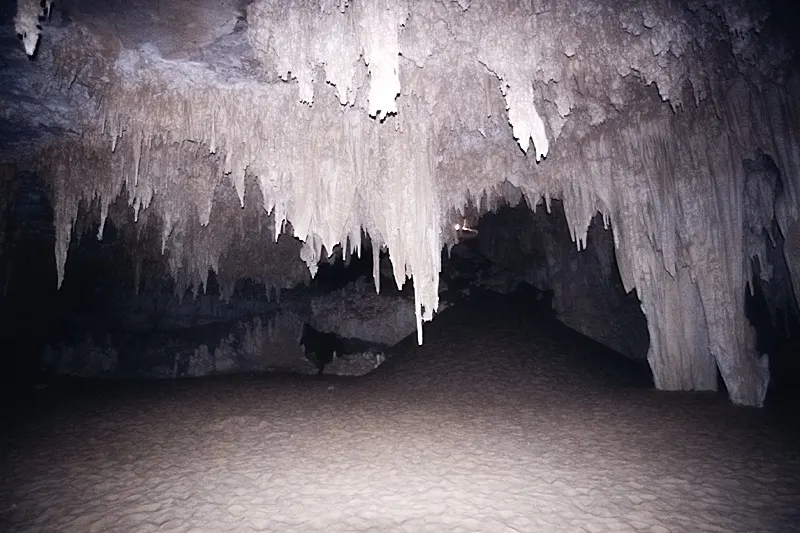
Djara is a limestone cave on the Abu Muharrik plateau, east of the White Desert, reached by most of a day of off-road driving over dune belts. Its chamber, about 30 m across, holds stalactites and flowstone from a wetter past, and its walls carry prehistoric engravings of gazelles and other animals. Plan four days from Cairo with two 4x4s.
Ask us on WhatsAppDjara is the trip we suggest to people who say "we've done the White Desert, what's next?". It adds a full crossing of empty desert, a cave you enter by torchlight and engravings left by people who lived here when the Sahara was green.
Djara at a glance
Short answer: A decorated limestone cave far off-road, east of the White Desert. It needs four days from Cairo, two 4x4s and a crew who know the route.
| Question | Answer |
|---|---|
| Where | The Abu Muharrik plateau, east of the White Desert and beyond the dune belt |
| How you get there | Off-road only, most of a day each way from the White Desert |
| Days from Cairo | Four, with three nights camping |
| Time at the cave | About two hours on our trip, 08:30 to 10:30 |
| Physical effort | Low: walking on sand and a short slope into the cave |
| Hardest part | Long, rolling days in a 4x4 and no facilities |
| Best months | October to April |
| Indicative price | About US$605–825 per person for two, private |
What's inside
Short answer: A chamber about 30 m long, 30 m wide and 7 m high, with stalactites, stalagmites and flowstone, and engravings of gazelles, other game and human figures.
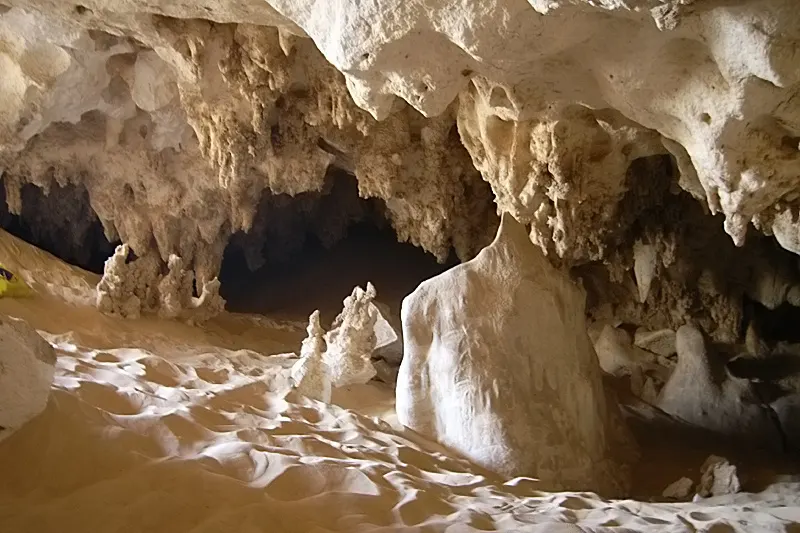
You enter down a short sloping passage into a chamber decorated with calcite formations. They grew when water dripped through the limestone in a much wetter climate. A geological study of four of the formations gave uranium-series ages between about 140,000 and 283,000 years, and found none from the Holocene, the last 11,500 years or so (Brook and others, Cave and Karst Science, 2002 (checked 19 November 2026)). The same study describes Djara as one of very few well-decorated caves in Egypt, with formations up to 6 m high. Torchlight brings out cream, gold and honey colours that photos rarely capture.
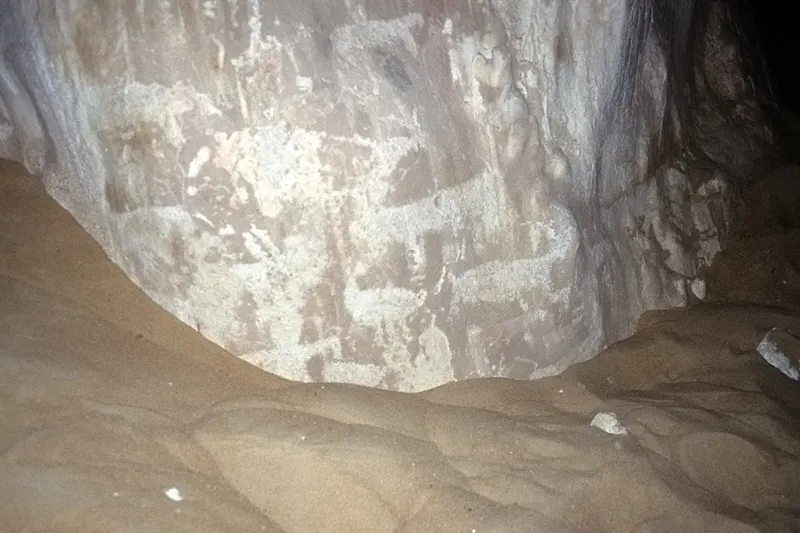
On the walls near the entrance and in the main hall are engravings of animals and people. Gazelles are the clearest, in a panel archaeologists call the hall of the gazelles, with what may be oryx beside them. The same panel, beside a decorated stalagmite, includes a pecked human figure. Around the cave, archaeologists have excavated hearths and stone tools from camps dated to roughly 8,600 to 6,000 years before present, when the Sahara was greener (University of Cologne ACACIA project (checked 19 November 2026)).
| Feature | What it is |
|---|---|
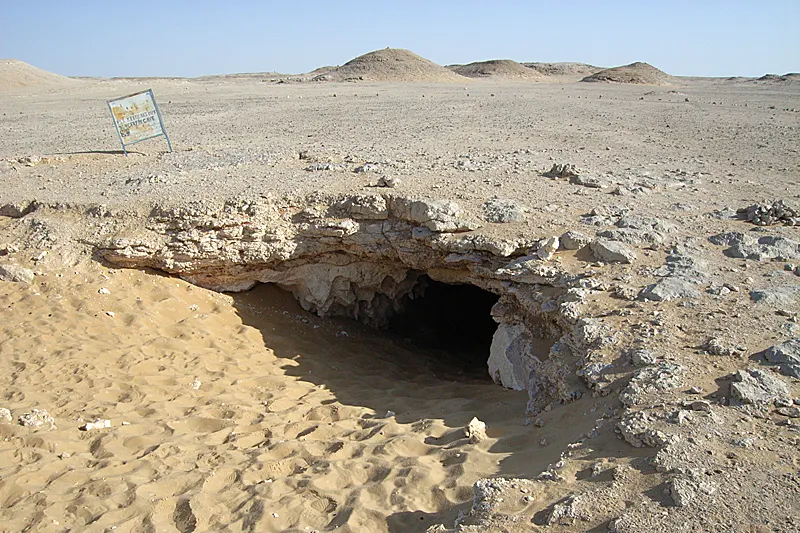
| Entrance | A sunken opening about 12 m by 5 m, often partly filled with sand |
| Main chamber | About 30 x 30 m and 7 m high: stalactites, stalagmites and flowstone |
| Rock art | Engraved gazelles, possible oryx, other game and human figures |
| Surroundings | Stone tools and prehistoric camp sites on the plateau |
How old is everything? A short timeline
Short answer: The formations are well over 100,000 years old. The engravings and camps belong to the last green Sahara, roughly 8,600 to 6,000 years ago. Outsiders only arrived in 1873.
It helps to keep two very different time scales apart. The cave's decoration is geological and far older than any human visitor. The art and the hearths are much younger and tell a story about people.
| When | What happened |
|---|---|
| About 283,000 to 140,000 years ago | The four dated calcite formations grow in wetter phases |
| About 11,500 to 6,500 years ago | A more humid period, though none of the dated formations grew then |
| About 8,600 to 6,000 years before present | Hunters camp around the cave; the engravings are linked to this phase |
| 24 December 1873 | Rohlfs' expedition reaches the cave |
| 1897 | Hugh Beadnell passes it while surveying Farafra |
| 1989 | Carlo Bergmann finds it again by camel |
| 1999 and 2000 | Cologne's ACACIA team surveys the rock art |
The first two rows come from Brook and others, 2002 (checked 19 November 2026); the camp dates from the ACACIA project (checked 19 November 2026). The honest point for visitors: no one can date the engravings directly. Linking them to the camps is the best reading of the evidence, not a certainty.
Discovery
Short answer: Gerhard Rohlfs' expedition reached the cave on Christmas Eve 1873; after a brief visit by a geologist in 1897 it was forgotten until Carlo Bergmann found it again in 1989.
The German explorer Gerhard Rohlfs led a large, well-supplied expedition across the Western Desert in 1873–74. It ran under the patronage of the Khedive Ismail, with about 100 camels and 90 men, and Karl Zittel went with him (Wikipedia: Friedrich Gerhard Rohlfs (checked 19 November 2026)). On Christmas Eve 1873, on the way from Assiut towards Farafra, a local guide led his team to Djara, and Rohlfs named it on the map he published in 1875. The geologist Hugh Beadnell came across it in 1897 while surveying Farafra; after that its location slipped out of record. The desert traveller Carlo Bergmann found it again in 1989, travelling alone by camel, and was the first to report the engravings. Cologne University's ACACIA project surveyed the art in 1999 and 2000 (Showcaves.com summary of the cave's history). Our guide to the desert explorers who mapped this region is coming soon.
Getting there
Short answer: Most of a day of off-road driving east across gravel plains and dune belts, with two 4x4s; best on a four-day private trip.
Djara lies in open desert, well away from any road. From the White Desert, the route crosses gravel plains and then belts of dunes, including the edge of the long Abu Muharrik dune belt. There's no track to follow; the sand moves and the route is read from landmarks. Expect stops to let tyres down, the occasional dig-out and short walks up dune ridges for the view.
The Abu Muharrik belt shapes the whole crossing. It is about 800 km long and up to about 50 km wide, running from the Bahariya depression south to the Sudan border (Arabian Journal of Geosciences, 2022 (checked 19 November 2026)). You cross only a small part of it, but that part sets the pace of day two.
| Plan | Days | Nights |
|---|---|---|
| White Desert and Djara | 4 | 3 camps: White Desert, open desert, back in the chalk |
| With the Great Sand Sea edge | 5 to 6 | More desert camps |
Our four-day White Desert and Djara trip follows the first plan. Day one is the usual drive from Cairo to the White Desert via Bawiti, about 370 km and 4.5–5 hours to Bawiti with a stop. Day two heads east into the dunes. Day three is the cave in the morning light, then back west. Day four is sunrise and the road home. See Cairo to Bahariya: the drive for the tarmac part.
Djara or a shorter White Desert trip?
Short answer: Choose Djara for remoteness, prehistory and proper dune driving. Choose a shorter trip if you have less time, are travelling with young children or want nights closer to the road.
| Overnight to three-day trip | Four days with Djara | |
|---|---|---|
| Time from Cairo | One to three days | Four days, three nights |
| Off-road driving | Short hops between formations | Two long days over dunes |
| Other groups | Classic sunset spots can be busy on holidays | Camps far from other groups |
| Facilities | Basic camp | Basic camp, further from help |
| Highlights | Chalk formations, Black Desert, Crystal Mountain | All of those, plus the cave and its engravings |
| Best for | First-timers, short stays, families | Repeat visitors, keen campers, photographers |
There's a trade-off. Djara adds many hours in the car for a morning at the cave. If the White Desert itself is what you came for, the three-day Bahariya, White Desert and Farafra trip gives you more time among the chalk and a hot spring. If you want the feeling of being properly far away, Djara delivers it. Still deciding on length? See how many days you need.
Safety on the route
Short answer: Two vehicles, extra fuel, water and spares, a driver who knows the route, and permits arranged in advance.
- Two 4x4s, so one can tow or carry everyone if the other has a problem.
- Extra fuel and plenty of water beyond what the planned route needs; we never run out of water.
- Spares and recovery kit: sand ladders, shovels, compressor, tyre repair.
- A driver who has done the route many times, not a first-timer with a GPS.
- No mobile signal for most of the route; ask us what communications we carry on your departure.
- Permits for foreign travellers, arranged in advance. We need your passport details one day before the trip; sending a copy when you book is easiest.
Checkpoints sometimes change what is allowed at short notice, and strong wind can make the dune crossing unwise. If either happens, we tell you and suggest a different order of days or another route around the White Desert and Farafra. Read 4x4 dune driving for what the dune days feel like from the back seat, and permits and safety for the rules on every trip.
At the cave: making the most of your time
Short answer: Arrive early while it's cool, let your eyes adjust, look for the engravings near the entrance first, and use a low, side-on torch beam.
Morning is the best time, while the air is still cool. Inside, give your eyes a few minutes to adjust before you switch on a strong beam.
- Start with the engravings. They're near the entrance and in the main hall. Ask your guide to point out the gazelle panel before you wander.
- Use raking light. Hold a torch low and to one side of a carving. The shadows in the cut lines make the animals stand out far better than a beam pointed straight at them.
- Then the formations. Shine the light through thin flowstone and stalactites to see the colours.
- Photography. A phone's night mode, or a camera resting on a small tripod or beanbag, works better than flash. Sand gets everywhere, so change lenses outside or not at all.
- Go in a few at a time. Fewer people means less dust and better light. Take turns if your group is large.
Visiting responsibly
Short answer: Bring a torch, don't touch the engravings or formations, and take nothing away, not even a flint.
Djara's art and formations are irreplaceable. Skin oils, chalk marks and even repeated breath in a closed space damage them. Use a torch rather than a flash, stay on the sandy floor, and never touch, wet or trace the engravings to make a better photo. Stone tools and other finds on the plateau must stay where they lie; moving them destroys the information archaeologists need.
Who it's for
Short answer: Travellers with four days who want true remoteness, prehistoric art and more off-road adventure than the standard trip.
If you've already seen the White Desert, or you want to go deeper on your first visit, Djara adds wilderness, history and long dune drives. Older children who enjoy adventure love it; for young children, our family private trip suits better. It isn't the right trip for anyone who dislikes long days in a 4x4, gets badly car-sick, or needs a proper bathroom; out here the facilities are a shovel and a rock, or a toilet tent, which we bring on request. A guide to longer deep-desert expeditions is coming soon.
When to go
Short answer: October to April; avoid May to September, when long off-road days in 35–38°C heat are hard on people and engines.
October, November, February and March are our favourite months: warm days, cool nights and good light in the cave mouth. December and January are fine by day but nights in open desert can drop close to 0°C. From May to September, average highs at Farafra run 35–38°C and we generally advise against the route; ask us if summer is your only option.
| Months | Days and nights | Our view for Djara |
|---|---|---|
| Oct–Nov | Warm days, mild nights | Ideal |
| Dec–Jan | Mild days, nights near 0°C in open desert | Good if you pack for cold |
| Feb–Mar | Warm days, cool nights | Ideal, though windy spells are possible |
| Apr | Getting warmer | Possible; start early each day |
| May–Sep | Highs of 35–38°C at Farafra | We generally advise against |
See weather and night temperatures and the best time to visit.
Our advice
Short answer: Bring a strong torch, a warm layer, closed shoes and motion-sickness tablets, and allow four full days.
- A strong head torch plus a spare; phone torches drain fast.
- Closed shoes with grip for the sloping entrance.
- A warm layer: the cave is cool, and desert nights are cold from November to March.
- Motion-sickness tablets if you're prone; dune driving rolls.
- A buff or scarf for dust, and a bag to keep your camera out of the sand.
- Patience: the dune stops are part of the trip.
The full list is on our packing list.
Checked November 2026: we recommend our Djara trip from October to April. It costs about US$605–825 per person for two (indicative), with two 4x4s, permits and protected-area fees included. Send us a WhatsApp message with "Djara" and your dates.
Questions people ask
Who discovered the Djara cave?+
The German explorer Gerhard Rohlfs' expedition reached it on 24 December 1873 while crossing from Assiut towards Farafra. The geologist Hugh Beadnell passed it in 1897, then outsiders lost track of it until the desert traveller Carlo Bergmann found it again by camel in 1989.
How old are the engravings?+
They are linked to the Holocene wet phase. Excavations around the cave give radiocarbon dates of roughly 8,600 to 6,000 years before present for the hunters who camped here, though the engravings themselves can't be dated directly. The calcite formations are far older; uranium-series dates on four of them range from about 140,000 to 283,000 years.
How long does it take to reach Djara from the White Desert?+
Most of a day off-road, with stops to lower tyre pressure, cross dune ridges and occasionally dig out. That's why our trip camps in open desert on the way and spends four days in total from Cairo.
Is Djara cave difficult to enter?+
Not physically. You walk down a short sloping passage, often half filled with sand, into the main chamber. You need a good torch, steady footing and closed shoes. There's no climbing or crawling, but the floor is uneven in places.
How much does a Djara trip cost?+
Our four-day White Desert and Djara trip is about US$605–825 per person for two travellers, as an indicative range. It includes two 4x4s, permits and protected-area fees, all meals and camping kit; sleeping bags are on request, so bring your own or ask us for one. Larger groups pay less per person.
Can I visit Djara on a day trip or from Bahariya alone?+
No. There's no road to the cave, and the round trip off-road is too long for a single day. Going with one vehicle is also unwise; we always send two 4x4s so that one can help the other.
How long do you spend inside the cave?+
Our four-day trip plans to arrive at about 08:30 and start back west at about 10:30, with roughly an hour and a half exploring inside. That's enough to see the chamber and the engravings without rushing. If you want longer for photography, ask us when you book.
Can I take photos inside Djara?+
Yes, for personal use. Use a torch or your camera's low-light setting rather than flash, and keep your hands and kit off the walls. The engravings show up best when a torch is held low and to one side, so the light rakes across the carved lines.
What happens if wind or a checkpoint stops the crossing?+
We tell you straight away and suggest changing the order of the days, or an alternative route in the White Desert and around Farafra. We don't push a dune crossing in strong wind, and we can't override a checkpoint. Ask us how this would affect your dates before you book.
Go with us
Trips that include this

2 days, 1 night
White Desert overnight camping trip from Cairo (2 days, 1 night)About US$185 to 230 shared · US$360 to 460 private, per person
Check dates
3 days, 2 nights
3-day White Desert tour: Bahariya, the White Desert and two nights outAbout US$495 to 660 per person for two travellers, private
Check dates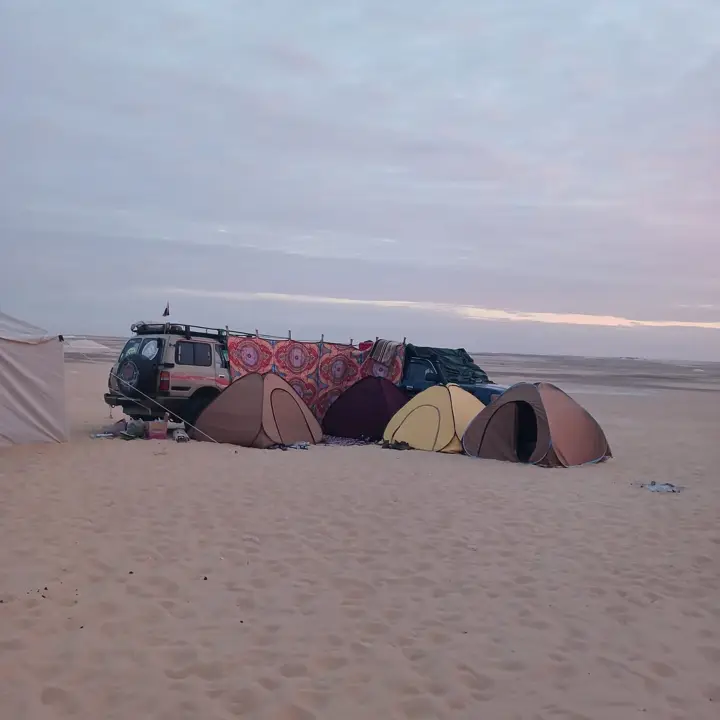
2 or 3 days
Private White Desert camping in comfortOn request (depends on group size and nights)
Check dates