
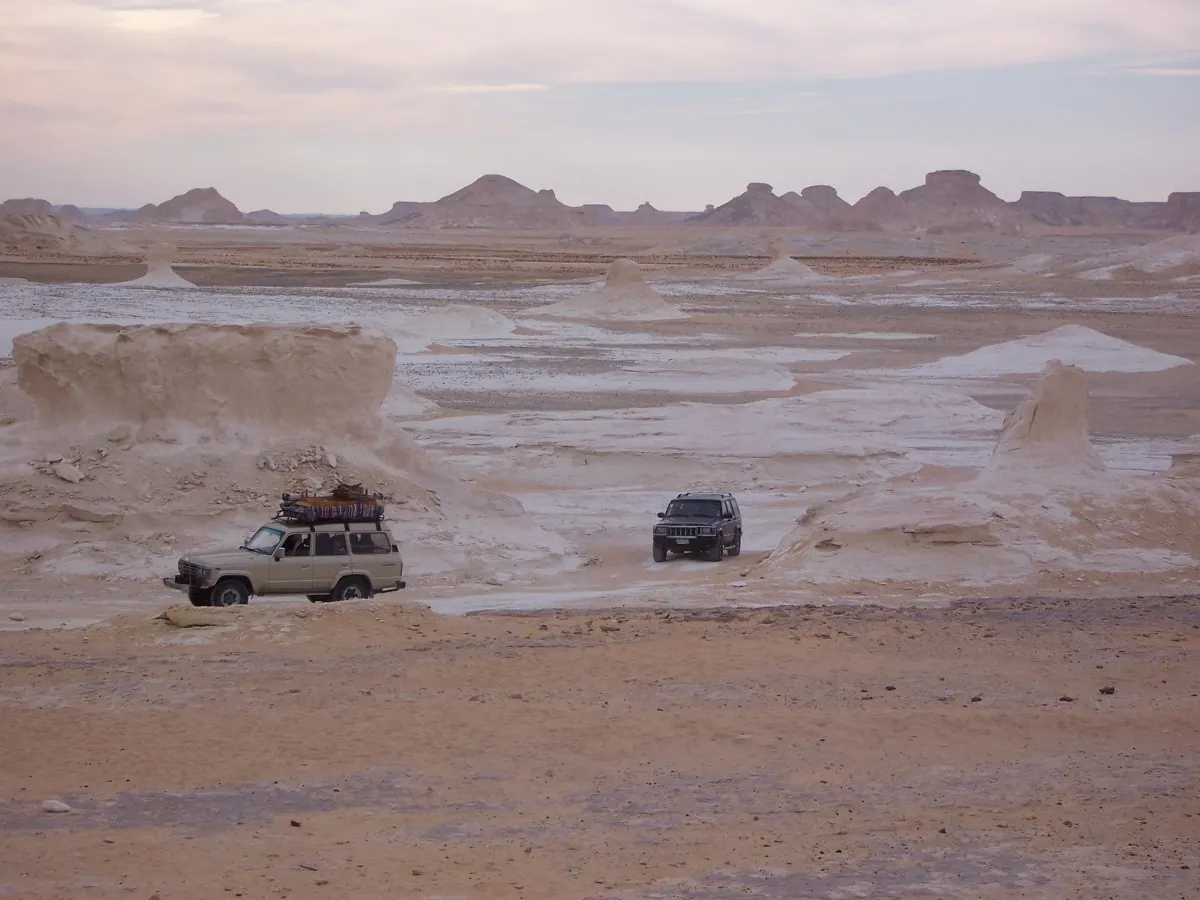
The short answer
Yes, for most travellers. The UK's FCDO lists the White and Black deserts, Bahariya, Farafra and the road from Giza to Farafra as exceptions to its Western Desert warning, and notes that driving off-road requires both a Ministry of Interior permit and a qualified guide. The everyday risks we plan around are heat, cold, sun and the long drive.
Ask us on WhatsAppWhat the travel advice actually says
Short answer: The UK FCDO advises against all but essential travel west of the Nile Valley but lists Bahariya, Farafra, the White Desert and the Black Desert as exceptions, and separately says off-road travel needs a qualified guide and a permit.
Most Western governments warn against travel in parts of Egypt's Western Desert, mainly the remote areas near the Libyan border. The UK Foreign, Commonwealth & Development Office (FCDO), for example, advises against all but essential travel to the area west of the Nile Valley and Delta, but lists exceptions that include the oasis towns of Bahariya and Farafra, the White Desert and the Black Desert, and the road between Giza and Farafra with 50 km either side of it. Dakhla and Kharga towns are also listed. Elsewhere in its advice, the FCDO says anyone travelling off road should use a qualified guide and get a permit from the Ministry of Interior, which is how every White Desert trip works.
Canada and Australia also name the White and Black deserts, Bahariya and Farafra, but only when you reach them by the roads each government names. All three warn against any travel close to the Libyan border, though the distance differs: 20 km for the UK, 40 km for Australia and 50 km for Canada.
Official travel advice, checked 15 November 2026
| Government | Level or wording for the Western Desert | Bahariya, Farafra, White and Black Desert named? | Link |
|---|---|---|---|
| UK FCDO (updated 27 Oct 2026) | Advises against "all but essential travel to the area west of the Nile Valley and Nile Delta regions", with exceptions | Yes, as exceptions: "the oasis towns of Bahariya, Farafra, Dakhla (Mut) and Kharga", "the White Desert and Black Desert" and "the road between Giza and Farafra and within 50km either side of this road" | gov.uk |
| US State Department | See the live page | See the live page | travel.state.gov |
| Canada (updated 26 May 2026) | Overall "Exercise a high degree of caution (with regional advisories)"; avoid all travel to "the Western Desert, west of the Giza-Luxor-Aswan-Abu Simbel road, including the oasis of Dakhla" | Yes, as exceptions on named roads only: "The White and Black deserts via the Oasis Road only." Bahariya and Farafra are exceptions via the Oasis and Farafra–Dairut roads. Dakhla is not | travel.gc.ca |
| Australia Smartraveller (updated 14 Sep 2026) | Overall "exercise a high degree of caution"; "Reconsider your need to travel" west of the Nile Valley and Delta | Yes, at the lower level: "the road from Giza to Farafra, including the areas of Bahariya, the Black Desert and White Desert and Farafra" | smartraveller.gov.au |
The FCDO warns against all but essential journeys on the desert road linking Bahariya and Siwa. Siwa town and the road from Marsa Matruh to Siwa are on its list of exceptions, so trips combining the two go via Cairo and the coast.
Permits and checkpoints: the advice and how it works on a trip
| Topic | What the official advice says | How it works on a White Desert trip |
|---|---|---|
| Permit | FCDO: "If you're travelling off road, use a qualified guide and get a permit from the Ministry of Interior." Canada: travel to these areas "requires a permit from the Travel Permits Department at the Egyptian Ministry of Interior Affairs." | The permit is arranged by a licensed operator. We need your passport details one day before the trip, apply in your name, and copies travel with the driver. |
| Guide | FCDO: use a qualified guide off road. Canada: "consider hiring an experienced guide from a reputable company". | The permit requires an official guide, so foreign visitors go with a licensed operator. |
| Checkpoints | Canada notes military checkpoints on the road to Siwa. The UK and Australian pages do not describe checkpoints on the White Desert route. | Expect several police checkpoints between Cairo, Bawiti and Farafra. The driver shows the permit and a list of passengers; most take a minute or two. Keep your passport with you. |
| Off the road | Smartraveller warns of landmines in some desert areas: "Get advice from local authorities before you travel and do not travel off marked paths or roads." | The protected area is entered off-road, so you go with a licensed operator, a permit and an official guide, never on your own. |
Advice changes, so read your own government's current page before you travel and check that your travel insurance covers the region.
Checked 15 November 2026:
- FCDO exceptions for Bahariya, Farafra and the White and Black deserts still apply; going off-road still means a Ministry of Interior permit and a qualified guide.
- The FCDO advises against all but essential travel on the Bahariya–Siwa road; Siwa town and the Marsa Matruh–Siwa road are exceptions.
- White Desert National Park has been a protected area since 2002. Its entry fee is a government protected-area fee for foreign visitors, collected through the operator and shown as its own line in your quote.
How the permit works
Short answer: You send us your passport photo page at least one day before the trip; we obtain the permit and give copies to the driver for the checkpoints.
You send us a photo of your passport's photo page; we need it one day before the trip. We apply for the permit, and copies travel with the driver. At checkpoints the police may look at passports and the paperwork; it takes a few minutes. Keep your passport with you, not in your Cairo hotel safe. A photocopy alone is not always accepted.
Checkpoints in practice
Short answer: Expect several police checkpoints between Cairo, Bawiti and Farafra; most take a minute or two, and your driver does the talking.
Guests are often surprised by how routine the checkpoints are. The driver slows, shows the permit and a list of passengers, and sometimes an officer looks at passports through the window. Occasionally you'll wait ten or fifteen minutes while a call is made. Smile, keep your passport handy and don't photograph the checkpoint. Checkpoints are also where camping instructions can change: on some nights groups are directed to a specific area. When that happens we tell you straight away and rebuild the evening around it.
The real day-to-day risks
Short answer: Heat in summer, cold nights in winter, sun on white ground and the long road from Cairo are the risks that actually matter.
- Heat and sun. In July, Farafra averages about 38°C by day. Drink more than you think and keep your head covered.
- Cold nights. In January, lows average about 4°C and the open desert can drop near 0°C. A good sleeping bag matters more than anything else you pack.
- Long drives. About 370 km and 4.5–5 hours from Cairo to Bawiti, then off-road. Most of the risk on any desert trip is the road.
- Off-road driving. Dune driving is exciting but should be done with care. Wear the seat belt and tell the driver if you want it gentler. Motion-sickness tablets help some people.
- Climbing in the Black Desert. The cones are loose and steep; wear proper shoes, not sandals, and avoid climbing in midday heat.
- Sand and wind. Spring khamsin winds, typically March to May, can bring dust and force a change of camp; on a private trip you can switch to a night in a Bahariya lodge instead. See sandstorms and wind.
- Medical care. Bawiti has basic medical services, but serious care is back in Cairo, several hours away. Bring any medicines you need; see health and first aid.
Road safety, the biggest real risk
Short answer: The highway is statistically riskier than the desert; rested drivers, daylight driving and seat belts reduce it.
- A rested driver: avoid itineraries that drive Cairo to Bahariya and back in one long day unless the driver changes.
- Daylight where possible: the highway is easier and more pleasant in daylight, so we plan timings around it when we can.
- Seat belts in every seat, including the back.
- A well-maintained vehicle: ask how old the cars are and how they're serviced.
- Two vehicles on long off-road routes such as Djara.
What happens if a car breaks down?
Short answer: On the standard route help is close and drivers carry spares; on remote routes a second vehicle is the backup.
On the standard route there's traffic on the main road and phone signal near Bahariya and Farafra, so help is usually within reach. Desert drivers are mechanics by necessity and carry spares and tools. On remote routes, the second vehicle is the backup. Ask any operator, including us, how they would call for help where there is no signal; it's a fair question.
What a properly equipped 4x4 carries:
- At least one spare tyre, a jack and a basic tool kit
- Plenty of extra drinking water, in case you wait; we never run out of water
- A first-aid kit, and a crew who know where it is
- A plan for calling help where there is no signal, such as driving to the nearest coverage or a second vehicle on remote routes
If an operator can't tell you how old its vehicles are or what they carry, treat that as an answer in itself.
Choosing a safe operator
Short answer: The permit only works through a licensed operator, so the safety of your trip starts with who you book.
Pick a team that names the permit and park fee in writing and can explain its breakdown plan. The questions to ask, the red flags and how to compare quotes are in how to choose an operator.
Travel insurance
Short answer: Check your policy names Egypt's Western Desert and covers off-road driving and camping.
Check that your policy covers Egypt's Western Desert and the activities you'll do, including off-road driving and camping. Some policies exclude areas under government advisories; since the White Desert is listed as an exception in UK advice, many standard policies cover it, but read the wording.
Women travellers
Short answer: Women travel here alone, with friends and with families all the time; dress modestly in towns and ask for your own tent.
In towns, modest clothing avoids unwanted attention; Bawiti is a conservative oasis town. At camp, ask us about your own tent. On shared trips, ask about the group's make-up if it matters to you. Good operators take this seriously. Read solo travellers.
Drones, cameras and checkpoints
Short answer: Leave the drone at home unless the Ministry of Defence has given permission in advance; cameras and phones are fine, but don't photograph checkpoints or police.
The FCDO warns not to import or use drones in Egypt without prior Ministry of Defence permission, and penalties can include a fine or prison. Normal cameras and phones are no problem. Don't photograph checkpoints, military installations or police.
Our advice: a safety checklist
Short answer: Passport on you, permit arranged in advance, insurance that covers the region, warm layers and water, and someone at home who knows your plan.
- Passport with you, not in Cairo
- Permit arranged by a licensed operator, with your passport details sent at least one day before
- Park entry fee and permit named in your quote
- Travel insurance that covers the region
- Enough water, sun protection and warm layers
- Closed shoes for the Black Desert and Crystal Mountain
- Personal medicines
- A charged phone and power bank; signal is patchy, see phone signal and internet
- Someone at home who knows your plan
Questions people ask
Do I need a permit for the White Desert?+
Yes. Foreign visitors to Bahariya, Farafra and the White and Black deserts need a permit arranged in advance and an official guide. Your operator applies with your passport details before you travel; we need yours one day before the trip.
Can I camp in the White Desert without an operator?+
Not as a foreign visitor. The permit for Bahariya, Farafra and the White and Black deserts is arranged in advance through a licensed operator and requires an official guide, and checkpoints on the Farafra road check the paperwork. The UK FCDO adds that any off-road driving requires a Ministry of Interior permit plus a qualified guide.
Is there phone signal in the White Desert?+
Patchy. Bahariya and Farafra towns have mobile coverage, and you may get a weak signal at some camps, but large parts of the route have none. Tell family you'll be offline for the night.
Is it safe for solo women?+
Many women travel to the White Desert alone or in pairs, and we host them every season. Choose a licensed operator who answers your questions clearly, ask who else is on a shared trip, or book a private trip if you prefer.
Has the White Desert ever been closed to tourists?+
Access to parts of the Western Desert has been restricted at times for security reasons, and rules can change. The White and Black deserts have generally remained open to permitted tourism with licensed operators.
Is it safe to drive from Cairo to Bahariya?+
The road is good tarmac with checkpoints. The main risks are the usual ones of a long highway drive, which a rested, careful driver and daylight driving reduce.
When do you need my passport details for the permit?+
We need your passport details one day before the trip. Send a clear photo of your passport's photo page; we apply for the permit in your name and copies travel with the driver. Sending it when you book is easiest, but one day before is enough.
Can I drive to the White Desert myself?+
Not as a foreign visitor without a licensed operator. The permit requires an official guide, the protected area is entered off-road, and checkpoints on the Farafra road check the paperwork. Drivers without the right paperwork can expect to be stopped at a checkpoint.
Why might a checkpoint change where we camp?+
Police and park authorities can direct groups to specific camping areas on a given night. It is rare, but when it happens we tell you the reason on the spot and rearrange the evening so you still see the chalk formations at sunset or sunrise.
Go with us
Trips that include this
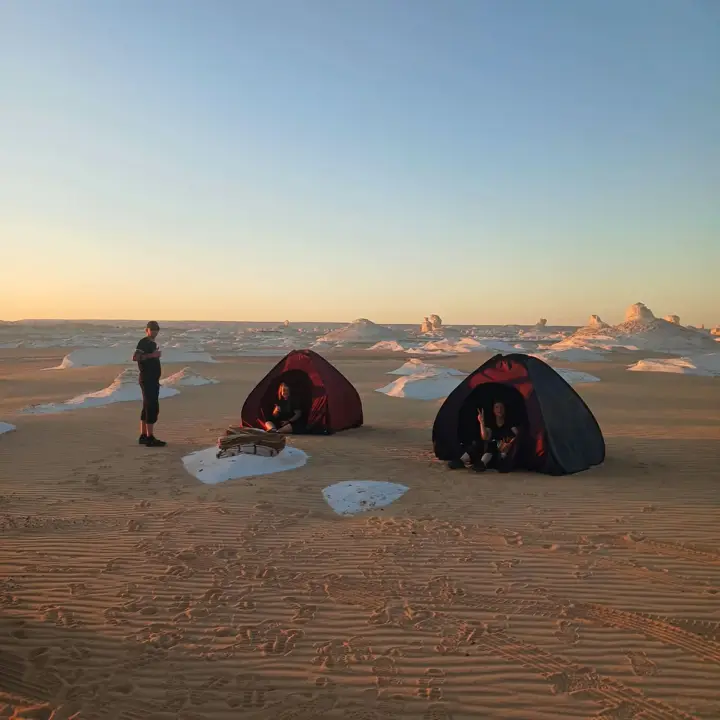
2 days, 1 night
White Desert overnight camping trip from Cairo (2 days, 1 night)About US$185 to 230 shared · US$360 to 460 private, per person
Check dates
3 days, 2 nights
3-day White Desert tour: Bahariya, the White Desert and two nights outAbout US$495 to 660 per person for two travellers, private
Check dates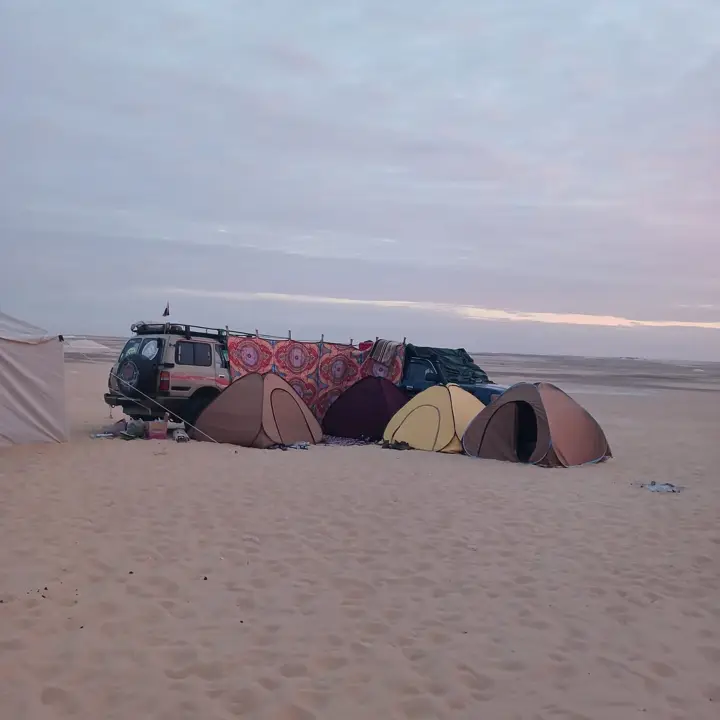
2 or 3 days
Private White Desert camping in comfortOn request (depends on group size and nights)
Check dates