
The short answer
Mobile signal is good in Bawiti and Qasr Farafra, patchy along the 370 km desert road from Cairo and weak or absent at many White Desert camps. Expect to be offline from late afternoon to the next morning. An Egyptian SIM or eSIM gives the best chance of signal. On a standard camp, charging is from the car's sockets only, so bring a full power bank.
Ask us on WhatsAppSignal along the route
Short answer: Good 4G in towns, patchy on the highway, mostly none in the White Desert itself.
| Place | Typical signal | Notes |
|---|---|---|
| Cairo and Giza | Strong 4G | Download everything here |
| Cairo–Bahariya road | Patchy | Long gaps between towers |
| Bawiti (Bahariya) | Good 4G | Last reliable data before the desert |
| Black Desert and Crystal Mountain | Weak to none | Sometimes a bar near the highway |
| Agabat and the New White Desert | Mostly none | Occasional signal on high ground |
| Old White Desert (Mushroom area) | Patchy | Near the highway you may get a bar |
| Qasr Farafra | Good in town | Fades as you head north |
Coverage changes as towers are added, and it differs between networks. Some camps get a weak signal, others none at all. Plan to be offline from late afternoon until the next morning.
Checked November 2026: what we see on our trips
Short answer: On our recent trips, data in Bawiti is reliable, the Mushroom area near the highway sometimes gets a bar, and most camps further from the road get nothing.
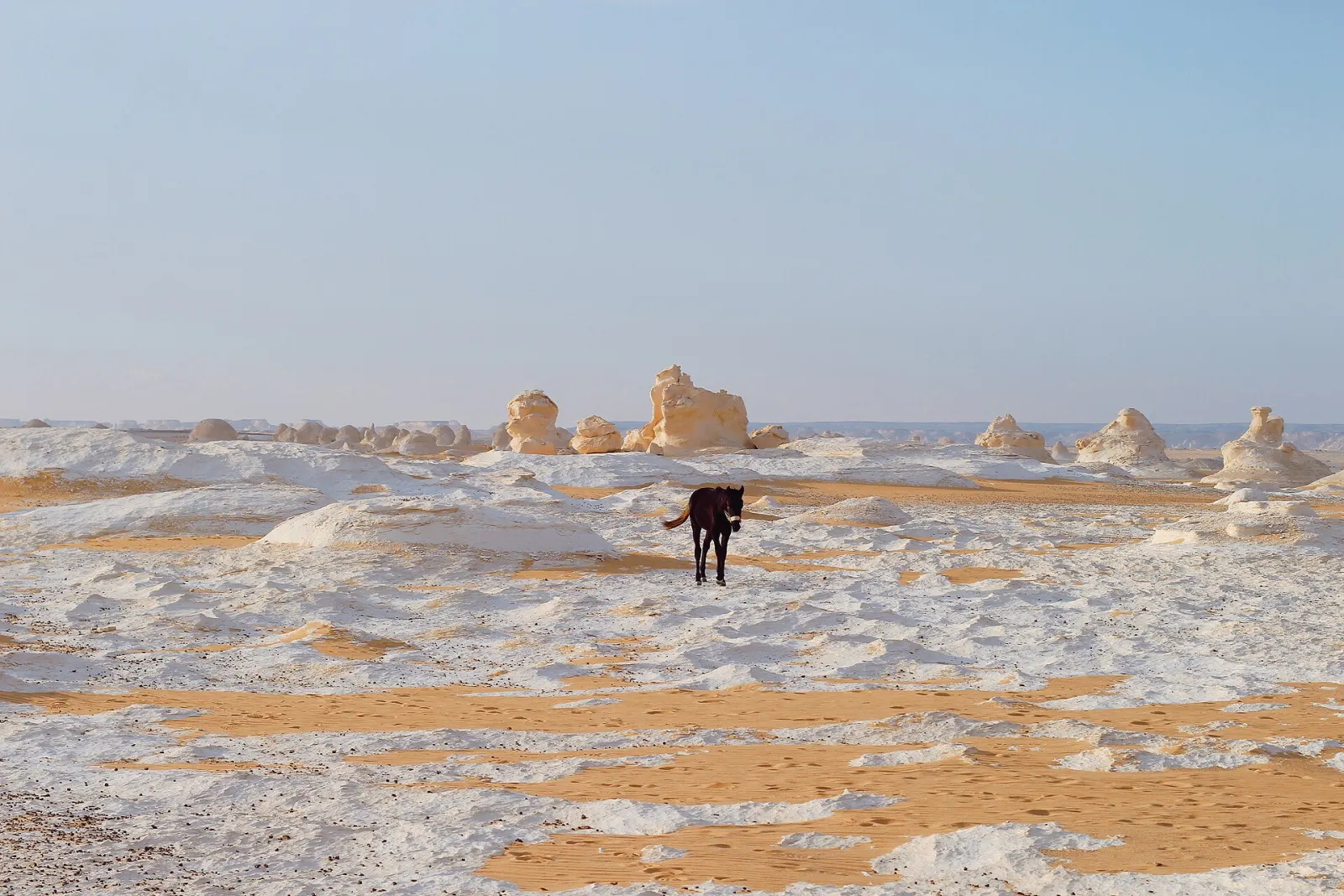
This is our crew's experience from regular trips this season rather than an official coverage map. Bawiti has solid 4G on all the main networks. On the road south, signal drops out for long stretches after the Black Desert. Around the Mushroom and Chicken, about 40 km north of Qasr Farafra, one or two bars sometimes appear close to the highway. Away from the road, in the New White Desert or deeper among the formations, expect nothing. Weather doesn't change much; distance from the road and height do.
Which SIM or eSIM?
Short answer: An Egyptian SIM or eSIM from one of the main networks gives the best chance; roaming works but is costly.
Egypt's main mobile networks all cover the oasis towns. Buy a tourist SIM at Cairo Airport arrivals, with your passport, or install an eSIM before you fly. In remote areas one network may have signal where another doesn't. If you're travelling as a group, it helps to have two different networks between you. Roaming from your home SIM works in the towns but can be expensive. For data on the road, a few gigabytes is plenty.
Before you go
Short answer: Download maps and apps, tell people you'll be offline, and charge everything in Cairo.
- Download offline maps of Bahariya and Farafra, and a star-chart app that works offline.
- Download music, podcasts or a book for the 4.5–5 hour drive.
- Tell family you'll be offline overnight, with our WhatsApp number as a contact.
- Charge your phone, power bank and camera batteries in Cairo the night before.
- Save a copy of your passport and booking on your phone and on paper.
Power and charging
Short answer: Charge from the 4x4 while driving, carry a 10,000–20,000 mAh power bank, and keep batteries warm at night.
There is no mains electricity at camp, though a power supply is available on request. The 4x4 has a USB or cigarette-lighter socket that you can use while driving; bring a car adapter and cables. A power bank covers your phone overnight. Camera batteries drain fast in the cold, so carry spares and sleep with them inside your bedding on winter nights, when the open desert can drop close to 0°C. Head torches are better than phone torches, which waste battery and dazzle everyone around the fire. See the packing list.
Wi-Fi in the oases
Short answer: Most lodges have Wi-Fi, but it's slow and shared; fine for messages, poor for video calls or uploads.
Hotels in Bawiti and Farafra usually offer free Wi-Fi in the lobby or garden, sometimes in rooms. It's enough for WhatsApp and email, and often too slow for video calls or big photo uploads, especially in the evening when everyone is online. Some eco-lodges keep connections minimal by choice. See hotels in Bahariya.
Staying in touch in an emergency
Short answer: Your driver knows where signal is most likely, carries a phone and drives tracks that other groups use most days in season.
White Desert trips run on well-used routes. Other 4x4s pass each day in season, and the highway is never far. Our drivers know the spots where a bar of signal tends to appear. Deep-desert routes are different, with no signal at all, so ask us how that particular trip is set up. If you need dependable contact for medical or work reasons, tell us before the trip and we'll check whether a camp nearer the highway is possible that night. See permits and safety and health and first aid.
Our advice
Short answer: Treat the night as offline, keep one charged device for emergencies, and save battery for photos at sunset and sunrise.
- Put your phone in flight mode at camp. Searching for signal drains the battery fast.
- Keep one phone or power bank untouched as a reserve.
- Shoot sunset and sunrise, the two moments you'll most want photos of, on a full battery.
- If someone at home will worry, give them a time to expect your message, such as 10 am the next day from Bawiti.
Embrace the disconnection
Short answer: Being offline is part of the experience, and many guests end up valuing it more than they expected.
Guests often tell us that a night without notifications, under a sky full of stars, is the real luxury of the White Desert. Set an out-of-office message and let it happen. See stargazing and first-time desert camping.
Send us a WhatsApp message with "signal" and your trip plan. We'll tell you where you'll be online and offline, and how to plan around it.
Questions people ask
Can I make an emergency call from camp?+
Sometimes directly, and usually through our crew. Our drivers know where a bar of signal tends to appear, usually on high ground or nearer the highway, and carry local phones. On remote routes such as Djara there is no signal, so ask us before booking how we handle communication on that trip.
Is there Wi-Fi at the desert camp?+
No. There is no mains electricity or Wi-Fi at the camps inside White Desert National Park, a protected area since 2002. You'll have Wi-Fi again at lodges in Bawiti or Farafra, and data in town on an Egyptian SIM.
Which Egyptian network works best in the White Desert?+
There's no single winner. Vodafone, Orange, e& (formerly Etisalat) and WE all work in Bawiti in our experience, and coverage in the desert shifts as towers are added. If you're a group, having two different networks between you doubles your chances of a bar at camp.
Can I charge my phone at camp?+
On a standard camp, from the 4x4's USB or cigarette-lighter socket while the engine runs, usually during the drive. A power supply at camp is available on request. Bring a 10,000–20,000 mAh power bank, a cable and a car adapter, and charge everything fully in Cairo the night before.
Will my phone work for photos of the stars?+
Recent phones with a night mode take surprisingly good star photos if you prop them on a rock or a small tripod and keep still for a few seconds. Turn the screen brightness down to save battery and to keep your eyes adjusted to the dark.
Can I work remotely from Bahariya?+
For messages and email, yes, from a lodge in Bawiti. For video calls and large uploads, the connection is often too slow, especially in the evening. Plan any important calls for Cairo, and treat the desert night as genuinely offline.
Go with us
Trips that include this

2 days, 1 night
White Desert overnight camping trip from Cairo (2 days, 1 night)About US$185 to 230 shared · US$360 to 460 private, per person
Check dates
3 days, 2 nights
3-day White Desert tour: Bahariya, the White Desert and two nights outAbout US$495 to 660 per person for two travellers, private
Check dates
2 or 3 days
Private White Desert camping in comfortOn request (depends on group size and nights)
Check dates