
The short answer
Most people camping in the White Desert book our overnight trip from Cairo: 2 days and 1 night, with sunset, a fire-cooked dinner and sunrise among the chalk. Price guide: about US$185 to 230 shared · US$360 to 460 private, per person. December and January nights average about 4 to 6°C, so pack warm layers. Message us on WhatsApp with your dates.
Ask us on WhatsAppWhat a camping trip costs and which one to book
Short answer: Book the overnight trip from Cairo: 2 days, 1 night, about US$185 to 230 shared · US$360 to 460 private, per person. Take the three-day trip if you want two nights out and a slower pace.
Most first-time campers take our overnight White Desert camping trip from Cairo. A driver collects you at your Cairo or Giza hotel around 6:00 to 7:00, in Bawiti you change into a 4x4, and after stops at the Black Desert, Crystal Mountain and Agabat you reach the chalk in the late afternoon. You sleep among the formations, get up for sunrise and are back at your hotel on the evening of day two. The price is about US$185 to 230 shared · US$360 to 460 private, per person.
Christmas and New Year is the busiest week, and December and January are the coldest months: nights average about 4 to 6°C and can fall close to freezing in the open. Ask for a tent and a sleeping bag when you book, because both are loaded in Bawiti before the 4x4 leaves. The overnight trip has a holiday supplement for the week from 20 December to early January; see Christmas and New Year in the desert. To check a date, message us on WhatsApp; we'll say which trips are running and send a written quote.
Our camping trips side by side
Short answer: The two-day camps are about US$185 to 230 shared · US$360 to 460 private, per person; the three-day trip is about US$495 to 660 per person for two travellers, private; for comfort, family and eclipse camps, ask us.
| Trip | Length | What you'll see | Starting point | Suits | Price guide |
|---|---|---|---|---|---|
| Overnight camping from Cairo | 2 days, 1 night | Black Desert, Crystal Mountain, Agabat, sunset, camp and sunrise in the chalk | Cairo or Giza hotel | First-timers; the classic trip | About US$185 to 230 shared · US$360 to 460 private, per person |
| Full-moon camping | 2 days, 1 night | The same route, plus a night walk among moonlit formations | Cairo or Giza hotel | Anyone uneasy about the dark | About US$185 to 230 shared · US$360 to 460 private, per person |
| Geminids meteor camp | 2 days, 1 night | The Geminid peak on 13–14 December 2026, reclining mats away from the fire, hot drinks through the night | Cairo or Giza hotel (or meet in Bawiti) | Stargazers | About US$185 to 230 shared · US$360 to 460 private, per person |
| Three days: Bahariya, the White Desert and two nights out | 3 days, 2 nights | Golden Mummies museum, a hot spring, Ain Khadra, the New White Desert towers | Cairo or Giza hotel | People who want time at each stop | About US$495 to 660 per person for two travellers, private |
| Private comfort camping | 2 or 3 days | Your own camp away from other groups; walk-in tents, camp beds, toilet and shower tents on request | Cairo or Giza hotel | People who want the stars without roughing it | Ask us |
| Family private trip | 3 days, 2 nights | A hot spring and lodge night in Bahariya, the Agabat dunes, a private camp with tents | Cairo or Giza hotel | Families with children | Ask us |
| White Desert and Djara cave | 4 days, 3 nights | The White Desert chalk, dune belts and Djara cave, with three camps far from other groups | Cairo or Giza hotel | Travellers after more than one night in the open | About US$605 to 825 per person for two travellers, private |
| Eclipse 2027 camp | 3 days, 2 nights | A White Desert camp night, then the total eclipse of 2 August 2027 from the Black Desert or Bahariya | Cairo or Giza hotel (or meet in Bawiti) | Eclipse watchers | Ask us |
| Day trip from Cairo | 1 day (about 15 hours) | A picnic among the chalk after the Black Desert, Crystal Mountain and Agabat; home the same night | Cairo or Giza hotel | People who can't spare a night | About US$220 to 280 per person for two travellers, private |
On the two-day trips the desert permit is in the price. The park fee is a government protected-area fee for foreign visitors, collected through the operator and shown as its own line in your quote. If one night isn't enough, read how many days you need; for every trip we run, see all our White Desert tours.
Why book with us
Short answer: A Bawiti crew of our own, permits and a licensed guide arranged, everything in writing, and bookings through a licensed agency.
- Based in Bawiti. We live in Bahariya Oasis, the gateway town north of the chalk, and our 4x4s and camp kit are kept there.
- Our own crew. Our own drivers, guide and camp cook run every trip; the trip is not subcontracted.
- Paperwork handled. We arrange the permit and the licensed guide; send your passport details one day before.
- Written quotes. Pick-up point, transport, meals, water, camp kit and what isn't included are listed before you travel.
- Licensed booking. Bookings are made with Intercontinental Travel, a Ministry of Tourism licensed agency (Category A, No. 2436). See booking terms and about us.
Setting up camp
Short answer: You don't carry, pitch or cook anything: the crew turns the 4x4s into a wall, hangs carpets between them against the wind, and lays mattresses and blankets inside, with sleeping bags on request.
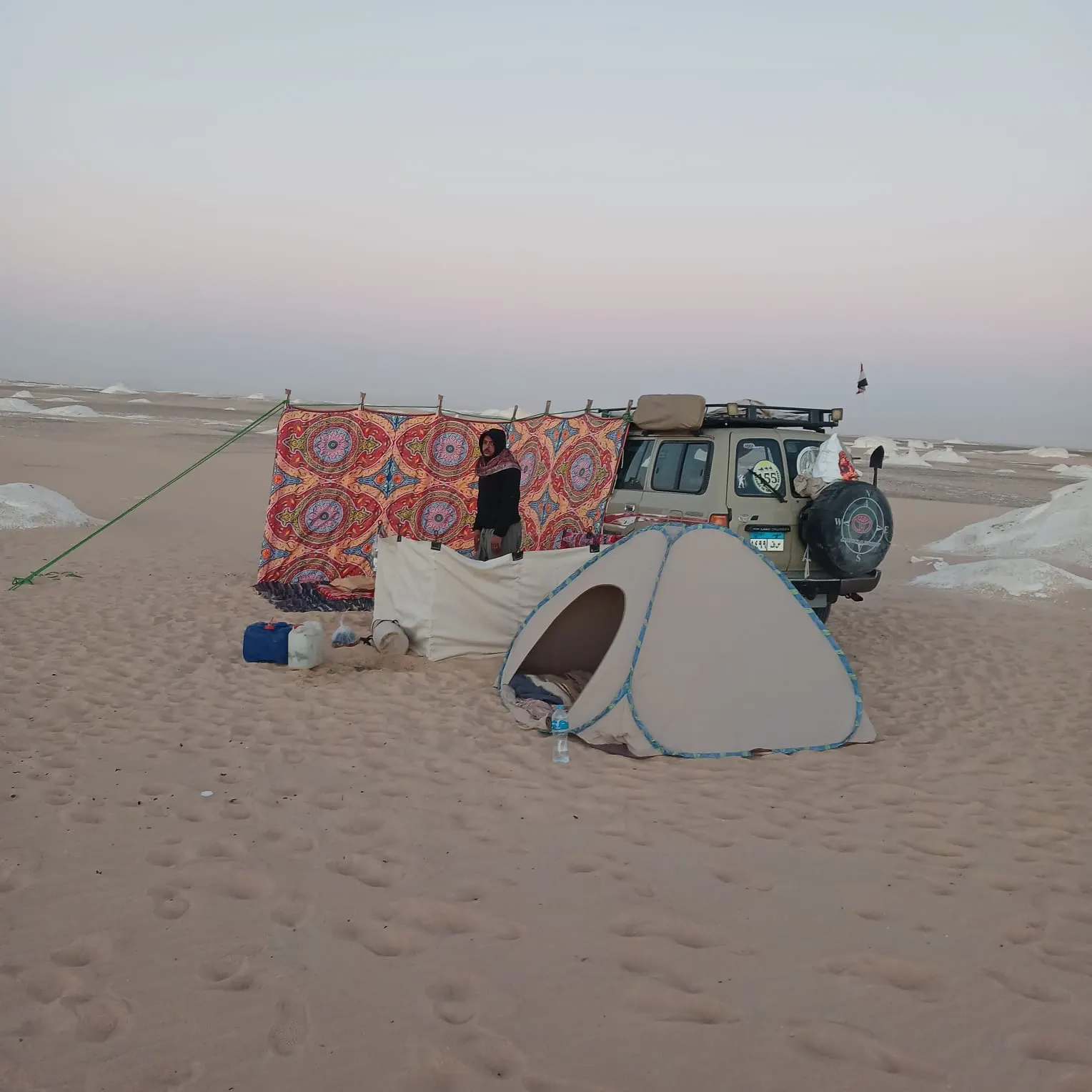
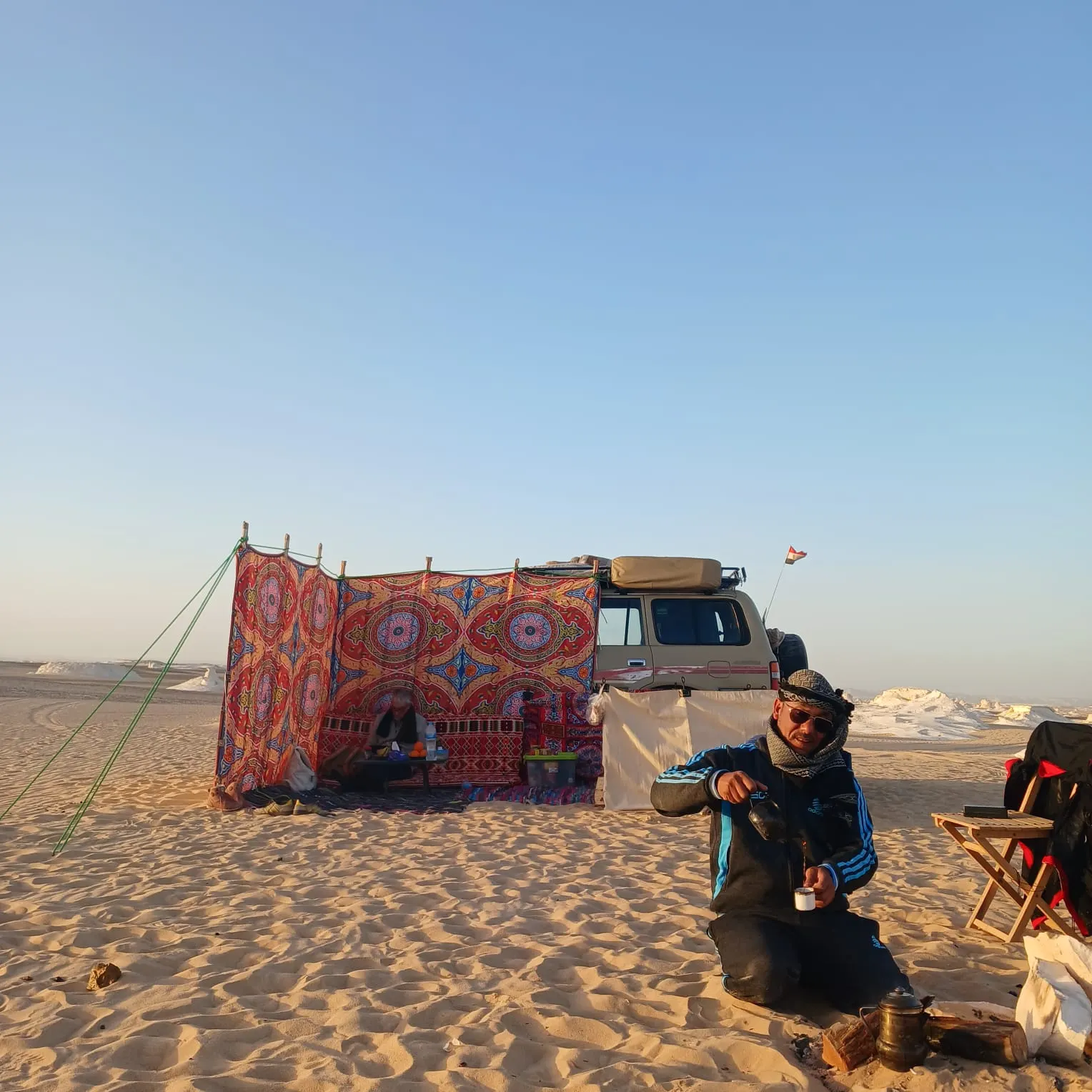
Setting up is our crew's daily routine, so it goes quickly, usually while you are still out photographing the sunset. Your driver chooses a sheltered spot among the formations, often in the lee of a big rock. The 4x4s are parked side-on to the wind and carpets or cloth are hung between them and pegged down. Inside that open "room", mattresses go down in a row with thick blankets (and sleeping bags if you've asked for them), and the fire burns a safe distance in front. A tent is pitched nearby if you've asked for one. In winter the windbreak makes a bigger difference than you'd think.
Where you camp
Short answer: In the permitted camping areas of White Desert National Park, usually the Old White Desert, in a spot your crew picks on the day for wind shelter, quiet and the sunrise view.
Before choosing, we look at a light-pollution map for the darkest ground, and a private trip gets a spot well away from any other group. Wind, checkpoint rulings or a busy holiday night can move camp, sometimes to Agabat or the Black Desert, and we always tell you before we drive. How the spot is chosen and the leave-no-trace rules are in where we camp; the protected area itself is covered in White Desert National Park.
The evening
Short answer: Sunset from a nearby rise, then tea by the fire, a hot dinner cooked over the embers, and hours of stars.
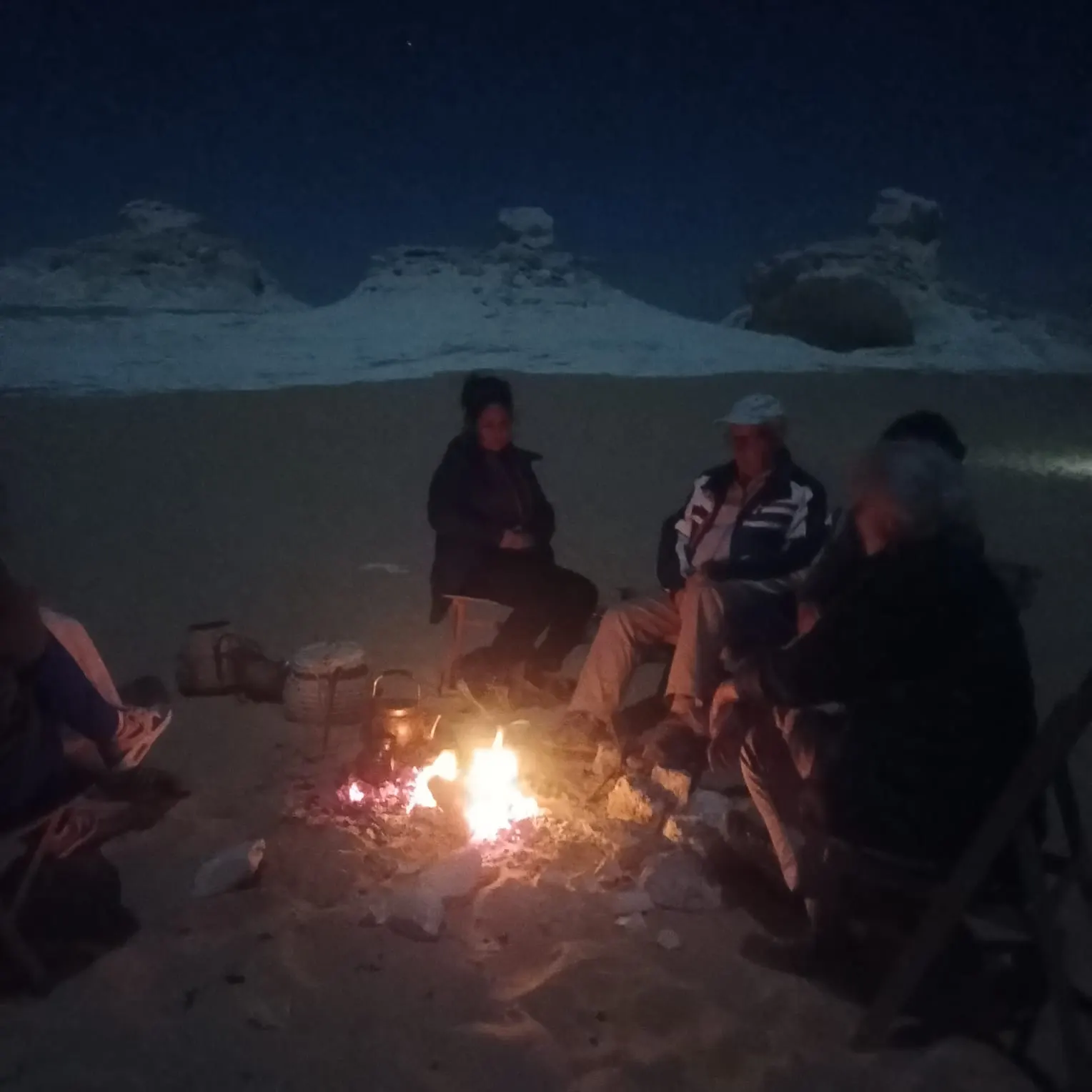
While the crew cooks, you watch the sunset from the nearest rise. As it gets dark, sweet tea and snacks appear by the fire, then dinner: typically grilled chicken, rice, vegetable stew and salad, followed by fruit. Some drivers bring a drum and sing. Then the fire burns down and the stars take over: give your eyes 20 minutes away from screens and torches and the sky fills right down to the horizon. Download a star app before you leave Cairo, as there's no signal at camp. See stargazing.
A timeline of a winter night
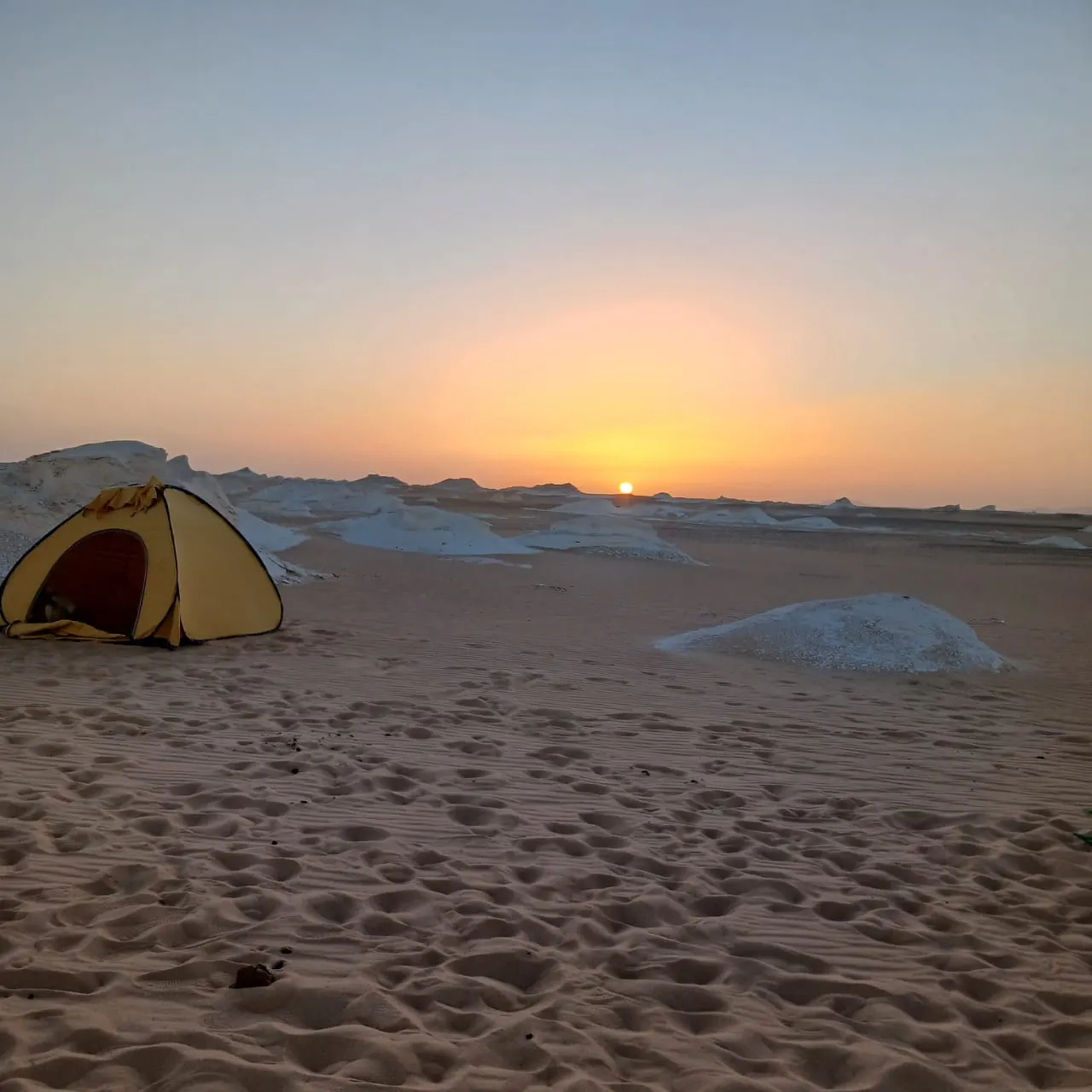
Short answer: In December and January you arrive at about 16:30, watch sunset at about 17:15 (early December) to 17:50 (late January), eat at around 19:00, sleep by 22:00 and get up for sunrise at about 06:40–07:00, with camp packed by 08:30.
| Time (Dec–Jan) | What happens | What you do |
|---|---|---|
| 16:30 | Arrive among the formations | Walk, take photos; put your warm layers in the day bag |
| 17:15–17:50 | Sunset | Find a rise and watch |
| Around sunset | Crew finishes the camp; fire lit, tea poured | Help or relax; pull on the down jacket |
| 17:40–18:15 | Last useful daylight (end of civil twilight) | Find your bed, head torch and toilet direction now |
| 18:35–19:10 | Fully dark (end of astronomical twilight) | Stars to the horizon on a moonless night |
| 18:30–19:30 | Dinner | Eat |
| 19:30–21:30 | Stars, stories, music, foxes | Look up; last toilet trip before bed |
| 21:00–22:00 | Bed | Open air or a tent, in dry clothes |
| 03:00–06:00 | The coldest hours | If you wake cold, add the spare blanket or move into the tent |
| 06:15–06:30 | First light | Crew relights the fire and boils water |
| 06:40–07:00 | Sunrise | Get up for the first light on the chalk |
| 07:30 | Breakfast: bread, cheese, eggs, jam, tea, coffee | Eat by the fire |
| 08:30 | Pack up and sweep the ground | Last photos |
Sun and twilight times are for Farafra, the nearest town, from timeanddate.com; evenings run about half an hour later in late January than in early December. In July, when sunset is at about 19:57–20:06 and sunrise about 06:17–06:31 (July times), the evening moves about two and a half hours later and the night is much shorter. Wake for sunrise even if it's cold: it's the best light of the trip. See sunrise and sunset.
Tent or under the stars?
Short answer: Open air gives you the whole sky; a tent is a few degrees warmer, blocks wind and sand and gives privacy. Most people sleep outside from April to October and take a tent from December to February.
Sleeping in the open is the classic White Desert night: a mattress behind the windbreak, the fire glowing a few metres away and total silence. The catch is that you feel every change in the wind, the air on your face can be near freezing by 4 am in winter, and dew can settle on still nights. A tent feels noticeably warmer out of the wind and gives you somewhere to change, at the cost of the view, which is why many guests keep the door tied open.
| Open air | Tent | |
|---|---|---|
| View of the stars | The whole sky from your pillow | Only through the door |
| Warmth | Colder, exposed to wind | A few degrees warmer, no wind chill |
| Privacy | Shared space behind the windbreak | Your own space for changing |
| Sand and dust | Can blow in on windy nights | Kept out |
| Insects (warm months) | A few mosquitoes possible | Zipped mesh keeps them out |
| Best months | April to October | December to February |
Month by month: tent, open air and sleeping bag
| Month | Average night low, Farafra | Where to sleep | Sleeping bag (comfort rating) |
|---|---|---|---|
| January | 4.1°C | Tent, or open air with very warm layers | Around 0°C, plus a blanket |
| February | 6.0°C | Tent, or open air with very warm layers | Around 0°C, plus a blanket |
| March | 9.2°C | Either; tent if it's windy or dusty | About 5°C |
| April | 13.8°C | Open air; tent if a dusty wind blows | About 10°C |
| May | 17.9°C | Open air | Blanket or a light bag |
| June | 20.6°C | Open air | Sleep on top of a bag or under a sheet |
| July | 21.9°C | Open air | Sleep on top of a bag or under a sheet |
| August | 21.5°C | Open air | Sleep on top of a bag or under a sheet |
| September | 19.5°C | Open air | Blanket or a light bag |
| October | 15.6°C | Open air | About 10°C |
| November | 10.1°C | Either | About 5°C |
| December | 5.6°C | Tent, or open air with very warm layers | Around 0°C, plus a blanket |
The lows are long-term averages for Farafra (NOAA normals for 1961–1990, as listed in Wikipedia's Farafra climate table). On a clear, still night in the open desert it is usually a few degrees colder than the town figure, and in late December and January it can dip close to freezing. The bag column uses the "comfort" figure on the label, which under the ISO 23537 standard is the temperature at which a relaxed sleeper just doesn't feel cold; the "limit" figure is for a curled-up warm sleeper and the "extreme" figure is a survival rating, not a target (Rab's explanation). If you feel the cold, choose a bag rated a few degrees lower than the table.
March to May is khamsin season, when hot, dusty winds can blow for a day or two, and a tent is the comfortable choice even on a warm night. Full figures are in weather and night temperatures.
The standard tent is a small dome tent for two that you crawl into; families can have two side by side. Walk-in tents with camp beds are available on request. If one is pitched you can choose all night: many people fall asleep outside, wake cold at 3 am and shuffle in with their bedding.
What's provided and what to bring
Short answer: We bring the windbreak, bedding, tents on request, fire, water and all meals; you bring a head torch, warm layers, wet wipes and tissues, a power bank and a small overnight bag.
| On every camping trip | On request (ask when you book) | You bring |
|---|---|---|
| Carpet and cloth windbreak around the vehicles | Sleeping bags and spare blankets | Warm layers, hat, socks for the night |
| Thin foam mattresses, thick blankets and pillows | Dome tents for two | Head torch |
| Low tables, cushions or folding chairs | Walk-in tents and camp beds | Tissues, small opaque bags, hand sanitiser, wet wipes |
| Fire and lanterns | Toilet tent | Toothbrush, sun cream, medicines |
| Bottled water, tea, coffee, dinner and breakfast | Hot-water shower tent | Charged power bank |
| Cooking kit and a rubbish bag that goes back to Bawiti | Power supply at camp | Your own sleeping bag or liner, if you prefer |
Anything on request is loaded in Bawiti before the 4x4 leaves, so it can't be added once you're in the desert. Keep your personal things in a small overnight bag; your main luggage stays in the car. Full list: packing list and what to wear.
The toilet
Short answer: A toilet tent is available on request on any trip; without one, you walk behind a rock with tissues and a bag.
It's the question every first-timer asks, and it's easier than it sounds. There are no permanent toilets anywhere inside White Desert National Park, so each camp arrives with its own kit and leaves nothing behind. The final flushing toilet is at the lunch stop in Bawiti, so use it before the 4x4 leaves.
Without a toilet tent:
- Before dark, the crew points out a direction away from camp, downwind and behind a formation. Men and women usually go different ways.
- Take tissues, a head torch and a small opaque bag. Wear shoes.
- Dig a shallow hole with your heel or a trowel, and cover it afterwards.
- Bring the used paper back in the bag and put it in the rubbish bag in the car. Never burn it or leave it under a stone.
- Clean your hands with sanitiser or a splash from the crew's water.
With a toilet tent: a pop-up cubicle with a seat and a bag inside, pitched a few steps from where you sleep. You still bring tissues and a torch, but you get a seat, a door and privacy, which is why families and older travellers usually ask for one.
At night: note the rock next to your bed before dark, keep the fire or the cars in sight and walk in pairs if you prefer; in the dark the formations all look alike. Drinking your last tea a little earlier saves a cold walk at 3 am.
Basic or comfort?
Short answer: The standard camp is mattresses and blankets in the open; a private trip can add walk-in tents, camp beds and duvets, a toilet tent and a hot shower tent if you ask.
The standard camp suits most travellers. Families, couples and older travellers often prefer the comfort set-up, which is run as a private trip. Compare the two in glamping or see private comfort camping.
Staying warm and sleeping well, November to March
Short answer: Insulation under you, a bag rated around 0°C plus a blanket over you, dry thermals and a hat on you, and a tent around you in December to February.
Most cold nights are cold from below: sand and chalk pull heat out of you, so ask for a second mattress, a folded blanket underneath or a camp bed before adding more on top. Change into a dry thermal top, leggings, wool socks and a beanie at bedtime; the day's clothes hold sweat and dust. Lie with your head towards the windbreak. A hot-water bottle filled from the crew's kettle helps a lot, and so does a hot drink and a full dinner just before bed. Keep tomorrow's clothes, your phone and spare batteries inside your bedding so they are warm and charged at sunrise.
The drop is fast: at 16:30 you may be in a T-shirt, and by 18:00 you'll want a down jacket, so keep it in your day bag, not the boot. Fires are kept small and in one place, tents go upwind of the fire, and nothing is lit inside a tent. If you wander out for the stars, keep the fire in sight and don't climb the fragile formations. Coming for the Geminids on 13–14 December 2026? You'll be outside for hours after dinner, so dress as for January. Crews appreciate a tip; see what a trip costs and permits and safety.
First time? Common worries answered
Short answer: Most first-time fears go by the time the fire is lit; what surprises people is the silence, the stars to the horizon, the foxes and how good sunrise is despite the cold.
- "I'll be cold." Not with proper layers and bedding; ask for a tent and spare blankets in winter.
- "I'll be scared of the dark." The stars and fire make it surprisingly bright, and the crew sleeps nearby. Around a full moon you can see the whole camp without a torch; see full-moon camping.
- "There will be insects." Very few, and almost none in winter.
- "I won't sleep." Many people sleep better than at home, after a long day in fresh air.
- "What about animals?" Usually just a curious fennec fox, which will steal shoes or snacks if you let it. Don't feed it.
If a whole night in the open still feels like too much, comfort extras such as a camp bed and a shower tent are the gentlest introduction we offer. Tell us what worries you before the trip; we'd rather plan around it.
Ready to book a night in the chalk?
Short answer: Send your dates, how many of you are coming and whether you want a tent; message us on WhatsApp and we reply from Bawiti with a written plan.
Message us on WhatsApp with "camping", your dates and how many of you there are. We'll say whether a shared trip is running, suggest standard or comfort camping for that month, and pack the tents and sleeping bags you need. If you'd like a night in the oasis before or after camp, read Bahariya Oasis; if you can't spare a night, the White Desert day trip from Cairo is the alternative. For the bigger picture, start at planning a White Desert trip.
Map: Bahariya to Farafra
Schematic map, not to scale: positions are approximate, and the desert sites spread over many kilometres. The road runs about 180 km from Bawiti to Farafra; shaded areas show roughly where the black hills and the white chalk are.
Questions people ask
How much does a White Desert camping trip cost?+
Our overnight camping trip from Cairo is about US$185 to 230 shared · US$360 to 460 private, per person. The three-day trip with two nights out is about US$495 to 660 per person for two travellers, private. Comfort camping and the family trip are priced on request, so ask us. The overnight trip carries a holiday supplement for the week from 20 December to early January.
What is included in the overnight camping trip?+
Your Cairo or Giza hotel pick-up and return, the drive to Bahariya, a 4x4 and an experienced desert driver, and the desert permit. Food runs from lunch on the first day to lunch on the second, with dinner and breakfast at camp, plus tea and drinking water. Camp kit is a mattress, blankets and the windbreak; ask for a tent or sleeping bag. You pay separately for tips, travel insurance and any drinks beyond water and tea.
Do I need a permit to camp in the White Desert?+
Yes. Foreign visitors must hold a permit, applied for ahead of the trip, and travel with a licensed guide. We handle both; send us your passport details a day before you leave. The park fee is a government protected-area fee for foreign visitors, collected through the operator and shown as its own line in your quote.
Is it safe to sleep outside in the White Desert?+
Yes. Everyone sleeps together behind the windbreak, our crew sleeps a few metres away by the vehicles, and there are no large predators; the usual night visitor is a small fennec fox. What catches people out is uneven ground after dark, so keep a head torch in reach. Solo women can ask for their own tent or a separate sleeping spot.
What is the best month to go camping in the White Desert?+
October to April for comfortable days. December and January give the longest dark nights for stars, but they are the coldest, at about 4 to 6°C on average and close to freezing on clear nights in the open. November and March are milder, at around 9 to 10°C. From May to September days are hot and trips start later.
Should I book a shared or a private camping trip?+
Shared is the lower price, with never more than four guests in a 4x4. Private means your own vehicle and crew, your timings, and a camp away from other groups. Comfort extras such as walk-in tents and a shower tent are on request with private comfort camping; a toilet tent can be requested on any trip, shared or private.
Do I need camping experience?+
None. The crew drives, picks the spot, builds the windbreak, lays out the bedding, cooks and packs everything away. You watch the sunset, eat, sit by the fire and sleep.
What sleeping bag do I need, and can you provide one?+
Go by the comfort rating on the label: around 0°C plus a blanket from December to February, about 5°C in November and March, about 10°C in April and October, and just a blanket or sheet from May to September. Sleeping bags and spare blankets are on request, so tell us when you book and we load them in Bawiti.
Are there toilets or showers at camp?+
Not on a standard trip, as the park has no permanent toilets. A toilet tent is on request on any trip, and a hot-water shower tent is on request on private comfort trips. Without a toilet tent you walk behind a rock with tissues and a small bag, and carry the paper out. On the three-day trip a Bawiti lodge night is an option.
Is there phone signal at camp?+
Usually not among the formations, so expect to be offline for about 18 hours. You can charge from the car charger while the engine runs, and power at camp is on request. Bring a full power bank and keep it inside your bedding on cold nights.
Full moon or a dark sky for camping?+
A full moon lights the chalk silver and lets you walk around camp without a torch, which suits nervous first-timers; the next ones are 24 November and 24 December 2026. A dark sky shows the Milky Way and meteors. For the Geminids on 13–14 December 2026, the sky is dark from about 21:00 to dawn.
Why would the camp be moved?+
Occasionally a checkpoint restricts where groups may camp that night, or strong wind makes the open chalk miserable. We tell you before we leave the road and, where allowed, still get you among the formations for sunset or sunrise. If the wind is too strong, a lodge night in Bahariya is the fallback.
Go with us
Trips that include this

2 days, 1 night
White Desert overnight camping trip from Cairo (2 days, 1 night)About US$185 to 230 shared · US$360 to 460 private, per person
Check dates
3 days, 2 nights
3-day White Desert tour: Bahariya, the White Desert and two nights outAbout US$495 to 660 per person for two travellers, private
Check dates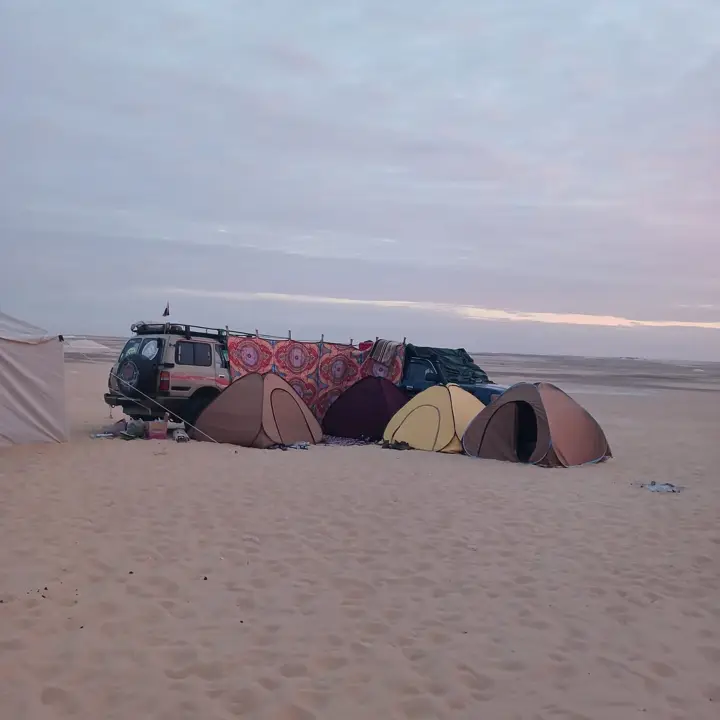
2 or 3 days
Private White Desert camping in comfortOn request (depends on group size and nights)
Check dates