
The short answer
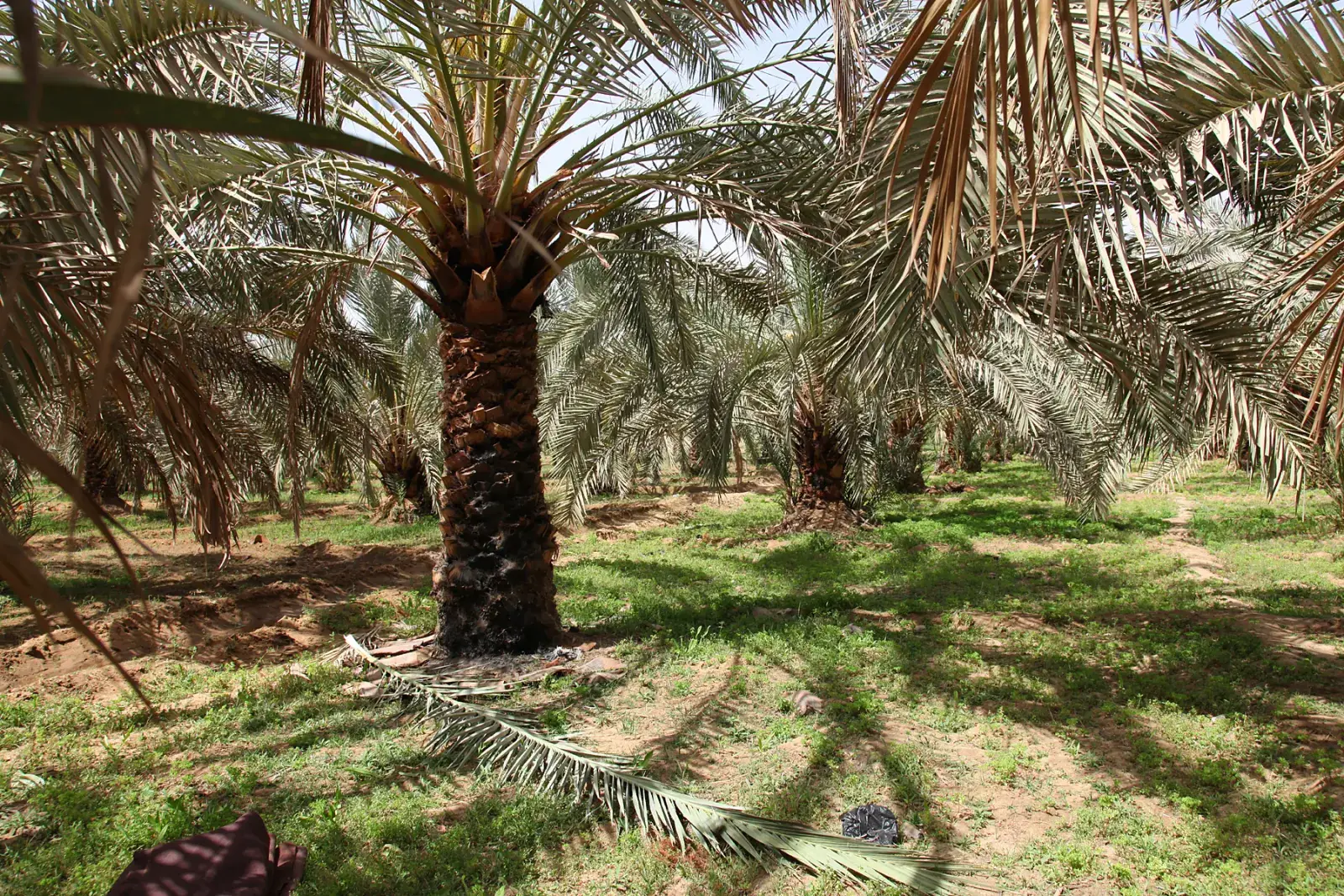
There are no hotels inside the White Desert: you either camp among the formations or sleep in an oasis town. Bahariya, two hours north, has the most choice, from palm-grove camps to Qasr El Bawity's stone suites. Farafra, 45 minutes south, has a few family-run hotels closest to the chalk. Most travellers combine one night camping with one in a lodge.
Ask us on WhatsAppYour four options
Short answer: Camp in the desert, stay in a Bahariya lodge, stay in a Farafra hotel, or, on a longer journey, add a lodge in Dakhla or Siwa.
| Option | Where | Distance to the chalk | Comfort | Best for |
|---|---|---|---|---|
| Standard desert camp | Inside the White Desert | You're in it | Basic: mattress, blankets, windbreak | The classic experience |
| Comfort or private camp | Inside the White Desert | You're in it | Higher; see glamping | Couples, families, older travellers |
| Bahariya lodge or hotel | Bawiti and around | About 2 hours | Simple to charming | A softer night, antiquities, springs |
| Farafra hotel | Qasr Farafra | About 45 minutes | Simple, friendly | Sunrise without camping |
| Lodge on a longer journey | Dakhla or Siwa | 4 to 5 hours, or a separate trip | Highest available | Honeymoons, slow travel |
Checked November 2026: White Desert National Park has been a protected area since 2002, and there is still no hotel, cabin or permanent camp inside it. Every bed in the park is a camp that arrives with the crew and leaves the next morning. The park covers about 3,133.5 km² of New Valley Governorate under Prime Minister's Decree No. 1220 of 2002, according to the EEAA protectorate table. Entry carries a government protected-area fee for foreign visitors, collected through the operator and shown as its own line in your quote. See White Desert National Park.
Camping in the desert
Short answer: The night in the desert is the reason to come; a standard camp suits most people, and a private comfort camp suits anyone who wants a real bed.
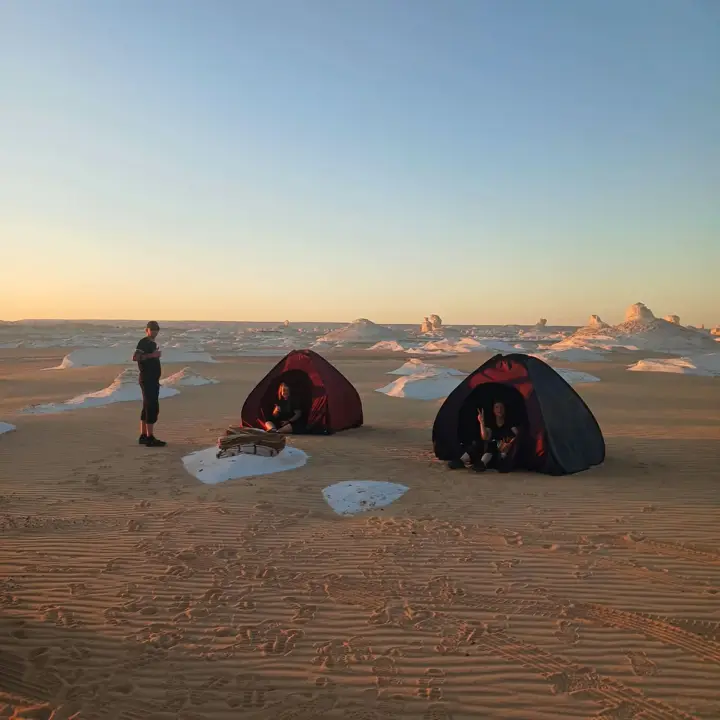
On a standard trip, the crew sets up camp between the formations as the sun goes down. They build a windbreak of carpets against the 4x4, lay mattresses and thick blankets, light a fire and cook dinner. You sleep in the open or in a simple dome tent. Dinner by the fire, the silence and the desert foxes that come to the edge of the light are what guests talk about afterwards. What catches people out is the cold: in winter, nights in the open desert can fall close to freezing, so bring layers; spare blankets and sleeping bags are on request.
Comfort extras such as a walk-in tent and duvets are on request; see glamping. If you want a toilet tent, ask us when you book and we'll confirm what's possible for your trip. On a private trip we camp away from other groups, choosing the spot with a light-pollution map for the darkest sky, and if strong wind blows up you can switch to a lodge night in Bahariya instead. Nothing stays behind either way: the camp is gone by mid-morning. Read camping in the White Desert, tent or open air and where we camp.
Lodges and hotels in Bahariya
Short answer: Around two dozen places in and around Bawiti, from palm-wood camps to the stone suites and hot-spring pools of Qasr El Bawity.
Bahariya is where most travellers sleep in town, about two hours' drive from the main chalk fields.
- Qasr El Bawity: hand-built stone suites on a hillside, with iron-red hot-spring plunge pools. The treat night of the oasis.
- Tzila Bahariya: a domed eco-lodge in Az Zaytun with a year-round pool and a bar. Calm and green.
- International Hot Spring Hotel and Desert Rose Eco Lodge: mid-range, each built beside warm spring water.
- Palm-grove camps such as Ahmed Safari Camp: simple huts and a family dinner for very little money.
A night here suits a three-day trip, a late start from Cairo, the Golden Mummies and painted tombs, or anyone who wants a hot shower between desert days. Full profiles, a comparison table and advice by traveller type are in hotels in Bahariya.
Bawiti is about 370 km from Cairo, and the drive takes 4.5–5 hours from central Cairo with a stop, so a lodge night here also splits the road in two. See the Cairo to Bahariya drive.
Hotels in Farafra
Short answer: A handful of family-run hotels, led by the domed Badawiya; the closest beds to the main chalk fields.
Farafra is smaller and quieter, and its hotels are simple.
- Badawiya Farafra: mud-brick domes, the town's biggest pool and a farm-fed kitchen.
- Rahala Safari: a quiet, artistic courtyard hotel off the main road.
- Aqua Sun: beside the Bir Sitta warm spring, with a pool filled from it.
They come into their own on a three-day loop, or for travellers who want to be among the formations at sunrise without sleeping in a tent. Farafra is entirely dry. For the town itself, its museum, fortress and springs, see Farafra Oasis. Our separate guide to hotels in Farafra profiles each one.
Bahariya or Farafra: side by side
Short answer: Bahariya wins on choice, food, springs and sights; Farafra wins on distance to the chalk and quiet. They are about 180 km apart.
Bawiti to Qasr Farafra is about 180 km, with the national park in between. Which town you sleep in mostly decides how early you reach the formations, and what else you can do that day.
| Bahariya (Bawiti) | Farafra (Qasr Farafra) | |
|---|---|---|
| Distance to the main chalk fields | About 2 hours | About 45 minutes |
| Number of places to stay | Around two dozen | A handful |
| Range | Budget camps to stone suites | Simple to mid-range |
| Hot springs | Several, including hotel pools | Bir Sitta, about 6 km west of town |
| Sights | Golden Mummies, painted tombs, Black Desert on the way | Badr's Museum, the old fortress, palm gardens |
| Alcohol | A couple of hotels | None; the town is dry |
| Cash | Banks with ATMs, which can be empty | Don't count on an ATM |
| Best for | Breaking the drive, archaeology, a treat night | Sunrise without a tent, onward travel to Dakhla |
| Main trade-off | A long drive to sunrise | Little choice; most beds fill early |
Our honest view: on a three-day trip, Bahariya is the better town night because it sits on the road back to Cairo. Farafra earns its place on four days or more, or when the trip continues south.
On a longer journey
Short answer: Continue south to Dakhla for Al Tarfa or Desert Lodge, or make Siwa's Adrère Amellal a separate leg via Cairo or the coast.
These are stays to build a slower trip around, not a night before the desert.
- Al Tarfa Desert Sanctuary, Dakhla: the Western Desert's best-known luxury eco-lodge, around twenty earthen-walled rooms and suites with a spa, pool, riding and its own protected dunes, about four to five hours beyond the chalk.
- Desert Lodge, Dakhla: a solar-powered mud-brick lodge of some thirty rooms on the hill above medieval Al-Qasr, cooking with vegetables from its own farm; the more affordable Dakhla choice.
- Adrère Amellal, Siwa: salt-rock and mud walls beneath the White Mountain, no electricity, candlelight and fires in winter. It is a separate trip from Cairo, not a drive across from Bahariya; the FAQ below and the gov.uk travel advice (checked 19 November 2026) explain why. See White Desert vs Siwa.
Al Tarfa and Desert Lodge are small and book ahead in winter. Give Dakhla two nights at least; the drive alone takes most of a day. From Farafra, Dakhla's main town, Mut, is roughly 300 km south.
Where you'll sleep warmest, month by month
Short answer: From October to November and in March, camping is easy. From December to February, take a tent or add a lodge night. From June to September, nights at camp are warm, and any lodge night needs air conditioning.
The season changes the right answer more than your budget does. The camp figures below are from our weather and night temperatures guide. Open-desert camps run colder than the Farafra weather station, often by 2–4°C by dawn.
| Months | Night at camp | Our suggestion |
|---|---|---|
| December to February | About 0–6°C, frost possible in January | Tent, sleeping bag and blankets; a lodge night either side helps |
| March | About 6–10°C | Camp; a windproof layer matters as the khamaseen season begins |
| April to May | About 10–18°C | Camp, but April has the highest wind and dust risk; keep a lodge as a back-up |
| June to September | About 17–22°C | Camp in the open; insist on air conditioning in writing for any lodge night |
| October to November | About 7–16°C | The easiest camping of the year; a fleece is enough |
Bahariya is within about 1.5°C of Farafra in every month, so the town you choose does not change the weather. What changes is walls and a roof. Many traditional rooms rely on domes and fans, which can struggle in the summer heat.
Camp, lodge or hotel: how to decide
Short answer: Camp if the desert night is the point; add a lodge if cold, toilets or the long drive worry you; use Farafra if you want sunrise without a tent.
The question we get most is whether to camp at all. Our honest answer, by traveller:
- First-timers on two days: camp. Bahariya is only a lunch stop, and the night among the chalk is what you came for. See first-time desert camping.
- Light sleepers and winter travellers: camp one night in a tent, then sleep in a lodge. Check weather and night temperatures for your month.
- Worried about toilets: ask us about a toilet tent for your trip, and a lodge night either side helps too.
- Families with young children and older travellers: break the 370 km drive from Cairo with a Bahariya night. See the White Desert with kids.
- Photographers: camp, or sleep in Farafra and drive out before dawn. See photography.
- Honeymoons: a private camp plus a Qasr El Bawity suite. See luxury White Desert trips.
- Eclipse watchers, August 2027: sleep in Bawiti or at camp. Farafra town is outside the path of totality, at about 99.7%. See the 2027 eclipse.
If you'd rather not camp at all
Short answer: Sleep in Bahariya the first night and Farafra the second. You still see the chalk at sunset and at sunrise, with a bed and a shower each night.
A lodge-only trip works because Farafra is so close to the main chalk fields. It takes three days and looks like this:
- Day one. Cairo to Bawiti, then a lodge night in Bahariya, with time for a spring soak.
- Day two. South through the Black Desert and Crystal Mountain to the White Desert for the afternoon and sunset. Then 45 minutes on to a Farafra hotel.
- Day three. Out in the dark for sunrise among the formations, back for breakfast, then the long road north to Cairo via Bawiti.
The trade-offs are real. You give up the darkest sky of the trip, you drive the 45 minutes to Farafra after dark, the last day is a long one on the road, and Farafra's few rooms need booking early. In return you get walls, a roof and a bathroom every night. This plan suits travellers with limited mobility, anyone nervous about a night outdoors, and winter trips when the cold puts people off. If you need a ground-floor room or a walk-in shower, ask us and we'll check with each hotel before you book.
What each kind of night gives up
Short answer: A camp gives up the shower; a Bahariya lodge gives up the sunrise; a Farafra hotel gives up choice and the antiquities.
No option does everything, and it helps to know what you're trading before you book.
| Desert camp | Bahariya lodge | Farafra hotel | |
|---|---|---|---|
| Sunset among the chalk | Yes | Only if you drive back in the dark | Possible, 45 minutes back to town |
| Sunrise among the chalk | Yes, from your mattress | Hard: about 2 hours' drive before dawn | Yes, with an early start |
| Hot shower | No | Yes | Yes |
| Proper bed | Only with comfort extras | Yes | Yes |
| Dark sky and stars | The darkest | Town lights; edges of the oasis are darker | Town lights |
| Phone charging | No sockets | Yes | Yes |
| Phone signal | Usually none | Good in town | Good near town, fading about 20 km out |
| Antiquities nearby | No | Golden Mummies, painted tombs | Badr's Museum, old fortress |
Sunset and sunrise shape all of this. In mid-December the sun sets at about 17:15 and rises at around 06:49, so a winter camp night is long and cold. See sunrise and sunset.
Which combination works best
Short answer: Two days: camp. Three days: one lodge night and one desert night. Longer: add Farafra, then Dakhla.
| Trip | Suggested nights |
|---|---|
| 2 days, 1 night | Camp in the White Desert |
| 3 days, 2 nights | Bahariya lodge, then White Desert camp (or the reverse) |
| 3 days, no camping | Bahariya lodge, then Farafra hotel, with sunrise in the chalk |
| 3 days, a treat | Qasr El Bawity suite, then a private camp, then Cairo |
| 4 days | Bahariya, White Desert camp, Farafra, return |
| 6 to 8 days | Bahariya, camp, Farafra, two or three nights in Dakhla, then Kharga, Luxor or Cairo |
On the longest loop you can fly back from Kharga when flights run. Siwa is always a separate leg. See how many days you need, the three-day trip, the 4-day itinerary and one week with Siwa.
What to expect in oasis lodges
Short answer: Simple, clean rooms, hot water, set dinners, cash payment, slow Wi-Fi and very little alcohol.
Even the best lodges here are rustic by city standards. Expect handmade furniture, domes and fans rather than air conditioning in many rooms, and early, set dinners. Breakfast is Egyptian. Wi-Fi is fine for messages but slow for anything heavy. Payment is often cash only, so read money and ATMs before you leave Cairo. Only a couple of Bahariya hotels serve alcohol, and Farafra is entirely dry. In summer, insist on air conditioning in writing. In both towns you usually eat where you sleep, with a few simple cafés on the main road.
A few practical points:
- Plugs. Egypt uses the two-pin plug types C and F, at 220 V and 50 Hz (Wikipedia, mains electricity by country, checked 19 November 2026). Charge everything before a camp night.
- Dress. Both oases are conservative farming towns. Cover shoulders and knees in town; normal swimwear is fine in a hotel's own pool. At Bir Sitta, wear a T-shirt over your swimsuit. See what to wear.
- Dietary needs. Dinner is nearly always set, so tell us early about vegetarian or other needs and we'll pass them on.
- Early starts. If you need breakfast before the hotel's usual time, or a packed breakfast for a Farafra sunrise, ask us and we'll arrange it with the hotel.
Questions to ask before you book
Short answer: Ask what's included, what happens if the wind blows up, and what the room actually has, in writing.
Whoever you book with, these questions save surprises:
- Is the lodge night in the price, or an extra you add yourself? See what the cost includes.
- Does the room have air conditioning or heating, and is that confirmed in writing?
- What happens if a strong wind makes camping unpleasant? On our trips you can switch to a lodge night.
- Is a toilet tent possible on your trip? Ask us.
- Are single, triple or family rooms available for your dates? Ask us.
- Is the camp shared with other groups, or private? See shared or private trip.
- How will you pay for drinks and extras: cash, card or neither?
For more on choosing who to travel with, read how to choose an operator.
Booking
Short answer: We book the lodge and the desert together and include both in one price.
Many lodges also run their own desert trips and fill up with their own guests in high season. Booking the bed and the camp as one plan saves you from gaps. Message us on WhatsApp with "where to stay", your dates, how many of you there are and your budget. We'll come back with options and one all-in price, with permits, driver-guide and 4x4 included, and the park fee shown as its own line.
Questions people ask
Is there luxury accommodation near the White Desert?+
Not international five-star hotels. Luxury here means a private comfort camp inside the desert, a suite at Qasr El Bawity in Bahariya, or a longer drive south to Al Tarfa Desert Sanctuary in Dakhla, about four to five hours beyond the chalk.
Do I need to book a hotel separately?+
Not on our trips. If your itinerary includes a night in town, the lodge is part of the quote, and we choose it to match your style and budget. Booking bed and desert together also avoids lodges that fill with their own safari guests.
Should I stay in Bahariya or Farafra?+
Bahariya for choice, food, antiquities and the best lodges; Farafra for proximity to the main chalk fields, about 45 minutes away, and a sunrise start without camping. On a three-day loop we usually put the town night in Bahariya.
Can I sleep in the White Desert without a tent?+
Yes. Many travellers sleep in the open on a mattress behind a windbreak, under the stars. From December to February nights can drop close to 0°C, so a tent is warmer then; see our tent or open air guide.
When do lodges book out?+
From November to February, and especially over Christmas, New Year and Egyptian holidays. Book four to six weeks ahead for the best lodges in high season; Qasr El Bawity's few suites go first.
What is the most romantic place to sleep on a White Desert trip?+
A private camp just for two, pitched between the chalk towers, with dinner by the fire and a full moon if your dates allow. Pair it with a suite at Qasr El Bawity in Bahariya, the night before or after.
Can I combine Adrère Amellal in Siwa with the White Desert?+
Yes, as two separate legs. On the road between Bahariya and Siwa, the UK government advises against all but essential travel; we route via Cairo and don't use it. Siwa is reached from Cairo or along the Mediterranean coast, so allow at least six or seven days in total.
Do the desert lodges have electricity and Wi-Fi?+
The Bahariya, Farafra and Dakhla lodges have electricity, though Desert Lodge in Dakhla runs on solar power and Wi-Fi everywhere is slow. Adrère Amellal in Siwa has no electricity at all, only candles and firelight.
Can I charge my phone and camera at a desert camp?+
No. There are no sockets in the desert, so charge everything in your Cairo or Bawiti hotel and bring a power bank. Egypt uses the two-pin plug types C and F, at 220 V and 50 Hz. Cold drains batteries fast, so keep spares in your sleeping bag on winter nights.
Where should I stay for the total solar eclipse on 2 August 2027?+
Bahariya or a desert camp, not Farafra. Bawiti gets 6 minutes 19 seconds of totality, with the peak around 12:53 local time. Farafra town is outside the path, at about 99.7%, so you would have to drive north on the morning. Rooms in Bawiti are limited, so book as soon as you know your dates.
Is it worth sleeping in Farafra if I am already camping?+
Only on a trip of four days or more. On three days, one camp night already gives you sunset and sunrise among the chalk, and Bahariya is on the way back to Cairo. Farafra makes sense when you continue south to Dakhla, or when you want a second sunrise without a second night outdoors.
Are there single rooms or solo options?+
Single, triple and family rooms vary from lodge to lodge, and the desert camp is shared with your own group only on a private trip. Ask us what's possible for your dates and group size before you book.
Can I sleep in a Bahariya lodge and still see sunrise in the White Desert?+
Only with a very early start. The main chalk fields are about two hours from Bawiti, and in mid-December the sun rises at around 06:49, so you would leave well before 05:00. For sunrise without camping, a Farafra hotel, about 45 minutes away, is the easier choice.
Do lodges get busier at Eid?+
Yes. The three days of Eid, and any long weekend around them, bring many Egyptian families and groups to Bahariya, and prices for cars and lodges rise. If you want quiet lodges and a quiet camp, avoid Eid weeks or book well ahead.
Is a lodge-only trip a good idea for older travellers?+
Often, yes. A Bahariya night followed by a Farafra night means a proper bed and bathroom every night, with the chalk at sunset and sunrise. Tell us about any mobility needs, such as stairs or a walk-in shower, and we'll check what each hotel can offer.
Go with us
Trips that include this
2 days, 1 night
White Desert overnight camping trip from Cairo (2 days, 1 night)About US$185 to 230 shared · US$360 to 460 private, per person
Check dates
3 days, 2 nights
3-day White Desert tour: Bahariya, the White Desert and two nights outAbout US$495 to 660 per person for two travellers, private
Check dates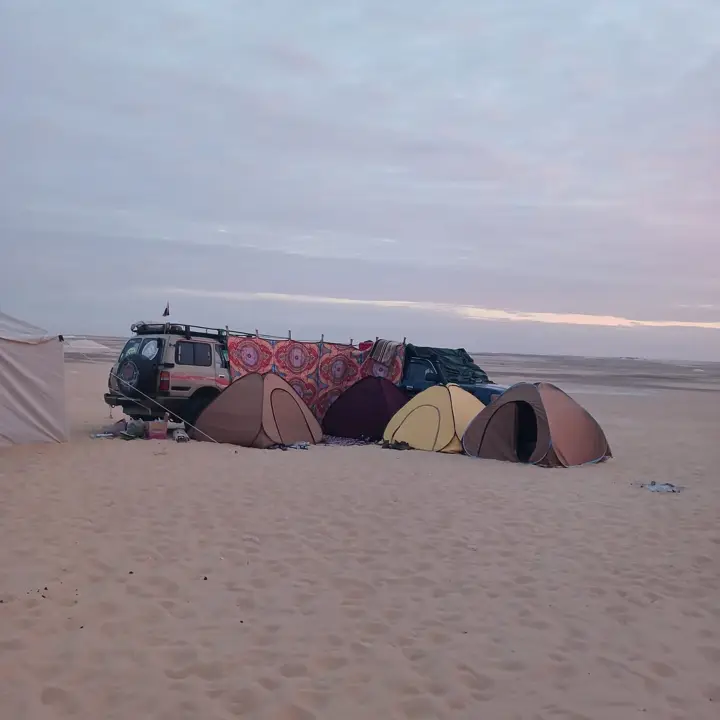
2 or 3 days
Private White Desert camping in comfortOn request (depends on group size and nights)
Check dates