
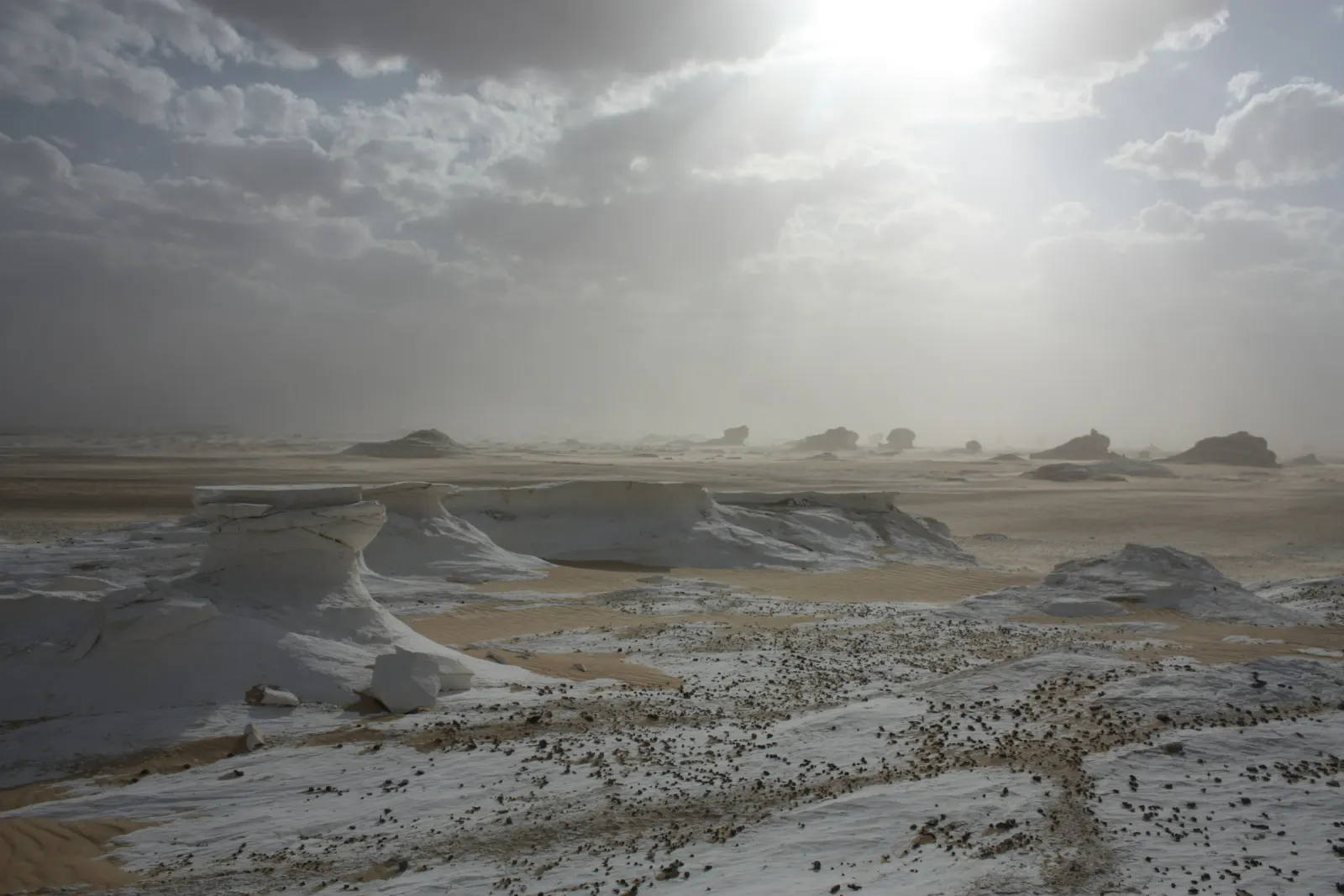
The short answer
The White Desert is warm by day and cold at night. Farafra's station averages 20°C by day and 4°C at night in January, and 38°C by day and 22°C at night in July. Open-desert camps run colder than the station: in December and January we often wake to 0–3°C. Rain is rare, about 2 mm a year.
Ask us on WhatsAppMonth by month
Short answer: Days run from about 20°C in January to 38°C in July; nights at camp from about 1–4°C in January to about 20–22°C in July, and wind risk peaks in April.
The day and station figures are long-term averages for Farafra (NOAA normals for 1961–1990, cross-checked with Japan Meteorological Agency normals and the Bahariya record), checked November 2026. The camp column is what we usually see at dawn in the open desert, from years of camping there, not an official measurement.
| Month | Day high | Night low, Farafra station | Night at camp (our experience) | Wind and dust risk | What to wear at night |
|---|---|---|---|---|---|
| January | 20°C | 4°C | 0–4°C, frost possible | Low; cold north wind some days | Down jacket, hat, gloves, thermals |
| February | 22°C | 6°C | 2–6°C | Low to moderate | Down jacket, hat, fleece |
| March | 26°C | 9°C | 6–10°C | Moderate; khamaseen season begins | Fleece and windproof shell |
| April | 32°C | 14°C | 10–14°C | Highest; khamaseen peak | Light fleece, buff for dust |
| May | 35°C | 18°C | 15–18°C | Moderate; last khamaseen episodes | Long sleeves, light layer |
| June | 38°C | 21°C | 18–21°C | Low | T-shirt; sheet or light blanket |
| July | 38°C | 22°C | 19–22°C | Low | T-shirt; sleep on top of the bag |
| August | 37°C | 22°C | 19–22°C | Low | T-shirt; sleep on top of the bag |
| September | 35°C | 20°C | 17–20°C | Low | Light layer for dawn |
| October | 31°C | 16°C | 12–16°C | Low | Light fleece |
| November | 26°C | 10°C | 7–10°C | Low | Fleece, hat after midnight |
| December | 21°C | 6°C | 2–6°C | Low; occasional cold wind | Down jacket, hat, gloves, thermals |
Bahariya, where trips start, is within about 1.5°C of Farafra in every month. Farafra's record low is −3.3°C, in January. Its record high is 47.8°C, in June, with 47.5°C recorded in May (Wikipedia, Farafra climate table, from NOAA normals (checked 19 November 2026)). Rain totals about 2 mm a year at Farafra and up to about 4 mm at Bahariya.
Old averages and recent years
Short answer: Recent years at Farafra run 1–3°C warmer at night than the 1961–1990 normals in the table above; days have barely changed. Pack for the older, colder figure.
The table above uses the long-term normals because they are the standard reference. Our best time to visit guide averages the station's records for 2009 to 2025 instead. The two sets disagree a little, mostly at night.
| Month | Night low, 1961–1990 normals | Night low, 2009–2025 average | Day high, 2009–2025 average |
|---|---|---|---|
| January | 4°C | 7°C | 20°C |
| April | 14°C | 15°C | 32°C |
| July | 22°C | 24°C | 39°C |
| October | 16°C | 18°C | 32°C |
| December | 6°C | 8°C | 21°C |
Both sets come from the station inside the oasis, and neither describes a night on open chalk. A warmer average does not rule out a cold northerly spell. For packing, use the colder column, then allow for camp being colder again.
White Desert and Cairo compared
Short answer: Days are similar to Cairo's, but nights in the desert are 6–10°C colder in winter. Pack for the desert, not for your Cairo hotel.
Many visitors spend a night or two in Cairo first and judge the desert by it. That is where packing goes wrong. The figures below are long-term averages for Cairo International Airport, 1991–2020 (Wikipedia, Cairo climate table (checked 19 November 2026)), next to Farafra station and our camp range.
| Month | Cairo day high | Cairo night low | Farafra day high | Farafra night low | Night at camp |
|---|---|---|---|---|---|
| January | 19°C | 10°C | 20°C | 4°C | 0–4°C |
| April | 28°C | 16°C | 32°C | 14°C | 10–14°C |
| July | 35°C | 24°C | 38°C | 22°C | 19–22°C |
| October | 30°C | 20°C | 31°C | 16°C | 12–16°C |
| December | 21°C | 12°C | 21°C | 6°C | 2–6°C |
In winter a Cairo evening in a light jacket becomes a desert night that needs a down jacket and a hat. Cairo is also wetter, with about 25 mm of rain a year against about 2 mm at Farafra. Bawiti is about 370 km from Cairo, 4.5–5 hours by car with a stop; see the Cairo to Bahariya drive.
Why camp nights are colder than the forecast
Short answer: The station sits in the oasis; our camps sit on open chalk and sand, where clear, still air lets the ground lose heat fast after sunset.
The temperatures on weather apps come from the station at Farafra, surrounded by palm gardens, irrigated fields and houses that hold warmth. Out among the formations there is nothing to hold heat. The air is so dry that once the sun sets the temperature falls quickly, often 15°C or more between late afternoon and dawn. The coldest moment is the half-hour before sunrise, not midnight. On a still, clear January night we have woken to a thin rime of frost on the sleeping bags.
Wind changes the feel more than the number. A light breeze at 6°C feels like 2°C. That's why the crew puts up a windbreak and chooses a camp spot in the lee of a formation.
What a January night at camp feels like
Short answer: Comfortable by the fire until about 22:00, cold once you step away from it, and fine in bed if you're dressed for it; the dawn is the sharpest part.
The question we get most in winter is "will I be cold?" Here is a typical January night. The sun sets at about 17:30 and the temperature falls fast. By 18:15 you want a fleece and a jacket. The crew lights the fire and dinner comes off the embers at around 19:00, and sitting close to the flames with tea it feels like a cool autumn evening. Walk 30 metres out to look at the stars and you feel the real temperature, around 6–8°C and falling.
By the time people go to bed it's about 4°C. In a warm sleeping bag with blankets on top, a hat on and dry socks, most guests sleep well. Sleeping bags and spare blankets are on request, so ask for them when you book a winter date. What catches people out is the morning: at 06:30, with the sky turning pink, it can be 1–2°C, and getting out of the bag takes resolve. The crew has the fire going and the kettle on before you're up, and by 09:00 the sun is warm enough for a T-shirt.
Ask for a tent in December and January, sleep in dry clothes and keep tomorrow's layers inside the bag. For the wider camp set-up see camping, and the packing list covers the layers. If you want to know the comfort rating of the sleeping bags on your trip, ask us when you book.
Summer heat: how we plan around it
Short answer: From June to September we avoid the middle of the day completely, spend the cool hours in the desert, and drink far more water than feels necessary.
Middays in the hot months reach 37–38°C on average, and the sun is very high. There is no shade among the formations. We plan summer trips like this:
- Later start from Cairo, around 08:00, and a long lunch and rest in Bawiti through the worst of the heat.
- Into the 4x4 at about 15:30 or 16:00, with short stops at the Black Desert and Crystal Mountain rather than climbs in the sun.
- Sunset in the formations after 19:30, dinner in the warm dark, and a night that's pleasant in a T-shirt.
- Sunrise walk at first light, around 06:00 in June and nearer 06:50 by mid-September, then breakfast and away before the heat builds.
Bring a wide-brimmed hat, long light sleeves, sun cream and electrolyte sachets, and drink before you feel thirsty. We carry plenty of drinking water in the 4x4s and never run out; ask the driver whenever you need a refill. Anyone sensitive to heat should avoid climbing the Black Desert hills in summer. On the plus side, summer nights are warm, clear and quiet, with the Milky Way high overhead. Our permits and safety guide covers the wider safety picture.
Heat and sky for the 2027 eclipse
Short answer: On 2 August 2027, plan for a hot, dry midday. The eclipse peaks around 12:53 local time, close to the hottest part of an August day.
August at Farafra averages about 37°C by day, and its long-term average rainfall is 0 mm (Wikipedia, Farafra climate table (checked 19 November 2026)), so cloud or rain is very unlikely. Totality lasts 6 minutes 24 seconds in the northern Black Desert, close to the centre line, and 2 minutes 5 seconds at the Mushroom and Chicken in the White Desert, according to timeanddate's calculations for those points. The hard part of the day is the heat.
Be in place early, sit in shade until the partial phase is under way, and drink steadily from mid-morning. The viewing spots and the camp plan are in our total solar eclipse 2027 guide.
Rain, frost and cold snaps
Short answer: Rain is rare and brief, frost happens on a few still January nights, and a cold snap can push the open desert just below 0°C in December or January.
- Rain: a shower is possible between November and January when a winter front crosses. It clears within hours. Camps don't flood, but the tracks can turn sticky for a while, so the drivers slow down.
- Frost: only on calm, clear nights in midwinter, and only in the open desert. It is gone within half an hour of sunrise.
- Cold snaps: a few nights each winter, a cold northerly airflow drops camp below 0°C. On those nights a tent and extra blankets make the difference; spare blankets are on request.
- Humidity: very low all year, which is why the stars are so sharp and why your lips and hands dry out. Bring lip balm and hand cream.
How dry is dry? Average relative humidity at Farafra runs from about 26% in May and June to about 55% in November, with a yearly average of about 38% (Wikipedia, Farafra climate table (checked 19 November 2026)). Sweat evaporates fast, so you lose water without noticing; drink by the clock, not by thirst.
Wind
Short answer: Most nights are calm; strong, dusty wind is likeliest from March to May, peaking in April, and winter wind is cold rather than dusty.
Wind makes a night feel several degrees colder than the number above. On private trips, if the wind is strong you can switch to a night in a Bahariya lodge instead of camp. A buff or scarf for your face, sunglasses and a bag for your camera cover most windy days.
Checking the forecast before you go
Short answer: Check Farafra or Bawiti three to five days out, take 2–4°C off the night low, and watch the wind as closely as the temperature.
Few forecasts name the White Desert itself, and those that do are model estimates for empty desert. Use the nearest towns and adjust.
| What to look at | Why it matters | What to do |
|---|---|---|
| Night low, Farafra or Bawiti | Camp is usually 2–4°C colder by dawn | Pack for the adjusted figure |
| Wind speed and gusts | A breeze makes 6°C feel like 2°C; strong wind brings dust | Add a windproof shell and a buff |
| Dust or strong wind, March to May | The khamaseen can blow for a day or two | Keep a spare day if you can |
If a strong wind or a cold snap is forecast for your dates, message us. Whether a trip can move to another date because of weather, and on what terms, is something to ask us before you book; see our booking terms too.
What to wear
Short answer: Layers in every season: sun protection by day, and from November to March a proper warm jacket, hat and gloves for the night.
The last column of the month table above gives the night layer for each month. Our full list is in what to wear, and the packing list covers everything else.
Our advice
Short answer: For the easiest weather choose October, November or March; for the clearest skies and crisp nights choose December to February and pack warm.
- If cold nights worry you, choose November or March.
- If you're coming for stars or the Geminid meteor shower in December, bring the warmest layers you own.
- If you can only travel in summer, it's still worth it; follow our heat plan and book a later start.
- Spring trips are lovely but carry the highest wind risk; keep a day of flexibility if you can.
- See the best time to visit for crowds, holidays and moon dates alongside the weather.
Questions people ask
How cold is the White Desert at night?+
From December to February, nights at camp usually fall to about 1–6°C, and on still, clear nights in January the sand can be close to freezing by dawn. Farafra has recorded −3.3°C. From June to September nights stay around 19–23°C, warm enough to sleep on top of a sleeping bag.
Why is it colder at camp than the forecast says?+
Forecasts and the averages you find online come from the weather station at Farafra, in the oasis. Camps sit out on open desert, away from palm gardens and buildings, and on a calm, cloudless night the ground loses heat straight to the sky. We usually find camp 2–4°C colder than the station by dawn.
Does it rain in the White Desert?+
Almost never. Farafra averages about 2 mm of rain a year, on less than one day. A brief shower is possible between November and January when a winter front crosses, and it clears within hours. We don't carry rain gear, but a windproof layer is always useful.
How much does the temperature drop between day and night?+
Often 15°C or more. The air is so dry that heat escapes fast after sunset. A typical January day of 20°C becomes 6–8°C by 20:00 and 1–2°C at dawn; a July day of 38°C still falls to about 20°C by dawn. The coldest moment is just before sunrise.
Does it ever freeze or snow in the White Desert?+
It doesn't snow, but frost is possible. On still, clear nights in January we have woken to a thin rime of frost on the sleeping bags, and Farafra's record low is −3.3°C. The white you see everywhere is chalk, not snow or ice.
Is the White Desert too hot in summer?+
Middays from June to August reach 37–38°C on average and on the hottest days can pass 45°C, so we don't walk in the open between about 11:00 and 16:00. Trips leave later, rest in Bawiti through the heat, and reach the formations for sunset. The nights are warm and pleasant.
Which months have the mildest weather?+
October, November and March. Days are about 26–31°C and nights at camp roughly 6–16°C, so you need only a fleece after dark. For a full ranking that also weighs crowds, holidays and the sky, see our best time to visit guide.
Is the White Desert colder than Cairo?+
By day the two are close, within a few degrees. At night the desert is much colder. In January, Cairo airport averages a low of about 10°C, Farafra station about 4°C, and our camps 0–4°C. If you pack only for Cairo in winter, you will be cold at camp.
Which weather forecast should I check before my trip?+
Look at the forecast for Farafra or Bawiti, the nearest towns with data, a few days ahead. Take 2–4°C off the night low for camp, and look at the wind speed and gusts as well as the temperature. Wind changes how a night feels more than a degree or two does.
Why do different websites give different night temperatures?+
They use different periods. Long-term normals for 1961–1990 give Farafra a January low of about 4°C. Recent years, 2009 to 2025, average about 7°C. Both are station figures from inside the oasis. For packing, plan on the colder figure, then allow for camp being colder still.
What will the weather be like for the August 2027 eclipse?+
August is one of the hottest months, with Farafra averaging about 37°C by day. Peak eclipse is around 12:53 local time, so you will be outside near the warmest part of the day. Plan for shade, a hat, plenty of water and a rest before and after.
Go with us
Trips that include this

2 days, 1 night
White Desert overnight camping trip from Cairo (2 days, 1 night)About US$185 to 230 shared · US$360 to 460 private, per person
Check dates
3 days, 2 nights
3-day White Desert tour: Bahariya, the White Desert and two nights outAbout US$495 to 660 per person for two travellers, private
Check dates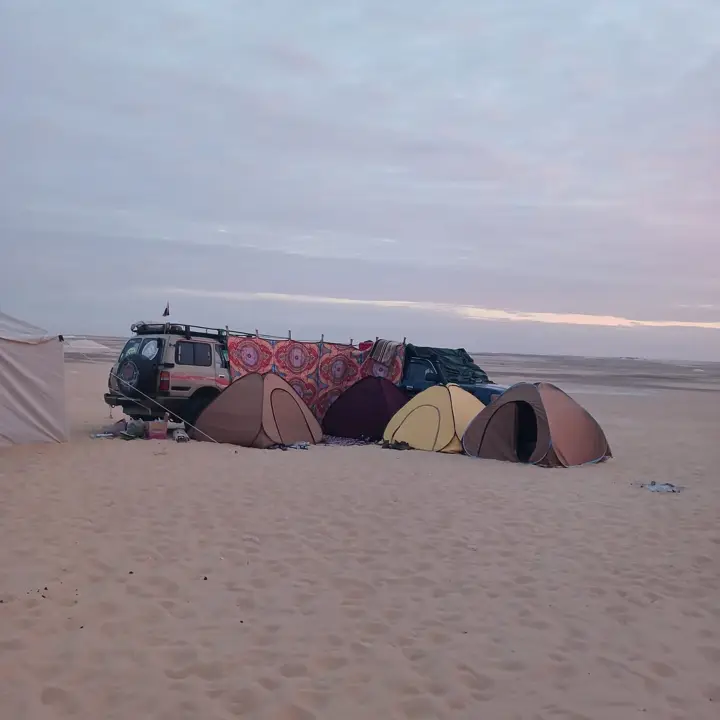
2 or 3 days
Private White Desert camping in comfortOn request (depends on group size and nights)
Check dates