
The short answer
The best meteor nights in the White Desert over the next year are the Geminids on 13–14 December 2026, under a thin crescent moon that sets in the evening, and the Eta Aquariids before dawn on 5–6 May 2027, at new moon. The Quadrantids on 3–4 January 2027 are good but brief. The 2027 Lyrids and Geminids are spoiled by a full moon.
Ask us on WhatsAppThe calendar at a glance
Short answer: Of the nine notable showers between December 2026 and December 2027, three are worth planning a trip around from the White Desert: the Geminids in December 2026, the Quadrantids in January 2027 and the Eta Aquariids in May 2027.
Checked November 2026 against the International Meteor Organization's 2026 Meteor Shower Calendar for the December 2026 showers, its 2027 calendar for the rest, and the American Meteor Society's moon figures. The rate is the zenithal hourly rate (ZHR): what a single observer would see in an ideal sky with the radiant straight up. Actual counts run lower, but the comparison between showers holds. Dates are the night of the peak; local times are Egypt time.
| Shower | Peak night | Peak rate (ZHR) | Moon at the peak | Our verdict |
|---|---|---|---|---|
| Geminids 2026 | 13–14 Dec 2026, best 01:00 to dawn | 150 | Waxing crescent, under a fifth lit, sets about 21:00 | Excellent. The best of the period |
| Ursids 2026 | 22–23 Dec 2026 | ~10 | Bright waxing gibbous, ~96% | Poor; skip |
| Quadrantids 2027 | Pre-dawn 4 Jan 2027, peak ~05:25 local | ~80 (60–200) | Thin waning crescent, 12–18% | Good, but brief. The peak lasts about six hours |
| Lyrids 2027 | 22–23 Apr 2027 | ~18 | Two days past full, about 95% | Poor; moonlight all night |
| Eta Aquariids 2027 | Pre-dawn 5–6 May 2027 | ~50 (40–80+) | New moon, under 1% | Very good. Better here than from Europe |
| Southern Delta Aquariids 2027 | 30–31 Jul 2027 | ~25 | Thin waning crescent, ~7%, rising only before dawn | Good, on warm nights |
| Perseids 2027 | 12–13 Aug 2027 | ~110–120 | Waxing gibbous, ~80–85% | Fair; watch after moonset, before dawn |
| Orionids 2027 | 21–22 Oct 2027 | ~20 | Last quarter, ~58% | Fair to poor |
| Leonids 2027 | 17–18 Nov 2027 | ~15 | Waning gibbous, ~80% | Poor, unless a forecast outburst on 20 Nov shows |
| Geminids 2027 | 14–15 Dec 2027 | 150 | Full moon on 13 Dec, ~97% | Poor; do not plan around it |
We'd rather tell you now that two famous showers fall on bad dates than have you drive five hours for a moonlit sky. The 2027 Geminids peak the evening after full moon, and the 2027 Lyrids two days after it.
The three nights worth planning for
Short answer: Geminids on 13–14 December 2026 first, Eta Aquariids before dawn on 5–6 May 2027 second, Quadrantids before dawn on 4 January 2027 third.
Geminids, 13–14 December 2026. This is the one we'd move a holiday for. The Geminids are the most reliable shower of the year, rich in slow, bright meteors that often leave a short glowing trail. At camp the radiant in Gemini rises in the north-east at about 18:45 and stands almost overhead at about 02:05. New moon is on 9 December, so on the 13th the moon is a crescent four or five days old that sets at about 21:03, leaving the rest of the night dark. The IMO's 2026 calendar puts the maximum at 14:00 UT on the 14th (16:00 in Egypt, in daylight), with a ZHR of 150. The maximum is broad, with ZHRs of 100 or more for roughly 10 to 12 hours, and the IMO's window for recent peaks runs from 23:00 on the 13th to 20:00 on the 14th, Egypt time. So the best hours for us are from about 01:00 until astronomical twilight begins at about 05:25. Moon and sun times are from timeanddate.com for a point in the White Desert. The catch is the cold: December nights at camp often drop to 3–6°C. Our Geminids meteor camp is built around this night.
Eta Aquariids, 5–6 May 2027. These are debris from Halley's Comet. The radiant in Aquarius rises only a couple of hours before dawn, which is why the shower is weak from Europe and much better from the latitude of the White Desert, around 27°N. New moon falls on 6 May, so the sky is as dark as it gets. The window is short, from about 03:00 to 05:15, but Eta Aquariids are fast and many leave long trails as they skim in from the horizon. The nights are mild, around 15–18°C, so you can watch in a light layer. The same camp format we run for the Geminids works here, with a lighter bed and an earlier alarm.
Quadrantids, 3–4 January 2027. The peak is sharp, lasting only a few hours, and forecast for about 05:25 local time on the 4th, just before dawn. If the timing holds, the last two hours of darkness can be busy. The radiant sits lower in the sky from Egypt than from Europe, which costs some meteors. It's also the coldest night on this list, close to freezing at camp. Come for it if you're already in Egypt over New Year; see the White Desert in January.
How to watch a meteor shower at camp
Short answer: Sleep early, set an alarm for about 01:00, lie flat on a mat away from the fire with your feet to the camp, and look at the whole sky rather than the radiant.
The routine we use on our meteor camps:
- Eat early and sleep for a few hours. Dinner is at about 19:00 and we let the fire die down by 22:00. The best meteors come after midnight, and you'll enjoy them more rested.
- Alarm at about 01:00. The crew puts the kettle on. Hot tea or sahlab makes the first ten minutes in the cold much easier.
- Lie flat, away from light. We set reclining mats and bedding a short walk from camp, behind a formation that blocks any glow from the embers. Lie on your back with your head slightly raised.
- Look about halfway up the sky, not at the radiant. Meteors appear everywhere; the ones far from the radiant have the longest trails.
- Give your eyes 20 minutes. Night vision builds slowly and one glance at a white phone screen undoes it. Use red light only.
- Watch in blocks. Twenty minutes looking, five minutes talking, then back. Counting meteors out loud with the group keeps everyone awake.
- Stay until the sky greys. Rates usually rise towards dawn.
In winter, the cold catches people out more than anything else. Once you're lying still on the sand, your body loses heat quickly, even when the air is 5°C. Get into your sleeping bag with a hat and gloves on before you start, and put a blanket on top. Sleeping bags and spare blankets are on request, so ask when you book. Read camping in winter and what to wear.
What to bring
Short answer: Warm layers, a hat and gloves, a red torch, a power bank and a sky app downloaded before you lose signal; on our meteor camps the mats and hot drinks are part of the trip, and sleeping bags are on request.
- A down or synthetic jacket, a warm hat, gloves and thick socks (December and January)
- A head torch with a red-light mode, or red cellophane over a normal torch
- A sky app such as Stellarium, downloaded before Bahariya, since signal is weak or absent at camp
- A power bank: cold drains phone and camera batteries fast
- A thermos if you like your own drink; on our meteor camps there's tea on the fire through the night
- For photographers: tripod, spare batteries, lens cloth and a lens heater or hand warmer to keep dew off
Photographing meteors
Short answer: Use a wide lens on a tripod, shoot continuous 15–20 second exposures for an hour or more, and let the camera catch the meteors while you watch with your eyes.
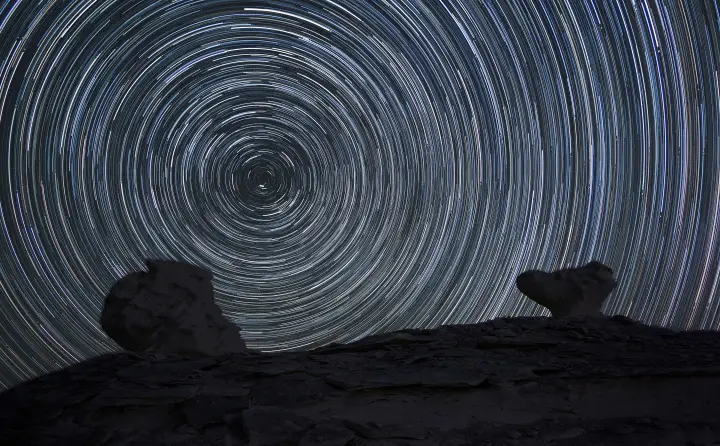
Meteors are random, so the method is volume. Put a camera on a tripod with the widest, fastest lens you have (14–24 mm, f/2.8 or faster). Set manual focus on a bright star, ISO 1600–3200 and exposures of 15–20 seconds, then use an intervalometer to shoot continuously. Point the camera about 45 degrees away from the radiant, with a chalk formation in the lower part of the frame for scale. Over two hours you might take 400 frames and find a handful of meteors. Later you can stack them onto a single background. Phones in night mode can catch the brightest fireballs, but don't expect many. Keep batteries in an inside pocket between sets. More in photographing the White Desert.
Why the White Desert suits meteor watching
Short answer: Small, distant towns, very dry air and a low, unbroken horizon give a sky dark enough for faint meteors; spring dust is the only regular spoiler.
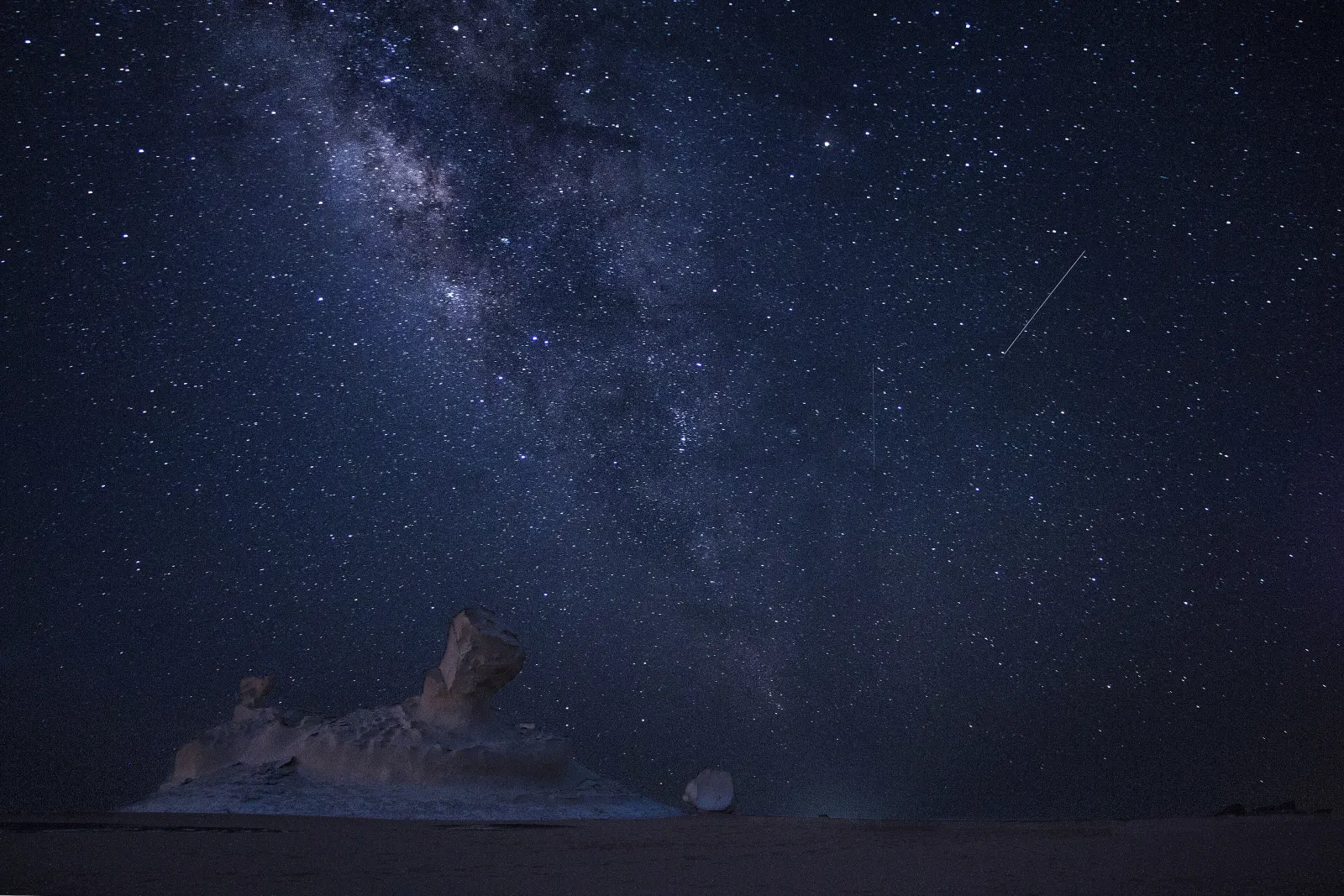
We choose our camp spots with a light-pollution map to find the darkest sky, and on private trips we camp away from other groups so no one else's lights spoil the view. The full explanation, and what else you'll see overhead, is in our stargazing guide; dark-sky dates are on the sunset and moon calendar.
Our advice
Short answer: If you can choose only one meteor trip in the next year, make it the Geminids on 13–14 December 2026; book a night that includes the peak, not the night after.
- Book the night of 13 December 2026 itself. The night before also gives decent rates. The evening of the 14th still falls inside the IMO's peak window, but the moon sets later (about 21:57) and the radiant is low until mid-evening, so it gives fewer good hours.
- If December is too cold for you, the Eta Aquariids in May 2027 are the warm alternative.
- Don't time a trip for the 2027 Geminids or Lyrids. Plan a full-moon night instead if those are your dates; full moon or new moon explains the trade-off.
- The Perseids in August 2027 fall 11 days after the total solar eclipse. The eclipse trip itself has moonless nights and early Southern Delta Aquariids; see the eclipse camp.
- Send us your dates on WhatsApp with "meteors" and we'll tell you honestly what the moon will be doing.
Questions people ask
When is the best meteor shower to see from the White Desert?+
The Geminids on the night of 13–14 December 2026. They are the richest shower of the year, with a ZHR of 150 in the International Meteor Organization's 2026 calendar, and the crescent moon sets at about 21:00 at camp, so the hours after midnight are fully dark.
How many meteors will I actually see?+
Fewer than the published peak rate, which assumes the radiant overhead and a perfect sky. In the White Desert on the Geminid peak night, you can hope for something like one a minute in the best hours after midnight if the sky is clear, though counts vary, with slow, bright ones among them. On an ordinary night you might see five to ten an hour.
Are the Perseids good from the White Desert in 2027?+
Only fair. The peak on 12–13 August 2027 comes with a waxing gibbous moon about 80% lit, so the evening is bright. Watch after moonset, in the hours before dawn, when the sky is dark enough for the brighter Perseids to stand out.
Should I plan a trip around the 2027 Geminids?+
No. The full moon falls on 13 December 2027, the evening before the Geminid peak, and its light washes out all but the brightest meteors. If you want Geminids, come in December 2026. In 2027 we'd point you to the Eta Aquariids in May instead.
Do I need binoculars or a telescope for meteors?+
No. Meteors move too fast and cover too much of the sky for any optical aid. Your eyes, a reclining mat, a warm sleeping bag and patience are the whole kit. Binoculars are still worth bringing for star clusters and the moon on other nights.
What time should I wake up to watch?+
For most showers the best hours are between about 01:00 and the first light of dawn, when your side of the Earth faces the direction of travel and the radiant is high. For the Eta Aquariids, the useful window is short: roughly 03:00 to 05:15 local time.
Go with us
Trips that include this
2 days, 1 night
Geminids meteor camp in the White Desert (13–14 December 2026)About US$185 to 230 shared · US$360 to 460 private, per person
Check dates
2 days, 1 night
White Desert overnight camping trip from Cairo (2 days, 1 night)About US$185 to 230 shared · US$360 to 460 private, per person
Check dates
2 or 3 days
Private White Desert camping in comfortOn request (depends on group size and nights)
Check dates