
The short answer
Ain Khadra, the Green Spring, is a small spring ringed by palms and reeds in the northern Farafra Depression, inside White Desert National Park, and reachable only off-road by 4x4. It is a stop on day two of our three-day trip, priced at about US$495 to 660 per person for two travellers, private. One-night trips usually leave it out.
Ask us on WhatsAppWhat Ain Khadra is
Short answer: A small natural spring with palms and reeds in the northern Farafra Depression, inside White Desert National Park: a 30-minute look, or the picnic lunch on our three-day trip.
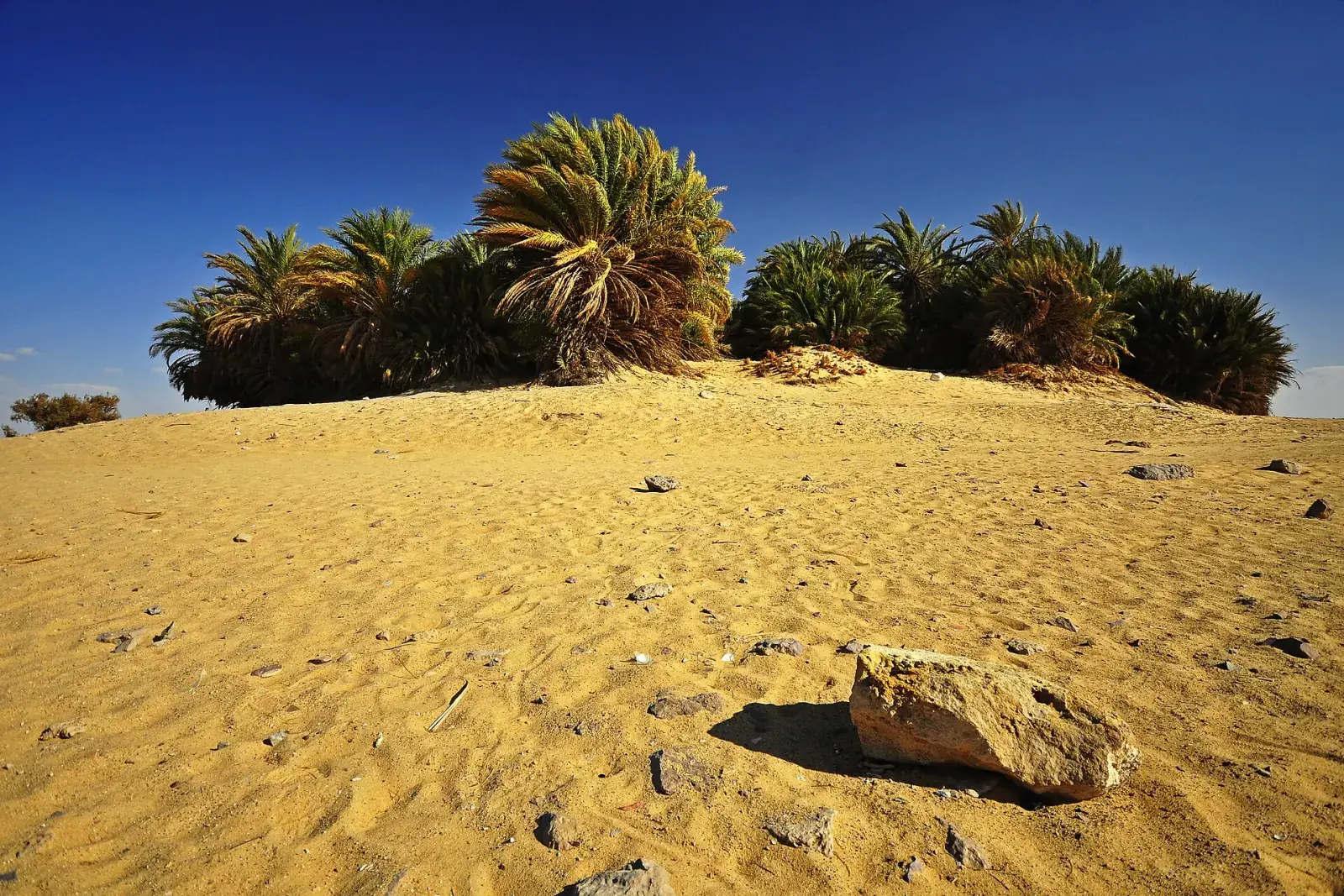
Ain Khadra means the Green Spring, and the name is the best description of it. After hours of white rock and pale sand, a knot of palm fronds and reeds appears among the chalk, fed by water rising from the ground. It is small. You can walk round the green patch in a few minutes, and our see-and-do overview allows about 30 minutes for the stop itself, plus the off-road drive in.
An article in Ancient Egypt magazine by Amir Ebrahim Elkorashy places Ain Khadra in the northern part of the Farafra Oasis, which lies between Bahariya and Dakhla, and describes its vegetation and clear water as relief from the surrounding desert (The Past, "Ain Khadra", issue 157, 21 October 2026 (checked 21 November 2026)). The author argues that remains around the spring show it was used for more than a quick drink, while stressing that the work rests on field visits, photographs, surface remains and satellite imagery, with no excavation. Treat any story you hear about who lived here and when as unconfirmed.
The spring lies within White Desert National Park, which covers about 3,133.5 km² of New Valley Governorate under Prime Minister's Decree No. 1220 of 2002 (EEAA protectorate table). For what else is inside the boundary, see the national park guide.
Why stop here
Short answer: Shade, green and quiet after a morning of white rock, and a small-scale picture of how the big oases work.
It isn't a dramatic sight in the way the Mushroom and Chicken are. Its appeal is contrast: palms against chalk cliffs, the sound of wind in the reeds, birds where the rest of the desert feels empty. In low morning or late light the green stands out most strongly against the white.
It also explains the oases you drive through. The park's 2007 draft management plan notes that plant life here depends mainly on groundwater and is concentrated in the wadis and around springs (EEAA, White Desert Protected Area management plan, draft 2007 (checked 21 November 2026)). Bawiti and Qasr Farafra are the same idea on a much larger scale: towns and gardens grown up around water from below. See Farafra Oasis and Bahariya Oasis.
What grows around the park's springs
Short answer: The 2007 plan lists date palm, common reed, Nile tamarisk and two acacias among the park's plants, mostly around springs and wadis.
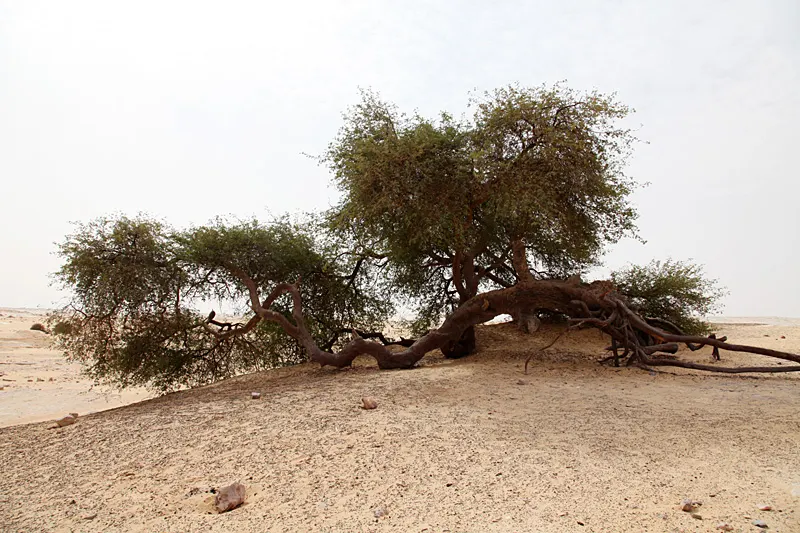
The management plan does not give a plant list for Ain Khadra alone. It gives one list for the park, and says the vegetation is concentrated around springs and wadis. The species below are the ones from that list you are most likely to notice at a spring like this; the plan describes some of its acacias and shrubs as scarce remnants that need careful protection.
| Plant (2007 plan's name) | Common name | What to look for |
|---|---|---|
| Phoenix dactylifera | Date palm | Tall fronds, the green you see first from a distance |
| Phragmites australis | Common reed | Dense, tall stems where the ground stays wet |
| Tamarix nilotica | Nile tamarisk | Feathery grey-green shrub or small tree |
| Acacia nilotica and Acacia raddiana | Acacias | Thorny trees with a flat, spreading crown |
| Alhagi graecorum | Camel thorn | Low spiny shrub on drier ground |
| Desmostachya bipinnata | Halfa grass | Coarse grass tussocks |
Source: EEAA, White Desert Protected Area management plan, draft 2007, section on plants (checked 21 November 2026). Spellings follow standard botanical usage where the plan has typing errors.
Wildlife at the spring
Short answer: Water draws birds and mammals; you are more likely to see tracks and birds than the animals themselves.
The same plan records at least 12 mammal species in the park, including fennec, red and Rüppell's foxes, the Dorcas gazelle, the sand cat and small rodents, and about 24 resident bird species. It adds that more than a hundred migratory species pass through, mostly in spring and autumn. Among reptiles and amphibians it lists one amphibian, the green toad, and expects it near water sources.
In practice, anything that visits the water leaves prints in the soft sand around it, so a spring is a good place to read tracks. Look early in the day, before wind and footsteps blur them: small paw prints, the looping trails of beetles, bird feet in the damp edges. Sit still for ten minutes and you will hear more than you see. Two species on the list, the slender-horned gazelle and the Barbary sheep, are flagged in the plan as possibly lost from the area, so don't hope for either.
How to see it from the White Desert
Short answer: It needs a second night out: the spring is on day two of our three-day trip and on the three-day private comfort camp.
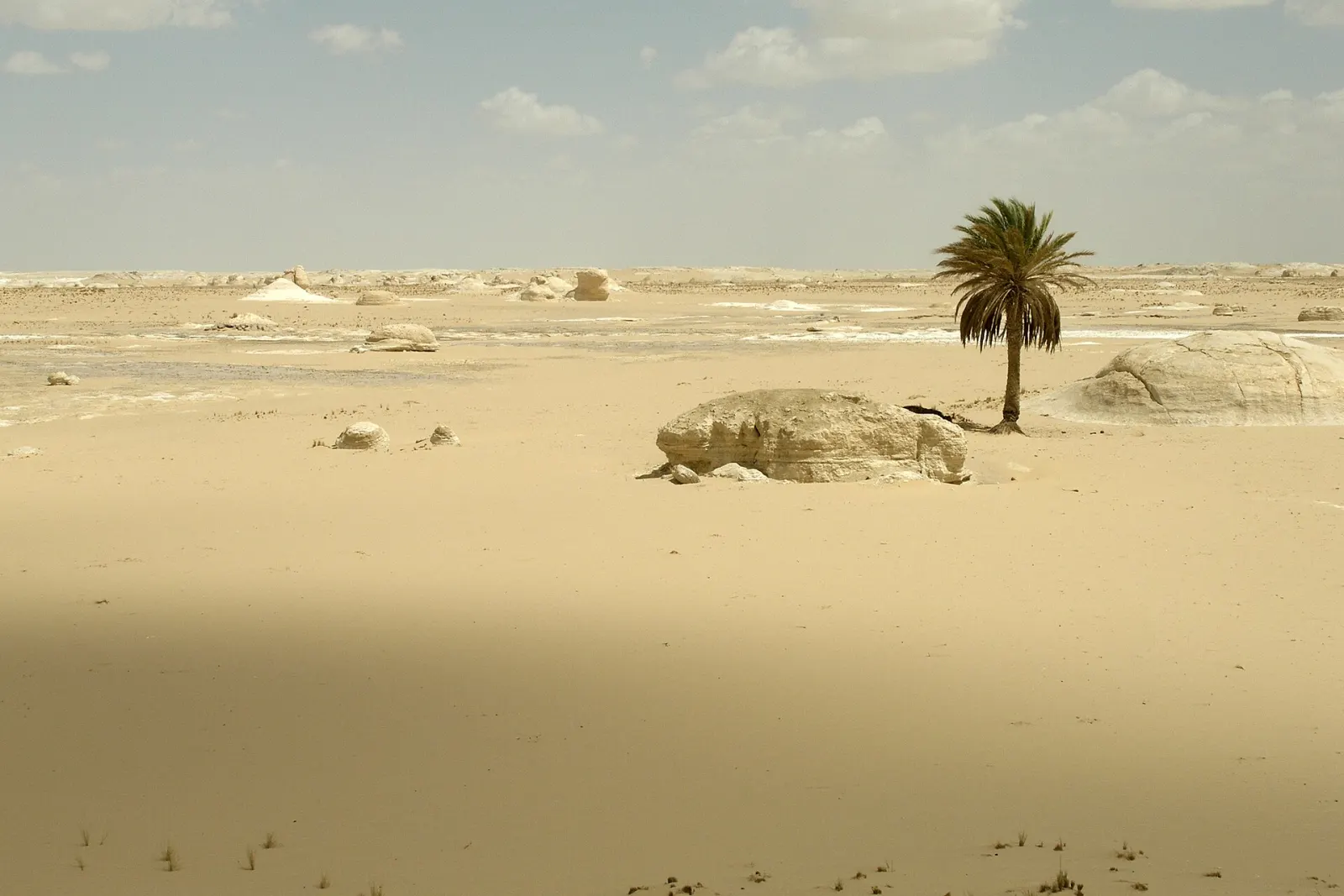
Ain Khadra is off-road only. There is no signpost or facility, and the tracks shift with the sand, so you need a 4x4 and a driver who knows the north of the park. On our three-day trip day two runs south from Bawiti through the Black Desert, Crystal Mountain and the Agabat valley, then heads off-road to Ain Khadra and the big towers of the New White Desert, ending among the mushroom shapes of the Old White Desert for sunset and camp. The published day plan has you leave the road for the New White Desert at about 12:00 and stop for a picnic lunch at the spring at about 13:00; the trip's stop table puts the New White Desert and Ain Khadra about 130 to 150 km from Bawiti, off-road, and gives them most of the afternoon. Price guide: about US$495 to 660 per person for two travellers, private. On its three-day version, private comfort camping gives a full day to the New White Desert and the spring, then a second night at camp, priced on request.
| Trip | Ain Khadra? | Price guide |
|---|---|---|
| Day trip from Cairo | No | About US$220 to 280 per person for two travellers, private |
| Overnight camping from Cairo | Not part of the usual route; ask us | About US$185 to 230 shared · US$360 to 460 private, per person |
| Three-day trip with two nights out | Yes, day two | About US$495 to 660 per person for two travellers, private |
| Comfort camping, 3-day version | Yes | On request (depends on group size and nights) |
| White Desert and Djara cave | Not in the itinerary; ask us | About US$605 to 825 per person for two travellers, private |
Whether a private one-night trip can fit it depends on your date and route, so ask us before you book rather than assume. Like everywhere in the park, foreign visitors need a permit arranged in advance, and the park has a government protected-area fee for foreign visitors, collected through the operator and shown as its own line in your quote. See permits and safety and how many days.
Light and timing
Short answer: Early morning for tracks and soft light; midday for shade. In winter the sun sets around 17:15, which is why the spring needs a full desert day.
The figures below are for 27.35° N, 28.40° E, the point our eclipse guide uses for Ain Khadra.
| Date | Sunrise | Sunset | Day length |
|---|---|---|---|
| 1 December 2026 | 06:38 | 17:11 | 10 h 33 min |
| 21 December 2026 | 06:51 | 17:16 | 10 h 25 min |
| 21 March 2027 | 06:09 | 18:18 | 12 h 08 min |
| 21 June 2027 | 06:12 | 20:04 | 13 h 52 min |
Source: timeanddate sun tables for December 2026, March 2027 and June 2027, local time (checked 21 November 2026).
A winter day of about ten and a half hours has to hold the drive from Bawiti, the northern sights, the spring and sunset in the Old White Desert. That is the practical reason it sits on three-day trips. If you want photographs or tracks, ask whether your route can reach the spring early; if you want a long lunch in the shade, midday is fine. For the rest of the light, see sunrise and sunset and photography.
Best time of year
Short answer: October to April. Farafra's average highs run from 20°C in January to about 38°C in June and July.
| Month | Average high, Farafra | Average low, Farafra | Average humidity |
|---|---|---|---|
| January | 20.0°C | 4.1°C | 51% |
| March | 26.2°C | 9.2°C | 38% |
| April | 31.6°C | 13.8°C | 29% |
| June | 37.8°C | 20.6°C | 26% |
| October | 31.2°C | 15.6°C | 42% |
| November | 25.5°C | 10.1°C | 55% |
| December | 21.1°C | 5.6°C | 53% |
Source: Wikipedia, Farafra climate table, from NOAA normals for 1961–1990 (checked 21 November 2026). The figures match our weather and night temperatures page.
From November to February a spot of shade is pleasant rather than essential, and insects are rarely a bother. From May to September the drive in is hot and the shade is the whole point. Spring and autumn bring the migrant birds, and warm still evenings near water bring a few mosquitoes, so pack repellent then.
The 2027 eclipse at the spring
Short answer: About 4 minutes 8 seconds of totality on 2 August 2027, peaking at about 12:53 local time.
Ain Khadra is inside the path of totality. timeanddate's calculation for 27.35° N, 28.40° E gives a partial phase from 11:29 to 14:16 local time, maximum at 12:53 and totality of 4 minutes 8 seconds (timeanddate, eclipse at 27.35° N, 28.40° E (checked 21 November 2026)). Other spots in the area differ. Totality lasts 6 minutes 24 seconds in the northern Black Desert, close to the centre line, and 2 minutes 5 seconds at the Mushroom and Chicken in the White Desert, according to timeanddate's calculations for those points. Our eclipse camp watches totality from the Black Desert or Bawiti.
Respecting the spring
Short answer: No soap, no rubbish, no firewood from the park, and keep off the plants at the water's edge.
Desert springs are small and fragile, and this one keeps birds and mammals alive. The 2007 plan asks that visitors and companies bring fuel from outside the park instead of burning its wild plants, and that inorganic waste be carried out of the protected area rather than dumped or buried (EEAA draft plan, 2007 (checked 21 November 2026)). At the spring that means:
- No washing with soap or shampoo in or near the water.
- No food scraps or fruit peel; they draw insects and change how animals behave.
- Walk on bare sand, not through the reeds.
- Leave pottery or stones where they lie; the archaeology here has not been excavated.
Our advice
Short answer: Book three days, bring repellent and binoculars, and treat it as a quiet rest stop, not a big sight.
- Insect repellent and a long-sleeved shirt for the shade by the water, from spring to autumn.
- Binoculars if you like birds, especially in spring and autumn.
- A hat and a refillable bottle; don't drink from the spring.
- Modest expectations: it's a small spring, not a lake.
Message us with "Ain Khadra" and your dates, and we'll tell you whether it fits your route. For the wider area, see things to do and the Old and New White Desert.
Sources: EEAA, White Desert Protected Area management plan, draft 2007; EEAA protectorate table; The Past / Ancient Egypt, "Ain Khadra"; timeanddate sun and eclipse data for 27.35° N, 28.40° E; Wikipedia, Farafra climate. All checked 21 November 2026.
Where it is
Schematic map, not to scale: positions are approximate, and the desert sites spread over many kilometres. The road runs about 180 km from Bawiti to Farafra; shaded areas show roughly where the black hills and the white chalk are.
Questions people ask
What does Ain Khadra mean?+
Ain is Arabic for a spring and khadra means green, so the name is simply the Green Spring. It describes what you see: a patch of palms and reeds standing out against white chalk and pale sand.
Is Ain Khadra inside White Desert National Park?+
Yes. It lies within the park, which covers about 3,133.5 km² of New Valley Governorate under Prime Minister's Decree No. 1220 of 2002 (EEAA protectorate table). The usual park rules apply: stay on existing tracks, take nothing, leave nothing.
Can you swim at Ain Khadra?+
No. It is a small spring that birds and other animals depend on, not a bathing pool. For a warm soak, go to the warm pools near Bawiti or Qasr Farafra; our hot springs guide lists them.
Can you drink the water at Ain Khadra?+
Don't. The water is untreated and shared with wildlife. Drinking water is listed as included on both trips that stop here, so bring a refillable bottle and fill it from the car's supply.
How long does the eclipse last at Ain Khadra on 2 August 2027?+
About 4 minutes 8 seconds of totality, with maximum eclipse at about 12:53 local time, according to timeanddate's calculation for 27.35° N, 28.40° E (checked 21 November 2026). The northern Black Desert gets over six minutes.
Which of your trips include Ain Khadra?+
Our three-day trip, on day two (about US$495 to 660 per person for two travellers, private), and the three-day version of private comfort camping (price on request). It is not on the day trip or the standard overnight.
Can I add Ain Khadra to a two-day trip?+
Ask us with your dates. It sits off-road in the north of the park, so on a single night it competes with sunset and camp for daylight; in December the sun sets at about 17:11 to 17:16 there. A second night is the relaxed way.
Are there mosquitoes at Ain Khadra?+
Sometimes a few. Standing water is where they breed, and the park's 2007 draft plan also expects green toads near its water sources. Bring repellent from spring to autumn; in December and January insects are rarely a problem.
Go with us
Trips that include this

3 days, 2 nights
3-day White Desert tour: Bahariya, the White Desert and two nights outAbout US$495 to 660 per person for two travellers, private
Check dates
2 or 3 days
Private White Desert camping in comfortOn request (depends on group size and nights)
Check dates