
The short answer
El Haiz lies about 50 km south of Bawiti, at the southern end of Bahariya Oasis, beside the road to Farafra and the White Desert. It has five small spring hamlets, and its main ruins, at El-Riz near Ain Ris, are a Roman-period settlement of about 10 hectares with a fortress and an early Christian church. Totality there on 2 August 2027 lasts 6 minutes 19 seconds.
Ask us on WhatsAppWhere El Haiz is
Short answer: El Haiz is a cluster of five small spring hamlets about 50 km south of Bawiti, at the southern end of the Bahariya depression, close to the road to Farafra.
El Haiz (also written El Hayz, El Heiz or El-Hayez) sits in the southernmost part of Bahariya Oasis, about 50 km south of Bawiti (Wikipedia: Bahariya Oasis, checked 21 November 2026). It is so far from the other villages that it may not always be counted as part of Bahariya, and the southern part of the depression around it apparently never had a separate name of its own (same source). Wikivoyage's German guide counts five hamlets clustered around the springs, each with Ain, "spring", in its name (Wikivoyage: Ḥeiz, checked 21 November 2026).
The road from Bawiti to Farafra runs past it, south of the Black Desert, so El Haiz lies on the way to the White Desert rather than off in another direction. For the wider oasis, read our Bahariya Oasis guide; for the road itself, see getting there.
What to see
Short answer: The main ruins are at El-Riz, near the hamlet of Ain Ris: a Roman fortress, an early Christian church close by, and traces of old orchards and water channels.
The clearest published description comes from the Czech Institute of Egyptology's report on its 2004 season (Bárta et al., Přehled výzkumů 45, checked 21 November 2026). It calls El-Riz by far the largest settlement in the El Haiz area, covering roughly 10 hectares, and almost certainly its centre in antiquity.
| Site | What is there | Source |
|---|---|---|
| El-Riz fortress | Roman fortress that dominates the site; briefly explored by Ahmed Fakhry | Czech Institute report, 2004 season |
| Church near the fortress | Early Christian church; usually called St George's, though one source names St Bartholomew | Wikivoyage; Collège de France |
| Palace and wine cellar | Found by the Bawiti antiquities inspectorate; possibly the commander's residence | Czech Institute report |
| Ain el-Khabata | Small Roman settlement with a house and a stone-and-mortar wine press | Czech Institute report |
| Bir el-Showish | Roman village near today's Gharbia, in the west of the area; mud-brick rooms with walls up to 2.5 m high and two pottery kilns | Czech Institute report |
| Manawar channels | Underground water tunnels linked by shafts 7–8 m deep | Czech Institute report |
All sources checked 21 November 2026.
The fortress dominates El-Riz, in the Czech report's own description. The same report records two very old nabq (Christ's thorn) trees near it, the remains of orchards, and large cemeteries in the surrounding ground, partly dug by the Bawiti inspectorate. The church stands not far from the fortress. Wikivoyage places both north-west of Ain Ris. Neither source gives a firm construction date for the church, so we describe it only as early Christian.
Bir el-Showish and Ain el-Khabata were trial-excavation sites, not laid out for visitors. Which ruins can be walked around on a given day depends on the antiquities authorities, so ask us and we will check for your date.
Who dug here, and what they found
Short answer: European travellers described the church from 1818, Ahmed Fakhry surveyed the area in 1938 and 1942, and a Czech team has worked here since 2003.
Wikivoyage's research history lists Giovanni Belzoni passing through in 1818 and noting the remains of an ancient village and the church, Frédéric Cailliaud a year later with the first fuller description, and John Gardner Wilkinson in 1825 (Wikivoyage: Ḥeiz, checked 21 November 2026). The Czech report credits the Egyptian archaeologist Ahmed Fakhry with the first scientific investigations and cites his published account of 1974. Wikivoyage dates his fieldwork to 1938 and 1942, while Wikipedia's article on him mentions a 1940 dig at El Haiz (Wikipedia: Ahmed Fakhry, checked 21 November 2026). Wikivoyage adds that a wine press was found near the fortress in 1988 and that Zahi Hawass began prospecting and excavating in 1993.
In 2000 the Egyptian authorities appealed to the international Egyptological community for help in rescuing threatened desert monuments, and the Czech team was assigned the concession for El Haiz (Collège de France lecture summary, 2011, checked 21 November 2026). The lecture summary puts the area at about 40 square kilometres and calls it archaeologically nearly untouched. The team's 2004 report sets out the main results:
- People lived here long before the Romans. The survey recorded a cultural sequence beginning in the Acheulian, the Old Stone Age.
- Settlement probably peaked in the 3rd to 4th centuries AD. Amphorae for wine and oil were plentiful, and fine red-slipped tableware had come from Roman North Africa.
- At Bir el-Showish the settlements covered at least 8 hectares, fed by a network of manawars some 20 km long that collected water from an area of about 700 hectares.
- Mud-brick structures in the north-east of Bir el-Showish, one of three sites given trial excavations in 2004, once covered about 20 hectares. The site also has a rock-cut corridor tomb, probably of the 2nd to 3rd century AD, filled with disturbed burials and a small faience amulet of the god Bes.
The Collège de France summary says the dig at Bir el-Showish showed life on the southern Roman frontier and the villagers' gradual conversion to Christianity. That puts the church at El-Riz in context: it belongs to the same late Roman world as the fortress. Our history and culture hub covers the wider story, and the Golden Mummies page covers Bahariya's best-known Greco-Roman finds.
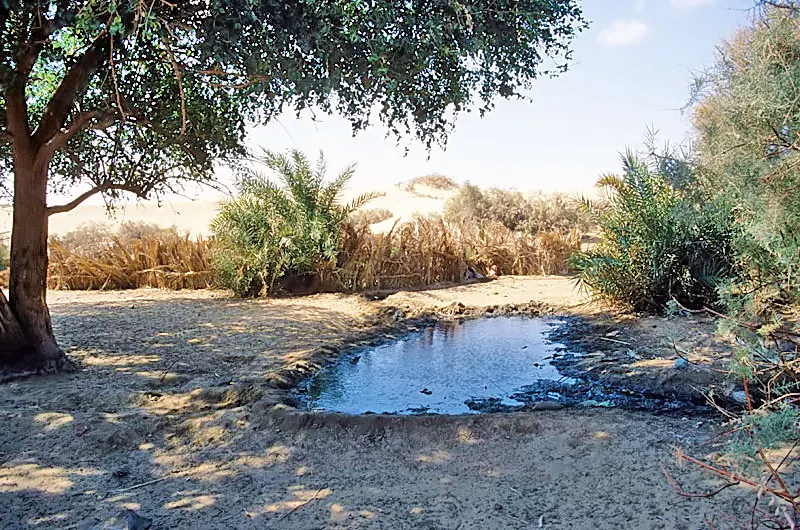
Ain Ris and the spring hamlets
Short answer: Water explains El Haiz. Springs feed palm gardens around five hamlets, and in Roman times underground channels carried water to the fields.
Wikivoyage calls Ain Ris the prettiest of the five hamlets. It gives 1980 figures of about 50 residents at Ain el-Gumʿa, with four "Roman" springs, and about 185 at el-Ain el-Gharbiya, with seven "Roman" springs and three newer private ones (Wikivoyage: Ḥeiz, checked 21 November 2026). Those numbers are old, but they show the scale: these are hamlets, not towns.
The same 1980 figures list what grew there: about 1,100 palms, 150 olive trees and 170 apricot trees on some 10 hectares at Ain el-Gumʿa, and about 550 palms, 80 olives and 200 apricots on 8.5 hectares at el-Ain el-Gharbiya (same source). Across Bahariya as a whole, Wikipedia names guavas, mangos, dates and olives as the main crops. The Roman farmers did not rely on springs alone. Their manawars, wells linked by underground tunnels, collected water from a wide, gently sloping plain and ran it to fields that lay close to the tunnel ends, according to the Czech report.
The springs are working water for farms, not bathing pools. For a soak, go to one of the warm pools near Bawiti covered in our hot springs guide. If you would like to stop at Ain Ris, ask us whether it is possible on your date.
Visiting the hamlets with respect
Short answer: El Haiz is a sparsely inhabited farming area, so keep to paths, ask before photographing people and cover shoulders and knees.
Walk on the tracks between gardens rather than through planted ground or along irrigation channels. Ask before you photograph anyone, and women in particular. Dress modestly; our what to wear page explains what works in the oases and in camp. Never climb on the ruins. Mud brick erodes fast, and the walls in this area have stood since Roman times.
Practical facts, checked 21 November 2026
Short answer: About 50 km from Bawiti, on tarmac, with no restaurants listed on site. Totality on 2 August 2027 lasts 6 minutes 19 seconds at the fortress.
| Source | ||
|---|---|---|
| Distance from Bawiti | About 50 km south | Wikipedia |
| Road | Hamlets on asphalt; main ruins near the road, short walk on site | Wikivoyage |
| Food | Restaurants in Bawiti or Farafra; only a single camp listed at El Haiz | Wikivoyage |
| Antiquities tickets | Bahariya tickets: about EGP 400 for foreigners since 1 October 2026 (was about EGP 100); check on the day. Whether El Haiz is ticketed: ask us | This site, cost page |
| Eclipse, 2 August 2027 | Total, 6 minutes 19 seconds at the El-Riz fortress; maximum around 12:53 local time | timeanddate |
| Time to allow on site | Ask us |
For the eclipse, the timeanddate figure at El Haiz matches Bawiti's 6 minutes 19 seconds, against 2 minutes 5 seconds at the Mushroom and Chicken in the White Desert. Our 2027 eclipse guide compares every stop along the route.
How to see it from the White Desert
Short answer: El Haiz sits on the road between Bawiti and the White Desert, so it fits a trip with spare daylight. A three-day private trip is the most natural fit; ask us to add it.
Every trip to the formations drives the Farafra road south from Bawiti, and El Haiz lies along that stretch. What limits the stop is time, not distance. On an overnight trip from Cairo the first day is spent reaching camp before sunset, so there is little room for an extra stop.
The three-day Bahariya, White Desert and Farafra trip gives you a full second day in the desert, through the Black Desert, Crystal Mountain and Agabat to Ain Khadra and the New White Desert. It costs about US$495 to 660 per person for two travellers, private. El Haiz is not in its published day plan, so ask us whether it can be added on your dates and what it would replace.
In the eclipse year, the eclipse 2027 camp drives back north from the White Desert to Bawiti on 1 August, on the same road, and watches totality from the Black Desert or Bahariya the next day; its price is on request. Ask us whether a stop at El Haiz could fit around the eclipse day itself.
If you are heading on to Farafra Oasis, El Haiz is the last of Bahariya before the long run south. Send us a WhatsApp message with "El Haiz" and your dates and we will tell you what fits.
Our advice
Short answer: Add El Haiz if you like Roman history and empty places and have a spare half-day; skip it on a single night out.
- Wear closed shoes: the ground around ruins is uneven.
- Bring a hat and water; Wikivoyage lists no restaurants at El Haiz itself.
- Late afternoon light is warm on mud brick; our photography guide has more on timing.
- Pair it with a warm spring near Bawiti for a slow oasis day.
Sources: Bárta et al., Czech Institute of Egyptology, 2004 season report; Collège de France lecture summary, 2011; Wikivoyage: Ḥeiz; Wikipedia: Bahariya Oasis; Wikipedia: Ahmed Fakhry; timeanddate eclipse calculation for El-Riz. All checked 21 November 2026.
Questions people ask
How far is El Haiz from Bawiti?+
About 50 km south of Bawiti, on the road towards Farafra and the White Desert. Wikivoyage notes that the hamlets are on asphalt and the main ruins lie near the road, so the stop needs a short walk rather than off-road driving. Ask us how long it adds to your day.
What is there to see at El Haiz?+
The centre is El-Riz, which the Czech Institute of Egyptology describes as the largest settlement in the El Haiz area, covering about 10 hectares. A Roman fortress dominates it, an early Christian church stands nearby, and two very old nabq trees mark former orchards.
Is the church at El Haiz dedicated to St George?+
Wikivoyage calls it the so-called church of St George (Mar Girgis). A 2011 Collège de France lecture summary on the Czech project calls it an early Christian basilica of St Bartholomew instead, so treat the dedication as uncertain.
Who has excavated at El Haiz?+
Ahmed Fakhry did the first scientific work here; Wikivoyage dates his investigations to 1938 and 1942, while Wikipedia mentions a 1940 dig. The Bawiti antiquities inspectorate dug at El-Riz in the 1990s and found what may be a commander's palace and a wine cellar. The Czech Institute of Egyptology began its survey in 2003.
Do I need a ticket for El Haiz?+
Bahariya antiquities tickets are about EGP 400 for foreigners since 1 October 2026 (was about EGP 100); check on the day. Whether the El Haiz ruins are ticketed or need an inspector present is something we confirm for your date, so ask us before you plan the stop.
Is El Haiz good for the 2027 eclipse?+
Yes. Timeanddate gives 6 minutes 19 seconds of totality at the El-Riz fortress on 2 August 2027, the same as Bawiti, with maximum eclipse around 12:53 local time. Farafra town, further south, is outside the path, at about 99.7%.
Is El Haiz on the standard three-day trip?+
It is not in the published day-by-day plan of our three-day trip, which costs about US$495 to 660 per person for two travellers, private. Ask us whether it can be added on your dates and what it changes on day two.
Is there anywhere to eat at El Haiz?+
Plan on eating in Bawiti, about 50 km north, or in Farafra. Wikivoyage points to those two towns for restaurants and lists only a single camp in the El Haiz area itself. Ask us what food and drink we can bring for a stop at the springs.
Go with us
Trips that include this

3 days, 2 nights
3-day White Desert tour: Bahariya, the White Desert and two nights outAbout US$495 to 660 per person for two travellers, private
Check dates