
The short answer
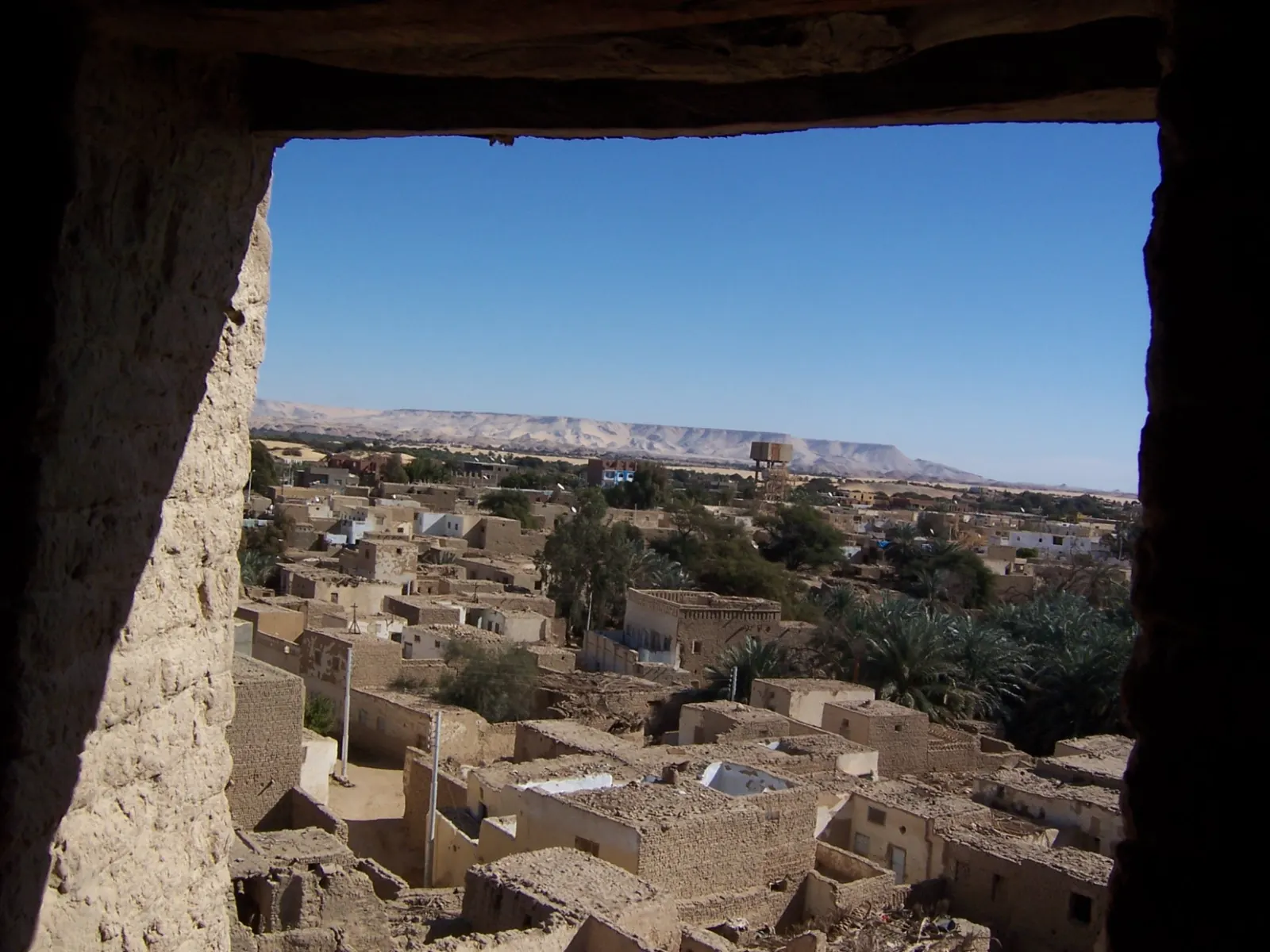
Dakhla is about 300 km south of Farafra, roughly four hours on tarmac, and Kharga is about 190 km further east. Dakhla has the Ayyubid-era town of Al-Qasr and Old Kingdom governors' tombs at Balat; Kharga has the Temple of Hibis and Bagawat, an early Christian cemetery of 263 chapels. Add at least two days to a White Desert trip.
Ask us on WhatsAppWhere they are
Short answer: Mut, Dakhla's main town, is about 300 km south of Qasr Farafra; Kharga is about 190 km east of Mut, and from Kharga the road drops to the Nile Valley at Luxor.
Dakhla and Kharga are the two biggest oases of New Valley Governorate, which covers about 440,000 km², roughly half of Egypt, and had an estimated 270,854 people in January 2024 (Wikipedia, checked 21 November 2026). Kharga town is the governorate's capital.
Dakhla is a long green strip, about 80 km from east to west and 25 km from north to south, lying some 350 km from the Nile (Wikipedia, checked 21 November 2026). Kharga sits in a depression about 160 km long, roughly 200 km west of the Nile Valley (Wikipedia, checked 21 November 2026).
From the White Desert the order is simple: north to south you pass Bahariya, the chalk, Farafra, then Dakhla, then Kharga. Every leg is on tarmac. Going on to Luxor turns the drive into a one-way crossing of the Western Desert, so you never repeat a road. The White Desert from Luxor guide covers that crossing from the Nile end.
| Leg | Distance | Time on the road |
|---|---|---|
| Mushroom and Chicken to Qasr Farafra | about 40 km | under an hour |
| Qasr Farafra to Mut (Dakhla) | about 300 km | about 4 hours |
| Mut to Kharga | about 190 km | about 2.5 hours |
| Cairo to Mut, via Bawiti and Farafra | about 850 km in total | two long days with stops |
These are the planning figures used across this site. Cairo to Bawiti is about 370 km and Bawiti to Qasr Farafra is about 180 km; see Farafra Oasis for the last town before the long southern road.
Dakhla: highlights
Short answer: Al-Qasr's Ayyubid and Ottoman lanes, the Roman temple of Deir el-Hagar, the Old Kingdom governors' town at Balat, and Roman-era Amheida and Kellis.
| Sight | What it is | Source |
|---|---|---|
| Al-Qasr | Fortified town built in the 12th century under the Ayyubids on a Roman fort, with a minaret about 21 m tall | Wikipedia |
| Deir el-Hagar | Sandstone temple about 10 km from Al-Qasr, put up under Nero, decorated under Vespasian, Titus and Domitian | Wikipedia |
| Ayn Asil and Qila el-Dabba (Balat) | Governors' residence from the early 6th to the 11th Dynasty, about 2350 to 2000 BC, with the governors' tombs nearby | IFAO |
| Amheida | Town with remains spanning nearly three thousand years, a painted 4th-century house and a 1st-century temple of Thoth | NYU ISAW |
| Kellis (Ismant el-Kharab) | Roman and Byzantine village about 11 km north-east of Mut, abandoned some time after 392 | Wikipedia |
| Mut | Modern main town, population 26,820 in 2021 | Wikipedia |
All checked 21 November 2026.
Al-Qasr grew up on the remains of a Roman fort, and many of the mud-brick houses standing today are Mamluk or Ottoman, some rising four storeys. Blocks carved with hieroglyphs, taken from the Thoth temple at nearby Amheida, are built into several walls. Wear shoes that can take dust, and ask before photographing anyone.
Deir el-Hagar, the "stone monastery", is a small Roman sandstone temple about 10 km from Al-Qasr. It was dedicated to the Theban triad of Amun-Ra, Mut and Khonsu, and to Seth.
Balat shows how far the pharaohs' administration reached. The French Institute of Oriental Archaeology (IFAO) has excavated the governors' residence at Ayn Asil since 1977, six years after Ahmed Fakhry discovered it. The necropolis of Qila el-Dabba holds the tombs of a line of eight governors. Those dates and the eight tombs come from the IFAO (checked 21 November 2026). About 500 hieratic tablets from the late 6th Dynasty came out of the palace (Wikipedia, checked 21 November 2026).
Which of the smaller digs are open to visitors on a given day is decided by the antiquities authorities, so ask us before you plan around one.
Kharga: highlights
Short answer: The Temple of Hibis, Bagawat's 263 Christian chapels and the Roman forts that guarded the Darb el-Arbain caravan road.
| Sight | What it is | Source |
|---|---|---|
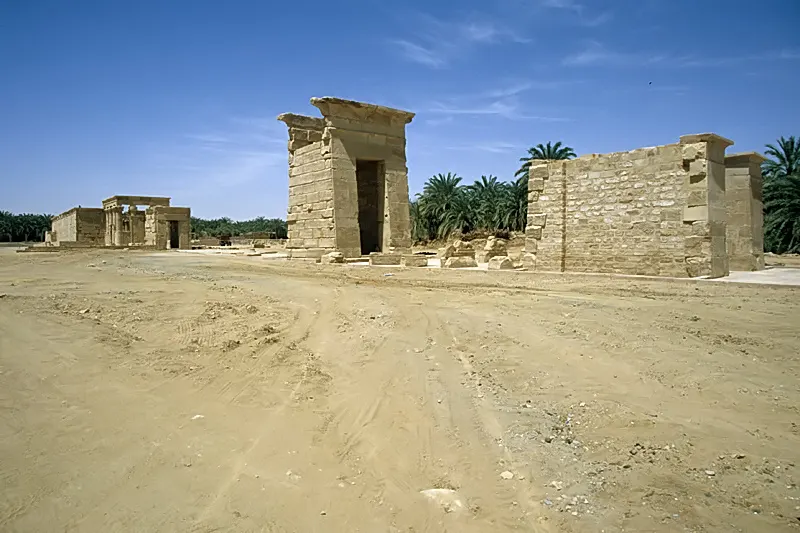
| Temple of Hibis | Temple to local forms of Amun, begun in the 26th Dynasty and decorated largely under Darius I, about 2 km north of town | Wikipedia |
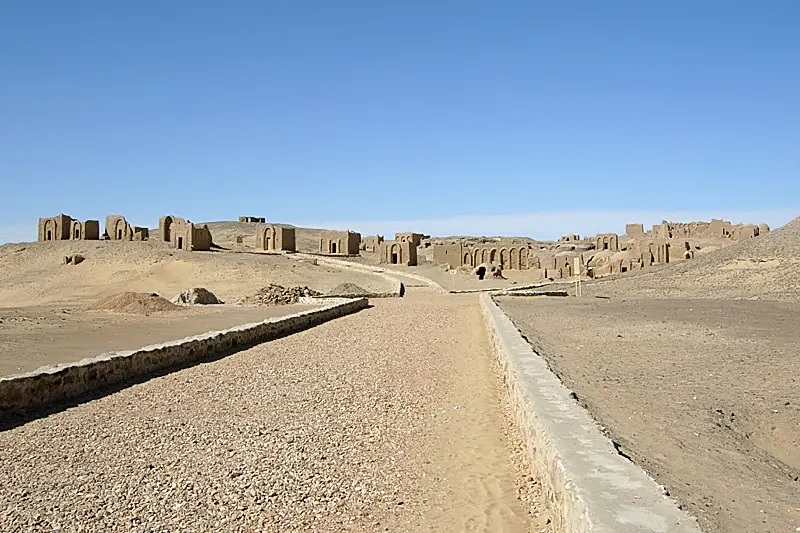
| Bagawat | Early Christian burial ground used between the 3rd and 7th centuries AD, with 263 funerary chapels | Wikipedia |
| Roman forts | Forts such as Qasr al-Labakha, Umm el-Dabadib and Deir al-Munira along the old caravan route | Wikipedia |
All checked 21 November 2026.
Hibis stands on an older New Kingdom site. Construction began in the 26th Dynasty, probably under Psamtik II. The Persian king Darius I is credited with much of the wall decoration, and later kings, Nectanebo I and II among them, added to it. The Metropolitan Museum of Art ran the first excavation in 1909–11. Rising groundwater has damaged the foundations, and the Egyptian antiquities service has considered moving the whole temple, so ask us whether all of it is open when you travel (Wikipedia, checked 21 November 2026).
Bagawat is among the earliest and best-preserved Christian cemeteries of the ancient world. The Chapel of Exodus, from the first half of the 4th century, shows Moses parting the Red Sea, Jonah and the Annunciation. The Chapel of Peace, from the 5th or 6th century, has Daniel in the lions' den, and Chapel 181 has Noah's Ark (Wikipedia, checked 21 November 2026).
The forts were built to protect the Darb el-Arbain, "the Way of Forty", a caravan road of about 1,800 km running from Darfur to Assiut (Wikipedia, checked 21 November 2026). Ask us which of them can be visited on your dates.
How they compare with Bahariya and Farafra
Short answer: Bahariya and Farafra are the way in to the chalk landscapes; Dakhla and Kharga are about history, with bigger towns, older monuments and no desert camp on the standard route.
| Bahariya and Farafra | Dakhla and Kharga | |
|---|---|---|
| Main draw | White and Black deserts, Crystal Mountain, Agabat | Al-Qasr, Balat, Hibis, Bagawat, Roman forts |
| Where you sleep | Desert camp and oasis lodges | Lodges and town hotels |
| Road distance from Cairo | about 370 km to Bawiti, about 550 km to Farafra | about 850 km to Mut, about 1,040 km to Kharga |
| Typical trip | 2–3 days | 5–8 days as part of a longer route |
If the chalk is why you are coming, start there and treat the southern oases as an extension. For the northern side, see Bahariya Oasis.
Weather: Dakhla and Kharga by month
Short answer: November to March is comfortable, with January highs of about 22°C; July averages about 39°C in Dakhla and 41°C in Kharga by day.
| Month | Dakhla high / low (°C) | Kharga high / low (°C) |
|---|---|---|
| November | 27.1 / 9.9 | 28.9 / 13.9 |
| December | 22.8 / 5.3 | 24.1 / 9.2 |
| January | 21.5 / 3.5 | 22.6 / 7.0 |
| February | 24.0 / 5.1 | 25.2 / 9.1 |
| March | 28.1 / 8.7 | 29.6 / 12.7 |
| May | 37.3 / 18.3 | 38.5 / 22.0 |
| July | 39.0 / 22.3 | 41.2 / 25.0 |
Mean daily maximum and minimum. Dakhla: NOAA climate normals 1961–1990, via Wikipedia. Kharga: 2000–2020, Meteomanz and NOAA, via Wikipedia. Checked 21 November 2026. The two series cover different periods, so compare the pattern rather than the decimals.
Rain is close to nil in both, and Kharga's record high is 50.3°C. The practical point is the gap between day and night in winter: a January afternoon at Al-Qasr is pleasant, and the same night out in the White Desert can be cold. Our weather and night temperatures page covers the camp end of the trip.
How to see them from the White Desert
Short answer: Book the chalk first, then bolt on two nights in Dakhla via Farafra; carry on through Kharga if you are ending in Luxor.
There are three realistic shapes.
- White Desert, then back to Cairo. Our 3-day Bahariya, White Desert and Farafra tour is the base: two nights out, costing about US$495 to 660 per person (private, two travellers). It returns north and does not include Dakhla.
- White Desert plus Dakhla. Add two nights in Dakhla after the camp and return north the same way. Ask us for a quote for this extension; the price depends on nights, lodges and vehicles.
- One way to Luxor. Camp in the White Desert, two nights in Dakhla, one in Kharga, then the Nile. The White Desert from Luxor page runs the same road from the other end.
Coming up from the south on your own, we also run a private overnight that starts in Qasr Farafra, about US$255 to 345 per person for two. See all trips on our tours page.
Staying in Dakhla and Kharga
Short answer: Dakhla has the two well-known lodges, Al Tarfa (20 rooms and suites) and Desert Lodge (32 rooms) above Al-Qasr; for Kharga, ask us.
| Lodge | What the published listings say |
|---|---|
| Al Tarfa Desert Sanctuary | Twenty individually designed rooms and suites, a terrace swimming pool and plunge pools in the suites (Uniq Hotels) |
| Desert Lodge, Al-Qasr | 32 rooms on a clifftop in Al-Qasr, solar water heating, and a farm growing organic produce (The Switchers, 2017) |
| Kharga town | No listing we could check; ask us for current options |
Both lodge listings checked 21 November 2026; confirm room types and prices with the lodges. Both Dakhla lodges are small and book ahead in winter. Bahariya and Farafra options are on where to stay in Bahariya and Farafra.
Practicalities
Short answer: A permit and licensed guide, your passport at checkpoints, cash from Cairo or Bawiti, and ask us for current site tickets.
- Permits: foreign visitors need a desert permit arranged in advance and travel with a licensed guide. We need your passport details at least 24 hours before the trip. Keep your passport in your hand luggage for the checkpoints. See permits and safety.
- Travel advice: the UK FCDO's warning covers most of the desert beyond the Nile Valley and Delta, but its exceptions name Dakhla (Mut) and Kharga as oasis towns, plus the Farafra–Dakhla–Kharga road and the Kharga–Baris and Baris–Luxor roads (gov.uk, updated 27 October 2026, checked 21 November 2026). Check your own government's advice and your insurance wording before you book.
- Tickets: ask us for current foreigner prices at the Dakhla and Kharga sites. For comparison, Bahariya's antiquities ticket is about EGP 400 for foreigners since 1 October 2026 (was about EGP 100); check on the day.
- Money: take enough cash from Cairo or Bawiti; see money and ATMs.
- Fuel: stations are few on the 300 km between Farafra and Mut, so fill up whenever you can.
Our advice
Short answer: Give the south at least five days in total, two of those nights in Dakhla, and keep the White Desert camp as the centrepiece.
The mistake is reading the map rather than the road. The oases look close together, but Farafra to Mut alone is about four hours of open desert. Trying to fit Dakhla into a three-day trip means spending most of it in the car. Do one long drive per day at most, start early so you arrive in daylight, and keep the late afternoon for Al-Qasr or Bagawat. Ending in Luxor? Hold off on the train or plane south until the oasis dates are settled.
Message us on WhatsApp with "Dakhla", your dates, group size and where you want to finish, and we will reply with a route and a quote.
Sources, all checked 21 November 2026: gov.uk Egypt travel advice; IFAO, Balat; NYU ISAW, Amheida; Wikipedia on Dakhla, Kharga, Hibis, Bagawat, Kellis, Mut and New Valley; lodge listings as linked above.
Map
Where the White Desert is
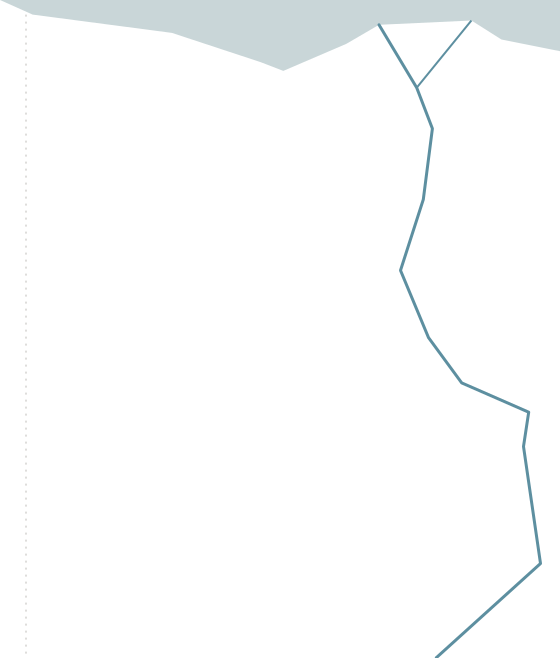
Egypt’s Western Desert, with the oases at their true positions. Tap a place to read its guide.
- The White Desert
- Towns and oases
- Desert sites
- Main desert roads
Positions are true latitude and longitude. The desert sites between Bawiti and Farafra are approximate, because they spread over many kilometres. Dashed lines are the main desert roads.
Questions people ask
How far is Dakhla from the White Desert?+
About 340 km by road from the Mushroom and Chicken area. That is roughly 40 km to Qasr Farafra, then about 300 km south to Mut, Dakhla's main town, which takes around four hours. Plan on most of a day with fuel and tea stops.
Is Dakhla or Kharga worth adding to a short trip?+
Not to a two- or three-day trip. Dakhla adds at least two days and Kharga one or two more. With five days or more, Dakhla is the better addition; Kharga makes sense mainly if you are carrying on to Luxor, as the UK government's exceptions include the road from Kharga to Baris and on to Luxor.
Which is better, Dakhla or Kharga?+
Dakhla for staying, Kharga for monuments. Dakhla has Al-Qasr, Balat and two well-known lodges, including the 32-room Desert Lodge above Al-Qasr. Kharga, the capital of New Valley Governorate, has the Temple of Hibis, the 263 chapels of Bagawat and a chain of Roman forts.
How old is Al-Qasr in Dakhla?+
The fortified town was built in the 12th century under the Ayyubids on the remains of a Roman fort, and its minaret is about 21 m tall. Many of the surviving mud-brick houses date from the Mamluk and Ottoman periods, some of them up to four storeys high.
What is the Temple of Hibis?+
Kharga's main pharaonic temple, dedicated to forms of Amun. Building began in the 26th Dynasty, probably under Psamtik II, and Darius I of Persia is credited with much of the wall decoration. The Metropolitan Museum of Art first excavated it from 1909 to 1911.
What is Bagawat?+
An early Christian burial ground in Kharga Oasis, used between the 3rd and 7th centuries AD. It has 263 mud-brick funerary chapels, a few of them painted, among them the Chapel of Exodus with the crossing of the Red Sea and Chapel 181 with Noah's Ark.
Does UK travel advice cover Dakhla and Kharga?+
Yes, as exceptions. The FCDO's warning for the desert beyond the Nile Valley excludes Dakhla (Mut) and Kharga towns, the Farafra–Dakhla–Kharga road, and the Kharga–Baris and Baris–Luxor roads (gov.uk, checked 21 November 2026). Other governments and insurers may differ, so check yours.
When is the best time to visit Dakhla and Kharga?+
November to March. Kharga's average daily high is about 41°C in July and August, against about 23°C in January. Dakhla's January nights average about 3.5°C, so pack warm layers for the White Desert camp and the lodge evenings alike.
Go with us
Trips that include this

3 days, 2 nights
3-day White Desert tour: Bahariya, the White Desert and two nights outAbout US$495 to 660 per person for two travellers, private
Check dates