
The short answer
Fayoum is the easy option: two to three hours from Cairo, with Wadi el-Hitan's whale fossils, the Wadi Rayan lakes and dunes, all in a day trip. The White Desert is about 500 km away and best with a night, but its chalk formations and dark skies are far more dramatic. One day: Fayoum. Two: the White Desert.
Ask us on WhatsAppWhat Fayoum offers
Short answer: Whale fossils in a UNESCO-listed valley, desert lakes and waterfalls, dunes, a pottery village and a big lake with birdlife, all near Cairo.
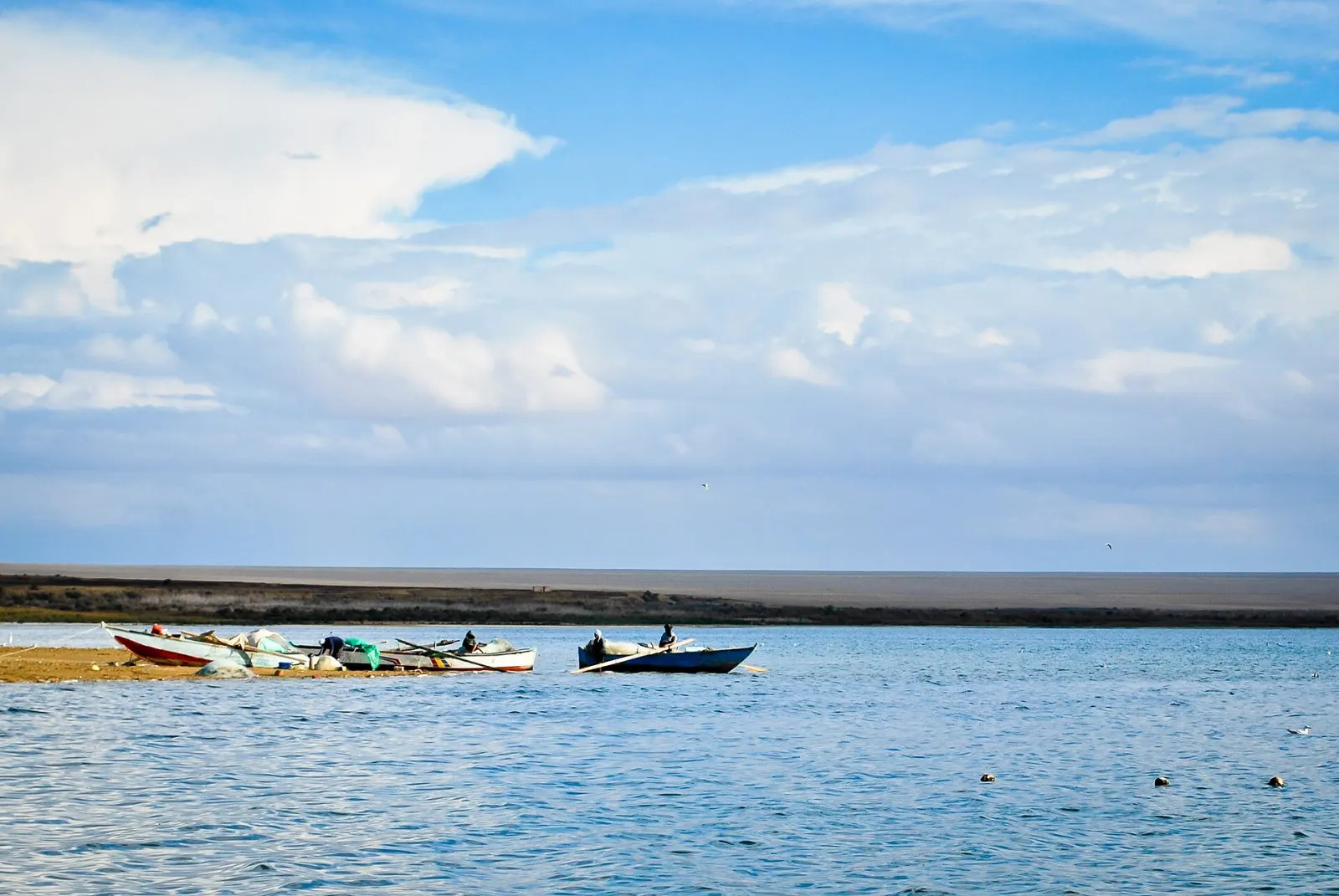
Fayoum is a large oasis-like basin about 100 km south-west of Cairo, fed by the Bahr Yusuf canal from the Nile. Its desert edges hold some of Egypt's best day-trip sights. Wadi el-Hitan, the Valley of the Whales, about 150 km from Cairo, has fossil skeletons of early whales that still had small hind legs, around 40 million years old, in a protected desert valley listed by UNESCO in 2005; Wikipedia's summary counts about 1,500 marine vertebrate skeletons there. Wadi el-Rayan has two lakes joined by small waterfalls, surrounded by dunes. Lake Qarun is good for birdwatching, and the village of Tunis is known for its pottery. Fayoum also has eco-lodges, so a night there is easy.
What the White Desert offers
Short answer: Unique chalk formations, the Black Desert and Crystal Mountain, hot springs, ancient sites and one of the darkest night skies in Egypt.
The White Desert, about 500 km from Cairo, is wilder and more remote. Its wind-carved chalk mushrooms and towers are unlike anything else in Egypt. On the way you cross the black hills of the Black Desert, the quartz of Crystal Mountain and the dunes of Agabat. Then you camp among the formations under an extraordinary sky. Bahariya adds hot springs, the Golden Mummies and painted tombs. See things to see on the way.
Fayoum's main sights at a glance
Short answer: Most visitors combine Wadi el-Hitan and the Wadi Rayan lakes in one long day, then add Lake Qarun or Tunis village if there is time.
| Sight | What it is | Worth knowing |
|---|---|---|
| Wadi el-Hitan | Open-air fossil valley with early whale skeletons | Inside the Wadi Rayan Protected Area; the listed site covers 200.15 km² plus a 58.85 km² buffer zone (checked 19 November 2026). The rocks are Middle to Late Eocene, and walkways and small shelters link the main skeletons. |
| Wadi Rayan lakes | Two lakes joined by waterfalls, with dunes around them | An upper lake of about 51 km² and a lower lake of about 62 km² (checked 19 November 2026); the falls between them are considered the largest in Egypt. |
| Lake Qarun | Large salt lake on the north side of the basin | Its surface lies about 43 m below sea level (checked 19 November 2026), and it has been a Ramsar wetland since 2012. Winter is the time for water birds. |
| Tunis village | Village above Lake Qarun known for pottery | A relaxed stop on the way back to Cairo. |
The fossil valley and the lakes are the core. They sit on desert tracks well away from Fayoum city, so a driver who knows the area makes the day much smoother. The whale trail is fully exposed, so go early in the warm months and carry water.
Compared in detail
Short answer: Fayoum wins on convenience; the White Desert wins on drama, remoteness and the night.
| White Desert | Fayoum | |
|---|---|---|
| Distance from Cairo | About 500 km | About 100 km to Fayoum city, 150 km to Wadi el-Hitan |
| Works as a day trip | Barely, and without sunset | Yes |
| Time to the main sights | 6 to 7 hours | 2 to 3 hours |
| Ideal length | 2 to 3 days | 1 day, or 2 with a night |
| Landscapes | Chalk formations, black hills, quartz, dunes | Lakes, waterfalls, dunes, fossil valley |
| Wildlife | Desert foxes around camp | Birds on the lakes |
| Fossils | Shells and urchins in chalk | Whale skeletons |
| Night sky | Among Egypt's darkest | Good, less remote |
| Camping | The classic experience | Possible at Wadi el-Hitan |
| Crowds | Few | More at weekends |
History and archaeology on each trip
Short answer: Fayoum has more ancient history in the basin itself; on the White Desert route the history is concentrated in Bahariya, and the chalk is pure landscape.
The Fayoum has been farmed for a very long time. The Bahr Yusuf canal (checked 19 November 2026) links it to the Nile, and the basin holds Karanis, one of the best-preserved towns of the late Roman period, and the site of el-Lahun. The famous Fayum mummy portraits, painted on wood in wax in the first three centuries AD, take their name from the area. Most of these sites need their own detour, so a single Fayoum day rarely covers both the archaeology and the whale valley.
On the White Desert route, history comes in Bawiti. The Golden Mummies, the painted tombs of Bahariya and the Temple of Alexander are all on or near the way. On a two-day trip they are a short stop; on a three-day trip they get an afternoon. If you want tombs and temples as much as desert, the longer White Desert trip balances the two better than a single Fayoum day.
Practicalities side by side
Short answer: Fayoum is a normal day out with a driver; the White Desert needs a permit, a licensed operator, a 4x4 and a night outdoors.
| White Desert | Fayoum | |
|---|---|---|
| Permit | Needed for foreign visitors; we need your passport details one day before the trip | Not the same desert permit; protected areas sell their own entry tickets |
| Guide | A licensed guide is required | A local driver is usual for the desert tracks |
| Vehicle | Car to Bawiti, then a 4x4 in the desert | Ordinary car to the city and Lake Qarun; local driver for the tracks |
| Distance | Cairo to Bawiti is about 370 km and 4.5–5 hours from central Cairo with a stop, then the 4x4 legs | About 100 km to Fayoum city, about 150 km to Wadi el-Hitan |
| Fees | Government protected-area fee shown as its own line in your quote | Protected-area tickets at the gate; check current prices locally |
| Where you sleep | Camp in the desert, or a lodge in Bahariya | Eco-lodges, guesthouses, or camps near Wadi el-Hitan and Wadi Rayan |
| Toilets | Basic in camp; ask us what your trip includes | Ask your Fayoum driver what to expect |
| Shade | Little in the chalk; shade comes from the vehicle and camp | Little on the whale trail |
Passports matter on both trips, because there are police checkpoints on the desert roads. Keep yours with you, not in the boot. Our permits and safety guide explains how the White Desert permit works.
Who should choose which
Short answer: Fossil and bird lovers, short stays and summer visitors lean to Fayoum; photographers, stargazers and anyone wanting a night in wild country lean to the White Desert.
| You are... | Better choice | Why |
|---|---|---|
| In Cairo for one free day | Fayoum | Two to three hours each way, back for dinner |
| Interested in fossils and evolution | Fayoum | Whale skeletons lying where they were found |
| A birdwatcher in winter | Fayoum | Lake Qarun and the Wadi Rayan lakes |
| A photographer | White Desert | Chalk at sunset and sunrise, and a dark sky |
| Keen on stars | White Desert | Far from city glow; see stargazing |
| Travelling with small children | Fayoum, or the White Desert with care | Shorter road day; see the White Desert with kids |
| Visiting in July or August | Fayoum | A short day out beats a long, hot desert drive |
| After one big adventure | White Desert | Camping, 4x4 driving and very few people |
Neither choice is wrong. The honest trade-off is time against atmosphere. Fayoum gives more sights per hour of driving. The White Desert asks for two days and gives you a night that is hard to find closer to Cairo.
What each trip costs
Short answer: Our White Desert trips start at about US$185–230 per person on a shared overnight. We do not publish Fayoum prices, so ask your Fayoum driver for those.
Our White Desert prices are on what a trip costs and on each tour page; the day-trip and overnight ranges are in the last section below. Much of the cost of a White Desert trip is distance: about 370 km to Bawiti each way, then the 4x4, the crew and the camp. If you want help with a Fayoum day as well, ask us.
Which to choose
Short answer: One day: Fayoum. Two days or more, and a love of wild places: the White Desert, which is a bigger, stranger landscape and worth the extra night. Both, if you can.
If you only have one day out of Cairo, Fayoum gives a lot for little travel. If you have two or three days, the White Desert is the more extraordinary experience. Some travellers do both: Fayoum as an easy day trip, the White Desert as the big adventure. See is the White Desert worth it and how many days.
Fitting both into three days
Short answer: Spend day one in Fayoum and back to Cairo, then do the two-day White Desert trip from Cairo on days two and three.
| Day | Plan | Driving |
|---|---|---|
| 1 | Cairo to Wadi el-Hitan and Wadi Rayan, lunch near Lake Qarun, back to Cairo | 5 to 6 hours in total |
| 2 | Cairo to Bawiti, the Black Desert, Crystal Mountain, Agabat, camp in the White Desert | 6 to 7 hours |
| 3 | Sunrise in the chalk, warm spring in Bahariya, back to Cairo | 6 to 7 hours |
That is a lot of road for three days, and we would only suggest it to people who enjoy the landscapes from the car as much as the stops. If you prefer fewer hours driving, choose one. Our two-day itinerary shows how the White Desert part is paced.
Season and comfort
Short answer: Both are best from October to April; in summer Fayoum is the easier choice because it is a short day out, while White Desert nights in December and January drop to about 4°C on average.
Fayoum sits lower and closer to the Nile, so it feels a little more humid and its winter nights are less sharp. The White Desert has the extremes: Farafra's long-term averages are about 20°C by day and 4°C at night in January, and about 38°C by day in July. For a day trip in summer, Fayoum is the gentler choice. For a winter night outdoors, the White Desert is colder, but we bring blankets and a fire, with sleeping bags and a tent on request. See weather and night temperatures.
Is the long drive worth it?
Short answer: Yes if the night matters to you; if fossils and natural history matter more, Fayoum is not a lesser choice.
The question when choosing between them is whether the White Desert justifies twelve to fourteen hours on the road there and back. Our honest answer is yes if the night matters to you. The chalk at sunset, the fire, the small fennec or Rüppell's foxes that often come to the edge of camp, and the silence are not something Fayoum offers in the same way. On the other hand, Wadi el-Hitan is a UNESCO-listed fossil site with whale skeletons lying where they were found, and nothing on the White Desert route compares for natural history. If you are a fossil person, do not skip Fayoum.
Checked November 2026
Short answer: The White Desert needs a desert permit arranged in advance and a licensed guide for foreign visitors, and its protected-area fee is shown as its own line in your quote; Fayoum's protected areas sell their own tickets.
- White Desert National Park covers about 3,133.5 km² of New Valley Governorate under Prime Minister's Decree No. 1220 of 2002, according to the EEAA protectorate table. Foreign visitors pay a government protected-area fee for foreign visitors, collected through the operator and shown as its own line in your quote. See the national park guide.
- Wadi el-Hitan has been a UNESCO World Heritage Site since 2005; Fayoum's protected areas set their own tickets, so check current prices with your Fayoum driver.
- If your White Desert trip includes Bahariya's antiquities, the ticket is about EGP 400 for foreigners since 1 October 2026 (was about EGP 100); check on the day.
Read more in permits and safety and what a trip costs.
If you only have one day but want the White Desert
Short answer: It can be done as a private day trip of about 15 hours, about US$220–280 per person for two, but you miss sunset, the night sky and camp.
Our White Desert day trip from Cairo leaves before dawn and gets back late at night, with most of the day on the road. It suits people who cannot spare a night and care more about seeing the chalk than about the stars. If the night is what draws you, an overnight trip, about US$185–230 shared or US$360–460 private per person, is far better value for the drive. Message us on WhatsApp with "Fayoum or White Desert" and your dates, and we will tell you which fits.
Questions people ask
Can I camp in Fayoum?+
Yes, there are camps around Wadi el-Hitan and Wadi Rayan, and the sky is reasonably dark, though less so than in the White Desert, which is about 500 km from Cairo's light. Fayoum's camps are also easier to reach for a single night.
Is Fayoum or the White Desert better for children?+
For younger children, Fayoum: the drive is two to three hours and you can be home for bedtime. Children who are excited by camping usually love the White Desert, but two long road days and basic camp toilets are harder for little ones. Tell us their ages and we will suggest the gentler option.
How old are the whale fossils at Wadi el-Hitan?+
About 40 million years. The valley holds skeletons of early whales such as Basilosaurus and Dorudon, which still had small hind legs, and it was listed by UNESCO in 2005. The White Desert's chalk is younger, laid down in a shallow sea roughly 70 to 80 million years ago.
Do I need a permit for Fayoum like the White Desert?+
For the White Desert, foreign visitors need a permit and a licensed guide, which we organise; we need your passport details one day before the trip. Wadi el-Hitan and Wadi Rayan are protected areas with their own entry tickets, and visits are normally made with a local driver who knows the tracks.
Can I see both Fayoum and the White Desert on one trip?+
Not easily on the same route, because they are on different roads out of Cairo. Most people do Fayoum as a day trip on one day and the White Desert as a separate two-day trip, which needs three days in total.
Which is better for stars, Fayoum or the White Desert?+
The White Desert. It is about 500 km from Cairo, far from city glow, and the camps sit in open country inside a national park; we choose our camp spots with a light-pollution map. Fayoum is good for stars at Wadi el-Hitan, but it is much closer to Cairo and the towns of the Fayoum basin, so the sky is less dark near the horizon.
Is there a museum at Wadi el-Hitan?+
Yes. A fossils and climate change museum opened at the site in [January 2016](https://english.ahram.org.eg/News/181068.aspx) (checked 19 November 2026), next to the open-air trail. It is a good first stop before you walk out to the skeletons, and it gives shade in the middle of the day.
Which trip has more ancient history, Fayoum or the White Desert?+
Fayoum, on balance. The basin was farmed and settled for thousands of years, and the Graeco-Roman town of Karanis and the famous Fayum mummy portraits come from there. The White Desert itself is pure landscape; the history on that route is in Bahariya, with the Golden Mummies, painted tombs and the Temple of Alexander.
Can I sleep in a lodge instead of a camp in the White Desert?+
Not inside the park: there is no hotel, cabin or permanent camp there. You can sleep in a lodge in Bahariya and drive into the chalk for sunset and sunrise, or take a three-day trip with one lodge night and one camp night. Fayoum has eco-lodges, so a roof is easier there.
Do I need a 4x4 for Fayoum?+
Not to reach Fayoum city or Lake Qarun, which are on ordinary roads. Wadi el-Hitan and the Wadi Rayan dunes are on desert tracks, so most visitors go with a local driver who knows them. In the White Desert a 4x4 with a desert driver is the only way to visit.
Go with us
Trips that include this

2 days, 1 night
White Desert overnight camping trip from Cairo (2 days, 1 night)About US$185 to 230 shared · US$360 to 460 private, per person
Check dates
3 days, 2 nights
3-day White Desert tour: Bahariya, the White Desert and two nights outAbout US$495 to 660 per person for two travellers, private
Check dates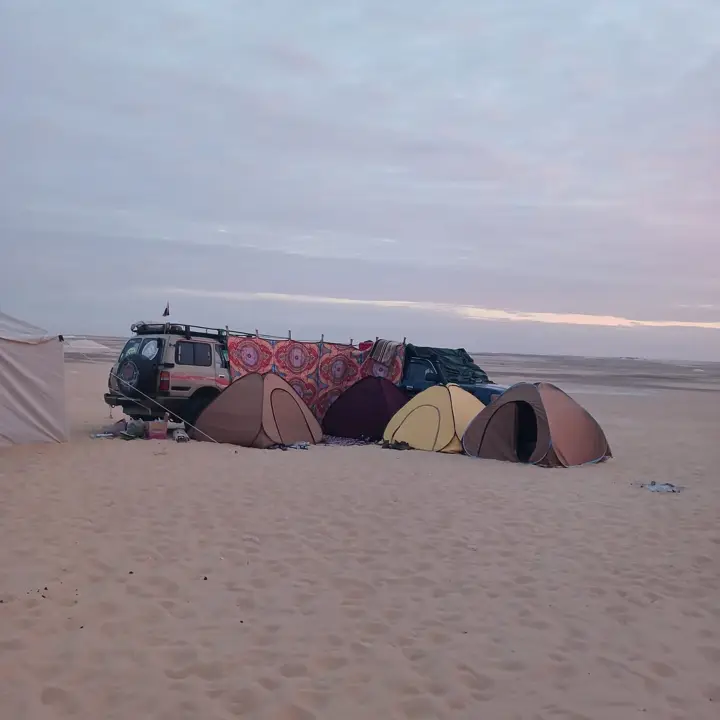
2 or 3 days
Private White Desert camping in comfortOn request (depends on group size and nights)
Check dates