
The short answer
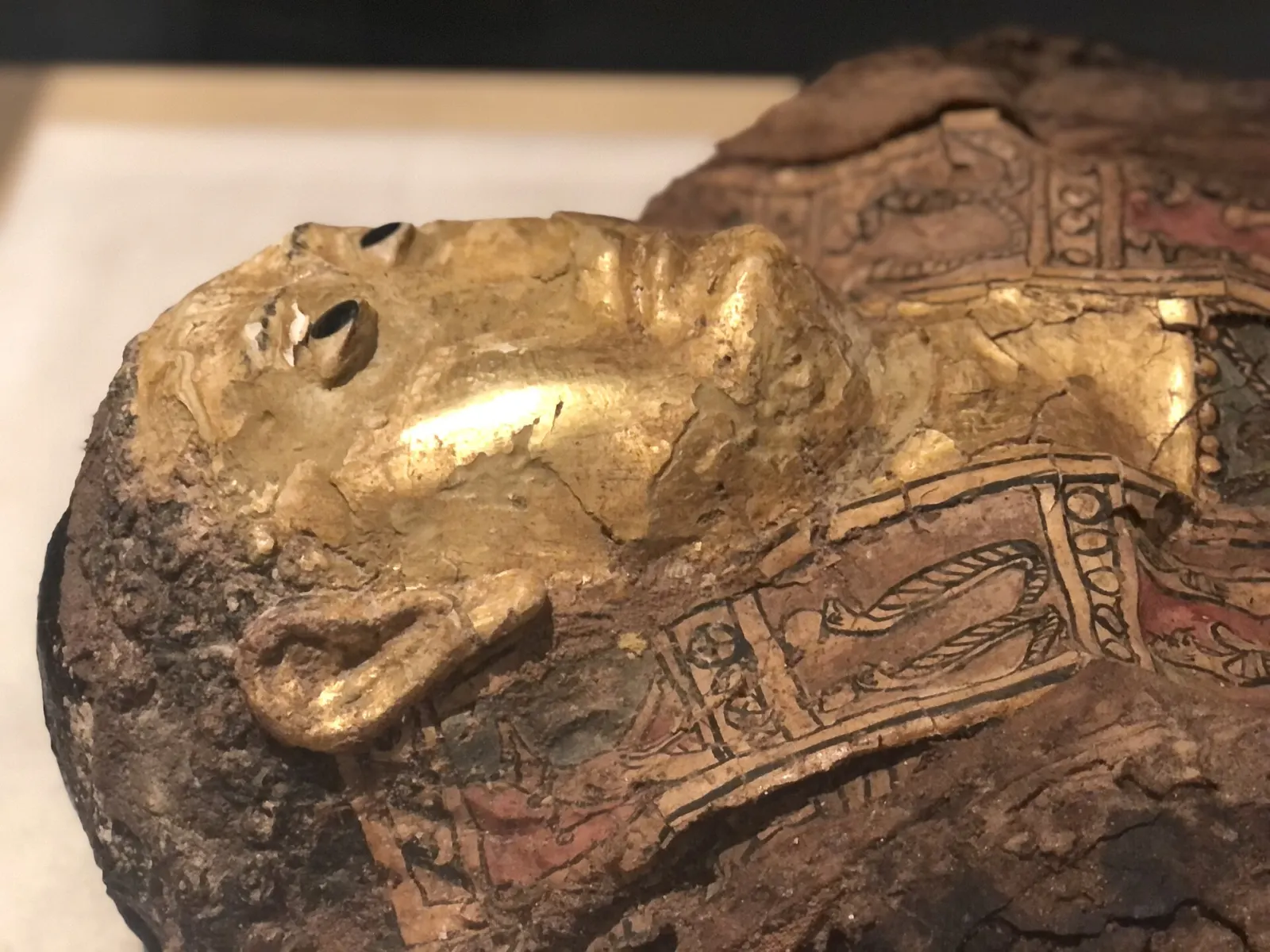
The Golden Mummies are mummies from a vast Greco-Roman cemetery near Bawiti in Bahariya Oasis, discovered in 1996 when a donkey stumbled into a hole. Excavations led by Zahi Hawass from 1999 uncovered many mummies with gilded masks and painted wrappings from around the first centuries AD. A few are displayed at the antiquities museum in Bawiti.
Ask us on WhatsAppA donkey, a hole and a lost city of the dead
Short answer: In 1996 a donkey's leg broke through the sand near Bawiti, revealing a vast Roman-era cemetery now called the Valley of the Golden Mummies.
Everyone in Bahariya tells the story. In 1996, a donkey working near the Temple of Alexander, a few kilometres from Bawiti, put its foot through the sand into an underground tomb. Its owner, a guard at the site, reported it, and archaeologists soon realised it was not one tomb but the edge of a huge cemetery. Officials kept the find quiet at first to protect it from thieves (VOA Learning English, checked 19 November 2026). Excavations began in 1999 under Zahi Hawass, then head of the Giza plateau and later Egypt's best-known archaeologist. The first season alone uncovered more than a hundred mummies from four tombs, many of them glinting with gold.
The numbers, and why they vary
Short answer: Around 250 mummies have been recovered over several seasons, from a cemetery thought to hold more than 10,000. Most of it has never been dug.
You will see different figures for the Golden Mummies, because sources were written at different stages of the work. This is what reputable sources say, and when.
| Figure | What it refers to | Source |
|---|---|---|
| More than 100 mummies, four tombs | The first season, 1999 | VOA Learning English (checked 19 November 2026) |
| 102 more mummies, seven tombs | The 2000 season | Time, October 2000 (checked 19 November 2026) |
| About 250 mummies | Total recovered over several seasons | Wikipedia (checked 19 November 2026) |
| More than 10,000 burials | The excavator's estimate for the whole cemetery | Wikipedia (checked 19 November 2026) |
| At least 10 km² | The area the cemetery may cover | VOA Learning English (checked 19 November 2026) |
| At least 50 years | Hawass's estimate for exploring it fully | Time, October 2000 (checked 19 November 2026) |
The honest summary: only a small part of the valley has been excavated, and the totals are estimates, not counts.
What was found
Short answer: Family tombs full of mummies, from simple linen wrappings to gilded masks and painted chest plates.
The tombs were cut into the soft rock and reached by a shaft or a stairway. Inside, side chambers held the dead, often whole families laid side by side, including children. The mummies fell into a few groups, which seem to reflect wealth.
| Type | What it looks like | Who it suggests |
|---|---|---|
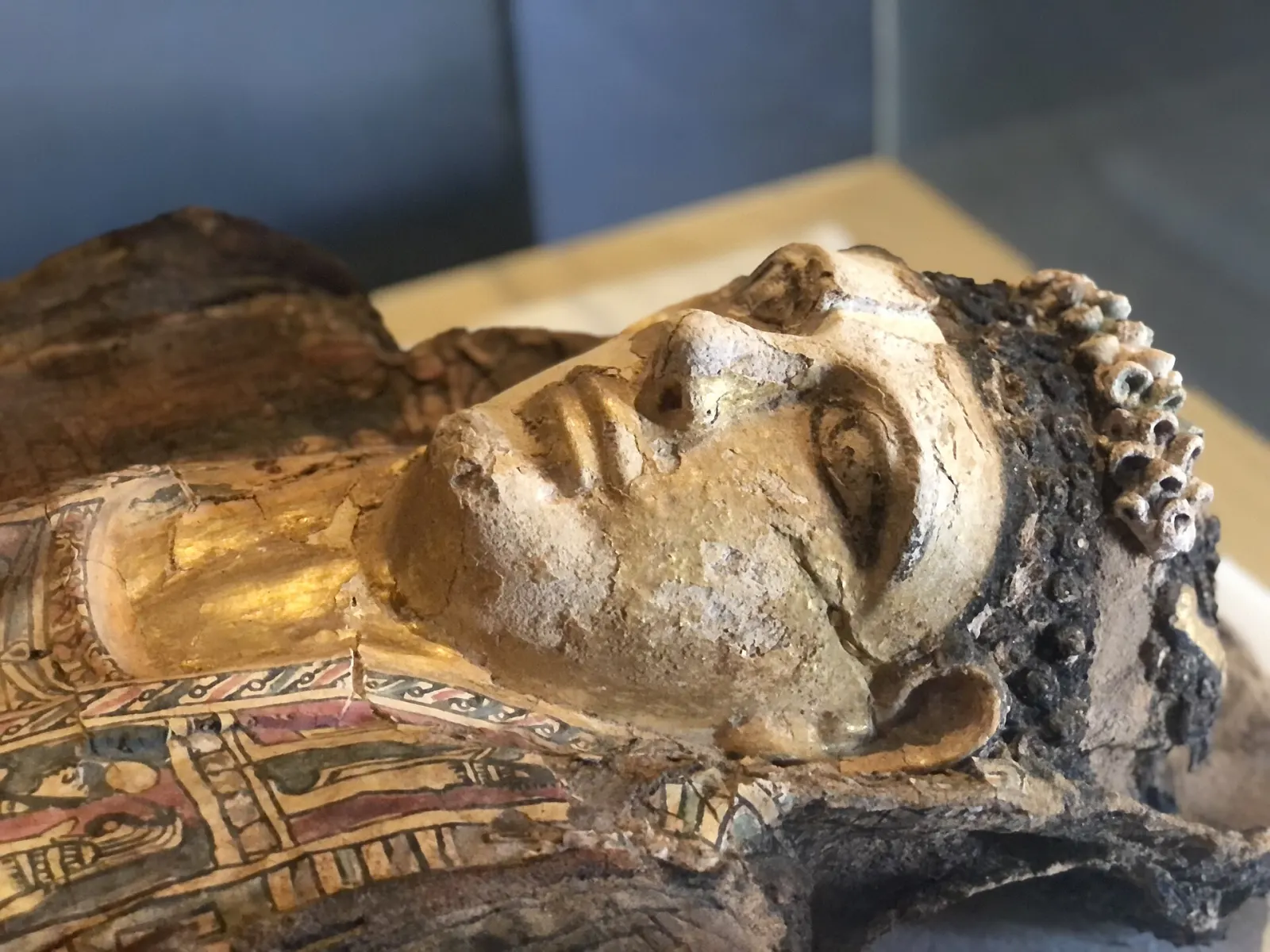
| Gilded | Masks and chest coverings covered in gold leaf, painted with gods and scenes | The richest families |
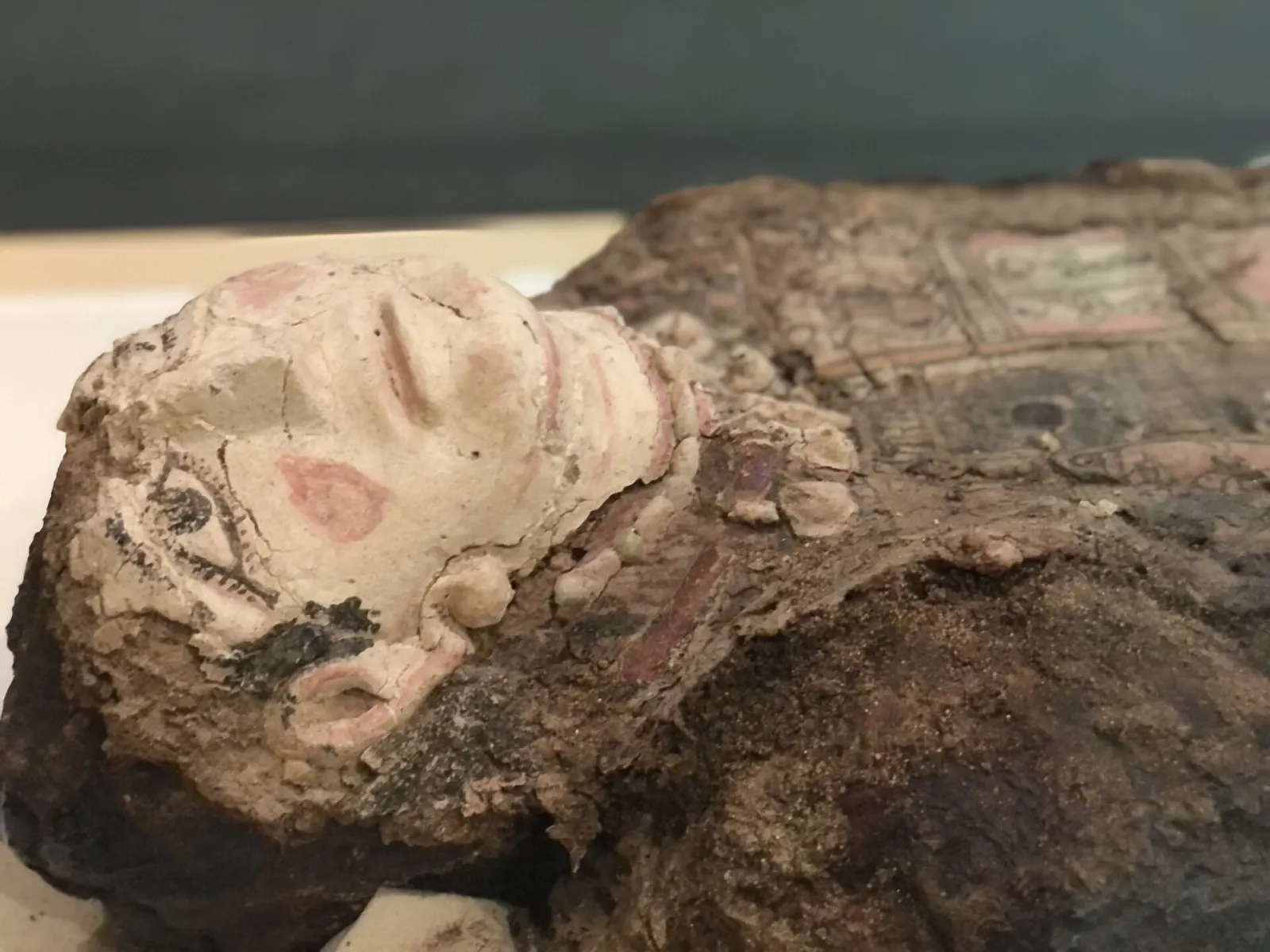
| Painted cartonnage | Masks and covers of linen and plaster, painted in bright colours | Prosperous families |
| Pottery coffin | No gold or cartonnage; the body laid in a coffin of fired clay shaped like a person | Families of middling means |
| Linen-wrapped | Bodies carefully wrapped, with no mask | Ordinary people |
| Simple burials | Wrapped in plain cloth or palm matting | The poorest |
Wikipedia's summary of the excavation counts about 60 of the recovered mummies in the gilded group, so even here gold was the exception (Wikipedia, checked 19 November 2026). The decoration mixes Egyptian gods, such as Anubis, Isis and the four sons of Horus, with Greek and Roman styles of hair and dress. The burials date from the Greco-Roman period, roughly the first to the fourth centuries AD. Pottery, coins, jewellery and figurines were buried alongside. Reports from the dig also mention cooking pots, amulets, small wooden statues and wooden stelae showing Osiris and Anubis (VOA Learning English, checked 19 November 2026).
How the mummies were made
Short answer: Wrapped in linen in the old Egyptian way, with reed sticks laid along the body under the wrappings to keep it stable.
By Roman times mummification was no longer reserved for kings and priests. Anyone who could pay was wrapped, and the richer the family, the more elaborate the cover. One detail stands out at Bahariya. Reed sticks were placed along each side of the body beneath the linen. Hawass said this made the mummies very stable (Wikipedia, checked 19 November 2026). In the museum, look at the shape of the wrapped bodies: they are straight and firm, not slumped.
Bahariya in Roman times
Short answer: A rich farming oasis famous for its wine, on the trade routes between the Nile and the desert.
The size of the cemetery shows that Bahariya was busy and prosperous in Roman times. Its springs watered fields of grain, olives and grapes. Bahariya wine was known in the Nile valley, and the oasis lay on caravan routes linking the Nile to the other Western Desert oases and Libya. The people buried here were farmers, merchants, officials and their families. They had Egyptian beliefs about the afterlife and Greek and Roman tastes. Hawass estimated the Roman-era population of the oasis at about 30,000, with wine from dates and grapes as its main industry (Wikipedia, checked 19 November 2026). For the wider story, see history and culture.
Why the cemetery stays closed
Short answer: It is an active archaeological site, mostly unexcavated, and the finds are fragile; the museum is the only place visitors see them.
There is nothing to stand and look at in the valley itself: the tombs are underground, and excavation is far from finished. The site is also close to the Temple of Alexander, which you can visit. Read the Temple of Alexander for that stop.
Where to see them
Short answer: A selection of the mummies is displayed in the small antiquities museum in Bawiti.
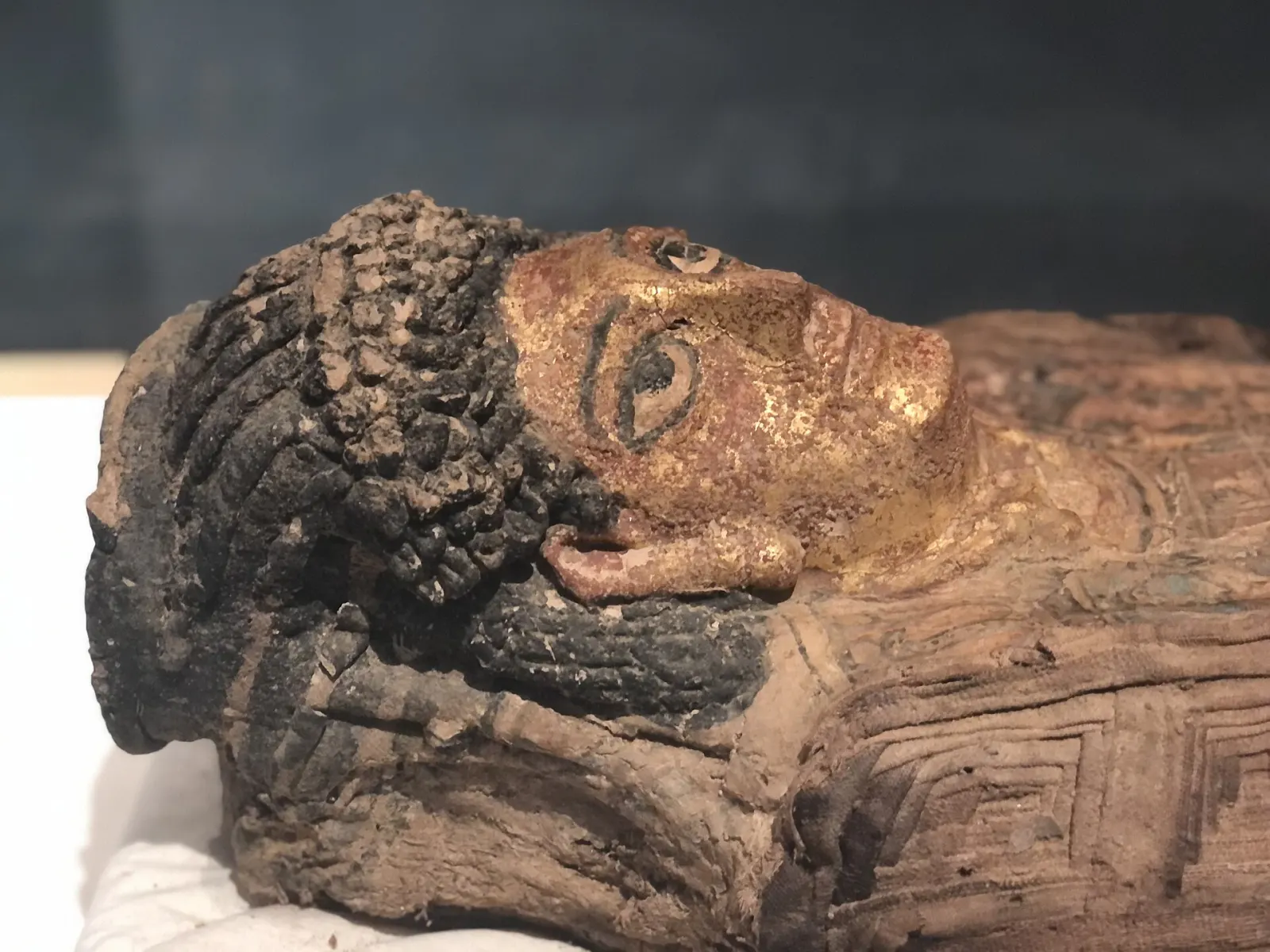
The cemetery itself is closed to visitors, and most of the valley is still unexcavated. A small number of the best-preserved mummies are displayed at the Bahariya antiquities museum in Bawiti, in glass cases with their gilded masks. It's a small museum, and most visitors spend 20 to 30 minutes there.
Other ancient sites in Bahariya
Short answer: The painted 26th-dynasty tombs, the tomb of Amenhotep Huy, the Ain el-Muftella chapels and the Temple of Alexander are all within a short drive of the museum.
They pair naturally with the mummies and are usually seen in the same block of time. What each site is, how long it takes and the ticket details are in the painted tombs and ancient sites of Bahariya.
Visiting the museum: checked November 2026
Short answer: The museum is a small building on the main road in Bawiti; a visit takes 20 to 30 minutes, and hours change, so ask us to check them for your day.
| Detail | |
|---|---|
| Where | The antiquities museum on the main road in central Bawiti |
| Time needed | 20–30 minutes for the museum, 1.5–2 hours with the tombs and temple |
| Hours | Daytime only; exact hours change, so ask us to check them for your day |
| Payment | Egyptian pounds in cash; cards are rarely accepted in Bawiti |
| Access | Ground level; ask us if you need step-free details |
The ticket is shared with Bahariya's other sites: about EGP 400 for foreigners since 1 October 2026 (was about EGP 100); check on the day. Details are on the painted tombs page and in what a trip costs. On our three-day trip museum entry is included. Bawiti is a lunch stop on our two-day route, so the museum is not part of it; ask us whether a short stop can fit on your date.
Is it worth the time? An honest comparison
Short answer: If you have one hour in Bawiti, the museum and one painted tomb give the best return. If ruins and ancient art leave you cold, a warm spring may suit you better.
| If you have… | Best choice | Why |
|---|---|---|
| 30 minutes | The museum | The Golden Mummies are unique to Bahariya and the visit is short |
| 1.5–2 hours | Museum and the painted tombs | Roman mummies and 26th-dynasty paintings, very different periods |
| Half a day | Museum, tombs, Ain el-Muftella and the Temple of Alexander | The full Bahariya story on one ticket |
| No interest in archaeology | A warm spring and English Mountain | Rest before the desert; see hot springs |
The trade-offs are real. The museum is small and the display is simple, so a guide makes a big difference. If you have already seen the large mummy collections in Cairo, the appeal here is different: these are ordinary oasis families, with their children, from one local cemetery. That is what makes it worth the stop for most people.
What guests notice at the museum
Short answer: How small and personal the display is, how bright the gilding still looks, and how many of the mummies are children.
The museum is modest, not a grand gallery. That is part of its charm. You stand close to the glass and see the faces painted on the masks, the curls of hair in Roman fashion, and small details like painted jewellery. Guests are often moved by the children's mummies, laid out beside the adults as they were found in the family tombs. Photography rules change from time to time, so ask the guard before you take out your phone.
Visiting with children or limited mobility
Short answer: The museum is the easiest of Bahariya's sites: short, at ground level and indoors. Prepare young children for the child mummies.
The museum and the Ain el-Muftella chapels are at ground level. The painted tombs are reached by short, steep stairs, and the Temple of Alexander is on sand and broken stone. If someone in your group finds stairs hard, the museum is the one site to keep. Children usually enjoy the gold and the donkey story; the child mummies can be a shock, so a word beforehand helps. Our White Desert with kids guide covers the rest of the trip.
Fitting the mummies into your trip
Short answer: Choose a three-day trip for an afternoon in Bawiti, or ask whether a quick museum stop fits a two-day trip.
On a two-day trip, the drive and the sunset in the White Desert set the pace, so there's rarely time for more than lunch in Bawiti. On our three-day trip, we give Bawiti an afternoon on day 1 for the museum, the painted tombs in town and English Mountain at sunset, before the desert. Bawiti is about 370 km from Cairo, 4.5–5 hours by car with a stop; see the Cairo to Bahariya drive. Message us on WhatsApp with "Golden Mummies" and your dates, and we'll check the museum hours for your day.
For everything else to see in town, from springs to English Mountain, see Bahariya Oasis and Bawiti.
Our advice
Short answer: Give Bahariya's history an afternoon on a three-day trip, and see the museum first, then the tombs.
- Start with the museum, then the 26th-dynasty tombs at Qarat Qasr Salim, then the Temple of Alexander.
- Bring small notes; guards sometimes unlock a side chamber or point out a detail, and a little thank-you is normal. Ask us what is usual.
- Combine it with a warm spring in the afternoon; see hot springs.
- Read up before you go. Ten minutes on the numbers and the mummy types above makes the small display far more rewarding.
- For more of the region's past, browse history and culture.
Questions people ask
Can you visit the Valley of the Golden Mummies?+
The cemetery itself is not open to visitors. You can see a selection of the mummies in the small museum in Bawiti, and museum entry is included on our three-day trip.
How old are the Golden Mummies?+
They date mainly from the Greco-Roman period, roughly the first to the fourth centuries AD, when Bahariya was a prosperous farming and wine-producing oasis. That makes them around 1,700 to 2,000 years old.
How many Golden Mummies are there?+
Archaeologists recovered around a hundred mummies from the first tombs opened in 1999, and the whole cemetery is thought to hold thousands more. Only a small part of the valley has been excavated.
Where is the Bahariya museum?+
In Bawiti, the main town of Bahariya Oasis, on the main road. It's small, and a visit takes 20 to 30 minutes. Opening hours can change, so ask us and we'll check them for your day.
Can I see the Golden Mummies on a two-day White Desert trip?+
The museum is not on our two-day route, because Bawiti is a lunch stop and the afternoon is needed to reach camp before sunset. Ask us whether a short stop can fit on your date. Our three-day trip gives you an afternoon in Bawiti for the museum and the painted tombs.
Are the mummies really made of gold?+
No. The name comes from the gilded masks and chest coverings that some of the richer mummies wore. Underneath, they're wrapped in linen like other Egyptian mummies.
How big is the Valley of the Golden Mummies?+
Nobody knows exactly, because most of it is still under the sand. Published estimates put the cemetery at 10 square kilometres or more, holding over 10,000 burials. Zahi Hawass said in 2000 that exploring it fully would take at least 50 years.
Is the museum on the same ticket as the painted tombs?+
The museum, the tombs and the Temple of Alexander have usually shared one Bahariya antiquities ticket. About EGP 400 for foreigners since 1 October 2026 (was about EGP 100); check on the day. Bring Egyptian pounds in cash.
Is the museum suitable for children?+
It is short, at ground level and easy to walk round, so it suits most families. Some of the mummies are children, which some young visitors find upsetting. Tell them what they will see before you go in, and keep the visit brief.
Who found the Golden Mummies?+
Nobody went looking for them. A guard's donkey fell into a buried tomb in 1996. The find was kept quiet at first, and an Egyptian team under Zahi Hawass began full excavation in 1999.
Go with us
Trips that include this

3 days, 2 nights
3-day White Desert tour: Bahariya, the White Desert and two nights outAbout US$495 to 660 per person for two travellers, private
Check dates