
The short answer
People have used this desert for at least 8,600 years, on chalk laid down 70 to 80 million years ago. Hunters camped at Djara about 8,600 to 6,000 years ago, pharaonic Bahariya was famed for wine, its 26th-dynasty tombs and Roman Golden Mummies survive near Bawiti, and the park was protected in 2002.
Ask us on WhatsAppBahariya and the White Desert sit on a long record: dinosaur bones about 100 to 95 million years old, chalk laid down 70 to 80 million years ago, and at least 8,600 years of people coming and going with the rains. The oasis was farmed for wine under the pharaohs, buried its Roman dead in gilded masks and was fought over in 1916. Inside the park the history is mostly natural; the human story is in and around Bawiti.
A green Sahara
Short answer: The Sahara was wet from about 14,500 years ago until between 6,000 and 5,000 years ago. Hunters camped at Djara about 8,600 to 6,000 years ago, and when the rains ended people moved towards the Nile.
Climate scientists call the last wet phase the African humid period. It began roughly 14,600 to 14,500 years ago and ended between 6,000 and 5,000 years ago, in several steps rather than all at once (Wikipedia: African humid period (checked 21 November 2026)).
The best place near the White Desert to see that world is Djara cave, on the plateau to the east. Cologne University's ACACIA project dated occupation around the cave to about 8,600 to 6,000 years before present (uncalibrated radiocarbon) and documented engraved and pecked figures of game and people, including a hall of gazelles with a decorated stalagmite (University of Cologne, ACACIA: Djara (checked 21 November 2026)). Bahariya itself has been lived in since the Neolithic, though the evidence has gaps (Wikipedia: Bahariya Oasis (checked 21 November 2026)).
As the rains failed, people left the open desert for places with reliable water, the Nile Valley above all. The same article links the humid period to the birth of ancient Egyptian civilisation (Wikipedia: African humid period (checked 21 November 2026)). At Djara, the ACACIA team also found surface sites showing intensive activity during that wet phase.
The northern oasis under the pharaohs
Short answer: Egyptians called Bahariya the northern oasis, or Djesdjes, and knew it for wine from the Middle Kingdom. A New Kingdom governor, Amenhotep Huy, was buried near Bawiti, and the oasis flourished again in the 26th dynasty.
The name Djesdjes first appears on a Middle Kingdom scarab. During the war against the Hyksos, King Kamose occupied the oasis, and a Czech team under Miroslav Bárta has found an Old Kingdom settlement at Qarat el-Abyad, so the link with the Nile may be older still (Wikipedia: Bahariya Oasis (checked 21 November 2026)). The French encyclopedia Universalis, in an entry by the Egyptologist Christiane Zivie-Coche, lists the ancient names as the northern oasis, Djesdjes and Kenmet, and notes that Bahariya wine is already mentioned in Middle Kingdom texts (Universalis: Oasis égyptiennes, archéologie (checked 21 November 2026)).
The oldest monument you can visit is the tomb of Amenhotep Huy, governor of the oasis, on the Qarat el-Hilwa ridge. Wikipedia dates it to the end of the 18th dynasty; Universalis allows the end of the 18th or the start of the 19th.
The high point came in the 26th dynasty, the 7th and 6th centuries BC. Universalis describes heavy building in this period and contacts with the Greek colony of Cyrene in Libya. Chapels went up at Ain el-Muftella, and wealthy families cut tombs under Qarat Qasr Salim and Qarat esh-Sheikh Subi. The painted tombs of Zed-Amun-ef-ankh and his son Bannentiu are the best of them; see the painted tombs of Bahariya for what is open and how long each takes.
Alexander, the Ptolemies and Rome
Short answer: Alexander's cartouches survive in a temple near Bawiti, though his route home from Siwa is unproven. Under Rome the oasis was the "small oasis", and its excavator thinks the Golden Mummies' cemetery holds more than 10,000 mummies.
Alexander took Egypt from the Persians in 332 BC and crossed the desert to the oracle of Amun at Siwa. The Temple of Alexander, west of Bawiti, was found by Ahmed Fakhry in 1938 and is named for the royal cartouches in its sanctuary. Wikipedia (checked 21 November 2026) describes it as a temple to Ammon at Qasr el-Miqisba and says some Egyptologists believe Alexander passed through on his way back. That is a reasonable guess, not a record.
The Romans knew Bahariya as the oasis parva, the small oasis, according to Universalis. They built a large fort at Qarat el-Toub, and the farming wealth of the period shows in the dead. The Valley of the Golden Mummies came to light in 1996, when a donkey broke through into a tomb; excavation led by Zahi Hawass began in 1999. About 250 mummies have been recovered, around 60 with gilded masks, and Hawass put the whole cemetery at more than ten thousand (Wikipedia: Valley of the Golden Mummies (checked 21 November 2026)). Wikipedia's Bahariya article gives the discovery as 1995 and counts about 34 tombs dug so far, so sources differ slightly on dates.
Christian Bahariya
Short answer: Universalis says the oasis became Christian in the 4th century and declined from the 8th. Excavations reported in 2019 and 2021 found 5th-century churches and monks' cells.
Christianity reached the oasis in the 4th century AD, and Universalis dates Bahariya's decline to the 8th century. In 2019 archaeologists reported 19 structures and a church cut into the bedrock with Greek inscriptions, dated to the 5th century; in 2021 a complex with three churches and monks' cells, also 5th century, was announced (Wikipedia: Bahariya Oasis (checked 21 November 2026)). In the same century the historian Olympiodorus of Thebes called Bahariya "the Third Oasis".
Explorers and dinosaurs
Short answer: Gerhard Rohlfs reached Djara on 24 December 1873. Ernst Stromer found Egypt's first dinosaur bones in Bahariya on 18 January 1911; his Spinosaurus was destroyed in Munich on 25 April 1944.
Rohlfs travelled with a large camel caravan backed by the Egyptian khedive. In 1874 his attempt to push west from Dakhla towards Kufra was stopped by the dune ridges of the Great Sand Sea, and the caravan turned north-west to Siwa (Wikipedia: Friedrich Gerhard Rohlfs (checked 21 November 2026)). Earlier on the journey it reached Djara on Christmas Eve 1873, as our Djara page records.
Ernst Stromer reached Bahariya on 11 January 1911 and a week later dug out three very large limb bones. His collector Richard Markgraf found a partial Spinosaurus in 1912, and Stromer named Spinosaurus aegyptiacus in 1915. RAF bombing of Munich on 25 April 1944 destroyed the collection, including the only known partial skeletons of Spinosaurus and Aegyptosaurus (Wikipedia: Ernst Stromer (checked 21 November 2026)). The fossil beds are Cenomanian, about 100 to 95 million years old.
The deep desert further west, the Great Sand Sea and the Gilf Kebir, falls inside the region where the UK Foreign Office "advises against all but essential travel to the area west of the Nile Valley and Nile Delta regions", with exceptions for "the White Desert and Black Desert" and the oasis towns including Bahariya and Farafra (gov.uk Egypt travel advice, updated 27 October 2026 (checked 21 November 2026)). Permits for those areas are arranged by specialist expedition operators.
The Senussi and English Mountain
Short answer: About 500 Senussi occupied Bahariya on 11 February 1916; their leader left for Siwa in October. A ruined post on a black hill outside Bawiti is called English Mountain, though who built it is disputed.
The Senussi, a religious order from Libya courted by the Ottoman Empire, moved into Egypt's western oases in 1916. About 500 men with Sayyid Ahmed ash-Sharif occupied Bahariya on 11 February. Aircraft of 17 Squadron from Faiyum bombed the oasis the next day, and a flight three days later found no Senussi there. Patrols of light Ford cars stretched British reach from tens of miles by camel to hundreds by vehicle. Later that year Sayyid Ahmed advanced from Dakhla to Bahariya; when news of a British attack leaked, he retreated to Siwa between 8 and 10 October 1916 (Wikipedia: Senussi campaign (checked 21 November 2026)). A military railway was built to Bahariya during the war (Wikipedia: Bahariya Oasis (checked 21 November 2026)). Black Gate notes the patrol cars were Model T Fords stripped of excess weight to run on soft sand.
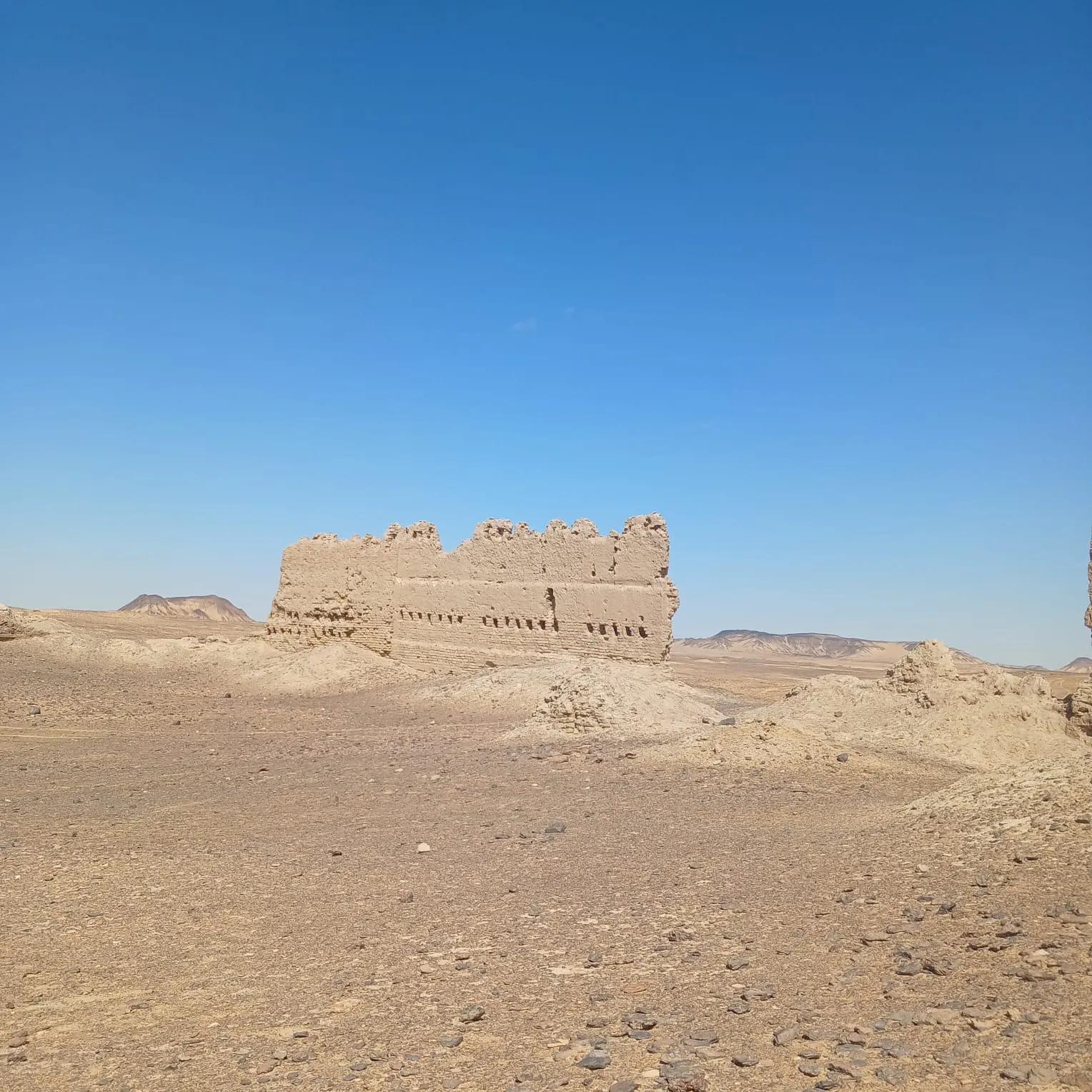
The ruin on the dark volcanic hill outside Bawiti carries a local story: an English soldier lived there to watch for raiders. Ahmed Fakhry linked the name to Claud Williams, a New Zealander who commanded No. 5 Light Car Patrol. A write-up of Russell McGuirk's book on the patrols argues Williams was never posted there and that the builder is unknown (Black Gate, 2019 (checked 21 November 2026)).
Road, iron and a protected area
Short answer: The asphalt road from Cairo was finished in the early 1970s, iron ore mining followed, and the White Desert became a protected area in 2002.
An asphalt road to Cairo was completed in the early 1970s, and agriculture, iron ore mining and tourism are now the oasis's main earners (Wikipedia: Bahariya Oasis (checked 21 November 2026)). By car Bawiti is about 370 km and 4.5–5 hours from central Cairo; see the Cairo to Bahariya drive. The park itself covers about 3,133.5 km² of New Valley Governorate under Prime Minister's Decree No. 1220 of 2002, citing the EEAA protectorate table. More on rules and wildlife in White Desert National Park.
Timeline at a glance
Short answer: Dinosaurs about 100–95 million years ago, chalk 70–80 million years ago, the wet Sahara until 6,000–5,000 years ago, painted tombs in the 26th dynasty, the Senussi in 1916, the park in 2002.
| When | What happened | Source |
|---|---|---|
| ~100–95 million years ago | Spinosaurus and other dinosaurs in Bahariya | Bahariya Oasis |
| ~70–80 million years ago | A shallow sea lays down the White Desert chalk | White Desert National Park |
| ~14,500 to 6,000–5,000 years ago | African humid period, the green Sahara | African humid period |
| ~8,600–6,000 years before present | Hunters camp at Djara | ACACIA, Cologne |
| Middle Kingdom | Djesdjes named on a scarab; its wine mentioned in texts | Bahariya Oasis, Universalis |
| New Kingdom | Tomb of the governor Amenhotep Huy | Universalis |
| 26th dynasty, 7th–6th century BC | Chapels and painted tombs around Bawiti | Bahariya Oasis |
| 332 BC | Alexander conquers Egypt and visits Siwa | Temple of Alexander |
| Roman period | Fort at Qarat el-Toub; the Golden Mummies' cemetery | Bahariya Oasis |
| 4th century AD | The oasis becomes Christian | Universalis |
| 5th century AD | Rock-cut church and monks' cells | Bahariya Oasis |
| 24 December 1873 | Rohlfs' expedition reaches Djara | Djara cave |
| 18 January 1911 | Stromer finds Egypt's first dinosaur bones | Ernst Stromer |
| 11 February 1916 | Senussi occupy Bahariya | Senussi campaign |
| 1938 | Fakhry finds the Temple of Alexander | Temple of Alexander |
| 25 April 1944 | Stromer's fossils destroyed in Munich | Ernst Stromer |
| Early 1970s | Asphalt road to Cairo completed | Bahariya Oasis |
| 1996 (1995 in some sources) | Golden Mummies found; digging from 1999 | Valley of the Golden Mummies, Bahariya Oasis |
| 2002 | White Desert declared a protected area | EEAA |
All external rows checked 21 November 2026.
How to see this history from the White Desert
Short answer: Take the three-day trip for the Golden Mummies, the tombs and English Mountain, or the four-day Djara trip for the cave engravings. Bahariya antiquities tickets are about EGP 400 for foreigners since 1 October 2026 (was about EGP 100); check on the day.
- Three days for the oasis. Our three-day trip spends the afternoon of day 1 in Bawiti: the museum with some of the Golden Mummies, the 26th-dynasty tombs in town and English Mountain at sunset, then two nights out. It costs About US$495 to 660 per person for two travellers, private. Museum entry is included; tomb tickets are extra. Ask us if you also want the Temple of Alexander fitted in.
- Four days for the green Sahara. The White Desert and Djara cave trip crosses to the engravings: About US$605 to 825 per person for two travellers, private. The antiquities ticket is not included if you add Bawiti's sites.
- Two days means natural history. The overnight camping trip does not stop at the museum or tombs, so its history is the chalk, the fossils in it and the Black Desert.
- Bring cash. Plan to pay site tickets in Egyptian pounds; our cost page has the full breakdown.
- Leave finds alone. Removing fossils, crystals or rocks from the park is against the law, so take a photo instead.
An old desert route runs from Siwa past small oases to Bahariya, and the Senussi used the oases as their road in 1916. Today the UK government advises against all but essential travel on the desert road from Bahariya west to Siwa; we route via Cairo and don't use it. For current advice on the White Desert itself, see permits and safety. More background is in history and culture.
Sources (checked 21 November 2026): Wikipedia: Bahariya Oasis, Universalis, ACACIA Djara, African humid period, Valley of the Golden Mummies, Ernst Stromer, Friedrich Gerhard Rohlfs, Senussi campaign, Black Gate, gov.uk, EEAA.
Questions people ask
When did the White Desert become a national park?+
In 2002. It covers about 3,133.5 km² of New Valley Governorate under Prime Minister's Decree No. 1220 of 2002. Visitors pay a government protected-area fee for foreign visitors, collected through the operator and shown as its own line in your quote.
Did Alexander the Great visit Bahariya?+
He conquered Egypt in 332 BC and went to the oracle of Amun at Siwa. A temple near Bawiti carries his cartouches, found by Ahmed Fakhry in 1938, but no ancient text puts him in Bahariya. Some Egyptologists think he came back this way; it remains a theory.
What was Bahariya called in ancient times?+
Egyptian texts call it the northern oasis and also Djesdjes, a name first seen on a Middle Kingdom scarab. The Romans called it the small oasis. A 5th-century historian, Olympiodorus of Thebes, called it the Third Oasis.
Was Bahariya famous for wine?+
Yes. The French encyclopedia Universalis says Djesdjes and Kenmet were both known for their wines, which are already mentioned in Middle Kingdom texts. In the Roman period, Zahi Hawass writes, wine made from dates and grapes was the oasis's main industry.
How old is the chalk of the White Desert?+
It is Late Cretaceous sea-floor sediment, some 70 to 80 million years old. The dinosaur beds of Bahariya, where Spinosaurus was found, are older still, about 100 to 95 million years. Wind and sand carved the chalk shapes far more recently.
When were the Golden Mummies found?+
In 1996, when a donkey stepped into a buried tomb; Wikipedia's Bahariya article gives 1995. Full excavation began in 1999. About 250 mummies have been recovered, roughly 60 of them gilded, and the excavator estimated more than 10,000 mummies in the whole cemetery.
What happened in Bahariya in the First World War?+
About 500 Senussi fighters occupied the oasis on 11 February 1916. British aircraft bombed it the next day, and the Senussi leader finally left Bahariya for Siwa in October 1916. A ruined stone post on a black hill outside Bawiti is still called English Mountain.
Can I see historical sites on a White Desert trip?+
Yes. Day 1 of the three-day trip covers the Bawiti museum with some of the Golden Mummies, the 26th-dynasty tombs and English Mountain at sunset; the two-day trip skips the museum and tombs. The tomb ticket is about EGP 400 for foreigners since 1 October 2026 (was about EGP 100); check on the day.
Go with us
Trips that include this
2 days, 1 night
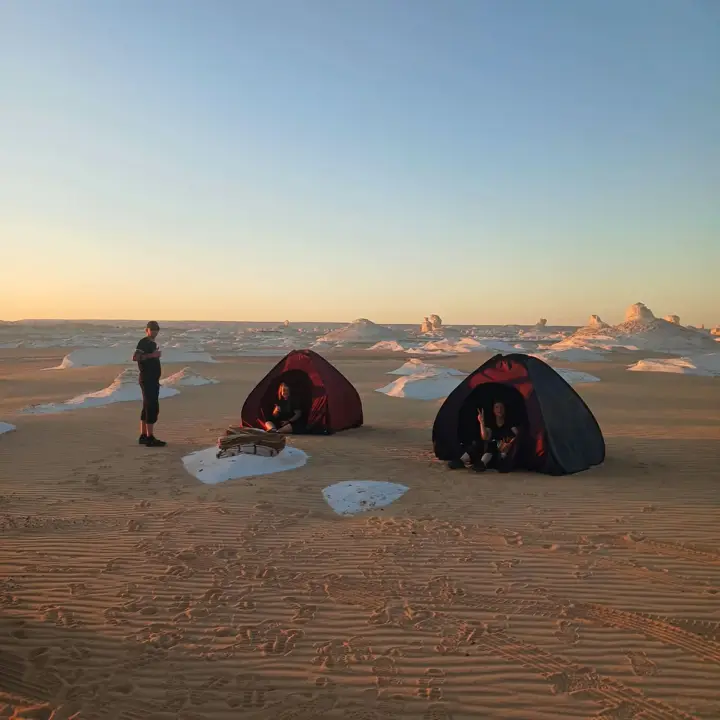
White Desert overnight camping trip from Cairo (2 days, 1 night)About US$185 to 230 shared · US$360 to 460 private, per person
Check dates
3 days, 2 nights
3-day White Desert tour: Bahariya, the White Desert and two nights outAbout US$495 to 660 per person for two travellers, private
Check dates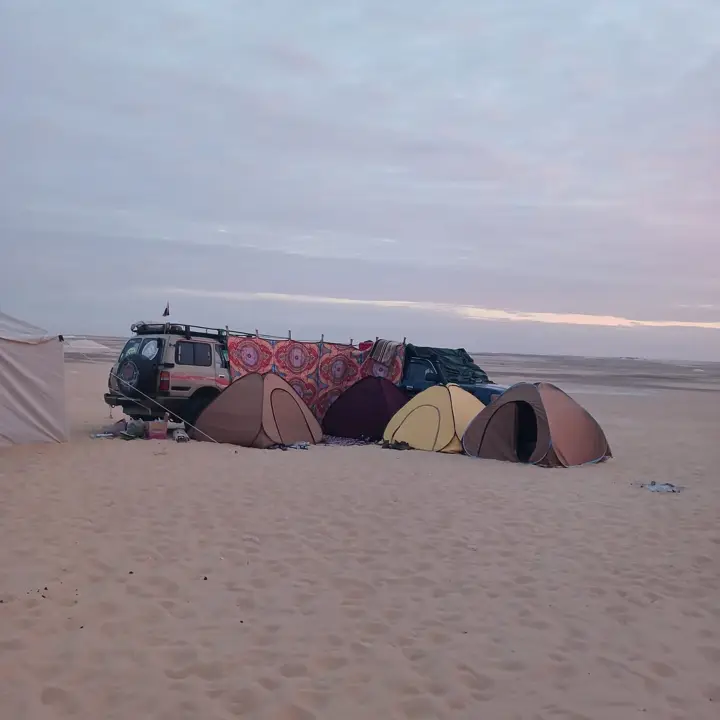
2 or 3 days
Private White Desert camping in comfortOn request (depends on group size and nights)
Check dates