
The short answer
Six dinosaur names have come from Bahariya's rocks, which are roughly 95 to 100 million years old. Ernst Stromer named Spinosaurus from here in 1915; his specimens were destroyed in the bombing of Munich in April 1944. In 2001 a University of Pennsylvania team published Paralititan, a giant sauropod. There is no museum display in the oasis; you visit the landscape.
Ask us on WhatsAppWhy Bahariya matters to palaeontologists
Short answer: Bahariya is the type locality of Spinosaurus, and its rocks have produced six dinosaur names plus fish, crocodile relatives and the first pterosaur reported from Egypt.
The Bahariya depression, which holds the oasis and the town of Bawiti, is cut into the Bahariya Formation, a layer of sandstone, siltstone and mudstone about 100 metres thick. It formed in the early Cenomanian, roughly 100 to 95 million years ago, along a coast where rivers met a rising sea. The formation takes its name from the oasis, and its reference section (the type section geologists use to define it) is at Gebel el-Dist, the hill at the northern end of the depression.
What makes the place famous is less the number of bones than their history. Almost everything found in the first collecting campaign was destroyed in the Second World War, so for most of the 20th century the best-known animals from Bahariya existed only as drawings, notes and a handful of photographs. Fieldwork since 1999, and new finds elsewhere in North Africa, have slowly rebuilt the picture.
Ernst Stromer and Richard Markgraf, 1911 to 1914
Short answer: Stromer reached Bahariya on 11 January 1911 and found Egypt's first dinosaur bones a week later; his collector Markgraf found Spinosaurus in 1912.
Ernst Stromer, a Bavarian palaeontologist from Nuremberg, arrived in Alexandria on 7 November 1910 for his most important Egyptian expedition. He reached Bahariya on 11 January 1911, and on 18 January dug out three very large limb bones, the first dinosaur fossils found in Egypt. His professional collector, Richard Markgraf, stayed on and kept digging. In 1912 Markgraf found the partial skeleton that Stromer named Spinosaurus aegyptiacus in 1915: a huge predator with tall spines on its back. Markgraf died in 1916, and some of his crates only reached Munich in 1922, damaged by repacking on the way.
From that material Stromer described a whole ecosystem. The main dinosaurs are in the table below, alongside the later finds.
The dinosaurs named from Bahariya
Short answer: Four were named by Stromer between 1915 and 1934, Paralititan in 2001 and Tameryraptor in 2025.
| Dinosaur | Type | Named | Named by | What is left today |
|---|---|---|---|---|
| Spinosaurus aegyptiacus | Sail-backed predator | 1915 | Ernst Stromer | Drawings, notes, photographs |
| Carcharodontosaurus (Bahariya specimen) | Large predator | 1931 | Ernst Stromer | Renamed in 2025, see below |
| Aegyptosaurus baharijensis | Long-necked plant-eater | 1932 | Ernst Stromer | Drawings and descriptions |
| Bahariasaurus ingens | Large predator | 1934 | Ernst Stromer | Illustrations only |
| Paralititan stromeri | Giant long-necked plant-eater | 2001 | Smith and colleagues, Science | Partial skeleton, Egyptian Geological Museum, Cairo |
| Tameryraptor markgrafi | Large predator | 2025 | Kellermann, Cuesta and Rauhut, PLOS ONE | A braincase cast, photographs, Stromer's figures |
Sources: Bahariya Formation, Aegyptosaurus, Bahariasaurus, Kellermann et al. 2025, Penn Today, 2001 (checked 21 November 2026).
Two of these names are still argued over. Bahariasaurus may be the same animal as Deltadromeus, known from Morocco; researchers have reached opposite conclusions. And the big predator Stromer placed in Carcharodontosaurus in 1931 was restudied from archive photographs and his original drawings, and in January 2025 given its own name, Tameryraptor markgrafi, after Markgraf. The authors concluded that the Bahariya and Moroccan predators are not as closely related as had been thought.
Other animals from the same rocks include the giant coelacanth Mawsonia, the sawfish relative Onchopristis, several crocodile relatives such as Stomatosuchus, the early sea snake Simoliophis, turtles, oysters and ammonites.
The fossils lost in 1944
Short answer: An RAF raid on Munich on the night of 24 to 25 April 1944 destroyed the museum and the Egyptian specimens on display, including the only Spinosaurus skeleton.
Stromer was openly critical of the Nazi regime. He was forced to retire in 1937, and two of his three sons died on the Eastern Front. He asked the museum's director, Karl Beurlen, to move the Egyptian fossils out of central Munich; Beurlen refused. On 25 April 1944 a bombing raid destroyed the building and, with it, the only known skeletons of Spinosaurus and Aegyptosaurus. Stromer's notes and drawings survived, and in 1995 his son Wolfgang gave photographs of the lost Spinosaurus to the palaeontology museum in Munich. Stromer died in Erlangen in 1952.
Paralititan, the "tidal giant"
Short answer: Found in January and February 2000 and published on 1 June 2001, Paralititan has a 1.69-metre upper arm bone and lived among mangroves about 94 million years ago.
In 1999 Joshua B. Smith, a doctoral student at the University of Pennsylvania, relocated Stromer's old site at Gebel el-Dist. The 2000 expedition found no skeletons at that hill, but during a seven-week dig in January and February 2000 it uncovered a partial skeleton at Gebel Fagga, another sandstone outcrop of the formation. Published in Science on 1 June 2001 as Paralititan stromeri, the "tidal giant" named in Stromer's honour, it was the first dinosaur reported from Bahariya since 1935. The co-authors included Yousry Attia of the Egyptian Geological Museum in Cairo, where the bones are catalogued as CGM 81119.
The find includes hip and tail vertebrae, ribs, parts of both shoulder blades, a complete right and partial left humerus, and part of a hand bone. That complete humerus, 1.69 metres long, was the longest known for any Cretaceous sauropod until Notocolossus was described in 2016. Penn estimated the animal at 80 to 100 feet long and 60 to 70 tons; later published estimates run from about 30 to 59 tonnes, because only around 5% of the skeleton is known.
The sediments around the bones, fine-grained, with plant remains and root marks, led the team to compare Bahariya to the mangrove coasts of Florida, and Paralititan is described as the first dinosaur shown to have lived in a mangrove habitat. A large predator's tooth found with the skeleton suggested to Smith's team that the carcass had been scavenged.
Did Spinosaurus swim? The debate since Morocco
Short answer: A 2020 study argued Spinosaurus swam with a paddle-like tail; a 2022 study argued it hunted by wading. The lost Bahariya specimen is still the reference point for both.
Because the Bahariya skeleton was lost, newer fossils from the Kem Kem beds of south-eastern Morocco, rocks of roughly the same age, now drive the research. On 29 April 2020 a team led by Nizar Ibrahim of the University of Detroit Mercy published the first Spinosaurus tail in Nature. Its tall spines give it a paddle shape, and tests with a robotic model led the authors to argue the animal swam actively and spent much of its time in water.
In November 2022 Paul Sereno's team at the University of Chicago replied in eLife with a paper titled "Spinosaurus is not an aquatic dinosaur". Using a digital model, they concluded it walked on two legs, was a slow and unstable swimmer too buoyant to dive, and was "a semiaquatic bipedal ambush predator" along coasts and rivers. Either way, the animal lived in a world of channels and fish, which is exactly what the Bahariya rocks record.
Bahariya then and now
Short answer: A coastline of tidal flats, channels and mangroves about 95 million years ago; a desert depression of springs, palms and dark hills today.
| About 95 million years ago | Today | |
|---|---|---|
| Landscape | Tidal flats, river channels and mangroves at the edge of a shallow sea | A desert depression ringed by hills, with Bawiti at its centre |
| Water | Shallow coastal channels | Springs and wells watering palm gardens |
| Plants | Mangrove forest on the tidal flats | Dates, olives, guavas and apricots |
| Large animals | Spinosaurus, Paralititan, Aegyptosaurus and other big predators | None of their kind; the bones lie in the hills |
The White Desert's chalk is a younger chapter. It is sea-floor sediment roughly 70 to 80 million years old, much younger than the Bahariya beds, and no dinosaur bones are known from the chalk. The Dakhla dinosaur Mansourasaurus, put at about 80 million years old when it was announced in January 2018 by Hesham Sallam's team at Mansoura University, comes from that later world, when Late Cretaceous dinosaurs in Africa are, in the Carnegie Museum's words, "few and far between".
How to see it from the White Desert
Short answer: Gebel el-Dist sits near Bawiti, which road trips from Cairo reach before the desert. It is not a fixed stop on our itineraries, so ask us whether it fits yours.
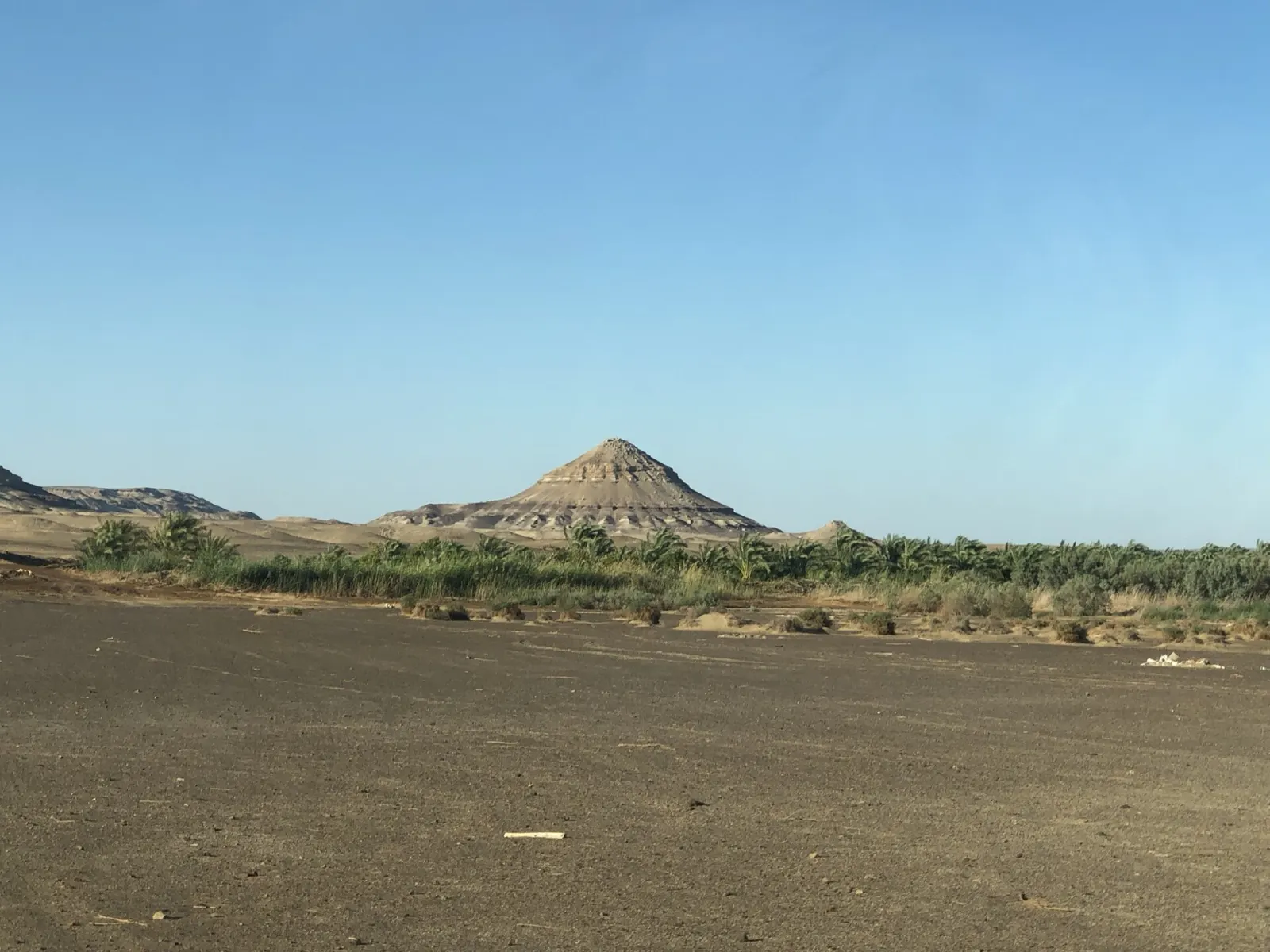
There is no dinosaur museum or bone display in Bahariya. What you visit is the setting: Gebel el-Dist, the pointed, layered hill near Bawiti that gives the formation its type section, and the low hills around it, including Gebel Fagga, where Paralititan was dug. The hill is cut into the sandstones, siltstones and mudstones of the formation itself. Anything you find on the surface stays where it is.
Road trips from Cairo reach Bawiti first, about 370 km and 4.5–5 hours by car, before heading south into the Black Desert and the chalk. Two of our trips pass through Bawiti:
- The three-day tour spends an afternoon in Bahariya with the Golden Mummies, the town's painted tombs and sunset from English Mountain. About US$495 to 660 per person for two travellers, private.
- The overnight camping trip stops in Bawiti for lunch, then goes through the Black Desert and Crystal Mountain to a night in the chalk. About US$185 to 230 shared · US$360 to 460 private, per person.
Neither itinerary lists Gebel el-Dist as a fixed stop. If you want it added, ask us when you book and we will tell you whether it fits your route and how long it adds. For a wider look at the oasis, see Bahariya Oasis; children who love dinosaurs may like the ideas on the White Desert with kids.
Treat any stop there as open desert: carry water and a hat, and ask us about access and walking on the hill before you go.
Ask us about a dinosaur stop
Short answer: Tell us your dates and that you want Gebel el-Dist, and we will say how it fits your trip.
Message us on WhatsApp with "dinosaurs" and your dates, or use the contact page.
Sources (checked 21 November 2026): Ernst Stromer · Spinosaurus · Paralititan · Tameryraptor · Kellermann et al., PLOS ONE 2025 · Penn Today, 30 May 2001 · Scientific American, 1 June 2001 · National Geographic, April 2020 · University of Chicago, 2022 · Carnegie Museum of Natural History, 29 January 2018 · Mansourasaurus.
Questions people ask
Can you see dinosaur fossils in Bahariya?+
Not on display in the oasis. Stromer's specimens went to Munich and were destroyed in 1944, and the Paralititan bones found in 2000 were deposited at the Egyptian Geological Museum in Cairo under catalogue number CGM 81119. In Bahariya you see the hills, such as Gebel el-Dist, where the bones came from.
Which dinosaurs were found in Bahariya?+
Stromer named Spinosaurus (1915), a large predator he placed in Carcharodontosaurus (1931), the sauropod Aegyptosaurus (1932) and Bahariasaurus (1934). Paralititan followed in 2001, and in 2025 Stromer's Carcharodontosaurus specimen was renamed Tameryraptor markgrafi.
How old are the Bahariya dinosaurs?+
The Bahariya Formation dates to the early Cenomanian stage of the Late Cretaceous, roughly 100 to 95 million years ago. The University of Pennsylvania team gave Paralititan an age of about 94 million years.
How big was Paralititan?+
Its complete right upper arm bone is 1.69 metres long. The Penn team estimated the animal at 80 to 100 feet (about 24 to 30 metres) long and 60 to 70 tons, though only a small part of the skeleton is known.
Why were the original Spinosaurus bones lost?+
They were on display in Munich's palaeontology museum when an RAF raid destroyed it on the night of 24 to 25 April 1944. Stromer had asked the director, Karl Beurlen, to move the Egyptian fossils, and he refused.
Did Spinosaurus swim?+
Scientists disagree. A 2020 Nature paper on a tail from Morocco argued it swam actively; a 2022 eLife paper by Paul Sereno's team called it a semiaquatic, two-legged ambush predator that hunted at the water's edge.
Were dinosaurs found anywhere else in the Western Desert?+
Yes. In January 2018 a Mansoura University team led by Hesham Sallam announced Mansourasaurus, a long-necked plant-eater from Dakhla Oasis about 80 million years old, much younger than the Bahariya animals.
Can I take fossils home from Bahariya or the White Desert?+
No. Inside the national park, declared in 2002, fossils, crystals and stones stay where they are. Around Bahariya, photograph what you find and leave it in place; the 2025 restudy that named Tameryraptor shows these beds are still being worked on.
Go with us
Trips that include this

3 days, 2 nights
3-day White Desert tour: Bahariya, the White Desert and two nights outAbout US$495 to 660 per person for two travellers, private
Check dates
2 days, 1 night
White Desert overnight camping trip from Cairo (2 days, 1 night)About US$185 to 230 shared · US$360 to 460 private, per person
Check dates