
The short answer
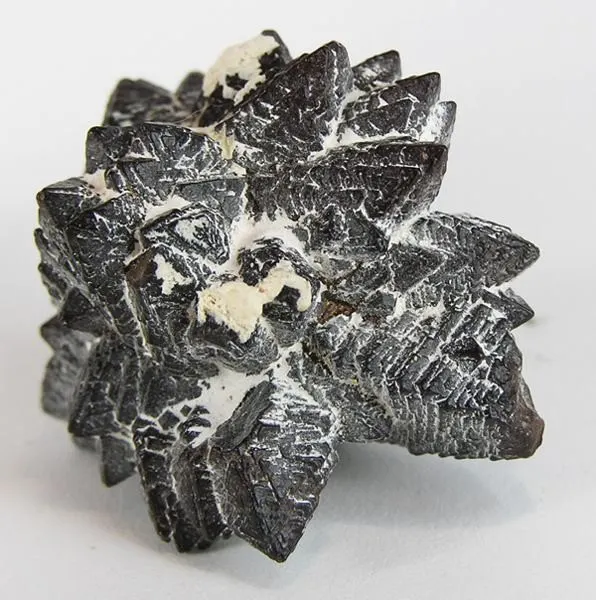
The White Desert's chalk is a sea floor laid down about 72 million years ago, around the Campanian-Maastrichtian boundary. Its 'desert flowers' are iron nodules that grew inside it: a Hamilton College study found they are mostly goethite that has replaced the original marcasite and pyrite. Egyptian law forbids removing rocks from the protected area, so photograph them and leave them.
Ask us on WhatsAppThe short version
Short answer: The chalk is an old sea floor, roughly 72 million years old; the dark "flowers" are iron nodules that grew in it. Both are protected.
The white rock you camp on was laid down as fine mud on the floor of a sea, near the end of the Cretaceous. The Egyptian Environmental Affairs Agency's 2007 draft management plan for the park names it the Khoman chalk and dates it to the Upper Campanian and Lower Maastrichtian, the stages either side of about 72 million years ago (EEAA 2007 draft management plan; Wikipedia: Maastrichtian, both checked 21 November 2026). The same plan says the chalk is cut by a great many joints filled with calcite and pyrite concretions. Those concretions, rusted and weathered out, are what people call desert flowers.
Age and setting, at a glance
Short answer: Late Cretaceous chalk, deposited in open sea on a continental shelf, later cracked by faults and veined with minerals.
| Question | Answer | Source (checked 21 November 2026) |
|---|---|---|
| What is the rock? | Snow-white Khoman chalk and chalky limestone, the oldest rock unit in the Farafra depression | EEAA 2007 plan |
| How old? | Upper Campanian to Lower Maastrichtian; the Maastrichtian ran from 72.2 to 66 million years ago | EEAA 2007 plan; Wikipedia: Maastrichtian |
| What kind of sea? | Outer shelf ("outer neritic") conditions in the Maastrichtian, with spells of shallowing | Mahfouz et al. 2021, Journal of African Earth Sciences |
| Named unit | The base of the Khoman Formation near Farafra is now called the White Desert member | Mahfouz et al. 2021 |
| Cracks and veins | A polygonal fault network exposed over about 900 km² of the chalk near Farafra | Tewksbury et al. 2014, Geology |
| The "flowers" | Mostly goethite replacing marcasite and pyrite; barite, gypsum and calcite also found | Allen, Bailey and Tewksbury 2014, GSA abstract |
The 2021 study by Kamel Mahfouz and colleagues, published in the Journal of African Earth Sciences, dated the Farafra succession using planktonic foraminifera, single-celled organisms far too small to see without a microscope. That is the honest picture of the fossil record here: the best-studied fossils in the White Desert chalk are microscopic. Larger marine fossils occur too, and our park guide lists marine fossils in the chalk among its features (see the national park guide), but we have not found a published list of the shells and urchins visitors spot at the formations.
What marine fossils look like
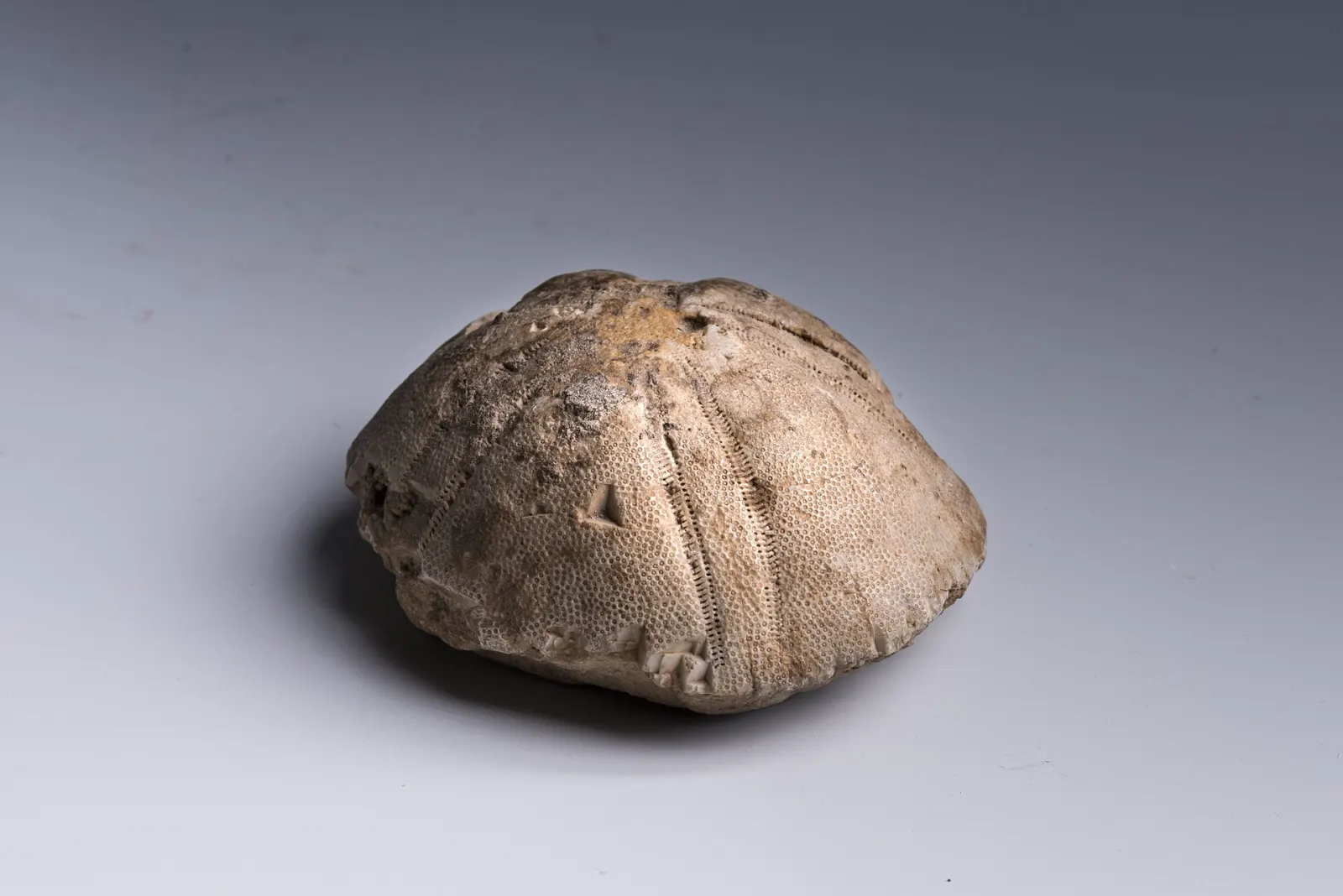
Short answer: Look for regular shapes the rock alone can't make: ribs, growth lines, a five-part star or a neat tube.
Use this as a recognition guide rather than a promise of what you'll find. These are the general signs of the main groups of sea-floor fossils.
| Group | What gives it away |
|---|---|
| Bivalve or oyster shell | A fan or cup shape with growth lines running parallel to the edge; oysters are thick and layered |
| Sea urchin (echinoid) | A rounded dome with a five-part pattern of rows radiating from the top |
| Burrow or trail | A tube or ribbon of slightly different texture cutting through the chalk |
| Foraminifera | Invisible to the eye; a hand lens shows only grains |
Ancient Egyptians noticed fossil urchins too. The Museo Egizio in Turin holds an Eocene cidaroid sea urchin, 56 to 34 million years old, found in the temple area at Heliopolis. Its base carries a hieroglyphic note that it was found south of the quarry by a priest called Tjanefer (Museo Egizio, Suppl. 2761 (checked 21 November 2026)). It is younger than the White Desert chalk and from another part of Egypt, but it shows how long people here have picked these shapes out of the rock.
What the "desert flowers" are
Short answer: Iron sulphide crystals that grew in the buried chalk and have since turned to goethite, keeping the original shapes.
In 2014 Hannah Allen, David Bailey and Barbara Tewksbury of Hamilton College presented a study of these aggregates from the Khoman chalk around Farafra; they note that collectors had long sold them as marcasite, but that they had not had significant scientific study before. Using microscopes, electron imaging and X-ray diffraction, they found they are mainly goethite, an iron hydroxide, that has replaced earlier marcasite and pyrite. Mineralogists call that a pseudomorph: a new mineral wearing an old one's shape. They suggest the crystals formed after the chalk was deposited, possibly as it was buried and lost water, and say the exact conditions can't be pinned down further (Allen, Bailey and Tewksbury 2014 (checked 21 November 2026)).
The four forms they recorded:
| Form | What it looks like |
|---|---|
| Stellate aggregate | A star or rosette of blades radiating from a centre |
| Spherical concretion | A rough, heavy, rounded ball |
| Tabular fracture filling | A thin, flat plate that grew in a crack |
| Cylindrical tube | A long rod or pipe |
Pyrite and marcasite have the same chemistry, iron disulphide, but different structures: pyrite is cubic, marcasite orthorhombic. Marcasite often twins into flat, grouped "cockscomb" crystals or spearhead shapes, which is why the bladed stars here get labelled marcasite. Fresh marcasite is also unstable; in damp air it breaks down into iron sulphate and sulphuric acid (Wikipedia: Marcasite (checked 21 November 2026)).
Tewksbury and colleagues also described the chalk's polygonal fault network, where clusters of dozens of steep normal faults, dipping at about 80 degrees, outline polygons and carry coarse calcite veins (Tewksbury et al. 2014 (checked 21 November 2026)). The nodule samples came from an area of small polygonal faults, but the study says more field work on where the nodules sit is needed before any link can be drawn, so treat any theory on that as unproven.
Fossil, nodule, flint or meteorite?
Short answer: Pale and patterned is a fossil, dark and heavy is a nodule, glassy with sharp edges is flint.
| What you're holding | How to tell |
|---|---|
| Fossil | Chalk-coloured, with ribs, growth lines or a five-part star |
| Desert flower | Brown to black, heavy, a star, ball, plate or tube |
| Calcite vein | A pale, sugary ridge standing proud of the chalk |
| Flint or chert | Usually grey or brown; breaks with curved, shell-like (conchoidal) fractures. Chert that forms in chalk is called flint |
| Meteorite | Very rare; most have a thin, dark fusion crust from their fall through the atmosphere |
Sources for this table (checked 21 November 2026): Wikipedia: Sea urchin on the five-part pattern, Wikipedia: Chert and Wikipedia: Meteorite; the nodule row follows the Hamilton College study above.
Chert appears in the official record too. The EEAA plan describes Qaret el-Sheikh Abdallah, a flat-topped hill on the plateau between the Farafra and Bahariya depressions, with Maastrichtian chalk at its base, Palaeocene limestone above, and a cap of limestone and chert gravels and boulders.
Why they lie on the surface
Short answer: Most likely because the wind strips the soft chalk and leaves the harder pieces behind.
The EEAA plan describes chalk stacks whose surfaces are pitted and sometimes polished, features it puts down to wind action, and says the stacks are commonest where the prevailing wind runs parallel to a set of joints. It also says the calcite filling the joints is left standing by differential weathering as sharp, elongated ridges. The likeliest reason iron nodules lie loose on top is the same: the wind lowers the soft chalk and leaves the denser pieces behind. That is our reading; we have not found a study that measures it. For the formations themselves, see the Mushroom and Chicken and the old and new White Desert.
Crystal Mountain and Bahariya's dinosaurs
Short answer: Crystal Mountain is a calcite-studded ridge on the road; the dinosaurs belong to Bahariya's older rock, not the chalk.
Between Bawiti and the chalk, the road passes Crystal Mountain, a modest ridge glittering with crystals that are mostly calcite, and nearly every trip stops there. On the way you also pass the dark-capped hills of the Black Desert. Further north, Bahariya's rocks are older than the chalk and hold dinosaur remains: the German palaeontologist Ernst Stromer described Spinosaurus from bones found there, and his specimens were lost when Munich was bombed in 1944. None of that is on view on a White Desert trip; for the oasis itself see Bahariya Oasis.
How to see them from the White Desert
Short answer: Every trip crosses the chalk; an overnight gives you the low light and time on foot that fossil spotting needs.
- Choose time on foot. The overnight trip from Cairo, priced at about US$185 to 230 shared · US$360 to 460 private, per person, puts you among the chalk for late afternoon and sunrise.
- For more ground, the 3-day Bahariya, White Desert and Farafra tour, about US$495 to 660 per person for two travellers, private, adds a second night and the Farafra side, where the nodule study was done.
- Where to stop. Which patches along the route show the most nodules and fossils is a question to ask us when you book; tell us it matters to you and we'll tell you what's possible. Contact us.
- Light. Low sun picks out ribs and spikes; midday glare flattens them. Put a coin or fingertip in the frame for scale. More in our photography guide.
- Children tend to enjoy the hunt; see the White Desert with kids.
Plants you may see
Short answer: Very few, and mainly where groundwater is close: acacias, tamarisk, palms, reeds and camelthorn.
Most of the park is bare chalk. The EEAA plan's plant list includes acacias, Nile tamarisk, date palms, common reed and camelthorn, and it says vegetation depends mainly on groundwater. Colocynth is not on that list, but it is a spreading desert vine whose range runs through the Sahara and Egypt; its round fruit is 5 to 10 cm across, yellow-green with yellow stripes as it ripens, extremely bitter and poisonous (Wikipedia: Citrullus colocynthis (checked 21 November 2026)). The plan also names collecting wild plants for firewood as a threat to be prevented.
Look, photograph, leave
Short answer: Egyptian law forbids removing rocks, shells or soil from a protected area, for any purpose.
The White Desert is a protected area under Law No. 102 of 1983 (see the national park guide). Article 2 of that law forbids damaging or removing living organisms or natural features and resources, naming shells, corals, rocks and soil, for any purpose, and forbids spoiling geological structures (Law No. 102 of 1983, FAOLEX (checked 21 November 2026)). The park's own plan has a section on the collection of fossils and prehistoric tools, with patrols and enforcement as the response. Pick a nodule up for a photo, then put it back where it lay, and follow our camping guidance on leaving no trace.
Sources (checked 21 November 2026): EEAA 2007 draft management plan; Allen, Bailey and Tewksbury 2014; Tewksbury et al. 2014; Mahfouz et al. 2021; Law No. 102 of 1983; Museo Egizio; Wikipedia on the Maastrichtian, marcasite, colocynth, sea urchins, chert and meteorites.
Questions people ask
Are the black balls in the White Desert meteorites?+
Almost certainly not. A 2014 Hamilton College study of these aggregates in the Khoman chalk near Farafra found they are goethite, an iron hydroxide, which has taken the shape of earlier marcasite and pyrite crystals. They grew inside the chalk after it was laid down.
How old is the White Desert chalk?+
The EEAA's 2007 management plan for the park dates the Khoman chalk to the Upper Campanian and Lower Maastrichtian, the last part of the Cretaceous. The Maastrichtian began about 72.2 million years ago and ended 66 million years ago with the extinction that wiped out the non-avian dinosaurs.
Can I take a fossil or a desert flower home?+
No. Article 2 of Egypt's Law No. 102 of 1983 forbids damaging or removing natural features such as shells, rocks or soil from a protected area for any purpose, and the park's management plan lists fossil collecting as a problem to be patrolled.
What is the difference between pyrite and marcasite?+
Both are iron disulphide, FeS2. Pyrite has a cubic crystal structure; marcasite is orthorhombic and often forms flat, grouped 'cockscomb' or spearhead shapes. In the White Desert most nodules have turned to goethite, so the shape is the best clue to which mineral they started as.
What shapes do desert flowers come in?+
The Hamilton College team recorded four common forms: star-shaped clusters, round concretions, thin flat sheets that filled fractures, and long cylindrical tubes. Barite, gypsum and calcite were also present in their samples.
Why do the nodules sit on top of the ground?+
The EEAA park plan describes chalk stacks pitted and sometimes polished by the wind, with calcite in the joints weathering out as sharp ridges. The likeliest explanation is that the denser iron nodules are left behind the same way, though we have not found a study that measures it.
Are there dinosaur bones in the White Desert?+
Not in the chalk. Dinosaur fossils come from Bahariya's older rocks, where Ernst Stromer described Spinosaurus in the early twentieth century; his originals were destroyed in Munich in 1944. You won't see bones on a White Desert trip.
What is the wild melon growing in the desert?+
Probably colocynth, Citrullus colocynthis, a desert vine whose range runs through the Sahara and Egypt. Its round fruit is 5 to 10 cm across, yellow-green with yellow stripes as it ripens, extremely bitter and poisonous, so look but don't taste. It is not on the EEAA plan's plant list for the park.
Go with us
Trips that include this

2 days, 1 night
White Desert overnight camping trip from Cairo (2 days, 1 night)About US$185 to 230 shared · US$360 to 460 private, per person
Check dates
3 days, 2 nights
3-day White Desert tour: Bahariya, the White Desert and two nights outAbout US$495 to 660 per person for two travellers, private
Check dates
2 or 3 days
Private White Desert camping in comfortOn request (depends on group size and nights)
Check dates