
The short answer
Bahariya has more ancient sites than most White Desert visitors realise. In Bawiti, the painted tombs of Zed-Amun-ef-ankh and his son Bannentiu, from the 26th dynasty, are the highlight. Nearby are the tomb of the governor Amenhotep Huy, the chapels of Ain el-Muftella, the Temple of Alexander and the museum with the Golden Mummies. Allow a morning for them.
Ask us on WhatsAppAncient Bahariya
Short answer: For three thousand years Bahariya was a prosperous oasis on the routes between the Nile and the desert, and it left tombs and temples to prove it.
Bahariya was already governed from the Nile valley in pharaonic times, and it thrived again in the Late Period and under the Greeks and Romans. Its springs watered grain, olives and vines, and its wine was known on the Nile. The officials and priests who ran the oasis built tombs and chapels in and around Bawiti, and the Romans buried their dead in the vast cemetery now called the Valley of the Golden Mummies.
Most White Desert trips drive straight past on their way south. As a team based in Bawiti, we think that's a shame: with a morning or an afternoon to spare, the sites add a whole other layer to the trip. For the wider story, read history and culture.
The sites at a glance
Short answer: Five sites within a short drive of central Bawiti; the museum and the two painted tombs are the essentials.
| Site | Period | What you see | Time |
|---|---|---|---|
| Bahariya museum | Mostly Greco-Roman | Golden Mummies and finds from the oasis | 20–30 minutes |
| Tombs of Zed-Amun-ef-ankh and Bannentiu, Qarat Qasr Salim | 26th dynasty | Painted underground tombs | 30–45 minutes |
| Tomb of Amenhotep Huy, Qarat el-Hilwa | New Kingdom | A governor's tomb, among Bahariya's oldest monuments | 20 minutes |
| Ain el-Muftella | 26th dynasty | Chapels with carved and painted reliefs | 20–30 minutes |
| Temple of Alexander | Late 4th century BC | Ruins of a temple from Alexander's time | 20–30 minutes |
Tickets and opening: checked November 2026
Short answer: About EGP 400 for foreigners since 1 October 2026 (was about EGP 100); check on the day, pay in cash and start early.
Checked November 2026:
- Price: about EGP 400 for foreigners since 1 October 2026 (was about EGP 100); check on the day. See what a trip costs.
- Where: a combined ticket has usually been sold at the museum in Bawiti; guards at the tombs check it.
- Payment: bring Egyptian pounds in cash. Don't count on a card machine.
- Hours: sites open in the morning and close mid-afternoon. Exact hours change, so ask us to confirm them the day before.
- Photography: often restricted inside the painted tombs, or charged separately. Ask first.
Site tickets are separate from the White Desert park entry fee, which is listed in your quote.
How the ticket works
| Detail | |
|---|---|
| Where to buy | At a booth in front of the antiquities building that houses the museum; not at the tombs |
| What it covers | One ticket for the sites on Bawiti's antiquities trail, including the museum and the tombs |
| Valid for | One day only |
| Students | Half the foreigner rate; bring a student card |
| Photography | Cameras are handed in before entering the tombs; photography has been banned there for several years |
| Getting round | The loop of sites is about 15 km, so most people go by car |
These details come from Wikivoyage's guide to Bawiti (checked 19 November 2026) and, for photography, its page on Qarat Qasr Salim (checked 19 November 2026). The Bawiti guide also records the rise to about EGP 400 in October 2026. The one-day rule matters: split the sites across an afternoon and the next morning, and you may need two tickets.
The tombs of Zed-Amun-ef-ankh and Bannentiu
Short answer: Bahariya's finest paintings, in two family tombs cut beneath a low hill in the middle of Bawiti.
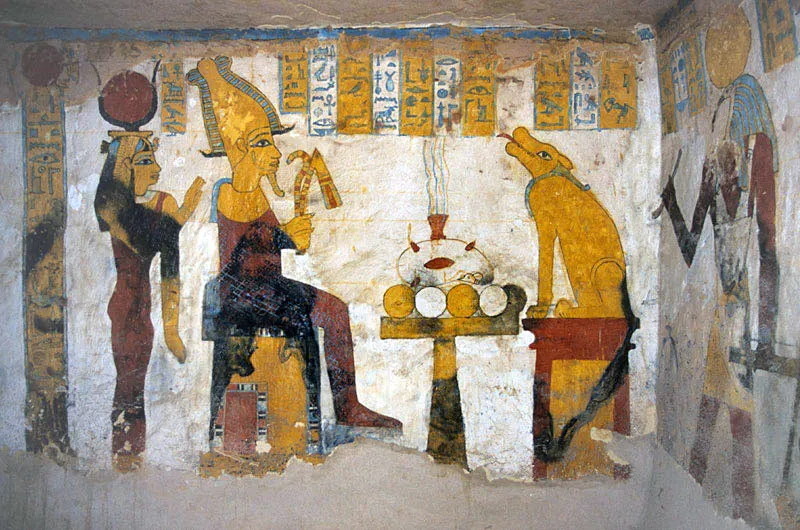
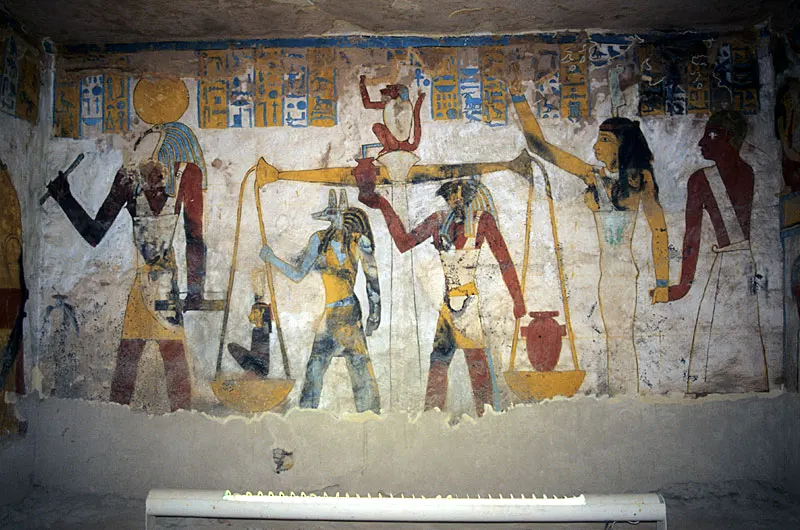
Under the small hill of Qarat Qasr Salim, surrounded by houses a few minutes from the centre, lie the tombs of Zed-Amun-ef-ankh, a wealthy official, and his son Bannentiu. They date from the 26th dynasty, in the 7th and 6th centuries BC. A stairway leads down to a columned hall and burial chambers. The walls are painted in rich colours with gods, the judgement of the dead and the journey of the sun through the underworld. Bannentiu's tomb is usually counted the better preserved of the two: a pillared chamber whose walls are still bright. The family prospered when Bahariya grew rich on trade and wine. The Egyptian archaeologist Ahmed Fakhry excavated them in the 1930s, and they are among the finest ancient paintings in the Western Desert.
What to look for
- The weighing of the heart: the dead man's heart balanced against the feather of truth before Osiris.
- The sun's night journey: the sun god travelling by boat through the hours of the night, to be reborn at dawn.
- Colours: reds, yellows and blues still strong after more than 2,500 years in the dry desert air.
- Family details: the son's tomb echoes the father's, a reminder that these were local families with status and money.
The chambers are small and only a few people fit at once, so expect to go in by turns.
Inside the two tombs
Short answer: You go down a shaft by wooden stairs into each tomb. Bannentiu's has a four-pillared hall and the richest paintings; his father's has a round hall with lotus columns and a painted ceiling.
Local people found the two main tombs in 1918, and Fakhry excavated them in 1938. Both owners lived under King Amasis (Ahmose II) of the 26th dynasty. The layout below follows Wikivoyage's site guide (checked 19 November 2026).
| Bannentiu (the son) | Zed-Amun-ef-ankh (the father) | |
|---|---|---|
| Way in | A square shaft about 6 m deep, with wooden stairs | A shaft just under 5 m deep |
| Main room | A hall about 8 by 7 m with four pillars | A roughly round hall with squat lotus columns and a ceiling of Nekhbet vultures |
| Burial chamber | A small, nearly square room about 3 m long | Not described in detail; niches were cut in later for Roman burials |
| Paintings | Thoth and Horus at the burial-chamber door, the judgement of the dead, mummification, the sun's night voyage and the moon's journey | Thoth and Horus at the entrance, mourners, the guardian gods of the organs and the owner's wife |
| Later history | Two scenes cut out by modern thieves in recent decades | Reused in Roman times; six of seven false doors replaced by burial niches |
Both tombs were robbed in antiquity and damaged again in recent decades, so expect gaps in the walls. Some shafts on the hill are unsecured, so stay on the path and keep children close.
The tomb of Amenhotep Huy
Short answer: The tomb of a New Kingdom governor of the oasis, on a ridge just outside Bawiti, with a fine view over the palms.
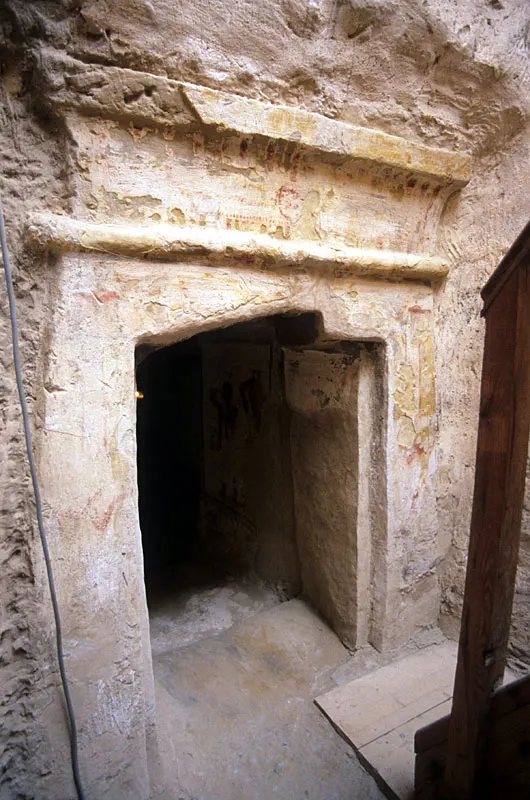
On the ridge of Qarat el-Hilwa, just outside town, is the tomb of Amenhotep Huy, a governor of Bahariya in the New Kingdom. It's among the oldest monuments in the oasis. Much of its decoration has faded, so it's more a stop for history lovers than for art, but it shows that Bahariya was run from the Nile valley more than three thousand years ago. The view from the ridge over the palm groves and the town is worth the short climb, especially in the low morning light.
Sources date the tomb slightly differently. Wikipedia places it at the end of the 18th dynasty (Wikipedia, Bahariya Oasis, checked 19 November 2026). Wikivoyage puts it in the early 19th dynasty, describes Amenhotep Huy as governor of the northern oases, and notes two halls with side niches and scenes of the owner with his wife (Wikivoyage (German), Bawiti, checked 19 November 2026).
Ain el-Muftella
Short answer: A group of 26th-dynasty chapels with carved and painted reliefs, in a quiet corner of the palm groves.
At Ain el-Muftella, on the western edge of Bawiti about 3 km from the centre, four small chapels were built in the 26th dynasty for a local governor of the time. Their carved and painted reliefs show the gods, including Bes, the dwarf god of household and festivities. Some walls are protected by a modern roof. It's a peaceful site with palms and a spring nearby, and it's at ground level, so it suits anyone who'd rather skip the tomb stairs.
The builder was the governor Zed-Khonsu-ef-ankh, and the main scenes show King Amasis making offerings to the gods (Wikivoyage (German), Bawiti, checked 19 November 2026).
The museum and the Temple of Alexander
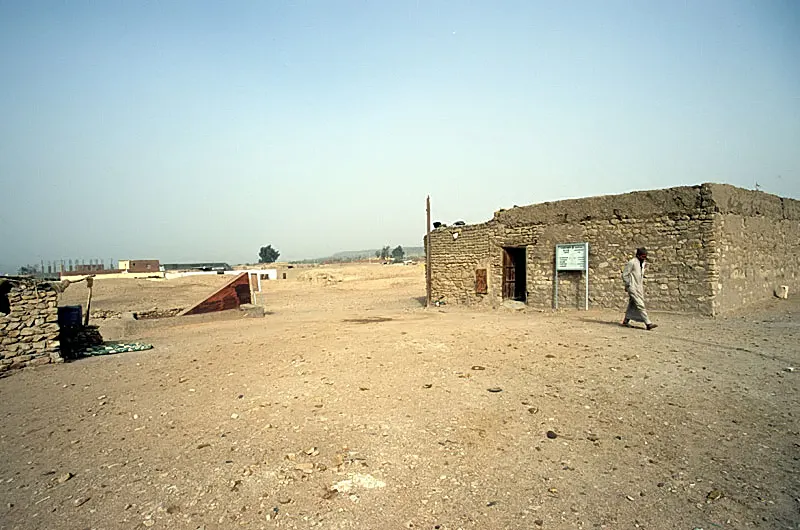
Short answer: The Golden Mummies are shown in the small museum in central Bawiti, and the low ruins of the Temple of Alexander lie about 5 km west of town; both are on the same ticket as the tombs.
The museum. A handful of the best-preserved mummies from the Valley of the Golden Mummies, with gilded masks and painted cartonnage, are displayed in Bawiti; the cemetery itself is closed. The discovery and what to see are in the Golden Mummies.
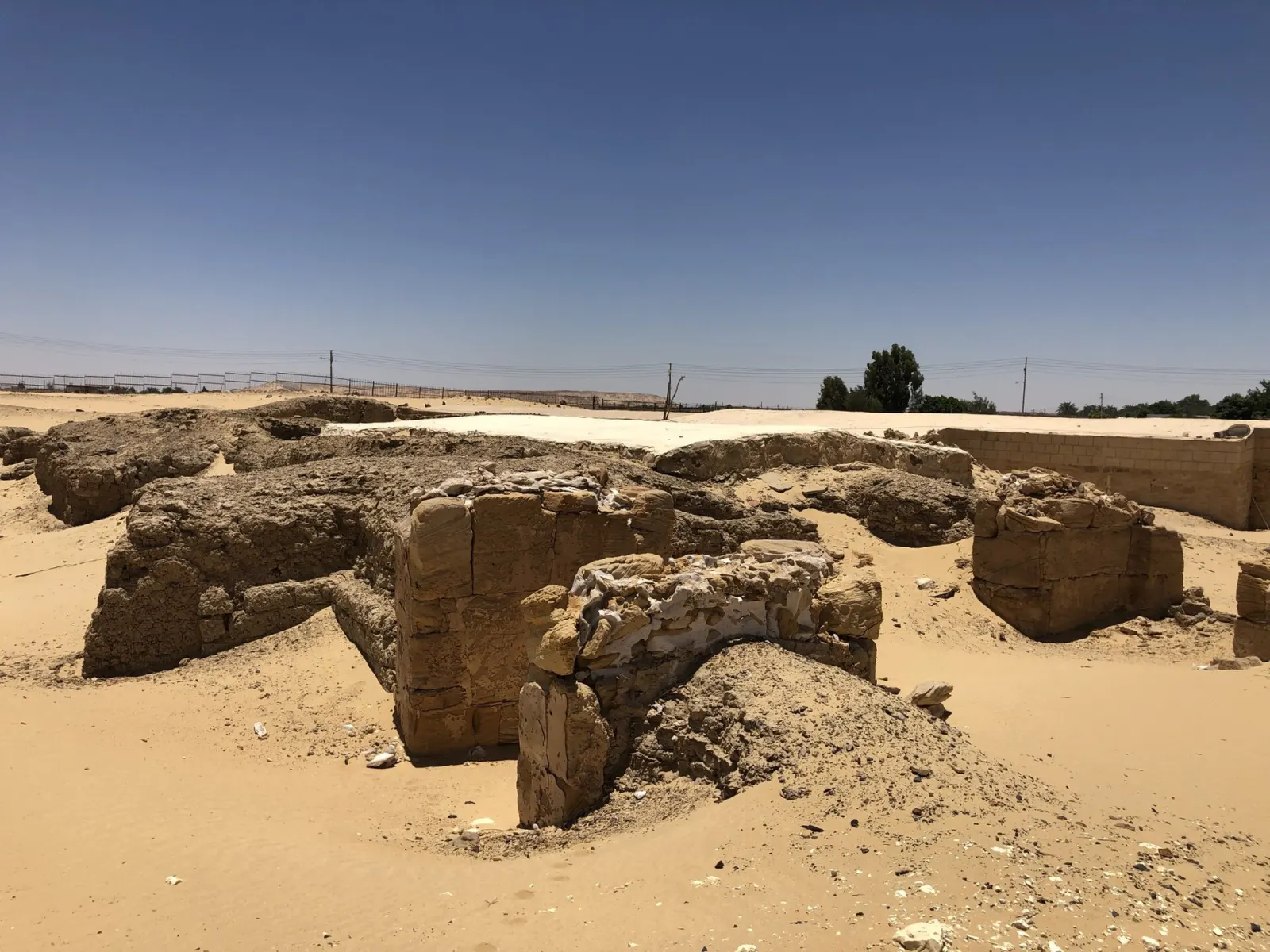
The Temple of Alexander. Low sandstone walls from the time of Alexander the Great, who conquered Egypt in 332 BC, near where the Golden Mummies were found. Its story and the Siwa connection are in the Temple of Alexander.
Sites you'll hear about but probably can't visit
Short answer: Several Bahariya sites are fenced, closed or need permission from the antiquities office. Don't plan a day around them.
| Site | What it is | Can you visit? |
|---|---|---|
| Qarat esh-Sheikh Subi | 26th-dynasty tombs west of Qarat Qasr Salim, rediscovered in 1999 | Fenced and closed to visitors |
| Ibis galleries | Galleries found in 1942 with thousands of ibis mummies, amulets and bronzes | Fenced since 2008; hard to visit |
| Temple of Herakles | A Roman temple of mud brick on a limestone base, from the time of Augustus | Only after asking the antiquities office; finds are not on show |
| Valley of the Golden Mummies | The Greco-Roman cemetery itself | Closed; selected mummies are in the museum |
The details come from Wikivoyage (German), Bawiti (checked 19 November 2026). If one of these matters to you, ask us before your trip and we'll find out what's possible; we can't promise access.
How much time to give it
Short answer: One to two hours covers the museum and the painted tombs; a full morning adds the chapels and the temple.
| Time you have | What fits | Trade-off |
|---|---|---|
| 1 to 2 hours | Museum and the two painted tombs | You miss the chapels and the temple, but see the best paintings |
| 2 to 3 hours | Add Ain el-Muftella | The easiest add-on, at ground level and close to town |
| A full morning | Add the Temple of Alexander and a viewpoint | A later start south; fine in winter, tight on short days if you leave late |
| An afternoon and a night | Sites, a warm spring and sunset | Needs a three-day trip or an extra night in Bawiti |
If the paintings are what you came for, spend your time in Bannentiu's tomb rather than racing round every site.
A suggested morning route
Short answer: Museum at opening, then the painted tombs, Ain el-Muftella and a viewpoint, back for lunch around 13:00 before driving south.
- About 09:00, the museum: buy the combined ticket and see the Golden Mummies.
- About 09:45, Qarat Qasr Salim: the two painted tombs, a few minutes' drive away.
- About 10:45, Ain el-Muftella: the chapels and the palm groves.
- About 11:30, the Temple of Alexander or English Mountain: depending on time and interest.
- About 13:00, lunch in Bawiti, then south through the Black Desert to the White Desert in the afternoon.
In winter, sunset is around 17:15 to 17:30, so this schedule still gets you to camp in good light. If you are staying the night in Bawiti instead, our half-day plan for Bahariya and Bawiti adds a warm spring and sunset on English Mountain.
Our advice
Short answer: Choose a three-day trip if the tombs matter to you, bring cash and comfortable shoes, and don't use flash on painted walls.
The sites are close together, and our driver can take you between them in a few minutes. On our three-day trip, day 1 gives the afternoon to Bawiti: the museum, then the painted tombs, a warm spring and sunset on English Mountain. Museum entry is in that trip's price; tickets for the tombs and other sites are paid on the day. On our two-day trip Bawiti is a lunch stop and the sites are not on the route, because the afternoon is needed to reach camp before dark. Wear shoes with grip for the tomb stairs, carry water, and keep a light layer handy: the underground chambers can be warm and still. Never touch the painted walls. If you are combining Bahariya with the Nile, our Egypt itinerary with the White Desert shows where a Bawiti morning fits. Message us on WhatsApp with "Bahariya tombs" and your dates.
See them on a trip: our 3-day White Desert tour visits the museum and the painted tombs on day 1, then spends two nights out, from about US$495 to 660 per person for two travellers, private.
Questions people ask
Can I take photos inside the Bahariya tombs?+
Rules change, and photography inside the painted tombs is often restricted or needs an extra ticket. Ask at the ticket office or the tomb entrance on the day, and never use a flash on painted walls, because the light damages the pigments.
Do I need a ticket for each site?+
A combined ticket for Bahariya's antiquities has usually been sold at the museum in Bawiti, covering the main sites, and guards at each tomb check it. Arrangements can change, so ask us to check before your trip.
How long do the sites take?+
About three to four hours for the museum, the painted tombs, Ain el-Muftella and the Temple of Alexander, with short drives between them. Two hours is enough for the museum and the tombs.
Are the tombs suitable for older travellers?+
The tombs are underground, reached by short, steep stairs, and can be warm and stuffy inside. Most people manage with care and a hand on the rail. The museum and Ain el-Muftella are at ground level.
How much is the ticket for the Bahariya tombs?+
About EGP 400 for foreigners since 1 October 2026 (was about EGP 100); check on the day. Bring Egyptian pounds in cash, because ticket offices may not take cards. Ask us and we'll check the current price before your trip.
Can I see the tombs on a two-day White Desert trip?+
Not on our two-day route. Bawiti is a lunch stop, because the afternoon is needed to reach camp before sunset. Our three-day trip visits the museum and the painted tombs on the afternoon of day 1, or you can arrive in Bawiti the evening before.
Who excavated the painted tombs of Bahariya?+
The Egyptian archaeologist Ahmed Fakhry excavated the tombs at Qarat Qasr Salim in the 1930s and worked across Bahariya for years after, including at the Temple of Alexander. Much of what we know about the oasis's ancient sites comes from his work.
Is one ticket valid if I split the sites over two days?+
Probably not. Wikivoyage describes the combined ticket as valid for one day only, so if you see the museum in the afternoon and the tombs the next morning, you may pay twice. Plan to see the sites you want in one block, and ask us to check the rule before you go.
Can I visit the ibis galleries or the tombs at Qarat esh-Sheikh Subi?+
Not normally. Wikivoyage lists the Sheikh Subi tombs as fenced and closed to visitors, and the ibis galleries as fenced since 2008 and hard to visit. The open sites are the museum, the two painted tombs, Amenhotep Huy, Ain el-Muftella and the Temple of Alexander.
Is there a student discount on the Bahariya ticket?+
Wikivoyage lists a student rate of half the foreigner price, which rose with the main ticket on 1 October 2026. Bring a valid student card and check on the day, because rules for student tickets change. Ask us if you want us to check before you travel.
Which site should I skip if I'm short of time?+
The tomb of Amenhotep Huy is the easiest to drop: it's older, but its paintings are faded. Keep the museum and the two painted tombs at Qarat Qasr Salim, which are close together in town.
Go with us
Trips that include this

3 days, 2 nights
3-day White Desert tour: Bahariya, the White Desert and two nights outAbout US$495 to 660 per person for two travellers, private
Check dates