
The short answer
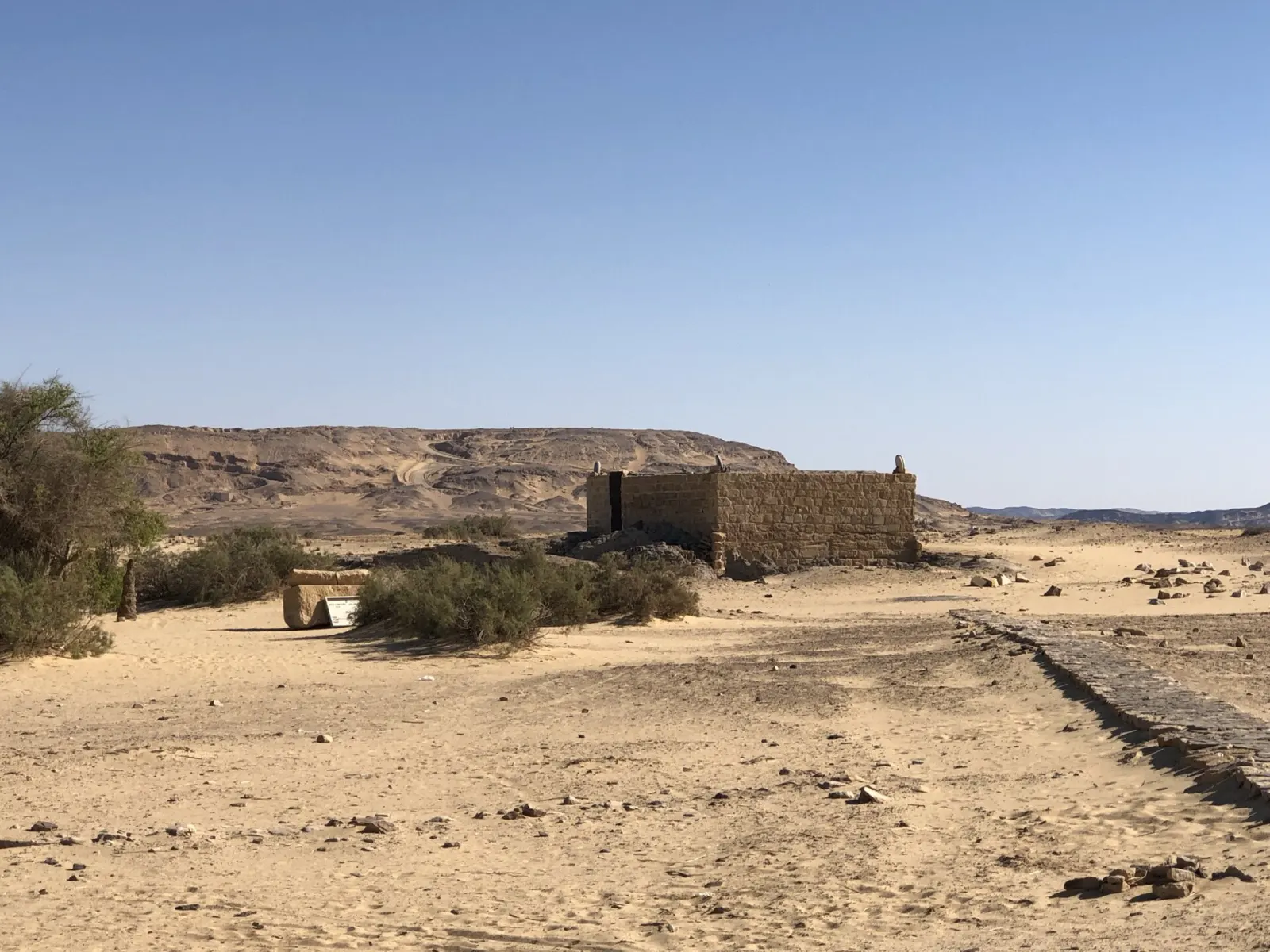
The Temple of Alexander is a ruined temple to Amun about 5 km west of Bawiti in Bahariya Oasis, built in the name of Alexander the Great, who conquered Egypt in 332 BC and visited the oracle at Siwa. Only low walls remain, but it is one of very few monuments in the Western Desert that carry his name.
Ask us on WhatsAppThe story behind the temple
Short answer: Alexander conquered Egypt in 332 BC and crossed the desert to the oracle of Amun at Siwa; temples across Egypt then honoured him as pharaoh.
When Alexander the Great took Egypt from the Persians in 332 BC, he was welcomed as a liberator. Soon after, he made a dangerous journey across the Western Desert to the oracle of Amun at Siwa. There, ancient writers say, he was greeted as the son of the god. Egypt's priests recognised him as pharaoh, and his name was carved in temple inscriptions in the traditional style, inside a royal cartouche.
The temple at Bahariya, at a place called Qasr el-Miqisba, carries his name in this way. That makes it one of the rare monuments in the Western Desert linked to him by name, and the only one you can visit on a White Desert trip.
The temple at a glance
Short answer: A small two-room sandstone sanctuary to Amun, inside a mud-brick enclosure of priests' rooms, found in 1938 and dated to Alexander's reign.
| Detail | |
|---|---|
| Where | Qasr el-Miqisba, also written 'Ain et-Tibniya, about 5 km west of Bawiti |
| Built for | Amun (Amun-Ra), in the name of Alexander the Great |
| Date | Alexander's reign in Egypt, 332 to 323 BC |
| Found | 1938 by Ahmed Fakhry; excavated until 1945 |
| Plan | Stone gateway, paved path, mud-brick rooms, two-chamber sandstone sanctuary |
| Later use | Still a working temple in the Roman period |
| Time needed | 20 to 30 minutes |
| Ticket | The shared Bahariya antiquities ticket; ask us to confirm it is open on your date |
The plan, dates and later use come from a study of the temple by the Egyptologist Francisco Bosch-Puche in the journal of the French Institute of Oriental Archaeology in Cairo (BIFAO 108, 2008 (checked 19 November 2026)). The alternative place name and the dedication to Ammon appear in Wikipedia's Bahariya Oasis article (checked 19 November 2026).
Did Alexander come to Bahariya?
Short answer: Nobody knows. He went to Siwa along the coast; one ancient account has him returning to the Nile by a direct route, which could have passed this way.
Ancient accounts describe Alexander travelling west along the Mediterranean coast to Paraetonium, near today's Marsa Matruh, then south through the desert to Siwa. Some writers say he returned to the Nile directly across the desert, and local tradition in Bahariya likes to think he passed this way. There is no firm evidence either way. What is certain is that his name was added to a temple here, in the same way pharaohs were honoured at temples they never saw. That makes the temple a record of how a remote oasis adapted to a new ruler.
The historian Arrian reports that Ptolemy, the general who later ruled Egypt, said Alexander went straight back to Memphis. Several scholars have suggested the Bahariya temple marks his passing along the oasis road to Memphis, but this is a theory, not a record (BIFAO 108 (checked 19 November 2026)). Wikipedia puts it the same way: some Egyptologists believe he passed through Bahariya on the way back from Siwa (Bahariya Oasis (checked 19 November 2026)).
The honest answer for a visitor: you are standing at a temple built in his name, during his reign, to the god whose oracle he had just consulted. Whether he ever saw it is open.
What you'll see
Short answer: Low sandstone walls and foundations of a sanctuary and dozens of surrounding rooms, in a sandy setting at the edge of the palm gardens.
| Feature | What it is |
|---|---|
| Sanctuary | The heart of the temple, where the cartouche of Alexander was found |
| Priests' rooms | Dozens of small rooms around the temple, for storage and living |
| Enclosure | Remains of the outer walls |
| Setting | Sand and low dunes at the edge of the palm gardens |
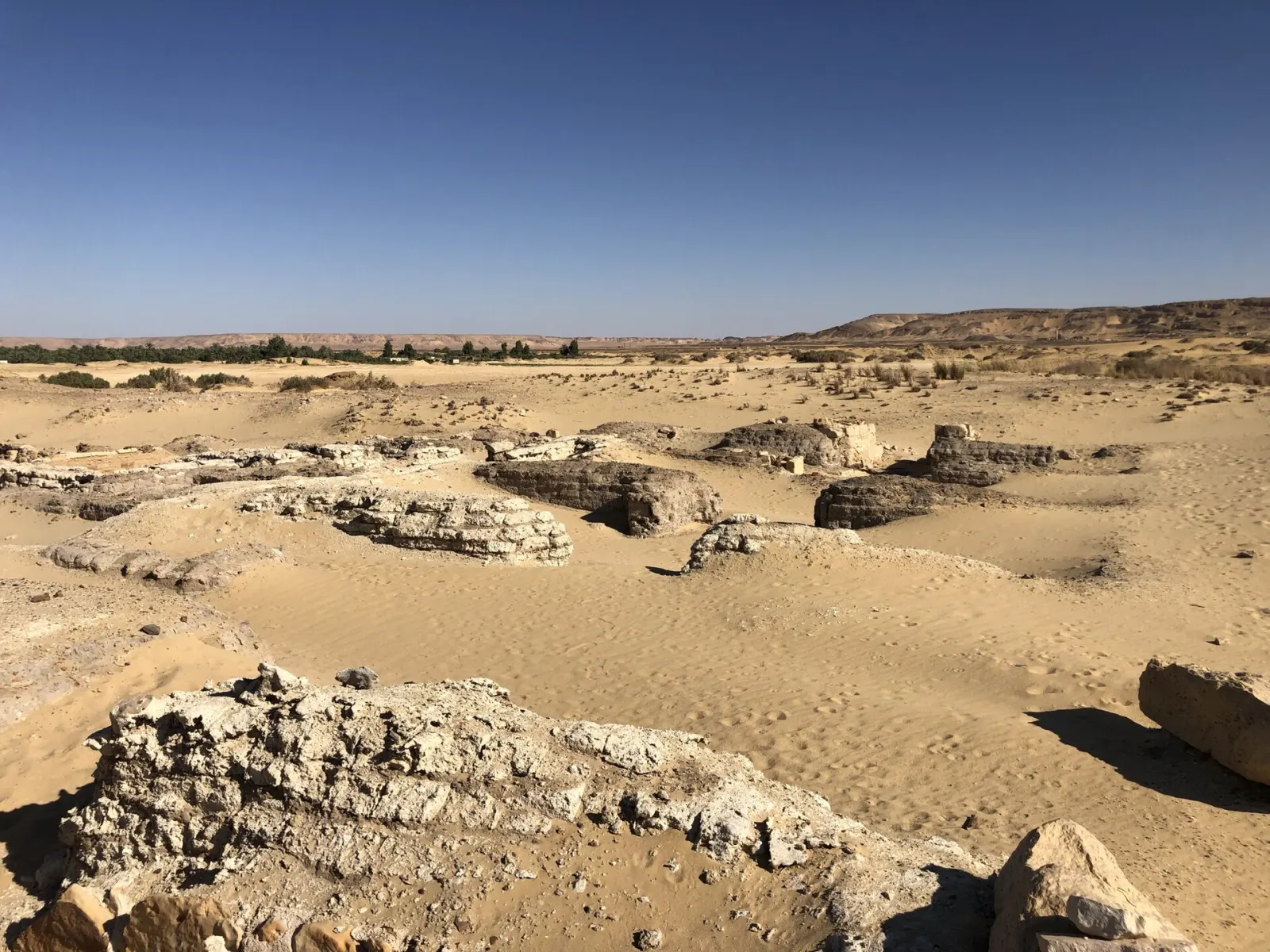
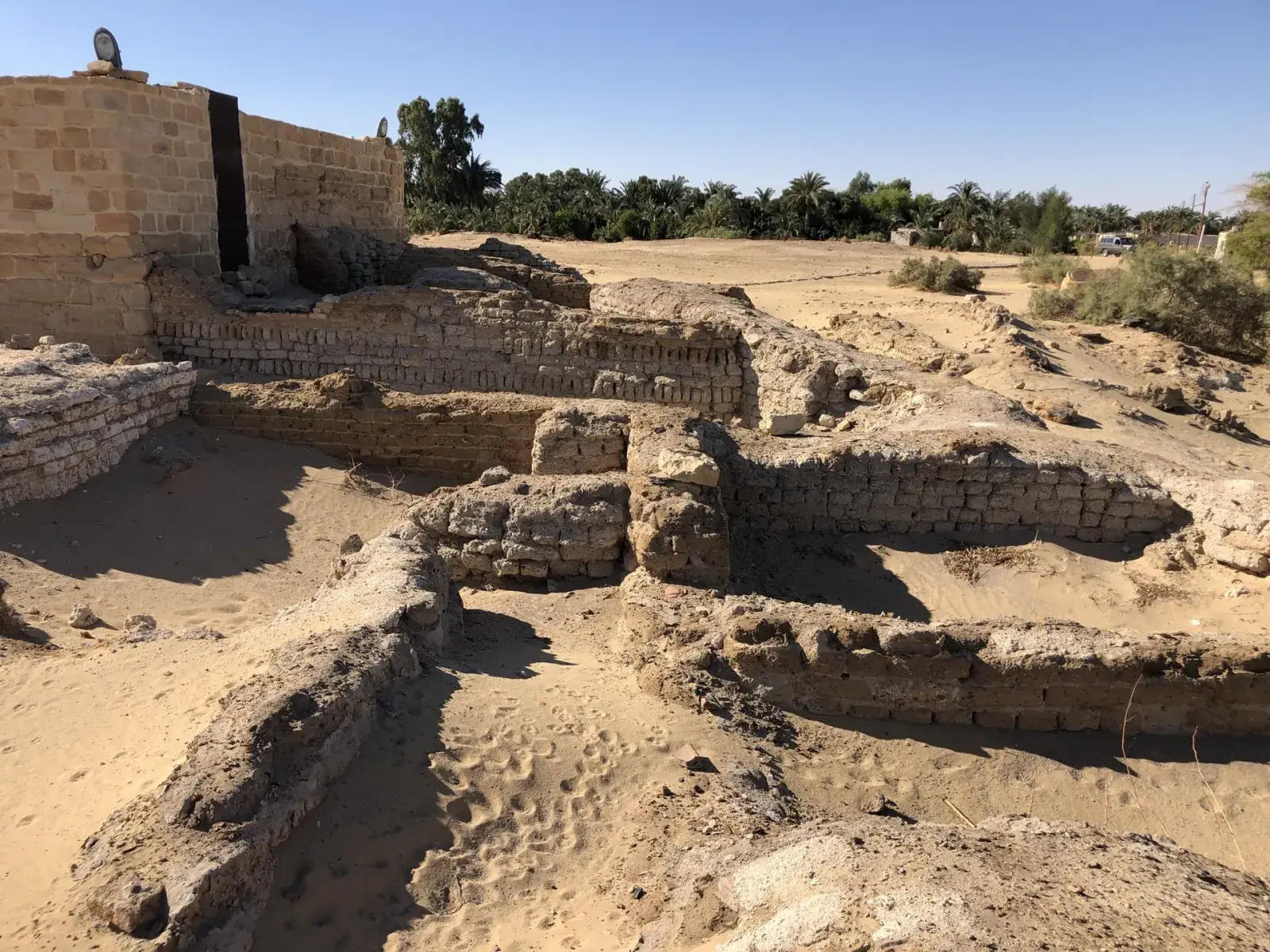
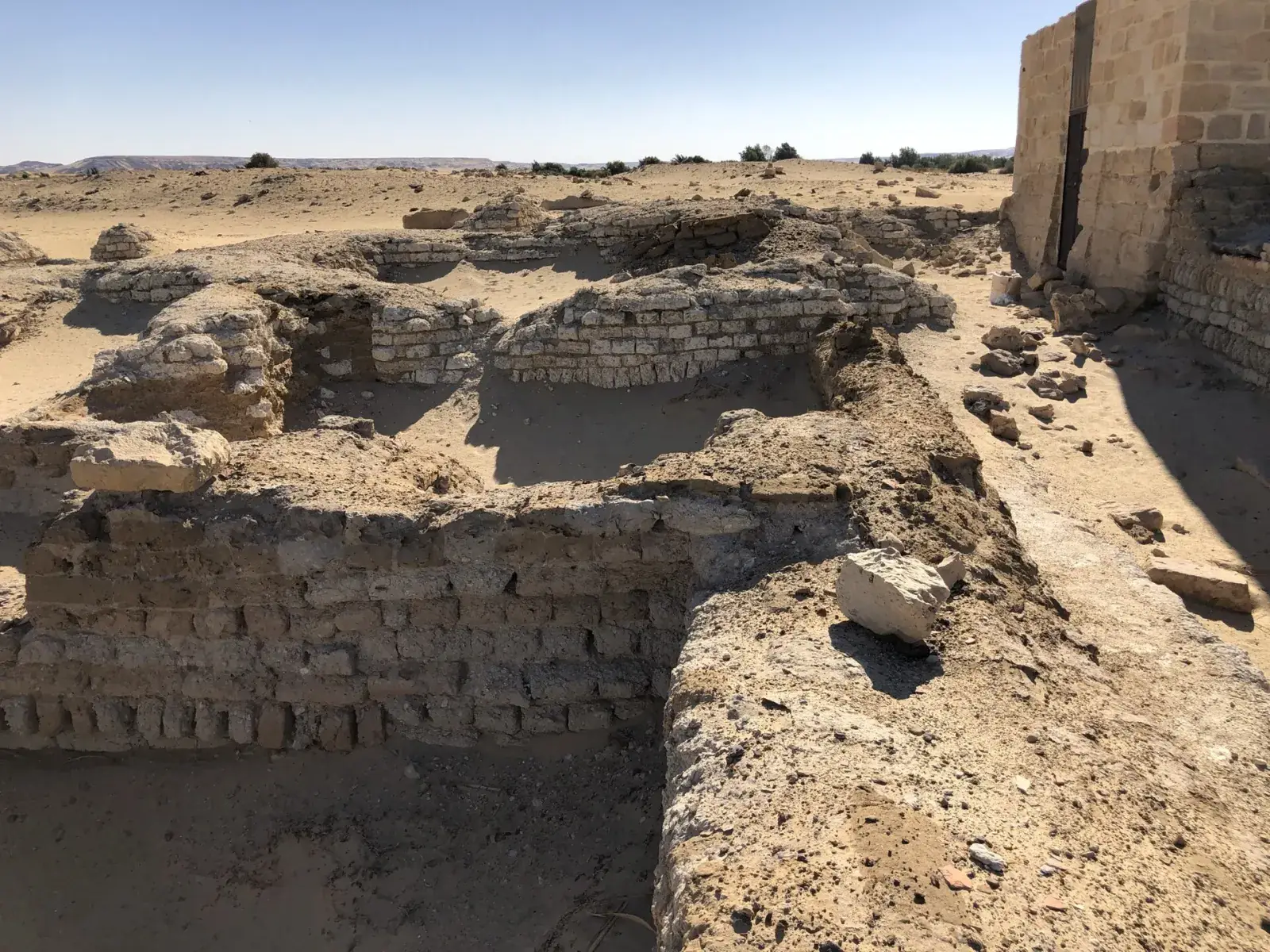
What remains is modest. Walls stand at most head height, parts have been consolidated, and much of the decoration has eroded or been removed for study. The rooms around the sanctuary show the scale of the complex, which may have housed dozens of priests and their stores. Bring imagination and a good guide.
Reading the ruins
The layout makes more sense if you walk it in the order a priest would have done. The published plan runs like this (BIFAO 108 (checked 19 November 2026)):
- The gateway, built of stone, at the south-west end. A Greek graffito cut here is the evidence that the temple was still in use in Roman times.
- The central path, paved with stone, running straight from the gate to the sanctuary.
- The side rooms, built of mud brick. Those nearest the sanctuary kept a bottom course of stone slabs that once faced the brick walls.
- The sanctuary, at the north-east end: two small sandstone rooms, one behind the other.
- The back wall of the sanctuary, where faint traces of two scenes survive. The decoration was never finished. A column of text between the scenes held Alexander's royal titles, now illegible.
Don't expect painted scenes like those in the tombs in Bawiti. What you see here is a ground plan. Its interest is in the shape of a working temple, and in whose name it was built.
The lost "altar" in Cairo
Short answer: The temple's most important find, an inscribed stone pedestal, carries a Greek dedication from King Alexander to Ammon, his father. It is not at the site.
During Fakhry's excavation, a block he called a granite altar was found lying overturned in front of the enclosure gateway. He thought it had come from the inner sanctuary. It was sent to the Egyptian Museum in Cairo, but it was missing from the museum's records and was long thought lost. Museum staff found it again in a basement store in 2007. The later study showed it is local sandstone, not granite, and probably a pedestal rather than an altar.
It carries texts in two scripts. On the front, in hieroglyphs, are Alexander's royal names as pharaoh. On one side, in Greek, is a short dedication from King Alexander to Ammon, his father. Fakhry never mentioned this Greek text. Bosch-Puche argues it is the only known Greek dedication in Alexander's name from Egypt, and the oldest inscription calling him the son of Ammon (BIFAO 108 (checked 19 November 2026)). It ties Bahariya to the result of his visit to the oracle at Siwa. It is not known to be on display, so treat it as part of the story rather than a sight.
Why it matters
Short answer: It shows Bahariya's importance in the Late and Greek periods, when the oasis prospered on wine and trade.
Under the last native dynasties and the Greek rulers who followed Alexander, Bahariya was wealthy. Its wine went to the Nile Valley, and caravans passed through on their way to Siwa and Libya. Temples, tombs and chapels from this time are scattered around Bawiti, including the 26th-dynasty tombs and the Ain el-Muftella chapels. Later still, the Greco-Roman cemetery of the Golden Mummies grew nearby, discovered in 1996. See history and culture, the Golden Mummies and the painted tombs and temples of Bahariya.
Alexander's name in Egypt: how this site compares
Short answer: Siwa has the oracle he visited and Luxor has a chapel in his name; Bahariya's temple is smaller and plainer, but it is the one on a White Desert route.
| Place | Link to Alexander | What you see today | On a White Desert trip? |
|---|---|---|---|
| Temple of Alexander, Bahariya | Temple to Amun built in his name | Low walls and a ground plan | Yes, on a three-day trip if added |
| Temple of the Oracle, Siwa | The oracle he consulted | A ruined temple in the old village of Aghurmi | Only on our seven-day Siwa trip |
| Luxor Temple | A chapel at the rear of the temple built in his name | Part of a major Nile Valley temple | No; a separate trip south |
Siwa's oracle temple keeps inscriptions from the 4th century BC within the ruins of Aghurmi (Siwa Oasis (checked 19 November 2026)). Luxor Temple has chapels at its rear built by Amenhotep III and by Alexander (Luxor Temple (checked 19 November 2026)). Both are richer sights than Bahariya. What Bahariya offers is quiet, and the chance to stand at an Alexander monument on the way to the White Desert.
Is it worth your time?
Short answer: Yes for history lovers on a three-day trip; skip it if your Bawiti time is short and you would rather see paintings.
| If you... | Then |
|---|---|
| Have a two-day trip | You won't see it; Bawiti is a lunch stop |
| Have half a day in Bawiti and like ruins | Add it after the museum and the painted tombs |
| Have only an hour or two | The museum and the painted tombs are the stronger choice |
| Are travelling with children | The Golden Mummies usually hold their attention better |
| Are following Alexander's story to Siwa | It is worth the 30 minutes |
The trade-off is simple. The painted tombs have colour; the museum has the mummies; this temple has a story and empty space. Our painted tombs page gives the time needed at each site, so you can weigh it against the rest.
Getting there and tickets
Short answer: The temple is a short drive, about 5 km, west of Bawiti; you need a car and a guide, and it shares the Bahariya antiquities ticket.
The temple lies about 5 km west of Bawiti, at Qasr el-Miqisba, on sandy ground beyond the gardens. There is no public transport and no shade or café at the site, so you need a car, water and a guide, which we provide. The Golden Mummies' cemetery is close by, though it is not open to visitors.
Tickets: the shared Bahariya antiquities ticket is about EGP 400 for foreigners since 1 October 2026 (was about EGP 100); check on the day. See the painted tombs and ancient sites of Bahariya for what it covers. Bring Egyptian pounds in cash; see money and ATMs. Opening hours change, so ask us to confirm them for your day.
Visiting tips
Short answer: Go in the morning or late afternoon, wear a hat and closed shoes, and combine it with the museum and tombs in a half day.
- Timing: mornings before 10:00 or the late afternoon. Midday sun on pale sandstone is harsh, and there is very little shade.
- Shoes: sand and broken stone underfoot; trainers are better than sandals. Our what to wear page covers sun and sand.
- Photography: low side light brings out the stone courses. Drone flying is not allowed without permission.
- Respect: don't climb on walls or touch any remaining decoration.
- Before you go: read the story first. A ground plan means far more when you know what you are looking for.
- Half-day plan: the museum and Golden Mummies, two painted tombs, the Ain el-Muftella chapels, then the temple, lunch and a spring. See Bahariya Oasis and Bawiti and hot springs.
The Siwa connection
Short answer: Siwa is where Alexander met the oracle. The UK government advises against all but essential travel on the desert road from Bahariya west to Siwa; we route via Cairo and don't use it.
Alexander's journey to the oracle at Siwa is one of the great stories of the ancient desert. You can follow it in spirit on our Siwa and the White Desert trip. After the desert night it returns to Cairo, then drives the coast to Marsa Matruh, near ancient Paraetonium, and turns south to Siwa. That is close to the route Alexander took. The UK government advises against all but essential travel on the desert road from Bahariya west to Siwa; we route via Cairo and don't use it (gov.uk). Our sister site covers Siwa Oasis and the Temple of the Oracle there. For how the two compare as trips, see White Desert or Siwa.
Our advice
Short answer: On a three-day trip, ask us to add it to the Bawiti afternoon; on a two-day trip there is no time for it.
On our two-day trip Bawiti is a lunch stop before the drive south to camp, and the sites are not on the route. On the three-day trip, day 1 gives the afternoon to Bawiti: the museum, the painted tombs, a warm spring and sunset on English Mountain. The temple is not on the set timetable, so ask us whether it can be added for your dates. Message us on WhatsApp with "Temple of Alexander" and your dates, and we'll suggest how to fit it in.
See it on a trip: our 3-day White Desert tour spends the afternoon of day 1 in Bawiti, then two nights out, from about US$495 to 660 per person for two travellers, private.
Questions people ask
Did Alexander the Great visit Bahariya?+
It's uncertain. He reached Siwa in 331 BC, probably via the Mediterranean coast. The temple may have been dedicated in his name by local priests rather than built on his visit, as happened at temples across Egypt.
How long do I need at the Temple of Alexander?+
About 20 to 30 minutes is enough to walk round the sanctuary and the rooms around it. Most visitors combine it with the museum, the painted tombs and the Ain el-Muftella chapels in Bawiti in a half day.
How much is the ticket for the Temple of Alexander?+
The temple shares the Bahariya antiquities ticket. It is about EGP 400 for foreigners since 1 October 2026 (was about EGP 100); check on the day. Which sites a ticket covers can also change. It is bought in Bawiti, and our painted tombs page has the details.
Who discovered the Temple of Alexander?+
The Egyptian archaeologist Ahmed Fakhry, who worked extensively in Bahariya, found the temple in 1938 and excavated it over the following years. Its name comes from the cartouches of Alexander found in the sanctuary.
Can I go from the Temple of Alexander on to Siwa, as Alexander did?+
Not directly. The UK government advises against all but essential travel on the desert road from Bahariya west to Siwa; we route via Cairo and don't use it. Our combined trip then follows the coast west to Marsa Matruh and turns south to Siwa, close to the way Alexander himself went.
Is the Temple of Alexander worth visiting?+
If you like ancient history, yes, for its story more than its walls. If you have only one afternoon in Bawiti and limited interest in ruins, the Golden Mummies and the painted tombs make a stronger first choice.
Which god was the Temple of Alexander built for?+
Amun, called Ammon by the Greeks, the same god whose oracle Alexander consulted at Siwa. The faded scenes on the sanctuary wall also show a falcon-headed god, which the excavator Ahmed Fakhry identified as Horus, though later scholars have questioned this.
Was the temple still used after Alexander's time?+
Yes. A Greek graffito cut on the gateway shows the temple was still in use in the Roman period, centuries after it was built. That is the same era as the nearby cemetery of the Golden Mummies.
Is the Temple of Alexander the same as Ain el-Muftella?+
No. Ain el-Muftella is a group of older chapels from the 26th dynasty on the western edge of Bawiti. The Temple of Alexander is a separate site further west, at Qasr el-Miqisba. Both are usually seen on the same morning.
Is the site suitable for older travellers or anyone with limited mobility?+
It is at ground level, with no stairs, but the ground is soft sand and broken stone, and there is no shade or seating. For wheelchair users it is difficult; ask us before you book and we'll talk it through.
Go with us
Trips that include this

3 days, 2 nights
3-day White Desert tour: Bahariya, the White Desert and two nights outAbout US$495 to 660 per person for two travellers, private
Check dates