
The short answer
A Black and White Desert tour is the classic trip from Cairo: road to Bahariya Oasis, then by 4x4 to the dark-capped hills of the Black Desert, the quartz ridge of Crystal Mountain, the sand valley of Agabat and the chalk formations of the White Desert, with a night camping among them. It usually takes two days and one night, about 500 km each way.
Ask us on WhatsAppBlack and White Desert tour options
Short answer: Four trips cover the Black and White Desert from Cairo: a long day trip, the classic two days with a night in the chalk, an easier three days and a four-day route to the Djara cave.
| Tour | Length | Price per person | Best for |
|---|---|---|---|
| Day trip from Cairo | 1 day, about 15 hours | About US$220–280 private, for two | Only if you cannot spare a night |
| Overnight camping from Cairo | 2 days, 1 night | About US$185–230 shared, US$360–460 private | The classic route with sunset, camp and sunrise |
| Bahariya, the White Desert and Farafra | 3 days, 2 nights | About US$340–420 shared, US$495–660 private for two | An easier pace with Bahariya's sights |
| White Desert and Djara cave | 4 days, 3 nights | About US$605–825 private, for two | Dune country and the cave, when the desert is the point |
Prices are indicative for the 2026–27 season, from your Cairo or Giza hotel. See what it costs for group sizes, and how many days you need to choose a length.
The stops, with distance and time at each
Short answer: From Bawiti it is about 40 km to the Black Desert, 100 km to Crystal Mountain, 120 km to Agabat and about 130 km to the chalk, where you spend sunset, the night and sunrise.
| Stop | Distance from Bawiti | Time there | What you do |
|---|---|---|---|
| Bawiti, Bahariya | About 370 km from Cairo | About 1 hour | Lunch, switch to the 4x4 |
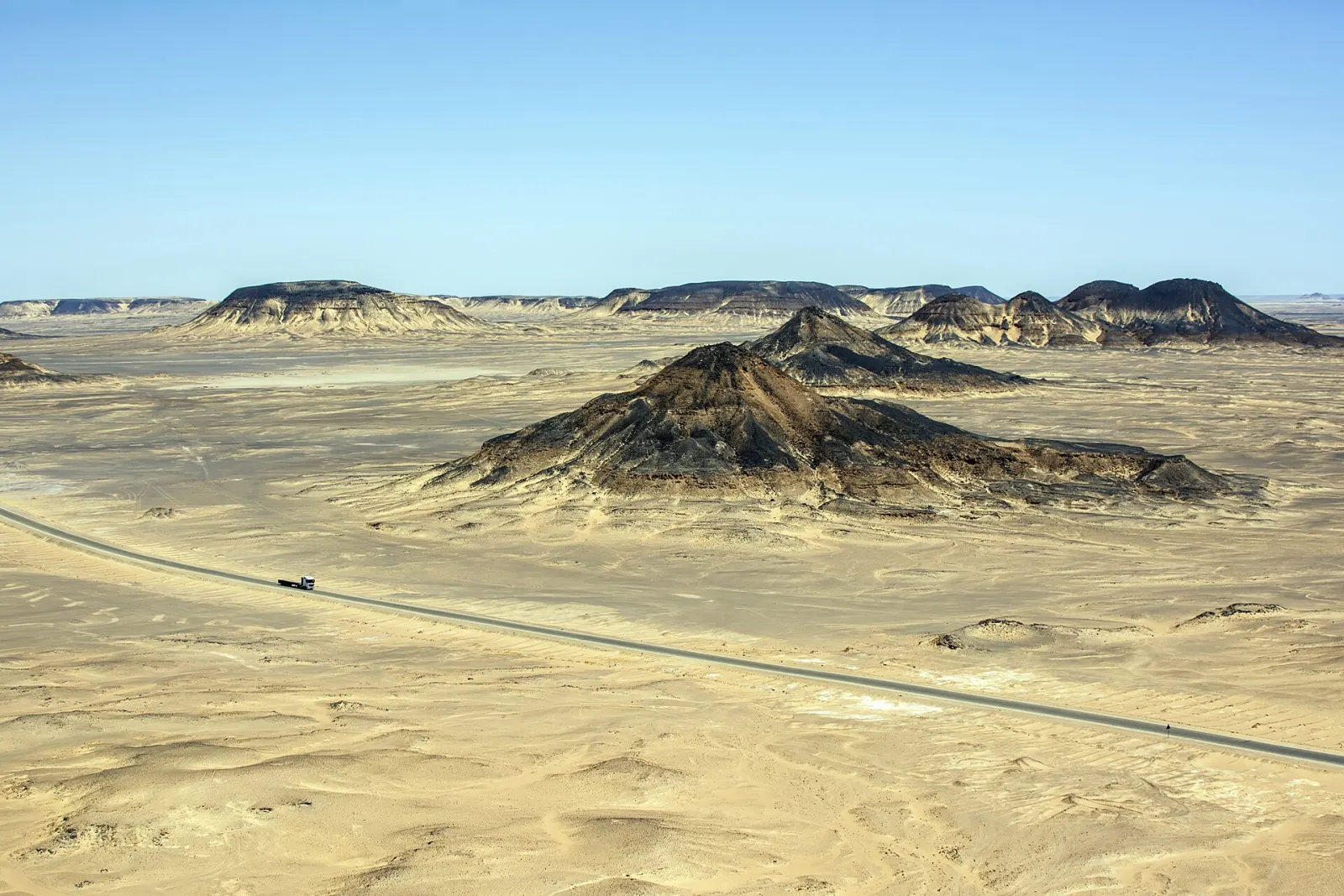
| Black Desert | About 40 km | 30–60 minutes | Climb a dark-capped hill for the view |
| Crystal Mountain | About 100 km | 20–30 minutes | Walk the quartz ridge and its rock arch |
| Agabat valley | About 120 km | 30–60 minutes | Dunes and limestone towers, a short descent on sand |
| Old White Desert | About 130 km | Sunset, camp, sunrise | Cliffs and towers in the evening light, fire, dinner, stars |
| Mushroom and Chicken | About 40 km north of Qasr Farafra | 20–30 minutes, next morning | The classic shapes after breakfast |
| Farafra Oasis | About 180 km | An option on the three-day trip | Springs and a quiet oasis town |
| A hot spring | Near Bawiti, on the way back | If time allows | A warm soak before the road to Cairo |
Each sight has its own guide; this page is about how the tour strings them together. Distances are approximate and depend on where your crew camps. What makes the route is the sequence: in under two hours the land changes colour from black to glittering quartz to gold to white. The return goes straight back north on the highway.
Leg by leg: how long you drive between stops
Short answer: After Bawiti the stops come close together: about 30 minutes to the Black Desert, 45 minutes on to Crystal Mountain, 20 minutes to Agabat, then 10–20 km off-road into the chalk.
| Leg | Distance | Drive time |
|---|---|---|
| Cairo or Giza hotel to Bawiti | About 370 km | 4.5–5 hours, with a coffee stop |
| Bawiti to the Black Desert | About 40 km | About 30 minutes |
| Black Desert to Crystal Mountain | About 60 km | About 45 minutes |
| Crystal Mountain to Agabat | About 20 km | About 20 minutes |
| Agabat to the White Desert camps | About 10–20 km | Off-road, with stops on the way |
The legs are short, but the afternoon still goes fast once you add the stops, so a long lunch in Bawiti eats into sunset. Bawiti is about 370 km and 4.5–5 hours from central Cairo by car; from Cairo International Airport allow about 5 to 5.5 hours. If you would rather not do the road in a private car, the bus takes five to six hours; see the bus to Bahariya.
Which stops are inside the national park?
Short answer: Only the southern half of the route. The Black Desert is outside the park, Crystal Mountain sits just outside or on its edge, and the protected area starts around Agabat.
White Desert National Park covers about 3,133.5 km² of New Valley Governorate under Prime Minister's Decree No. 1220 of 2002, according to the EEAA protectorate table. Here is where each stop falls:
| Stop | Park status | What it means for you |
|---|---|---|
| Black Desert | Outside the park | No fee of its own; camping is occasional, not the norm |
| Crystal Mountain | Just outside or on the northern edge | Treat it as protected: leave every crystal where it is |
| Agabat | Northern edge of the park | The off-road part begins here |
| Old White Desert and the Mushroom and Chicken | Inside the park | Camp only in permitted areas, on your crew's instructions |
The park fee is a government protected-area fee for foreign visitors, collected through the operator and shown as its own line in your quote. We don't publish a figure for it. Read White Desert National Park for the rules on fossils, fires and where vehicles may go.
A typical day, in brief
Short answer: Leave Cairo early, reach the chalk for sunset, camp, and be back at your hotel on the second evening.
- Hotel pick-up in Cairo or Giza between 6:00 and 7:00, with a coffee stop halfway.
- Bawiti around 11:00 for a short lunch and the switch to the 4x4.
- The Black Desert around 13:00, then Crystal Mountain and Agabat in the afternoon.
- The Old White Desert for sunset, then camp, dinner on the fire and stars.
- Sunrise on the chalk, breakfast, back to Bawiti and your Cairo hotel by about 17:30.
The full hour-by-hour timetable, with distances and sunset times, is on the overnight camping tour. For the road itself, read the Cairo to Bahariya drive.
What's normally included, and what isn't
Short answer: Hotel transfers from Cairo, the 4x4 and driver, permit and park entry fee, meals, water and camping kit should be included; tips, extra drinks, snacks, insurance and antiquities tickets usually are not.
| Normally included | Normally not included |
|---|---|
| Hotel pick-up and drop-off in Cairo or Giza | Tips for the driver and camp crew |
| Road transfer to Bahariya and a 4x4 with a desert driver | Drinks other than water and tea |
| Desert permit and the park entry fee, listed in your quote | Snacks at the rest house |
| Lunch on day one, dinner, breakfast and lunch on day two | Travel insurance |
| Water and tea | Bahariya antiquities tickets, about EGP 400 for foreigners since October 2026 |
| Camping kit: mattress, blankets and windbreak; a tent and a sleeping bag on request | A toilet tent, which is on request on any trip |
Check every quote against this list, line by line. If a price looks low, it is usually because the park fee, the camping kit or the Cairo transfer is missing. See what it costs; ask us about tipping.
Why the Black Desert is black
Short answer: Its hills are capped with dark iron-rich quartzite and dolerite that has shattered and scattered down the slopes over the orange sand.
For the full explanation, and how it compares with the White Desert, read our Black Desert guide.
Two days or three?
Short answer: Two days covers the classic route; three days adds Bawiti's antiquities, a hot spring, often Farafra, and cuts the driving to about 4 to 5 hours a day.
Our three-day trip follows the same route at a calmer pace. See how many days you need.
Choosing a tour
Short answer: Check what's included, how many people share a 4x4, whether the permit and park fee are paid, and whether the camp is shared with other groups.
Quotes vary a lot, and the cheapest often leave things out. On our trips there are never more than four guests in a 4x4, and on a private trip we camp away from other groups, choosing the spot with a light-pollution map for the darkest sky. See how to choose an operator and shared or private trip.
Where tours go wrong, and how we avoid it
Short answer: The common problems are rushed 20-minute stops, a long lunch that leaves no time for sunset, a park fee charged on the day and a camp moved without explanation; each is avoidable.
We are a Bawiti crew, and over the years we have heard the same complaints about rushed tours again and again. The patterns are consistent:
| What goes wrong | What we do instead |
|---|---|
| A two-hour hotel lunch, then a race to camp | A short lunch in Bawiti; the antiquities wait for the return or a third day |
| Twenty minutes at each stop | Enough time to climb the Black Desert hill and walk Agabat's slope |
| Too long at the Black Desert, arriving in the chalk after the light has gone | We watch the clock so you reach the White Desert well before sunset |
| Park fee or "camping fee" collected on the day | Every fee is in your written quote |
| Camp moved to the Black Desert without warning | If a checkpoint restricts camping, we tell you why and still bring you into the chalk at sunset and sunrise |
| Too many people squeezed into one 4x4 | Never more than four guests in one of our 4x4s, shared trips included |
Read where we camp for how checkpoint decisions work.
Checked November 2026
Short answer: Foreign visitors need a desert permit and a licensed guide, Bahariya's antiquities cost foreigners about EGP 400 since October 2026, and the 2027 eclipse puts the Black Desert close to the centreline.
- Permits are arranged in advance: we need your passport details one day before the trip, and you carry the original for checkpoints. See permits and safety.
- Bahariya's archaeological sites, often added on three-day tours, raised foreigner tickets on 1 October 2026, to about EGP 400. Check on the day.
- Totality lasts 6 minutes 24 seconds in the northern Black Desert, close to the centre line, and 2 minutes 5 seconds at the Mushroom and Chicken in the White Desert, according to timeanddate's calculations for those points. Bawiti gets 6 minutes 19 seconds, with the peak around 12:53 local time. See our eclipse camp.
When to go
Short answer: October to April, with October, November, March and April the most comfortable; December and January nights can approach freezing, and June to August highs reach 37–38°C.
How the same route changes through the year, using the figures on our weather and sunrise and sunset pages:
| Months | Day high | Night at camp | Sunset, roughly | What changes on the tour |
|---|---|---|---|---|
| December–February | 20–22°C | About 0–6°C | About 17:15–18:00 | Early sunset, so the lunch stop must be short; bring a down jacket |
| March–April | 26–32°C | About 6–14°C | About 18:15–18:30 | Pleasant, but khamaseen winds can bring dust, worst in April |
| May–September | 35–38°C | About 15–22°C | About 19:15–20:05 | Departure moves about two hours later; stops are kept short in the heat |
| October–November | 26–31°C | About 7–16°C | About 18:40 in October, 17:15 in November | Warm afternoons, mild nights; the easiest months |
Egypt has used summer time in recent years from late April to late October, which is why summer sunsets come so late. The Black Desert climb is the stop most affected by heat: the dark stones warm up fast, so on a hot afternoon look from the base instead. See best time to visit for month-by-month detail.
Is the tour worth it? The honest trade-offs
Short answer: Yes, if you want to see four very different landscapes and sleep in the desert. No, if you mind about 1,000 km of road in two days or a night without a bathroom.
What you get is a lot of change in a short time: black, glittering, gold and white in one afternoon, then a night in the chalk. What it costs you is time on the road. Here is the plain version:
| You will like it if… | Think again if… |
|---|---|
| You want the classic sights in one weekend | You get car-sick or hate long drives |
| You are happy with a simple camp, a fire and a mattress on the sand | You need a proper bathroom every night |
| You care about sunset, stars and sunrise more than museums | You want Bahariya's tombs and museum too: take three days |
| You can travel in the cool months | Your only dates are June to August and you dislike heat |
| You want short, easy walks | You want deep desert and real dune driving: see the four-day Djara trip |
If the long road is the problem, a three-day trip spreads the driving over more days. If you are already in Bahariya or Farafra, ask us about starting there, which cuts out the Cairo legs. For a wider view, read is the White Desert worth it and day trip or overnight.
Combining it with Siwa or the Nile
Short answer: Siwa is possible as a seven-day loop via Cairo and the coast, not by the direct road.
We route via Cairo and don't use the direct desert road between the two oases; the UK travel advice on that road is quoted on our permits and safety page. Our Siwa and White Desert trip does the Black and White Desert first, returns to Cairo, then reaches Siwa from Marsa Matruh. If you only have time for one of the two, read White Desert or Siwa?.
Coming from the Nile or the Red Sea? See from Luxor, from Hurghada and our Egypt itinerary with the White Desert.
Book the Black and White Desert
Short answer: Message us with your dates and group size; we'll send the plan and an all-in price.
Our overnight trip and three-day trip follow this route, shared or private. If you are already in Bawiti, we can meet you there instead of in Cairo, which drops the transfer from the price. Send us a WhatsApp message with "Black and White Desert" to check availability.
Map: Bahariya to Farafra
Schematic map, not to scale: positions are approximate, and the desert sites spread over many kilometres. The road runs about 180 km from Bawiti to Farafra; shaded areas show roughly where the black hills and the white chalk are.
Questions people ask
Can you do the Black and White Desert in one day?+
Technically, yes, but it's about 15 hours door to door with around 10 on the road, and you see the White Desert in midday light and miss sunset, the stars and sunrise. Two days, with a night camping in the chalk, is far better value for the same road.
How much does a Black and White Desert tour cost?+
Our two-day trip from Cairo is about US$185–230 per person shared and US$360–460 per person private. The three-day version is about US$495–660 per person for two, indicative. Check that any quote includes the permit, park entry fee, meals and camping kit.
Is the park entry fee included?+
In ours, yes. It is a government protected-area fee for foreign visitors, collected through the operator and shown as its own line in your quote. Some cheaper tours leave it out and collect it on the day, which is the most common surprise we hear about. Ask any operator to confirm in writing.
How long do you spend at each stop?+
On our trips, 30 to 60 minutes at the Black Desert, 20 to 30 minutes at Crystal Mountain, 30 to 60 minutes at Agabat and the whole evening and morning in the White Desert. If you want longer anywhere, a private trip lets you change the pace.
Will the Black Desert be in the 2027 eclipse?+
Yes, it is about as good as it gets. Totality lasts 6 minutes 24 seconds in the northern Black Desert, close to the centre line, and 2 minutes 5 seconds at the Mushroom and Chicken in the White Desert, according to timeanddate's calculations for those points. Bawiti gets 6 minutes 19 seconds. The peak comes around 12:53 local time.
What shoes do I need for the Black Desert climb?+
Trainers or walking shoes. The slopes are loose, dark stones that roll underfoot and heat up in the sun. People who climb in sandals often struggle on the way down. Take water, go slowly, and skip the top on a very hot afternoon.
What is not included in a Black and White Desert tour?+
On ours, tips for the driver and camp crew, drinks other than water and tea, snacks at the rest house, travel insurance and Bahariya antiquities tickets, about EGP 400 for foreigners since October 2026. The museum and tombs are not on the two-day route anyway.
Is the Black Desert inside White Desert National Park?+
No. The Black Desert lies outside the park and has no fee of its own. Crystal Mountain sits just outside or on the park's northern edge, and the protected chalk begins around Agabat. The park fee in your quote covers the White Desert part of the route, where you spend the night.
Can I add Siwa to a Black and White Desert tour?+
Yes, as a seven-day loop. Our Siwa and White Desert trip camps in the chalk first, returns to Cairo, then reaches Siwa along the coast via Marsa Matruh. It does not use the direct desert road from Bahariya; see permits and safety for the official travel advice on that road.
How much of the tour is off-road?+
Less than people expect. Day one covers about 500 km, almost all of it on tarmac: about 370 km to Bawiti, then the highway south through the Black Desert, Crystal Mountain and Agabat. The sand driving is the last 10–20 km into the formations, plus the morning loop past the Mushroom and Chicken.
How cold is the night in camp?+
It depends on the month. From December to February, camp usually falls to about 0–6°C, and frost is possible in January. October and November nights run roughly 7–16°C. From June to September nights stay around 17–22°C.
Go with us
Trips that include this

2 days, 1 night
White Desert overnight camping trip from Cairo (2 days, 1 night)About US$185 to 230 shared · US$360 to 460 private, per person
Check dates
3 days, 2 nights
3-day White Desert tour: Bahariya, the White Desert and two nights outAbout US$495 to 660 per person for two travellers, private
Check dates
1 day (about 15 hours)
White Desert day trip from CairoAbout US$220 to 280 per person for two travellers, private
Check dates