
The short answer
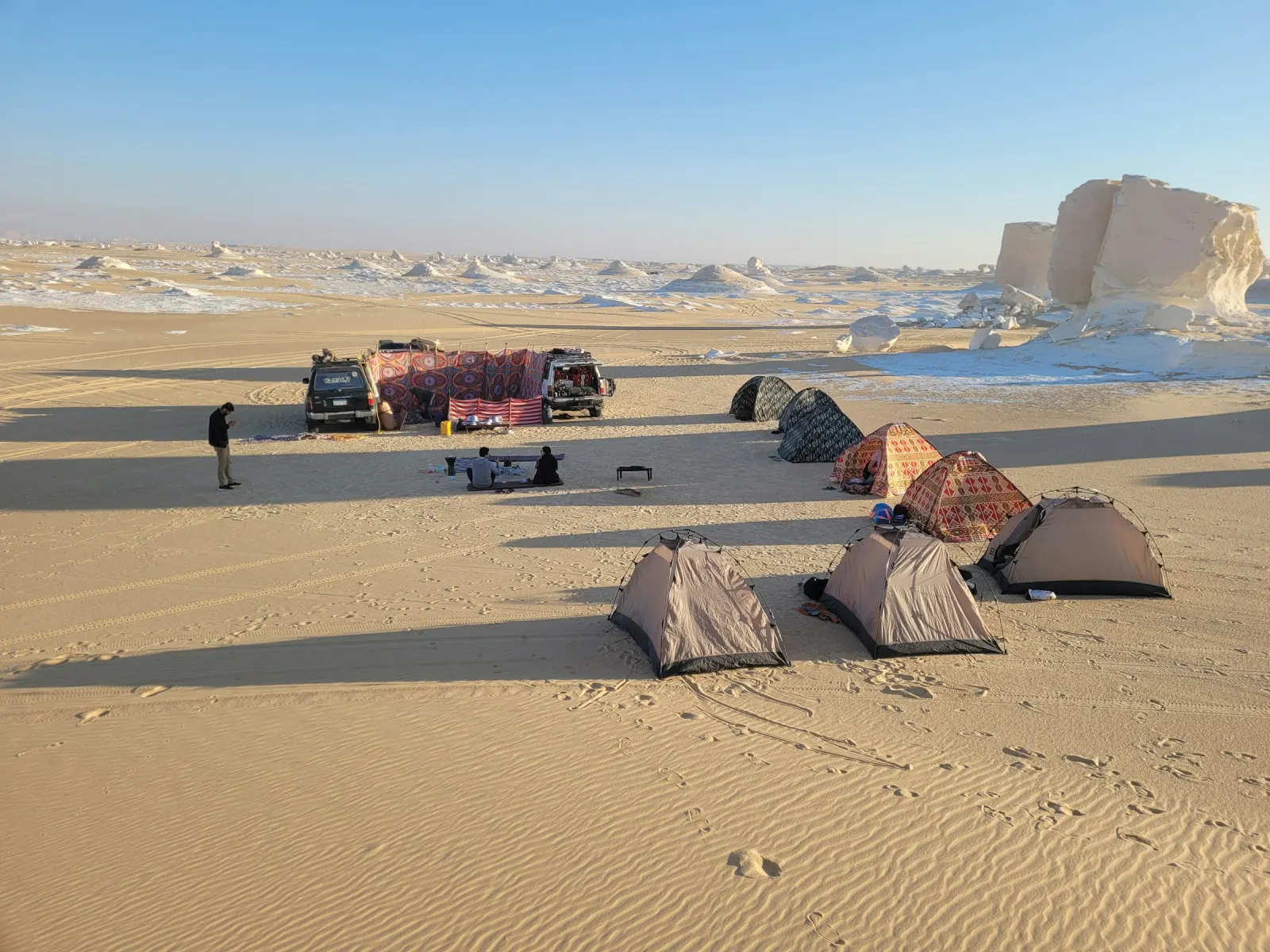
We camp in the permitted camping areas of White Desert National Park, usually among the Old White Desert's formations. Our Bawiti crew picks each night's spot for wind shelter, the sunrise view and the darkest sky, checked on a light-pollution map. On private trips we camp away from other groups, and in strong wind you can switch to a lodge night in Bahariya.
Ask us on WhatsAppHow we choose a camp spot
Short answer: Five things decide it: shelter from the wind, what the park allows, the darkest sky on a light-pollution map, distance from other groups, and the view for sunset and sunrise.
Our crew are from Bawiti, and we have been running trips here since 2012. We start with a light-pollution map, which shows where the sky is darkest, away from the glow of Bawiti, Farafra and the road. The exact spot within those areas is a judgement call made on the day. Here is what goes into it.
| What we look for | Why it matters |
|---|---|
| Shelter in the lee of a large formation or ridge | Cuts the wind, keeps sand out of food and bedding |
| A permitted camping area | The park is protected; rules come first |
| The darkest sky on the light-pollution map | More stars and a clearer Milky Way |
| Distance from other camps | Quiet, dark skies, no generator noise |
| Flat, firm ground | Comfortable sleeping, safe for the 4x4s |
| A sunrise view to the east | The first light on the chalk is the best moment of the trip |
| A short walk to a sunset viewpoint | You watch sunset while the crew sets up |
| Away from the formations themselves | Chalk is fragile; no camping on or against them |
In practice that usually means the Old White Desert, the flat plain of mushroom shapes and towers north of Farafra, where the classic Mushroom and Chicken stands. On longer trips we also camp near the New White Desert's big towers or in quieter corners. See the Old and New White Desert.
The camp areas compared
Short answer: The Old White Desert is the classic camp. The New White Desert has bigger towers and fewer people. Agabat and the Black Desert are quieter fall-backs, used on three-day trips, on windy nights or when a checkpoint limits where groups may camp.
All four sit along the same road south of Bawiti.
| Camp area | Where it is | What a night there is like | When we use it | Trade-off |
|---|---|---|---|---|
| Old White Desert | About 40 km north of Qasr Farafra, close to the main road | Thousands of small chalk mushrooms and shapes around camp; the postcard view at sunrise | Most nights on the overnight trip | Busiest at sunset; we drive on to a quieter spot to camp |
| New White Desert | North, just beyond Agabat, reached off-road | Large chalk mountains and towers, good shelter, fewer groups | Longer trips | Fewer of the famous small shapes |
| Agabat | Roughly 120 km south of Bawiti, at the northern edge of the park | Cliffs and sand slopes that catch the first light | A windy night that needs an enclosed valley, or a checkpoint ruling | Not the mushroom field |
| Black Desert | Starts about 40 km south of Bawiti | Orange sand and dark-capped hills; quiet, sheltered and dark | First night on a three-day trip, or a checkpoint ruling | No white chalk around you at night |
Waking among the white formations is what we plan for. When it can't happen, we say so before we drive.
The rules inside the protected area
Short answer: Camp only in permitted areas with a licensed guide, keep off the formations, one small fire, nothing left behind.
The White Desert National Park has been a protected area since 2002. It covers about 3,133.5 km² of New Valley Governorate under Prime Minister's Decree No. 1220 of 2002, according to the EEAA protectorate table. Foreign visitors need a permit arranged in advance and a licensed guide. Inside the park, the rules that shape where we camp are straightforward:
- Camp in the permitted areas, not on or right against the chalk formations.
- Drive on existing tracks; fresh tyre marks scar the white crust for years.
- Keep one small fire, in one place, using wood brought from the oasis.
- Don't carve, climb on or break off pieces of the formations.
- Carry all rubbish out of the park.
- The park fee is a government protected-area fee for foreign visitors, collected through the operator and shown as its own line in your quote.
Very cheap operators sometimes skip the camping fees or use unlicensed vehicles. That can mean being turned back at a checkpoint. See White Desert National Park and how to choose an operator.
Distance from other groups
Short answer: On private trips we camp away from other groups; on any trip we aim to see, at most, another camp's fire on the horizon.
The silence is one of the things guests remember most. So we avoid the spots right beside the most photographed formations, where several shared groups often stop for sunset. On a quiet weeknight in November you may see nobody at all. Over Christmas, New Year and Egyptian holidays the main areas are busier. Then our drivers head further into the plain or to a side valley, and we keep music low so the next group's night is quiet too.
On a private trip, including a private comfort camp, we camp away from other groups. The car and crew are yours, so there is more flexibility over timing and the crew can drive on to a secluded spot.
Wind: the deciding factor most nights
Short answer: Wind direction on the day decides which side of a formation we camp on, and a strong wind can move us entirely.
The prevailing wind in the White Desert is from the north. On a normal evening we camp on the sheltered side of a large rock, park the 4x4s as a wall, and hang carpets between them as a windbreak. That's usually enough.
In spring, mainly March to May, hot dusty khamsin winds can blow for a few days at a time. If the forecast or the sky looks wrong, we may camp in a more enclosed spot, such as a valley at Agabat or behind the hills of the Black Desert. On a very windy night you can switch to a lodge night in Bahariya instead; tell your guide and we arrange it. Our sandstorms and wind guide has more on the khamsin.
Camp spot by season
Short answer: In winter we chase shelter from the north wind; in spring we watch for dust; in summer we look for any breeze; autumn is the easiest time of year to camp.
| Season | Night at camp | What shapes the spot | What it means for you |
|---|---|---|---|
| December to February | About 0–6°C, frost possible in January | Shelter from the cold north wind comes first | Ask for a tent and a sleeping bag; the windbreak matters most now |
| March to May | About 6–18°C | Khamsin dust; April has the highest wind risk | A more enclosed spot, or a lodge night if a storm blows |
| June to September | About 17–22°C | We camp for an open sky and any breeze, and arrive for sunset after the heat | Sleep on top of the bag; a few mosquitoes on still nights |
| October and November | About 7–16°C | Little wind; the widest choice of spots | The easiest months to get the camp you want |
Night figures are camp temperatures from our weather guide.
Where the sun comes up
Short answer: Sunrise is to the east-south-east in winter and to the north-east in early summer, so the crew sets the camp's open side differently through the year.
The sun rises due east only around the equinoxes. At Farafra, the nearest town, the sun rises at 114° (east-south-east) at 06:40 on 1 December 2026, and at 116° at 06:53 on 21 December (timeanddate, checked 19 November 2026). On 21 June 2027 it rises at 63°, in the north-east, at 06:14, and sets at 297° at 20:05 (timeanddate, checked 19 November 2026).
In winter the north wind and the sunrise come from different sides, so the windbreak goes to the north and the south-east stays open for first light. In summer the wind is usually lighter, so the camp can open towards the north-east. On the first evening your guide points out where the sun will rise, so you know which way to face when you wake. See sunrise and sunset.
The darkest sky: what the light-pollution map shows
Short answer: A light-pollution map shows where artificial light brightens the sky. We use it to keep camp well away from the glow of the towns and the road, and the moon does the rest.
Astronomers grade sky darkness on the Bortle scale, from Class 1, an excellent dark-sky site, to Class 9, an inner-city sky. At the darkest end, even the faint zodiacal light is easy to see (Wikipedia: Bortle scale, checked 19 November 2026).
The formations are tens of kilometres from Bawiti and Farafra, so the sky is dark almost anywhere we camp. The map helps at the margins, such as which side of a ridge hides a town's faint glow. The bigger factor is the moon. Within about four nights of a new moon, the Milky Way shows up without binoculars; near a full moon the stars fade but the chalk glows silver. Pick your dates with our stargazing guide and the calendar.
What can change the plan
Short answer: Checkpoint rulings, wind and, rarely, an unexpected closure. We decide with you, not for you.
| What happens | How often | What we usually do |
|---|---|---|
| A checkpoint or the authorities limit camping to certain zones that night | Occasionally | Camp in the best permitted area: another part of the White Desert, Agabat or the Black Desert |
| Strong wind or a dust storm | Mostly spring | Move to a sheltered valley, use tents, or switch to a Bahariya lodge night |
| Very busy holiday night | Christmas, New Year, Egyptian holidays | Head further from the main sunset points |
| A vehicle problem | Rare | Help from another vehicle or from Bawiti; camp nearer the road |
The thing we never do is move camp without telling you. Guests deserve to know if the White Desert they came for is about to become a night in the Black Desert. When a ruling comes in, usually at a checkpoint south of Bawiti, your guide explains it in plain words before we drive on. If we can still see the White Desert's formations at sunset or sunrise, we plan the day so you do. If you'd rather have a lodge night and a morning in the chalk, ask us and we'll try to arrange it, and tell you if it changes the price.
How we tell guests
Short answer: At booking, on the day and at the moment it happens, in plain words.
- When you book: we explain that the exact camp spot is decided on the day and can change for wind or rulings.
- The day before: if we hear of restrictions, we message you on WhatsApp.
- On the road: your guide tells you of any change before we leave the main road, and why.
- At camp: we show you where sunrise will be and where the toilet area is.
Your first ten minutes at camp
Short answer: Before it gets dark, find your bed, your head torch and the toilet direction, and put your shoes somewhere safe.
The light goes fast after sunset, so a few habits help:
- Pick your spot on the mattress while you can still see, and put your overnight bag at its head.
- Keep your head torch in a pocket, not in the car.
- Learn the toilet direction and a landmark rock, so you can find it in the dark.
- Put shoes and snacks in your bag. Fennec foxes come to the edge of camp and are happy to steal both.
Questions to ask any operator
Short answer: Ask where they camp, how they choose the spot, what happens if a checkpoint moves the group, and whether the park fee is its own line in the quote.
A good operator names an area and a plan B, explains the choice in terms of wind, rules and darkness, and tells you before the plan changes. More in how to choose an operator and shared or private trip.
Leave no trace
Short answer: Everything we bring in goes back to Bawiti, and we ask the same of every guest.
The White Desert stays white only if every camp leaves it as it found it. Our crew bags all rubbish and takes it back to town, burns nothing plastic, and clears the fire site in the morning. We ask guests to:
- Carry used toilet paper out in the bag we give you.
- Keep food scraps in the bin bag, not on the sand, so foxes don't learn bad habits.
- Stay off the formations, however tempting the photo.
- Take nothing away: no chalk, no fossils, no stones from Crystal Mountain.
Read camping in the White Desert and tent or under the stars. Our wildlife guide covers the foxes and other animals you may see near camp.
Our advice
Short answer: Trust your crew's spot, ask questions, and choose a private trip if seclusion matters most: on private trips we camp away from other groups.
If a quiet, secluded camp is the point of your trip, choose a private trip and avoid holiday weeks. If dark skies matter, pick dates near the new moon; we already choose camp areas by the light-pollution map. Message us on WhatsApp with "camp" and your dates.
Questions people ask
Can you camp anywhere in the White Desert?+
No. The White Desert has been a protected area since 2002. Groups camp in the permitted areas with a licensed guide, keep away from the formations themselves, use one fire site and carry everything out. Exact zones can change with the authorities' rulings.
Why would my White Desert camp be moved to the Black Desert?+
Occasionally a checkpoint or the park authorities limit where groups may camp on a given night, or a strong wind makes the chalk plain miserable. Then the best permitted alternative may be the Black Desert or Agabat. In strong wind you can also switch to a lodge night in Bahariya. We tell you before moving and explain the options.
Will we be near other groups?+
On a private trip, no: we camp away from other groups. On any trip we choose spots away from the busiest sunset points, so most nights you see no more than a distant firelight. On holiday weeks, like Christmas and New Year, the main areas are busier, but the desert is large and we keep a respectful distance.
Do you camp in the same place every time?+
No. We have favourite areas, chosen with a light-pollution map for the darkest sky, but the exact spot depends on the wind direction that afternoon, how many groups are out, and what the park allows. Our drivers decide on the day, usually while you're watching sunset.
Is it safe to camp in the White Desert?+
Yes, with a licensed operator. Camps sit in permitted areas, our crew sleeps near the vehicles, and the only regular night visitors are small, shy fennec foxes. The main hazard is tripping in the dark, so keep a head torch handy.
What happens to rubbish and toilet waste at camp?+
Everything goes back to Bawiti in the cars. We bag all rubbish, burn nothing plastic, and ask guests to carry used toilet paper out in a bag. If you ask for a toilet tent, its waste is packed out too.
Can I choose where we camp?+
You can tell us what you care about most, such as the mushroom field, the big towers of the New White Desert or a quiet valley, and the crew aims for it. The final spot still depends on the wind and what the park allows that night. On a shared trip the group camps together, so ask us before you book if a particular area matters to you.
Can we camp right next to the Mushroom and Chicken?+
No. Camps keep away from the formations themselves, and the Mushroom and Chicken is one of the busiest sunset points in the park. We visit it in daylight or at sunset and camp a short drive away, where it is quieter and darker.
Which way does the camp face for sunrise?+
Towards the east, but the exact direction moves with the seasons. In December the sun rises in the east-south-east, and in June in the north-east. The crew sets bedding so you can see that side of the sky from your mattress.
Is the camp easy to reach for someone who struggles walking on sand?+
Ask us before you book. We look for flat, firm ground that the 4x4s can reach, but sunset viewpoints can mean a short walk over soft sand. Tell us about any mobility needs and ask us what is practical for your dates.
Go with us
Trips that include this
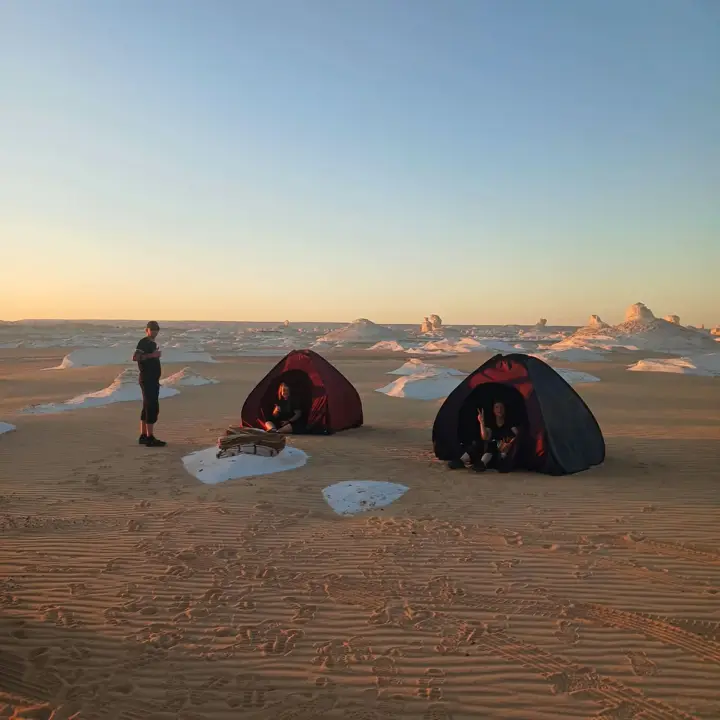
2 days, 1 night
White Desert overnight camping trip from Cairo (2 days, 1 night)About US$185 to 230 shared · US$360 to 460 private, per person
Check dates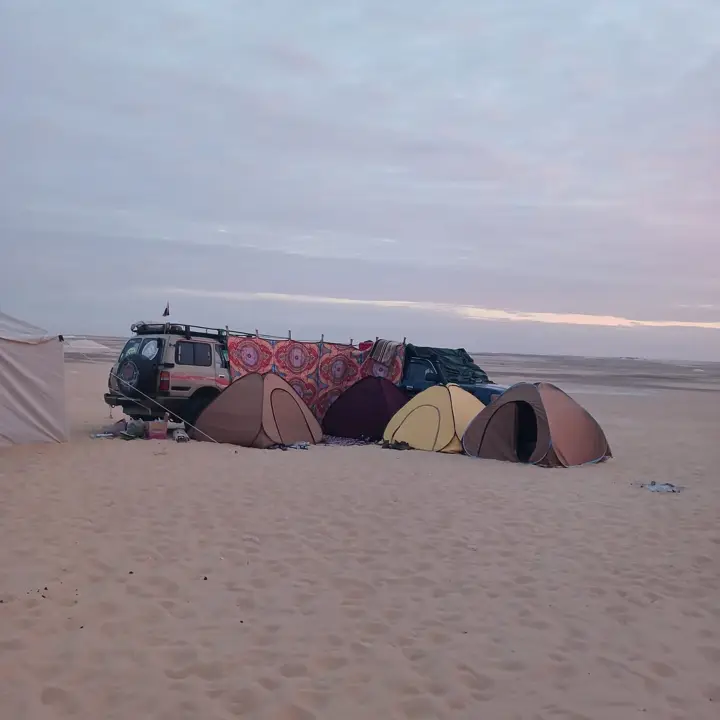
2 or 3 days
Private White Desert camping in comfortOn request (depends on group size and nights)
Check dates