
The short answer
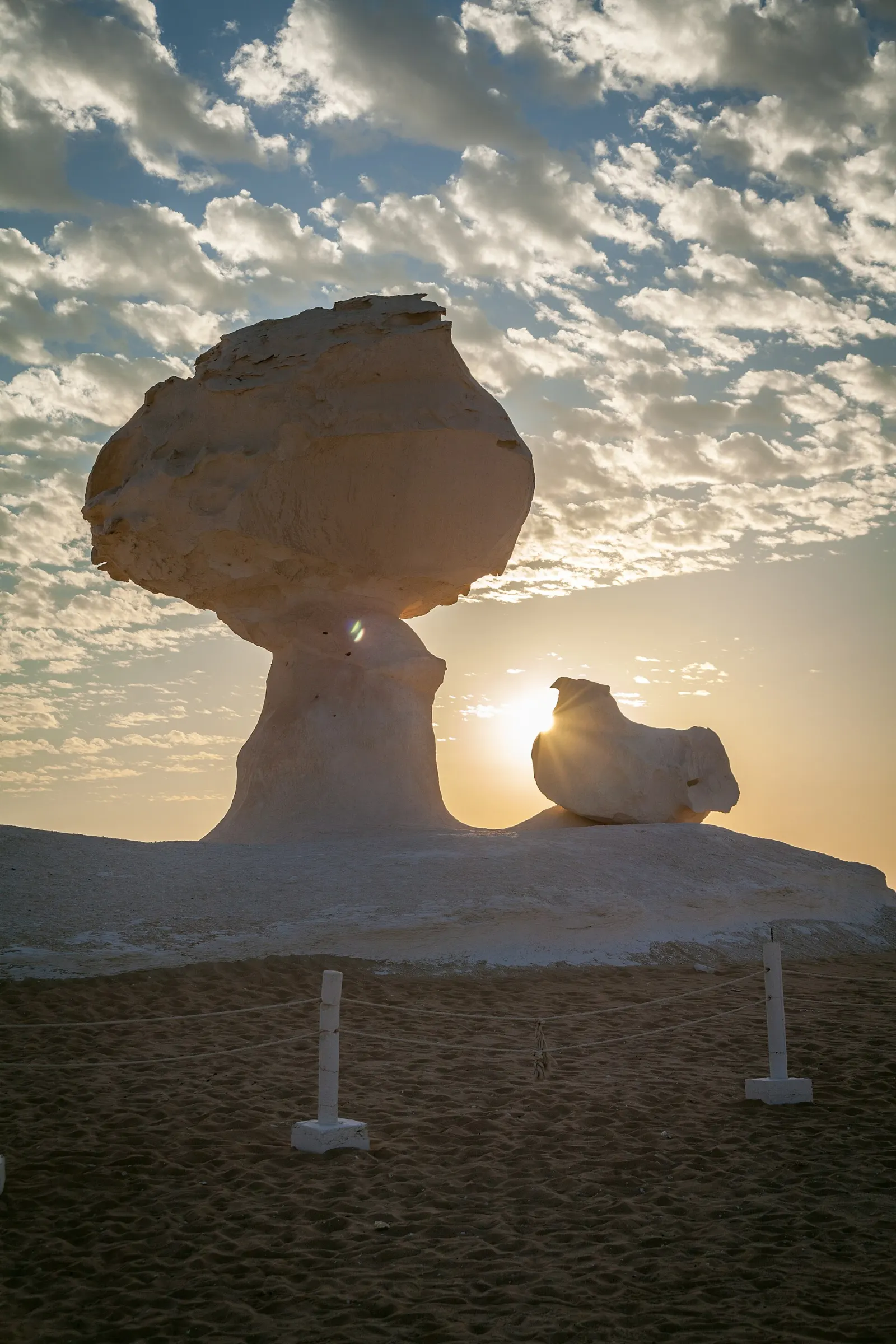
Sunset and sunrise are the reason to stay overnight in the White Desert. In the last hour before sunset the chalk turns gold, then pink and lilac; at dawn it glows soft orange with long blue shadows and no one else around. Sunset ranges from about 17:15 in December to about 20:00 in June, and good trips plan the day around it.
Ask us on WhatsAppApproximate times (Egypt time)
Short answer: Sunset runs from about 17:15 in December to about 20:00 in June and July, when Egypt is on summer time; sunrise from about 05:45 in April to about 07:05 in October.
| Month (mid-month) | Sunrise | Sunset | Notes |
|---|---|---|---|
| January | ~06:58 | ~17:33 | |
| February | ~06:45 | ~17:58 | |
| March | ~06:18 | ~18:15 | |
| April | ~05:44 | ~18:31 | Summer time starts at the end of April |
| May | ~06:19 | ~19:47 | Summer time |
| June | ~06:12 | ~20:03 | Summer time |
| July | ~06:21 | ~20:04 | Summer time |
| August | ~06:38 | ~19:46 | Summer time |
| September | ~06:52 | ~19:13 | Summer time |
| October | ~07:06 | ~18:39 | Summer time ends at the end of October |
| November | ~06:27 | ~17:17 | |
| December | ~06:49 | ~17:15 |
Times are calculated for the middle of the White Desert and shift by a few minutes across each month. Egypt has used summer time (UTC+3) from late April to late October in recent years; check the rule for your dates.
A sunset hour by hour
Short answer: The show lasts about ninety minutes: golden light, then the sun's last minutes, then pink afterglow and the blue hour.
| Time before or after sunset | What happens to the chalk |
|---|---|
| 60 minutes before | Light turns warm; long shadows stretch from every formation |
| 30 minutes before | Gold and cream; the best light for portraits among the towers |
| Sunset | The sun drops behind the horizon; the tops glow orange |
| 10 minutes after | Pink and peach afterglow on the chalk and the sky |
| 15 to 40 minutes after | Blue hour: the sky goes deep blue, the chalk an even lilac and blue-grey, the first stars |
| 60 minutes after | Night; Venus or Jupiter often bright in the west |
Arrive at your sunset spot at least 45 minutes early. The colours after the sun has gone are often the best, so don't rush back to the fire. The blue hour, roughly 15 to 25 minutes after sunset, gives the chalk a cool, even tone that many guests end up liking more than the sunset itself.
Why only these hours? White chalk reflects almost all the light that hits it. Between about 11:00 and 15:00 the sun is high, the rock turns into a flat white glare and the formations lose their shape. The chalk shows its texture only when the light comes in low and from the side, which is why everything on a good trip is timed around the first and last hours of the day.
Sunrise, the quieter show
Short answer: Sunrise is cold, silent and soft, with long blue shadows that turn gold; you'll usually have it to yourself.
Most groups linger over dinner and sleep in, so sunrise is the quietest time in the desert. Set an alarm for about 30 minutes before sunrise, put on every warm layer and walk a few minutes from camp. The sky lightens to blue and pink, the formations appear as silhouettes, and then the first rays hit the tops of the towers. Within minutes the plain turns gold. Because you sleep among the formations, you are already in place: no driving, and in December the sun is up at about 06:50. It's the best moment of the trip for photography; see photography.
Best spots
Short answer: The Old White Desert's mushroom field for sunset and sunrise, the New White Desert's chalk towers and cliffs for late afternoon, and Agabat and the Black Desert in the early morning.
| Spot | Best light | What you get |
|---|---|---|
| Mushroom and Chicken, Old White Desert | Sunset, sunrise | The famous pair, backlit or side-lit; busy at sunset in high season, quiet at dawn |
| Old White Desert field | Sunset, blue hour | Dozens of small mushrooms and "ice-cream" shapes, room to walk away from other groups |
| New White Desert towers and cliffs | Late afternoon, sunrise on the cliffs | Big white walls, a person for scale, few other cars |
| Agabat valley | Morning, late afternoon | Sand ramps between tall limestone towers, soft side-light |
| Black Desert hills | Early morning, or sunset on a three-day trip | Dark volcanic caps against pale sand, a fine contrast with the chalk |
| English Mountain, Bawiti | Sunset | The view over the palms of Bahariya Oasis |
| Camp | Sunrise, night | Formations around your tents, no driving needed |
The New White Desert is the northern half, just beyond Agabat, with the big chalk mountains; the Old White Desert is the southern plain about 40 km north of Qasr Farafra, where the mushrooms stand. See Old and New White Desert, Mushroom and Chicken, Agabat, Black Desert and English Mountain. Most groups converge on the Mushroom and Chicken at sunset, so walking 300 to 500 m away usually gives you a formation to yourself.
How the season changes the light
Short answer: Winter gives clear, saturated colours; spring dust makes big red suns; summer sunsets are late, around 20:00, and the heat lingers.
In winter, the air is clear and the colours are crisp, and the strongest colour usually comes on the clearest evenings. Sunsets come early, around 17:15 to 17:30, leaving a long evening by the fire. In spring, the khamsin winds can fill the air with fine dust, turning the sun into a red disc and the sky into soft pastel. In summer, on Egypt's summer time, sunset comes close to 20:00 and the heat lingers. Autumn has clear, warm evenings. See best time to visit.
Planning the day around the light
Short answer: Good trips leave Cairo early enough to reach the formations two hours before sunset.
On an overnight trip, the timing of the morning departure is set by sunset: leave Cairo too late and you arrive in the dark. Arrive at the formations about two hours before sunset and you have time for the Mushroom and Chicken, a walk among the towers and a sunset spot without rushing. On a private trip, ask for your schedule to be built around the golden hours: the New White Desert's towers in the afternoon, sunset in the Old White Desert, sunrise among the mushrooms.
On longer trips the morning matters too. The dark hills of the Black Desert and the towers of Agabat look best before about 10:00, which is why on a three-day trip we drive south early rather than lingering at breakfast. What catches people out on a one-night trip is the opposite: a long lunch in Bawiti and a late start can mean racing to camp with the sun already low. If the light matters to you, tell us when you book and we will plan the day backwards from sunset.
Moonrise on full-moon nights
Short answer: On a full-moon night the moon rises in the east within minutes of sunset in the west, so you get both at once; after that it rises about 50 minutes later each night.
For full-moon dates and how we time the camp, see full-moon camping and the sun and moon calendar.
Checked November 2026: what we have verified
Short answer: The table uses calculated times for the middle of the White Desert; Egypt's summer time (UTC+3) runs from late April to late October; and on 2 August 2027 the sky goes dark at midday instead.
Our times are worked out for about 27.3°N, 28.1°E, near the Mushroom and Chicken, and shift a few minutes across each month and a minute or two further north in the Black Desert. Summer time has been in force in recent years, but Egypt has changed the rule before, so we confirm it before each season. One date breaks every pattern: on 2 August 2027, Bawiti and the Black Desert go dark for over six minutes just before 13:00 local time during the total eclipse, with a 360° sunset glow on the horizon. The southern White Desert sits near the edge of the path and gets far less; see total solar eclipse 2027.
Our advice: getting sunset right
Short answer: Be in position 45 minutes early, face the formations rather than the sun, and do not leave when the sun disappears.
The mistake we see most is people photographing the sun itself and missing the chalk behind them, which is where the colour is. Stand with the sun at your side or back and watch the formations change. The second mistake is leaving too early: the afterglow is often the best ten minutes. The third is arriving late, which usually comes from a long lunch in Bawiti. On our trips the day is planned backwards from sunset, which is why we leave Cairo at about 06:30 in winter. And on a cold evening, put your jacket on before the sun goes, not after; the temperature drops fast. Read photography for camera settings.
See it for yourself
Short answer: Message us with your dates; we'll tell you the sunset time and plan the trip around it.
Send us a WhatsApp message with "sunset". See the overnight trip.
Questions people ask
Can I see the sunset on a White Desert day trip?+
Usually not. To get back to Cairo at a sensible hour, day trips leave the chalk by mid-afternoon. The overnight trip is built around sunset and sunrise.
What time is sunset in the White Desert in December?+
About 17:15 Egypt time in mid-December, the earliest of the year. Sunrise is around 06:49. We plan to be among the formations by about 15:30, so you have nearly two hours of softening light before the sun goes down behind the chalk.
Is sunrise worth getting up for in winter?+
Yes. It is cold, with January dawns averaging around 4°C and open-desert nights dropping close to 0°C, but the light on the chalk is the softest of the day and you usually have it to yourself. Keep tomorrow's clothes inside your bedding, put on every layer and walk five minutes from camp.
Where is the best place to watch sunset in the White Desert?+
The Old White Desert's field of small mushrooms, a few hundred metres away from the Mushroom and Chicken, which can be busy at sunset in peak weeks. We often save the famous pair for sunrise, when it is quiet, and visit the big towers of the New White Desert in the afternoon.
Does Egypt use daylight saving time?+
Yes, in recent years Egypt has used summer time, UTC+3, from late April to late October, and UTC+2 the rest of the year. That is why sunset jumps from about 18:31 in mid-April to about 19:47 in mid-May. Check the rule for your dates.
How long does the sunset colour last?+
About 90 minutes from the first warm light to the end of the blue hour. The best colour on the chalk is often 5 to 15 minutes after the sun has set, so stay out rather than heading straight back to the fire.
Go with us
Trips that include this

2 days, 1 night
White Desert overnight camping trip from Cairo (2 days, 1 night)About US$185 to 230 shared · US$360 to 460 private, per person
Check dates
3 days, 2 nights
3-day White Desert tour: Bahariya, the White Desert and two nights outAbout US$495 to 660 per person for two travellers, private
Check dates