
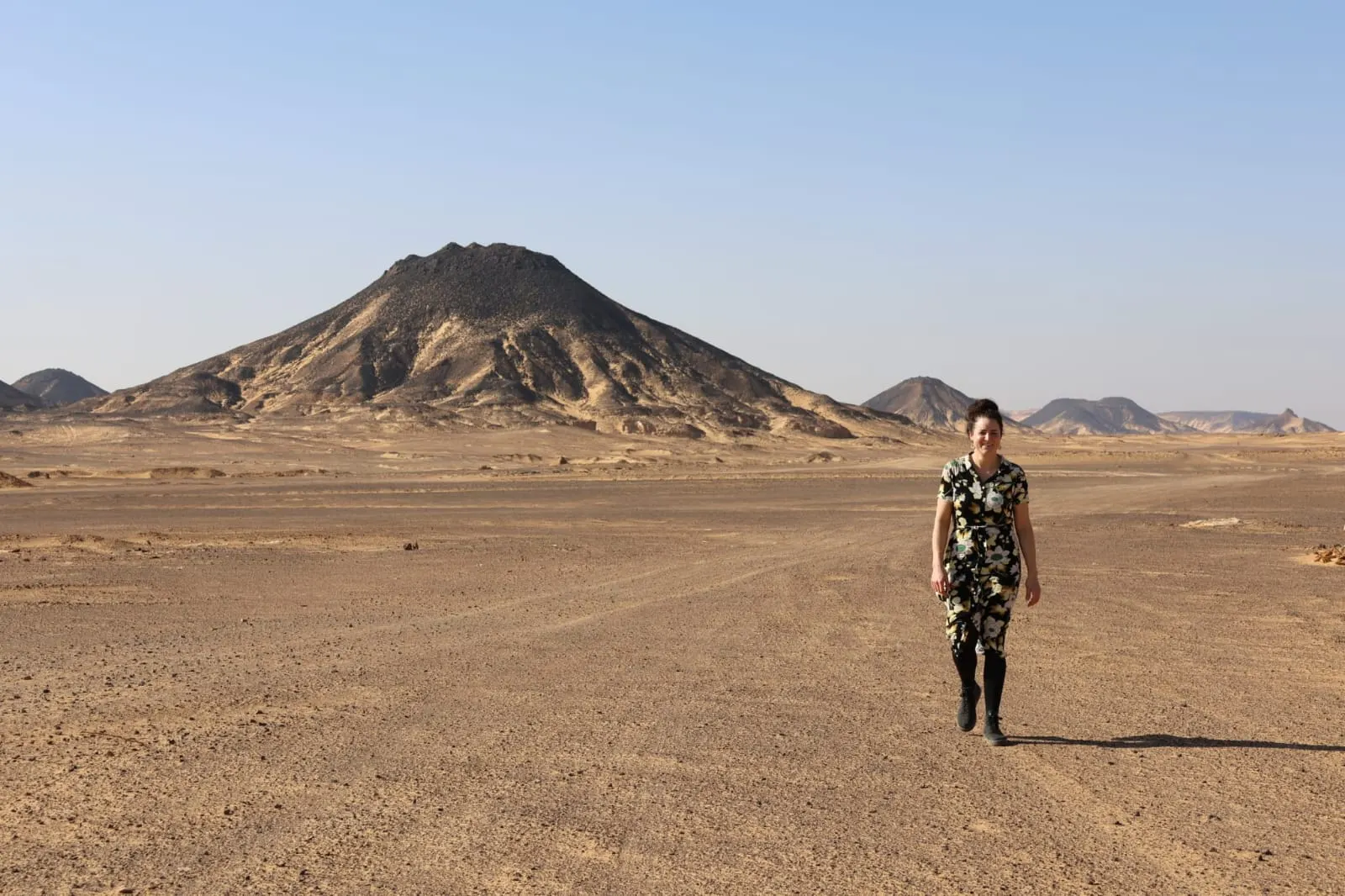
The short answer
English Mountain, Gebel el-Ingliz in Arabic, is a dark hill on the edge of Bawiti in Bahariya Oasis, topped by ruined stone walls that local tradition and the archaeologist Ahmed Fakhry tie to a First World War lookout against Senussi raiders. Allow about 45 minutes for the visit. Go for sunset: about 17:10 in mid-December and 20:03 in mid-June, local time.
Ask us on WhatsAppEnglish Mountain in brief
Short answer: a dark hill on the edge of Bawiti with a ruined stone post on top, a visit of about 45 minutes, and a wide view over Bahariya Oasis at sunset.
Bahariya is an oval depression in the Western Desert, about 94 km long and up to 42 km wide, ringed by higher ground (Wikipedia: Bahariya Oasis (checked 21 November 2026)). Its floor is not flat. Dark hills stand up out of the palm gardens and fields, and Gebel el-Ingliz is one of them, on the edge of the main town. From its top the whole layout of the oasis makes sense: town, gardens, springs, and the edge of the plateau you drive across to reach the Black Desert and then the chalk further south.
The summit carries a ruin. One writer who visited described it as larger than he expected, with several rooms and walls still standing (Black Gate, 2019 (checked 21 November 2026)). There are no signs, no fence and no ticket office. What you get is a short, rough climb, a long view and a story from the First World War.
| Fact | Detail | Source |
|---|---|---|
| Arabic name | Gebel el-Ingliz, "the mountain of the English" | Local name; see Black Gate |
| Where | Edge of Bawiti, main town of Bahariya Oasis | This site: Bahariya Oasis |
| Oasis size | About 94 km by up to 42 km, around 2,000 km² | Wikipedia: Bahariya Oasis |
| On the summit | Ruined stone post, several rooms | Black Gate, 2019 |
| Linked event | Senussi occupation of Bahariya, 11 February 1916 | Wikipedia: Senussi campaign |
| Visit length | About 45 minutes | This site: Bahariya Oasis |
| Best time | The hour before sunset | Sunset table below |
The 1916 story, and what is disputed
Short answer: the Senussi occupied Bahariya in February 1916; the British cut the oases off with aircraft, light car patrols and blockhouses; tradition puts an English lookout on this hill, but who built it is unknown.
The Senussi were a Sufi religious order that began in Libya in the late 18th century (Black Gate, 2019). During the First World War, armed by the Ottomans and Germans (Black Gate, 2019), they moved east into Egypt. The British campaign against them ran from November 1915 to February 1917 (Wikipedia: Senussi campaign (checked 21 November 2026)).
Bahariya was drawn in early. On 11 February 1916, about 500 Senussi with their leader, Sayyid Ahmed ash-Sharif, occupied the oasis. Observers from a 17 Squadron detachment at Faiyum spotted them, and on 12 February aircraft dropped eight 20 lb bombs on the oasis. A reconnaissance flight three days later found the Senussi gone; they were next seen at Dakhla on 27 February. In March the British commander ordered a light railway from Beni Mazar to Bahariya and a line of blockhouses along the Darb el Rubi track from Samalut. In October 1916 Sayyid Ahmed came back to Bahariya with a force weakened by hunger and illness, then withdrew between 8 and 10 October when word of a British advance leaked. A light car column tried to cut off his rearguard west of the oasis but could not catch it over the rough ground (all from Wikipedia: Senussi campaign (checked 21 November 2026)). The wartime line reached the oasis as the Baharia Military Railway (Wikipedia: Bahariya Oasis).
The light car patrols are the part of the story most linked to this hill. They drove Model T Fords stripped of every spare kilo, often with a machine gun mounted, and after the Senussi had gone they chased smugglers and mapped empty stretches of desert. Ahmed Fakhry, in his 1974 book on Bahariya and Farafra, which drew on his expeditions there in the 1930s, tied the hill's name to Claud Williams, a New Zealander who led No. 5 Light Car Patrol. Russell McGuirk, editing a collection on the patrols that includes Williams's own manuscript, found that Williams was never posted on the hill and had left the Western Desert by spring 1919. Another local tale dates the post to the Second World War. Either way, the builder is unknown (Black Gate, 2019 (checked 21 November 2026)).
So the fair version is this: the name and the ruin are genuine, the Senussi threat to Bahariya in 1916 is well documented, and the link to any one named officer is not. For the wider timeline, from the Golden Mummies to the 2002 park, see history and culture.
The climb
Short answer: a short, steep path of loose dark stone; good soles matter more than fitness, and the way down is the harder half.
The path is not built or marked. It climbs over broken dark rock, steep in places, and the loose surface is what slows people down rather than the height. Trainers with a decent tread are enough; sandals and smooth-soled town shoes slide. Use your hands on the steeper sections and come down slowly, facing the slope if it helps.
Points worth knowing before you go up:
- Light. If you stay for the afterglow, the walk down starts in dusk. In mid-November civil twilight at Bawiti ends about 25 minutes after sunset (timeanddate, November 2026 (checked 21 November 2026)), so carry a head torch.
- Water. Take some in every season. The air is dry and there is nothing on the hill.
- Children and older travellers. Whether the top is right for your group depends on footing and balance more than age. Stopping part-way still gives a view over the rooftops. Ask us about your group and we can suggest a plan.
- The ruin. It is unprotected and fragile. Don't climb on the walls, move stones or build cairns.
The dark stone underfoot is the same kind of cover you see further south on the road: our Black Desert guide explains how hard iron-rich caps break up and scatter over softer slopes.
What you see from the top
Short answer: Bawiti and its palm gardens below, the fields and villages of the depression around, and the dark hills that lead the road south.
| Direction | What you see |
|---|---|
| Straight down | The roofs, minarets and palm gardens of Bawiti |
| Across the floor | Fields, springs and smaller villages of the oasis |
| On the horizon | The higher ground that encloses the depression |
| To the south | Dark hills marking the road towards the Black and White Deserts |
In the last half hour the palms darken first, then the stone around you turns warm red, then lights come on in town. Face away from the sun as well as towards it: the long side-light on the gardens is often better than the sunset itself.
Sunset and heat by month
Short answer: sunset at Bawiti runs from about 17:07 in early December to about 20:05 at the end of June; aim to start up about 40 minutes before.
The times below are timeanddate's figures for 28°21'N, 28°51'E, the coordinates of Bawiti, in local time. In timeanddate's tables Egypt's summer time starts on 30 April 2027 and ends on 29 October 2027, which is why sunset jumps by an hour across those dates. The heat column is Bahariya's mean daily maximum for 1971–2000 (Wikipedia: Bahariya Oasis climate table (checked 21 November 2026)).
| Date | Sunset at Bawiti | Month's mean high in Bahariya | Source for sunset |
|---|---|---|---|
| 15 November 2026 | 17:11 | 25.5°C | timeanddate |
| 15 December 2026 | 17:10 | 20.7°C | timeanddate |
| 15 February 2027 | 17:54 | 21.8°C | timeanddate |
| 15 March 2027 | 18:12 | 24.8°C | timeanddate |
| 15 April 2027 | 18:29 | 30.7°C | timeanddate |
| 15 June 2027 | 20:03 | 36.9°C | timeanddate |
| 15 August 2027 | 19:43 | 36.8°C | timeanddate |
| 15 October 2027 | 18:35 | 30.3°C | timeanddate |
All sunset times checked 21 November 2026. From November to March the late afternoon is comfortable and a jacket is useful on top once the sun goes. From May to September the hill has no shade at all, so keep to the last hour of light or go up just after sunrise; on 15 June 2027 sunrise is at 06:07 at the same coordinates. Dust from spring winds can flatten the view on some days in March and April. For the wider pattern, see weather and night temperatures and sunrise and sunset.
English Mountain on eclipse day, 2 August 2027
Short answer: Bawiti has 6 minutes 19 seconds of totality, peaking around 12:53 local time, so a hilltop here sees the whole oasis go dark.
timeanddate gives Bawiti's coordinates 6 minutes 19 seconds of totality, with maximum at 12:53 and the partial phase running from 11:29 to 14:15 (timeanddate eclipse, 28°21'N 28°51'E (checked 21 November 2026)). From high ground you would see the light drop across the gardens and a glow on every horizon. The catch is the hour: the August mean high in Bahariya is about 36.8°C and you would be on bare rock at midday. If you want to try it, plan to be up and down within the eclipse window with plenty of water, and ask us how we would arrange shade nearby. Our eclipse 2027 camp is priced on request; the full planning guide is total solar eclipse 2027.
How to see it from the White Desert
Short answer: choose a trip with a night in Bawiti; the three-day trip has English Mountain at sunset on day 1.
English Mountain sits at the start of the journey, not in the White Desert itself. Every trip from Cairo passes through Bawiti, about 370 km and 4.5–5 hours from central Cairo by car (the Cairo to Bahariya drive), but on a two-day trip the town is a lunch stop and the light you want is spent driving south to camp.
| Trip | English Mountain? | Price as quoted |
|---|---|---|
| 3-day Bahariya, White Desert and Farafra | Yes, at sunset on day 1, with a lodge night in Bawiti (or camp) | About US$495 to 660 per person for two travellers, private |
| Overnight camping from Cairo | Not in the plan; Bawiti is a lunch stop. Ask us if you want to add it | About US$185 to 230 shared · US$360 to 460 private, per person |
On the three-day trip the published day-1 timetable has you heading up at 16:45 for a winter sunset of about 17:10, after the museum and the painted tombs. In summer sunset is nearer 20:00, so ask us how we would rearrange that afternoon for your dates. If your days are fixed and you want the climb added to another private trip, ask us and we will tell you whether it fits.
Combine it with
Short answer: the museum and painted tombs earlier in the afternoon, a warm spring after, dinner in town.
Bawiti's sights are close together, so English Mountain slots in at the end of a half-day in town. Start with the museum and the painted tombs of Bahariya, see the Golden Mummies, then climb for sunset and finish in one of the hot springs. Antiquities ticket: about EGP 400 for foreigners since 1 October 2026 (was about EGP 100); check on the day. For a fuller afternoon plan, see Bahariya Oasis and Bawiti.
Our advice
Short answer: spend a night in Bawiti, start up about 40 minutes before sunset, wear shoes with grip and leave the ruin as you find it.
- Treat the 1916 story as the backdrop, not a museum: there is nothing on site to explain it.
- Check the sunset time for your date in the table above, and remember the summer-time jump.
- Carry water, a head torch and, from November to March, a warm layer.
- Message us on WhatsApp with your dates and "English Mountain", and we'll plan your Bahariya afternoon around the light.
Sources (checked 21 November 2026): Wikipedia: Senussi campaign, Wikipedia: Bahariya Oasis, Black Gate, 2019, timeanddate sun tables for 28°21'N 28°51'E, timeanddate eclipse for 28°21'N 28°51'E.
Questions people ask
Why is it called English Mountain?+
Because of the ruined post on the summit. Local Bedouin say an English soldier once lived there to watch for raiders, and Fakhry placed him in the First World War, when about 500 Senussi fighters occupied Bahariya on 11 February 1916. Gebel el-Ingliz simply means "the mountain of the English".
Who built the ruins on English Mountain?+
Nobody knows for certain. The archaeologist Ahmed Fakhry linked the name to Claud Williams, the New Zealander who commanded No. 5 Light Car Patrol. Research for Russell McGuirk's book on the patrols concluded that Williams was never posted on the hill, so the builder is still unknown.
How long does a visit to English Mountain take?+
Allow about 45 minutes in all, including the climb, time on top and the walk down. The path is loose dark stone, so the descent is slower than the way up. Ask us if you want a precise climbing time for your group before you book.
What time is sunset from English Mountain?+
At Bawiti's coordinates, timeanddate gives sunset at 17:10 on 15 December 2026, 17:54 on 15 February 2027, 18:29 on 15 April 2027 and 20:03 on 15 June 2027. In timeanddate's tables Egypt's summer time starts on 30 April 2027, which moves sunset an hour later.
How hot is it on the hill?+
Bahariya's mean daily maximum is about 19.8°C in January and 37.1°C in July (1971–2000 averages). There is no shade on the summit, so from May to September climb only in the last hour of daylight or just after sunrise.
Can I see English Mountain on a two-day White Desert trip?+
Usually not. On the two-day trip from Cairo, Bawiti is a lunch stop on the way to camp. Our three-day trip, about US$495 to 660 per person for two travellers, private, has English Mountain at sunset on day 1, then a night in a Bawiti lodge or a Black Desert camp.
Can I watch the 2027 eclipse from English Mountain?+
Bawiti gets 6 minutes 19 seconds of totality on 2 August 2027, peaking around 12:53 local time. The hilltop gives a wide view of the oasis going dark, but the average August high in Bahariya is about 36.8°C and the summit has no shade.
Is there anything to read or see on the summit?+
Only the ruin: several rooms and stretches of wall in dark stone, with no signs, ticket office or display. That is why it helps to know the 1916 story before you go up. Please leave the stones where they are.
Go with us
Trips that include this

3 days, 2 nights
3-day White Desert tour: Bahariya, the White Desert and two nights outAbout US$495 to 660 per person for two travellers, private
Check dates