
The short answer
On Monday 2 August 2027 the Moon's shadow crosses the Western Desert. From the Black Desert and Bahariya totality lasts about 6 minutes 20 seconds, among the longest anywhere on the track, peaking around 12:53 local time. At the Mushroom and Chicken it lasts about 2 minutes 5 seconds, and Farafra town sits just outside the path, so choose your spot carefully.
Ask us on WhatsAppThe eclipse in one table
Short answer: Totality is longest at Bahariya and the Black Desert, shrinks towards the White Desert and misses Farafra town by about 20 km.
On 2 August 2027 the Moon's shadow enters Egypt from Libya and crosses the Western Desert from north-west to south-east in a band about 256 km wide before reaching the Nile. The classic White Desert road from Bahariya to Farafra runs across the path at an angle. That's why the length of totality changes so much along a route you'd normally drive in an afternoon.
Totality lasts 6 minutes 24 seconds in the northern Black Desert, close to the centre line, and 2 minutes 5 seconds at the Mushroom and Chicken in the White Desert, according to timeanddate's calculations for those points.
The centre line, the 256 km path width and the central durations of 6 min 22.1 s to 6 min 22.6 s across Bahariya come from Fred Espenak's NASA GSFC path table. The centre line runs between Bawiti and the Black Desert, so the northern Black Desert along the road south of town is the spot to aim for. Each row below is a calculation for one point, given as latitude and longitude, from timeanddate's eclipse calculator, cross-checked with Xavier Jubier's 2027 eclipse calculator. Bawiti's times are from Eclipseando's page for Al Bawiti, with the Sun 78.7 degrees high. Times are Egypt summer time (UTC+3), assuming Egypt keeps summer time in 2027. At every place in the table the partial phase starts between about 11:29 and 11:30 and ends between about 14:15 and 14:16.
| Place | Lat, lon | Totality | Totality, start–end | Maximum | Sun covered | Position in the path | Source |
|---|---|---|---|---|---|---|---|
| Bawiti, Bahariya | 28.348, 28.869 | 6m 19s | 12:50:20–12:56:39 | 12:53:30 | 100% | ~21 km from the centre line | Eclipseando; timeanddate gives 6m 18s |
| Black Desert, north (by the road south of Bawiti) | 28.18, 28.73 | 6m 24s | 12:50:13–12:56:37 | 12:53:25 | 100% | ~2 km from the centre line | timeanddate |
| Black Desert, our map point | 28.10, 28.65 | 6m 21s | 12:50:11–12:56:32 | 12:53:22 | 100% | ~14 km south of the centre line | timeanddate |
| Black Desert, south | 28.02, 28.58 | 6m 16s | 12:50:12–12:56:28 | 12:53:20 | 100% | South of the centre line | timeanddate |
| Crystal Mountain | 27.66, 28.43 | 5m 27s | 12:50:48–12:56:15 | 12:53:31 | 100% | ~61 km from the southern edge | timeanddate |
| Agabat | 27.50, 28.31 | 4m 38s | 12:51:11–12:55:49 | 12:53:30 | 100% | ~40 km from the southern edge | timeanddate |
| Ain Khadra | 27.35, 28.40 | 4m 08s | 12:51:50–12:55:58 | 12:53:54 | 100% | ~30 km from the southern edge | timeanddate |
| New White Desert | 27.40, 28.06 | 3m 11s | 12:51:31–12:54:42 | 12:53:07 | 100% | ~17 km from the southern edge | timeanddate |
| Mushroom and Chicken | 27.255, 28.13 | 2m 05s | 12:52:25–12:54:30 | 12:53:28 | 100% | ~7 km from the southern edge | timeanddate |
| Southern White Desert | 27.22, 28.15 | 1m 43s | 12:52:42–12:54:25 | 12:53:33 | 100% | ~5 km from the southern edge | timeanddate |
| Southern edge of the path | 27.20, 28.10 | 23s | 12:53:17–12:53:40 | 12:53:29 | 100% | Under 1 km from the edge | timeanddate |
| Road towards Farafra | 27.18, 28.08 | None | None | 12:53:28 | Just under 100% (magnitude 0.999) | Just outside the path | timeanddate |
| Farafra town | 27.058, 27.970 | None | None | 12:53:24 | about 99.7% | ~20 km outside the path | timeanddate |
Checked 15 November 2026. Every figure is for a single point and drifts as you move; near the southern edge it changes fast. Jubier's calculator agrees with timeanddate to within 5 seconds at every point except right on the edge, where it gives 37 seconds against 23. Different calculators can be up to about 15 seconds apart, and none of these figures allows for the Moon's uneven limb or your height above sea level, which matter most near the edge. Distances to the edge and the centre line are from Jubier's calculator, and Farafra's from the NASA table's southern limit. We have not calculated a separate point at about 27.3°N: the Mushroom and Chicken and the New White Desert rows bracket it. The Mushroom figure uses the point on our own map; if you stand a few kilometres further south you lose much of it. Farafra's 99.7% is for the town centre. Eclipseando's Farafra page shows 99.2% because it is calculated for a point about 25 km south-west of town.
The difference between 99.7% and 100% is everything. Outside the path the sky stays bright and you never see the corona. Inside it, day turns to a deep twilight for a few minutes.
Weather odds
Short answer: Cloud is very unlikely. Heat and, on a bad day, dust are the real risks.
For cloud, the reference is Eclipsophile, the 2027 weather study by eclipse climatologist Jay Anderson. In 23 years of satellite pictures for the eclipse date, parts of the track over Libya and western Egypt show no cloud at all. His closing advice names Bahariya as one of the safest bets on the whole track, with almost no chance of cloud and relatively sheltered from dust storms. Dust haze is the smaller worry: he puts the mean August aerosol optical depth along the centre line at about 0.3, where 0.4 already means a hazy sky.
That leaves heat as the factor that shapes the day; see heat, glasses and safety below.
Where we'd watch it
Short answer: The Black Desert, for the longest totality and a wide, empty horizon; Bahariya as the comfortable second choice.
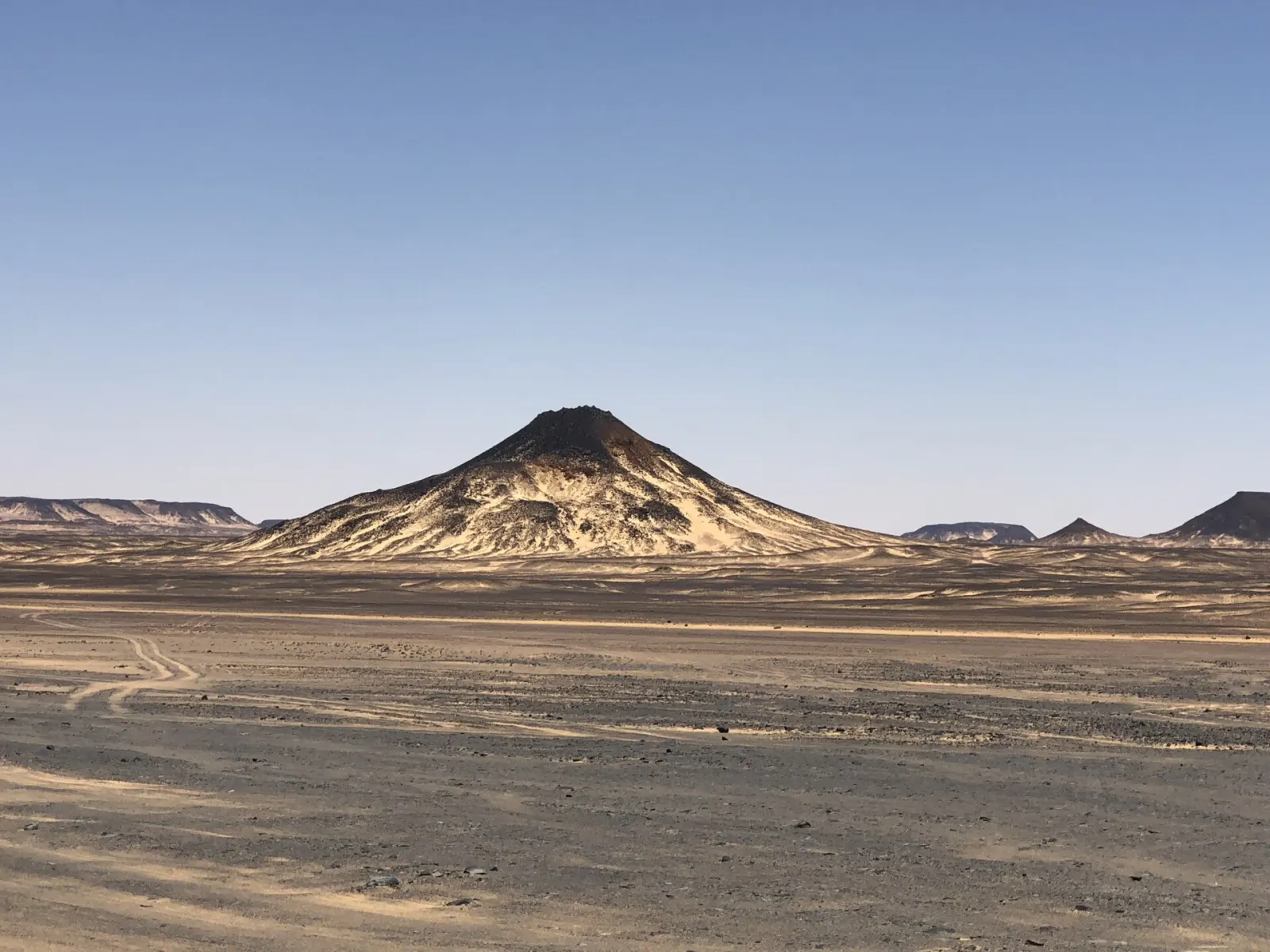
If the eclipse is the reason for the trip, we'd watch from the open plain of the Black Desert, between Bahariya and Crystal Mountain. Its northern part, along the road south of Bawiti, is close to the centre line, so totality is at its longest: 6 minutes 24 seconds. The ground is flat enough to see the shadow's edge and the glowing horizon all around. A small rise gives a view of the dark-capped hills. Bawiti itself is only about five seconds shorter. It's the right choice if you'd rather have a hotel room, a shower and air conditioning close by.
The White Desert's famous formations are still inside the path, but nearer its southern edge. At the Mushroom and Chicken you'd trade more than four minutes of totality, keeping about 2 minutes 5 seconds, for the chalk shapes in the strange eclipse light. That's a fine choice for photographers who want the formations in the frame. For the sky itself, go north.
Planning the trip
Short answer: Be in place the night before and allow three days; our eclipse camp packages the dates, permits, vehicles and camp as one plan.
Don't leave the drive from Cairo until eclipse morning: it takes four and a half to five hours with checkpoints, and a flat tyre or a slow checkpoint could cost you totality. Bahariya has a limited number of hotel rooms, licensed 4x4s and crews, and demand will come from around the world, so book as soon as you know your dates. Our trip for this eclipse is the eclipse 2027 camp: three days from 31 July to 2 August 2027, a moonless night camped in the White Desert, then totality from the Black Desert plain or Bawiti, with glasses, shade and water included. That page has the day-by-day plan, the heat plan, what's included and how to book; this guide keeps the eclipse facts and times. See also permits and safety and how many days you need.
What you'll see
Short answer: The light fading for an hour, then a sudden dusk, the corona, bright planets and a sunset glow on every horizon.
The partial phase starts around 11:30. For more than an hour the Sun becomes a shrinking crescent, visible only through eclipse glasses. As it narrows, the light turns flat and silvery and shadows sharpen. In the last minutes, look at the ground for shimmering shadow bands. Watch the western horizon for the darkness racing towards you.
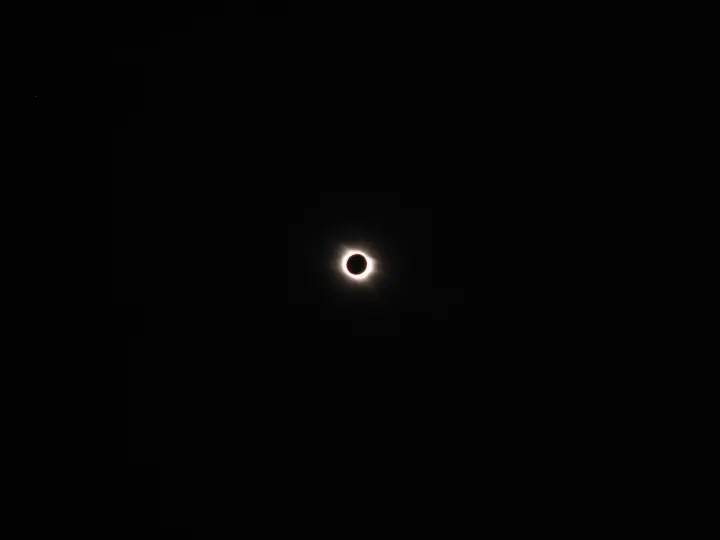
At about 12:50 the last bead of sunlight breaks into Baily's beads and a final "diamond ring", then goes out. Take the glasses off. The Sun's corona spreads out around the black disc, and pink prominences may show at its edge. The brightest stars and planets appear, and an orange glow surrounds you on all sides like a 360-degree sunset. The air cools a few degrees. When the Sun's edge reappears, glasses go back on at once.
Heat, glasses and safety
Short answer: August heat is the main risk; certified glasses are the other non-negotiable.
The eclipse happens in the hottest part of an August day, with the Sun almost overhead at about 79 degrees. Expect an average high of about 37°C, often more, and there's no natural shade on the open plain. Bring or arrange shade, and don't stand in the open for hours before first contact; our eclipse camp has its own heat plan. Wear a wide hat, long light sleeves and sun cream, and drink more than you think you need; read the White Desert in August and health and first aid.
Use eclipse glasses certified to ISO 12312-2 from a reputable supplier, and check them for scratches. Cameras, binoculars and telescopes need proper solar filters on the front for the partial phases. Never look at the partly covered Sun through an unfiltered lens, even for a second.
Photographing it
Short answer: Practise at home, use a filter for the partial phases, then take it off and enjoy totality with your own eyes.
A phone on a tripod will capture the darkness, the horizon glow and the people around you. For the corona you need a camera with a long lens on a steady tripod. Fit the solar filter for the partial phases and remove it only for totality. Bracket your exposures widely, because the inner and outer corona need very different settings. Set everything up the day before. With six minutes of totality there's time for photographs and for simply looking, and we'd urge you to save at least a minute for that. Read photography in the White Desert.
The nights around the eclipse
Short answer: A solar eclipse always falls at new moon, so the nights either side are as dark as the desert gets.
Because the Moon is between the Earth and the Sun, the nights of 1 to 3 August are moonless. With warm air and the summer Milky Way overhead, they're among the best stargazing nights of the year in the White Desert. Early Perseid meteors are already falling, and the shower builds towards its peak on 12–13 August, though that night has a bright gibbous moon until the small hours. A night of camping before or after the eclipse is worth adding, and we choose the camp spot with a light-pollution map to find the darkest sky. If you also want to see the Nile, ask us how to combine it with our trips. See stargazing, meteor showers and the White Desert in August.
Questions people ask
Is the White Desert in the path of totality in 2027?+
Yes, most of it. Bahariya, the Black Desert, Crystal Mountain, Agabat, the New White Desert and the Mushroom and Chicken are all inside the path. But the southern edge runs only about 7 km south of the Mushroom and Chicken, at about 27.2°N, and south of that line there is no totality at all.
Is Farafra in the path of totality?+
No. Qasr Farafra town lies about 20 km outside the southern edge of the path. It gets a deep partial eclipse, with about 99.7% of the Sun covered at 12:53, but no totality and no corona. The nearest totality is to the north-east, on the road through the White Desert: about 2 minutes at the Mushroom and Chicken, and longer the further north you go.
How long is totality at the Mushroom rock?+
About 2 minutes 5 seconds, from 12:52:25 to 12:54:30 Egypt summer time, at the point we use for the Mushroom and Chicken (27.255°N, 28.13°E). That is timeanddate's figure; Xavier Jubier's calculator gives 2 minutes 8.5 seconds. The rock is only about 7 km inside the southern edge, so a few kilometres south totality drops below 2 minutes, while Agabat, further north, gets 4 minutes 38 seconds.
Where is the longest totality between Cairo and Farafra?+
Around the Black Desert and Bahariya, near the centre line: 6 minutes 24 seconds in the northern Black Desert by the road south of Bawiti, and 6 minutes 19 seconds in Bawiti. Totality gets shorter as you go south: 5 minutes 27 seconds at Crystal Mountain, 4 minutes 38 seconds at Agabat, 3 minutes 11 seconds in the New White Desert and 2 minutes 5 seconds at the Mushroom and Chicken.
What time is the eclipse in Bahariya?+
In Bawiti the partial phase starts at about 11:30, totality runs from 12:50:20 to 12:56:39 and the partial phase ends at about 14:15, Egypt summer time (UTC+3). Eclipseando gives 6 minutes 19 seconds of totality and timeanddate 6 minutes 18 seconds for the same point. The Black Desert is within a few seconds of the same times.
Can I drive from Cairo on the morning of the eclipse?+
We strongly advise against it. The drive is about five hours with checkpoints, and the road will be busier than usual. Spend the night of 1 August in Bahariya or camped in the Black Desert so you're in place long before first contact.
How hot will it be?+
Early August afternoons average about 37°C and can be hotter, and the Sun will be almost overhead. Plan shade, a hat and a cool place to rest before and after totality; we carry plenty of water and never run out. The temperature drops a few degrees around totality, but it's still hot.
Do I need eclipse glasses?+
Yes, for every minute of the partial phases. Use glasses certified to ISO 12312-2 and a proper solar filter on cameras and binoculars. Only during totality itself, when the Sun is completely covered, is it safe to look without them.
Go with us
Trips that include this
3 days, 2 nights
Eclipse 2027 camp: White Desert nights and totality in the Black Desert (3 days, 2 nights)On request (depends on group size, vehicles and lodge or camp)
Check dates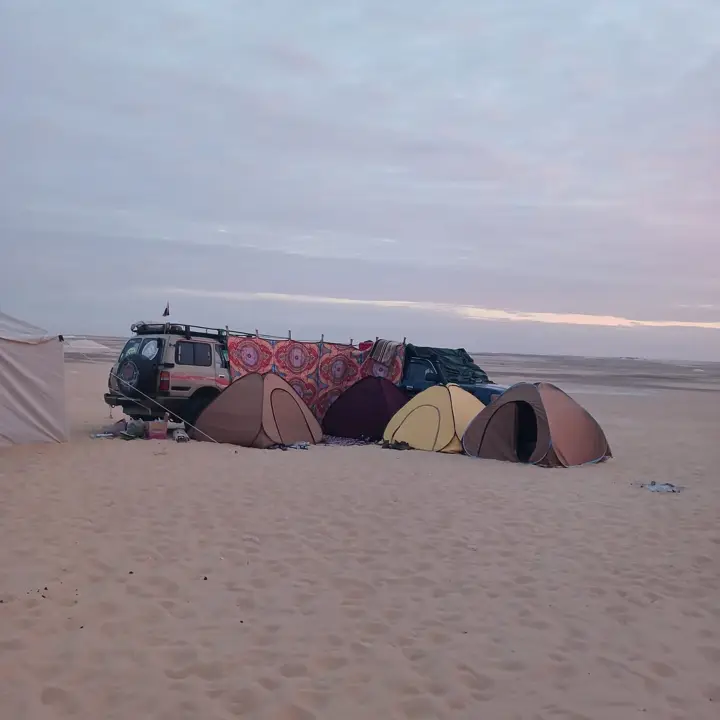
2 or 3 days
Private White Desert camping in comfortOn request (depends on group size and nights)
Check dates
3 days, 2 nights
3-day White Desert tour: Bahariya, the White Desert and two nights outAbout US$495 to 660 per person for two travellers, private
Check dates