
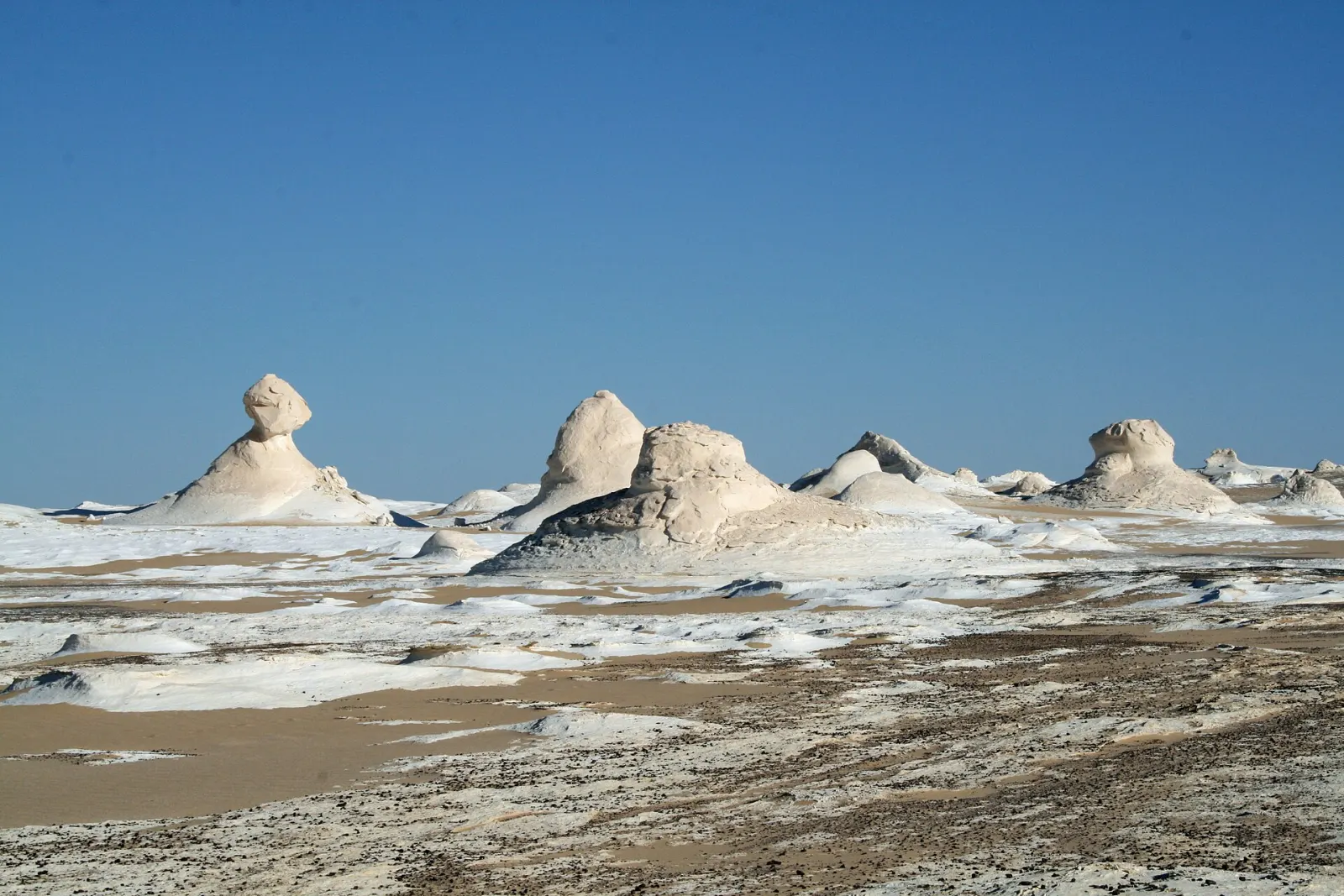
The short answer
The main health risks on a White Desert trip are sun, heat and dehydration from April to October, cold nights near 0°C in December and January, motion sickness on the long drive, and an upset stomach. Drink 3–4 litres of water a day, cover up and pack warm layers. Scorpion and snake encounters are rare. Bawiti has a hospital for basic care; serious cases go to Cairo.
Ask us on WhatsAppThe main risks, honestly
Short answer: Sun and dehydration, cold at night, motion sickness, stomach upsets, minor cuts and, rarely, scorpion stings. Serious incidents are uncommon.
| Risk | When | How to prevent it |
|---|---|---|
| Sunburn and heatstroke | April to October especially | Hat, sun cream, water, shade at midday |
| Dehydration | All year | Drink 3 to 4 litres a day; more in heat |
| Cold at night | November to March | Layers, hat, proper bedding |
| Motion sickness | Off-road sections | Front seat, tablets, gentle driving |
| Upset stomach | Any time | Bottled water, hand hygiene, cooked food |
| Cuts and grazes | On rocks and chalk | Closed shoes, care when climbing |
| Twisted ankles | On loose stones and dunes | Good shoes, watch your step |
| Bites and stings | Rare; mostly warm evenings | Repellent, torch, shake out shoes |
| Eye irritation | Windy days | Sunglasses, eye drops |
Checked November 2026: the climate you're preparing for
Short answer: Long-term Farafra normals run from about 20°C by day and 4°C at night in January to about 38°C by day and 22°C at night in July.
| Month | Day high | Night low | Main health focus |
|---|---|---|---|
| January | about 20°C | about 4°C (near 0°C in the open) | Cold at night |
| April | about 32°C | about 14°C | Sun, wind and dust |
| July | about 38°C | about 22°C | Heat and dehydration |
| October | about 31°C | about 16°C | Sun by day |
These are long-term averages for Farafra; Bahariya is almost identical. Farafra's record high is 47.5°C and its record low −3.3°C. See weather and night temperatures.
Heat and hydration
Short answer: Drink before you're thirsty, add salts on hot days, and avoid walking in full sun at midday from April to October.
The desert air is dry, so sweat evaporates fast and you may not notice how much water you're losing. Sip water all day; aim for three to four litres, more in summer. Rehydration salts help on hot days or after a stomach upset. Signs of heat exhaustion are headache, dizziness, nausea and heavy sweating. If they appear, move into shade, cool down with water and rest. Heatstroke, with confusion and hot dry skin, is an emergency. Tell your driver at once.
The place people most often struggle is the Black Desert climb on a hot afternoon. Dark stones hold the heat. Wear shoes, not sandals, carry water and take it slowly; there's no prize for reaching the top first.
Cold
Short answer: Nights can approach freezing in December and January; dress warmly, eat well and keep dry.
Cold is a bigger issue than most visitors expect. Wear a hat and layers, put on dry clothes before sleeping, and ask us for spare blankets or a sleeping bag when you book; both are on request. Eating a hot dinner and drinking warm tea helps. Children and older travellers feel the cold more; check on them during the night. See camping in winter and what to wear.
The long drive
Short answer: Four and a half to five hours of tarmac, then 1.5–2 hours off-road; stretch at every stop and take motion-sickness tablets if you need them.
The road from Cairo to Bawiti is long and straight. Stay hydrated, get out and walk at each stop, and if you have circulation problems, wear compression socks. The off-road sections into Agabat and the White Desert are slower and bumpier. If you have back problems, tell us; a well-driven 4x4 at low speed is much kinder than a rushed one.
Stomach health
Short answer: Drink sealed bottled water, wash or sanitise your hands before meals, peel fruit and be cautious with raw salad in towns.
Most stomach upsets come from water or unwashed hands. Drink only sealed bottled water, which is included on our trips; we carry plenty and never run out of water. Use hand sanitiser before meals, especially at camp. In town restaurants, cooked dishes are safest. Bring anti-diarrhoea tablets and rehydration salts just in case. See food at camp and where to eat.
Bites and stings
Short answer: Scorpions and snakes are rarely seen, and mosquitoes are mainly an oasis nuisance at dusk; neither is a common health problem on our trips.
Mosquitoes bite mostly in the oasis gardens and around springs on warm evenings, and Egypt's oases are not malaria areas. Scorpion stings are rare and usually happen on warm nights. Where insects bite, how to avoid stings and what to do if someone is stung are covered in full in mosquitoes, flies and scorpions.
A first-aid kit to bring
Short answer: Basic medicines, rehydration salts, plasters, antiseptic, sun care, and any personal prescriptions in your day bag.
- Painkillers and fever reducers
- Anti-diarrhoea tablets and oral rehydration salts
- Motion-sickness tablets
- Antihistamine tablets and cream
- Plasters, blister pads and a small bandage
- Antiseptic wipes or cream
- Eye drops
- Sun cream and lip balm with SPF, after-sun
- Insect repellent
- Tweezers, for splinters and thorns
- Personal prescriptions, with a copy of the prescription
- Hand sanitiser and wet wipes
Medical care and insurance
Short answer: Bawiti and Farafra have hospitals for basic care; serious emergencies go to Cairo. Travel insurance that covers medical evacuation from remote areas is essential.
The nearest hospitals are in Bawiti and Farafra, and they offer basic treatment such as rehydration, dressing wounds and treating stings. Bawiti's hospital is roughly 1.5–2 hours' drive from the main camps in the Old White Desert; Farafra's is closer to the southern formations. For serious problems, patients are driven to Cairo, about four and a half to five hours from Bawiti. Pharmacies in Bawiti stock the basics, but brands and choice are limited, so bring what you rely on.
Our crews carry a first-aid kit and know the area, the routes are well used, and the highway is never far from the main camps. Phone signal comes and goes in the open desert, so drivers know the spots where a call goes through. If you have a medical condition, allergy or take regular medication, tell us before the trip so we can plan around it. For a food allergy or special diet, tell us two days before so the cook can shop for it.
Make sure your insurance covers medical evacuation as well as off-road driving and camping in Egypt's Western Desert; what to check in the policy wording is in permits and safety.
Our advice
Short answer: Tell us about any condition in advance, keep medicines in your day bag, drink steadily, and speak up early if you feel unwell.
- Keep your medicines on you, not in luggage strapped to the roof.
- Drink a full bottle before the off-road section starts.
- Wear closed shoes at every stop.
- Tell the crew early. A headache at 4 pm is easy to fix; heat exhaustion at 6 pm is not.
Send us a WhatsApp message with "health" and your question. We'll tell you honestly what the trip involves and how to make it work for you.
Questions people ask
Do I need any vaccinations for the White Desert?+
No special ones beyond what's recommended for Egypt generally, such as routine vaccines and often hepatitis A and typhoid. Check with your doctor or a travel clinic six to eight weeks before you travel; there's no malaria risk in Bahariya or Farafra.
How far is the nearest hospital from the White Desert camps?+
Bawiti's hospital, for basic care, is roughly 1.5–2 hours' drive from the main camps; Farafra's is closer to the southern formations. Serious cases go to Cairo, about 370 km from Bawiti. Our crew carries a first-aid kit and knows where to find phone signal.
Will I get motion sickness on the drive?+
Some guests do. The Cairo–Bawiti road is smooth tarmac, but the off-road sections, about 1.5–2 hours, are bumpy in places. If you're prone to it, take a tablet before the off-road part, sit in the front seat, and tell your driver so he takes a gentler line.
What should I put in a first-aid kit for the White Desert?+
Painkillers, anti-diarrhoea tablets, oral rehydration salts, motion-sickness tablets, antihistamines, plasters and blister pads, antiseptic, eye drops, sun cream and lip balm, plus your own prescriptions. Keep it in your day bag, not on the roof rack, because the pharmacy choice in Bawiti is limited.
What happens if I get ill at camp?+
Tell the crew straight away. For minor problems we use the first-aid kit and keep an eye on you overnight. For anything more serious, we drive to the nearest hospital in Bawiti or Farafra and call ahead where there's signal. The highway is never far from the main camps.
Is it safe to climb the Black Desert hill?+
Yes, if you take it slowly in proper shoes. The climb is 10–20 minutes on loose black stones. In the heat, or in sandals, people slip or get dizzy; go in the cooler hours, carry water, and come down slowly. The view from the base is fine too.
Go with us
Trips that include this

2 days, 1 night
White Desert overnight camping trip from Cairo (2 days, 1 night)About US$185 to 230 shared · US$360 to 460 private, per person
Check dates
3 days, 2 nights
3-day White Desert tour: Bahariya, the White Desert and two nights outAbout US$495 to 660 per person for two travellers, private
Check dates
2 or 3 days
Private White Desert camping in comfortOn request (depends on group size and nights)
Check dates