
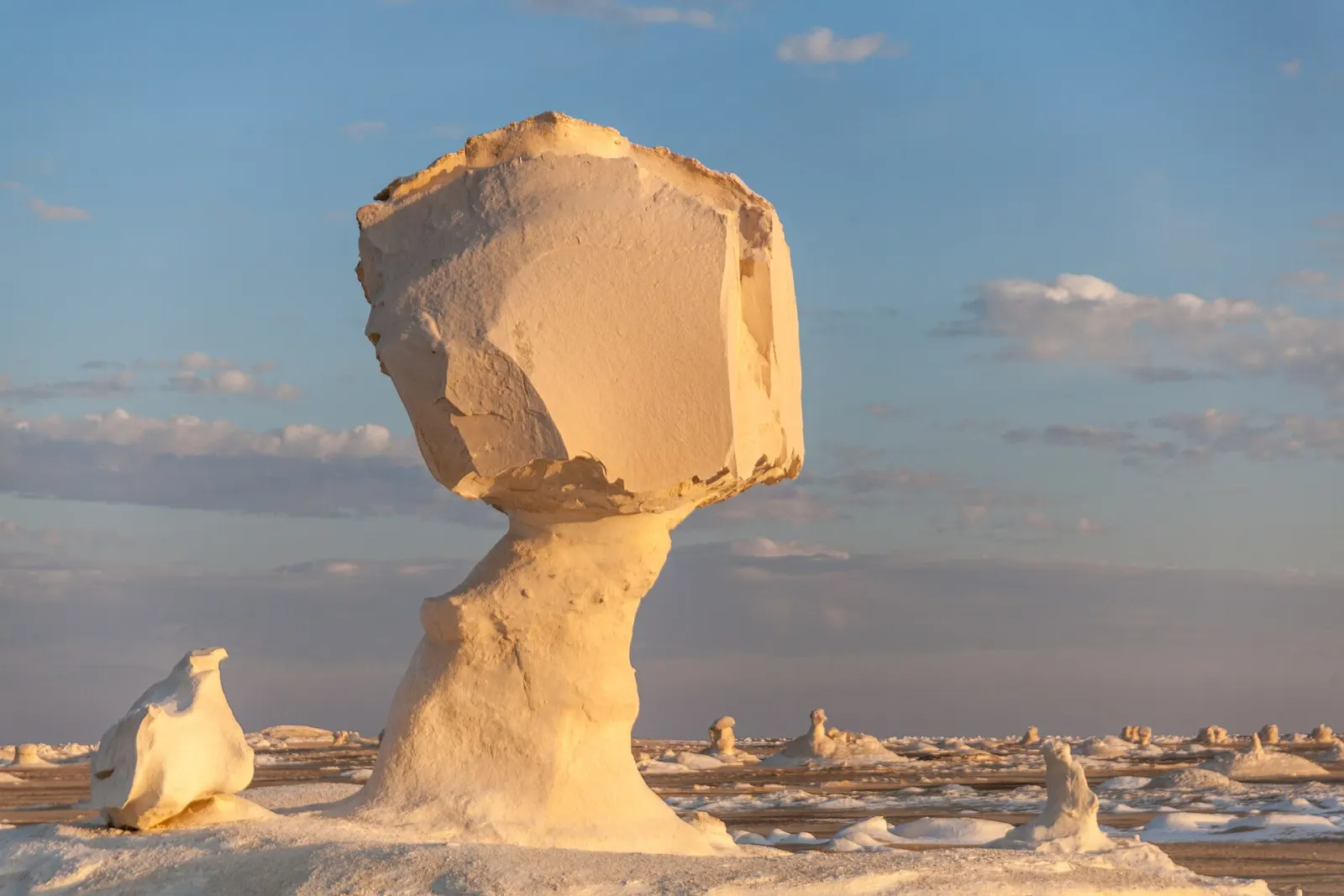
The short answer
The best time to visit the White Desert is October to November, then February to March. Days are warm, around 22–32°C, nights are cool and the wind is usually light. November is our favourite month. December and January are clear but cold at night, and May to September works if you travel late in the day.
Ask us on WhatsAppMonths ranked
Short answer: November, October and March are the best months; February, December and April come next; January suits those who don't mind cold; May to September work with a late-day plan.
This is how we rank the year for a first trip of one or two nights, balancing comfort, sky, light and crowds. For the temperature in each month, see White Desert weather and night temperatures.
| Rank | Month | Verdict | Why |
|---|---|---|---|
| 1 | November | Best overall | Mild days, cool nights, calm air, soft light |
| 2 | October | Excellent | Warm days and warm-enough nights; busy weekends |
| 3 | March | Excellent | Lovely days, occasional windy spell; Eid al-Fitr in 2027 |
| 4 | February | Very good | Clear and quiet; cold nights; Ramadan in 2027 |
| 5 | December | Very good | Geminids in 2026, crisp stars; cold nights, holiday crowds |
| 6 | April | Good | Warm and pleasant; highest chance of a khamaseen day |
| 7 | January | Good if you pack warm | Clearest air, coldest dawns of the year |
| 8 | May | Fair | Hot middays, warm nights, few groups; Eta Aquariids in 2027 |
| 9 | September | Fair | Still hot, cooling late in the month; quiet |
| 10 | June to August | For night lovers | Very hot days, beautiful warm nights, Milky Way overhead |
There is no month when the White Desert is closed. The ranking only tells you how much planning a month asks of you. Most months have their own page: January, February, March, April, May, October, November and December.
Typical values for the White Desert and Bahariya, matching our month guides. Open desert nights can be a few degrees colder; individual days vary.
Each month at a glance
Short answer: No month scores well on everything. Autumn wins on comfort, midwinter on clear air, spring loses a little to wind, and summer trades hot days for the best nights of the year.
This table splits each month into the things that decide how a trip feels. Day and night descriptions follow the averages in the next section; wind risk follows the wind column on our weather and night temperatures page.
| Month | Middle of the day | Night at camp | Wind and dust | Crowds | Good for |
|---|---|---|---|---|---|
| January | Pleasant for walking | Cold; frost possible | Low; cold north wind some days | Busy around school break | Clear air, winter stars |
| February | Pleasant | Cold | Low to moderate | School break early on, then quiet in Ramadan 2027 | Calm, clear trips |
| March | Warm | Cool | Moderate | Very busy at Eid al-Fitr; Western Easter on 28 March 2027 | Comfort, walking |
| April | Warm to hot | Mild | Highest of the year | Fairly quiet in 2027 | Mild nights, long days |
| May | Hot | Warm | Moderate | Busy at Coptic Easter and Eid al-Adha, quiet otherwise | Eta Aquariids, solitude |
| June | Very hot | Warm | Low | Quiet | Milky Way, sleeping out |
| July | Very hot | Warm | Low | Quiet | Milky Way, sleeping out |
| August | Very hot | Warm | Low | Busier in 2027 for the eclipse | The eclipse on 2 August 2027 |
| September | Hot | Warm | Low | Quiet | Warm nights, low season |
| October | Warm | Comfortable | Low | Busy weekends | All-round comfort |
| November | Mild | Cool | Low | Busy weekends | Best overall |
| December | Mild | Cold | Low | Very busy at Christmas | Geminids 2026, holiday camps |
Temperatures month by month
Short answer: At the Farafra weather station, days average 20°C in January and 39°C in July; nights average about 7°C in January and 24°C in July. Camp in the open desert is usually a few degrees colder at dawn.
These are average day highs and night lows at the Farafra weather station (WMO 62423), the nearest long-running station to the White Desert. We averaged the monthly records that Meteostat publishes for Farafra for every complete month from 2009 to 2025, about 12 to 13 years per month, and rounded to the nearest degree. Checked November 2026.
| Month | Day high | Night low (station) | What it means for your trip |
|---|---|---|---|
| January | 20°C | 7°C | Good walking; the coldest dawns of the year |
| February | 22°C | 7°C | Clear and quiet; still a cold night |
| March | 26°C | 10°C | Easy days, cool nights, some wind |
| April | 32°C | 15°C | Warm days; the windiest month |
| May | 35°C | 19°C | Hot middays; plan around the afternoon |
| June | 38°C | 22°C | Late-day trips only; warm nights |
| July | 39°C | 24°C | The hottest month; nights fine in a T-shirt |
| August | 39°C | 24°C | As hot as July; the 2027 eclipse month |
| September | 36°C | 22°C | Still hot; cooling slowly late in the month |
| October | 32°C | 18°C | Warm days, comfortable nights |
| November | 26°C | 12°C | Mild days, cool nights, usually calm |
| December | 21°C | 8°C | Crisp days; cold nights by the fire |
Two things to keep in mind. The station sits inside the oasis, among palm gardens and houses, while our camps sit on open sand and chalk, so camp is usually 2 to 4°C colder than the station by dawn. And these recent averages run 1 to 3°C warmer at night than the older 1961 to 1990 normals on our weather and night temperatures page, which also lists the camp temperatures we see each month. For packing, plan on the colder figure.
Rain hardly matters: Farafra averages about 2 mm a year.
Daylight, sunset and the length of the night
Short answer: You get about 10.5 hours of daylight in December and January and nearly 14 hours in June. Winter means a long evening by the fire; summer means a late sunset and a short, warm night.
On a one-night trip from Cairo you reach the formations in the afternoon, so sunset decides how much light you have. The times below are the mid-month figures from our sunrise and sunset guide; the daylight column is simply the gap between them.
| Month (mid-month) | Sunrise | Sunset | Daylight | What it means |
|---|---|---|---|---|
| January | ~06:58 | ~17:33 | About 10 h 35 min | Early sunset; long, cold evening |
| February | ~06:45 | ~17:58 | About 11 h 15 min | Still a long night by the fire |
| March | ~06:18 | ~18:15 | About 12 h | Even day and night |
| April | ~05:44 | ~18:31 | About 12 h 45 min | Early dawn; summer time starts at the end of the month |
| May | ~06:19 | ~19:47 | About 13 h 30 min | Late sunset, warm evening |
| June | ~06:12 | ~20:03 | About 13 h 50 min | Longest days; shortest night |
| July | ~06:21 | ~20:04 | About 13 h 45 min | Dinner after dark |
| August | ~06:38 | ~19:46 | About 13 h 10 min | Eclipse month in 2027 |
| September | ~06:52 | ~19:13 | About 12 h 20 min | Days shortening |
| October | ~07:06 | ~18:39 | About 11 h 30 min | Summer time ends at the end of the month |
| November | ~06:27 | ~17:17 | About 10 h 50 min | Sunset soon after 17:00 |
| December | ~06:49 | ~17:15 | About 10 h 25 min | Shortest days of the year |
In winter, a one-night trip that leaves Cairo late can reach the chalk with little light left. If sunset among the formations matters to you, choose an early start between November and February.
Season by season
Short answer: Autumn is the best all-round season, winter is clear and cold, spring is warm with some wind, and summer is hot by day with warm nights.
| Season | Days (Farafra average) | Nights at camp | In a word |
|---|---|---|---|
| Autumn, October to November | 26–32°C | about 7–16°C | Easy |
| Winter, December to February | 20–22°C | about 0–6°C | Crisp |
| Spring, March to April | 26–32°C | about 6–14°C | Warm, sometimes windy |
| Summer, May to September | 35–39°C | about 15–22°C | Hot days, warm nights |
Autumn (October to November): the best all-round
Warm days, comfortable nights, calm weather and clear skies. Shared trips run frequently and the desert is at its most welcoming. The only downside is demand: book ahead, especially at weekends.
Early October still has middays near 32°C; by mid-November you can walk at any hour.
Winter (December to February): clear and cold
Bright, mild days and cold nights. The air is at its clearest, the winter stars are spectacular and the sun sets early, so the evening by the fire is long. Pack properly and ask for a tent; our winter camping guide covers the sleep system, and camping explains how a night at camp works.
The Christmas and New Year week is the busiest and dearest of the season; see Christmas and New Year. Mid-December and the weeks after 7 January are calmer.
Spring (March to April): warm with some wind
Lovely temperatures, longer days and mild nights, with the risk of the hot, dusty khamaseen wind for a day or two at a time. Most trips are unaffected, but this is the season to keep a day of flexibility.
March is the better half of spring: cooler, calmer and with nights you can sleep through in a light bag. April is warmer and brighter but has the highest chance of a khamaseen day. Easter and Sham el-Nessim fall in spring and bring more groups; see Easter and Sham el-Nessim.
Summer (May to September): hot days, warm nights
Days are very hot, but nights are warm and perfect for sleeping out, and the Milky Way is at its best. Trips are timed for late afternoon, night and early morning. Fewer visitors and often lower prices.
From June to August there is no walking in the open between about 11:00 and 16:00.
The best month for…
Short answer: October, November and March for comfort; December to February for crisp stars and light; June to August for the Milky Way; May and September for solitude and price.
| Priority | Best months |
|---|---|
| Comfortable temperatures | October, November, March |
| Fewest people | May, September |
| Milky Way | June to August (new moon) |
| Crisp winter stars | December, January |
| Meteor showers | December 2026 (Geminids), January and May 2027 |
| Glowing chalk under a full moon | Any month, around full moon; best when nights are mild |
| Photography light | November to February |
| Walking and hiking | November to February |
| Families | October–November, February–April |
| Sleeping in the open | April to October |
| Lowest prices | May to September |
See White Desert with kids and photography for those two choices in more detail.
Picking dates for the sky
Short answer: New moon for stars, full moon for glowing chalk; the Geminids on 13–14 December 2026 and the eclipse on 2 August 2027 are the dates worth planning around.
Choose dates near the new moon for the Milky Way and near the full moon for a silver-white landscape; stargazing explains the trade-off. The full moon of 24 December 2026 lights Christmas Eve. The Geminids on 13–14 December 2026 and the Eta Aquariids on 5–6 May 2027 are the best meteor nights of the year ahead, with every date in meteor showers. On 2 August 2027 a total solar eclipse gives Bawiti about 6 minutes 19 seconds of totality.
Here are the new and full moons for the year ahead, in Cairo time, from timeanddate's moon phase tables for Cairo for 2026 and 2027 (checked 19 November 2026). For a dark sky, aim for a night within about four days of the new moon. For moonlit chalk, aim for the night before or of the full moon.
| Month | New moon | Full moon | Worth knowing |
|---|---|---|---|
| December 2026 | 9 December | 24 December | Geminids on 13–14 December under a thin crescent |
| January 2027 | 7 January | 22 January | New moon falls on Coptic Christmas |
| February 2027 | 6 February | 21 February | Dark skies at the start of Ramadan |
| March 2027 | 8 March | 22 March | New moon just before Eid al-Fitr |
| April 2027 | 7 April | 21 April | Full moon spoils the Lyrids |
| May 2027 | 6 May | 20 May | Eta Aquariids at new moon |
| June 2027 | 4 June | 19 June | Milky Way high in the evening |
| July 2027 | 4 July | 18 July | Warm, dark nights early in the month |
| August 2027 | 2 August | 17 August | The eclipse falls on the new moon |
| September 2027 | 30 September | 16 September | August has a second new moon on 31 August |
| October 2027 | 29 October | 15 October | Late-month dark skies |
| November 2027 | 28 November | 14 November | Dark skies at the end of the month |
| December 2027 | 27 December | 13 December | Full moon spoils the Geminids |
The nights either side of the eclipse are dark, so an eclipse trip doubles as a stargazing trip.
The 2027 eclipse: is August worth the heat?
Short answer: Yes, if the eclipse is the reason you are coming. Totality lasts 6 minutes 24 seconds in the northern Black Desert, close to the centre line, and 2 minutes 5 seconds at the Mushroom and Chicken in the White Desert, according to timeanddate's calculations for those points.
Bawiti gets 6 minutes 19 seconds, with the peak around 12:53 local time. That is the hottest part of the day in one of the hottest months. Farafra town is outside the path of totality, at about 99.7%, so it is not the place to watch from. Our eclipse guide has the full timings and the eclipse camp shows how we run the trip.
Weather risks to know
Short answer: Spring wind, cold dawns in midwinter and midday heat in summer are the three things to plan for; rain is rare.
| Risk | When | How likely | What changes on the trip |
|---|---|---|---|
| Cold nights and frost | December to February | Every night is cold; frost on still, clear nights in January | Warm sleeping bag, blankets, a hat, a tent |
| Khamaseen wind and dust | March to May, peaking in April | A day or two at a time, not every trip | Sheltered camp, buff and wrap-around glasses, lodge night if needed |
| Cold north wind | December to February | Some days | Windbreak at camp; the fire feels more important |
| Midday heat | May to September | Every day in June to August | Later start, rest in Bawiti, no walking 11:00–16:00 |
| Rain | November to January | Rare; about 2 mm a year at Farafra | Usually none; a shower clears within hours |
For more on each, see weather and night temperatures and our sandstorms and wind guide; permits and safety covers the wider safety picture.
Holidays and busy dates
Short answer: Eid al-Fitr, Eid al-Adha, Egyptian school breaks, Christmas, New Year and Easter bring the most groups to the White Desert. Weekdays outside those dates, and May and September, are the quietest.
Egyptian public holidays, the two Eids and the mid-year school break bring local families into the desert, alongside international peaks at Christmas, New Year and Easter. Spread-out camps mean it never feels crowded the way a monument does, but the classic sunset spots at the Mushroom and Chicken get busy, and cars and lodges cost more. If you want solitude on those dates, go private: on private trips we camp away from other groups, and we choose the spot with a light-pollution map for the darkest sky; see where we camp.
| Period, 2026–27 | What to expect |
|---|---|
| Christmas to New Year, 24 December 2026 to 1 January 2027 | Busiest international week; book early. See Christmas and New Year |
| Coptic Christmas, 7 January 2027 | Egyptian holiday; also a new moon |
| Egyptian mid-year school break, usually late January to early February | Many Egyptian families and student groups |
| Ramadan, about 8 February to 9 March 2027 | Quiet desert, adjusted meal times; our Ramadan guide explains what changes |
| Eid al-Fitr, straight after Ramadan, around 10 March 2027 | Very busy for three days and the weekend around them |
| Easter, 28 March (Western) and 2 May 2027 (Coptic) | Busier, especially around Sham el-Nessim, the day after Coptic Easter |
| Eid al-Adha, about ten weeks after Eid al-Fitr, mid-May in 2027 | Busy with domestic travellers despite the heat |
Islamic holiday dates depend on moon sighting and can move by a day; we confirm them when you book.
Egypt's fixed public holidays also make long weekends for local travellers. In 2027 the ones that matter most are Revolution Day on 25 January, Sinai Liberation Day on 25 April, Labour Day on 1 May (next to Coptic Easter and Sham el-Nessim on 2–3 May) and Armed Forces Day on 6 October. Eid al-Adha is expected on 17–19 May, after Arafat Day on 16 May (timeanddate, Egypt holidays 2027 (checked 19 November 2026)).
Fitting the desert into a wider Egypt trip
Short answer: October to March suits Cairo, the Nile valley and the desert alike. In summer the desert is easier than Luxor by night but similar by day, so plan both around early mornings and evenings.
Most people visit the White Desert as part of a longer trip. Bawiti is about 370 km from Cairo, 4.5–5 hours by car with a stop; see the Cairo to Bahariya drive.
| Month | Cairo (day / night) | Luxor (day / night) | Farafra (day / night) |
|---|---|---|---|
| January | 19°C / 10°C | 23°C / 7°C | 20°C / 7°C |
| April | 28°C / 16°C | 35°C / 18°C | 32°C / 15°C |
| July | 35°C / 24°C | 41°C / 26°C | 39°C / 24°C |
| October | 30°C / 20°C | 36°C / 20°C | 32°C / 18°C |
Cairo figures are 1991–2020 airport averages from our weather page; Luxor figures are the 1991–2020 averages for Luxor airport, rounded, from Wikipedia's Luxor climate table (checked 19 November 2026). Farafra figures are the station averages above.
In winter, pack for the desert night, not for Cairo or Luxor. In summer, Luxor is hotter by day than the desert. For routes and orders, see our Egypt itinerary with the White Desert, and for arriving from the Nile, from Luxor.
Trip length and style by season
Short answer: In the cool months any length works, and three days is worth it if you can spare them. In summer, one night is the sweet spot: the hot middle of the day makes a day trip hard and a long trip tiring.
| Season | Day trip | One night | Two or three nights |
|---|---|---|---|
| Autumn | Possible, but you miss sunset and stars | Ideal | Ideal; comfortable days for a long trip |
| Winter | Possible; short days mean little light | Ideal if you pack warm | Very good for walking; two cold nights |
| Spring | Possible | Ideal; keep a spare day in April | Good; more chance of meeting a windy day |
| Summer | Hard; you arrive in the heat of the day | Best choice; late start, sunset, sunrise | Possible, with long rests in the shade |
A day trip gives you two to three hours in the desert, in summer at the hottest time, so we suggest at least one night from May to September. See day trip or overnight and how many days for the trade-offs, and shared or private if you are weighing up crowds on a busy date.
Packing by season
Short answer: Winter means a down jacket, hat, gloves and thermals for the night; summer means a wide-brimmed hat, long light sleeves and sunglasses; spring adds a buff and wrap-around glasses for dust.
Autumn needs only a fleece and a hat after midnight. The full lists are in the packing list and what to wear. If you are coming between December and February, ask us about the warmth of the sleeping bags on your trip.
Prices and booking by season
Short answer: October to April is high season, with the Christmas and New Year week about 15–30% dearer; May to September is low season. Book further ahead for November weekends, Christmas and the Eids.
Where the trip starts and whether it is shared or private also shape the price. In holiday weeks private cars and crews run out first; for Christmas and New Year we suggest booking three to six weeks ahead. Our cost guide gives the 2026–27 ranges. For exact prices and availability on your dates, ask us.
Our advice: how to choose your month
Short answer: Pick October, November or March if you want comfort; December to February if you can handle cold nights; and summer only if you love warm nights and accept a slow middle of the day.
The question we get most is "when is best?", and our honest answer depends on what you fear more, cold or heat. Guests who visit in January are often surprised by how cold the hour before dawn is, even after a 20°C afternoon. Guests in April are sometimes surprised by a dusty, hazy day. Guests in July are surprised that the night is the best part of the trip. None of those is a reason not to go; they are reasons to pack and plan for your month.
- First trip, free choice: November. If November is full, October or March.
- Coming for stars: a new-moon week between December and February for crisp air, or June to August for the Milky Way.
- Travelling with children or older relatives: October, November or late February to March, when neither the night nor the midday asks much of anyone.
- Fixed dates in summer: come anyway, and book a trip that starts later from Cairo so you reach the formations for sunset.
- Fixed dates in spring: keep a spare day in your Egypt plan so we can move the desert night if the wind is up; in strong wind you can also switch to a lodge night in Bahariya.
- Only free over the holidays: book early and go private; on a private trip we camp away from other groups.
- On a budget: May or September, midweek, on a shared trip.
- Coming for the eclipse: 2 August 2027, with a plan for shade and water, and an early booking.
Once you have a month, how many days helps you pick the length of the trip, our calendar gathers the dated events, and our tours show which trips run in which season.
Questions people ask
What is the best month to visit the White Desert?+
November, in our experience. Days are about 25°C, nights at camp about 7–10°C, the wind is usually calm and the afternoon light is soft. October and March come close behind. Book ahead for November weekends, which are among the busiest of the year.
What is the worst time to visit the White Desert?+
Midsummer, from June to August, is the hardest for walking and sightseeing because the middle of the day is very hot. Trips still run with a late start and the nights are lovely. In spring, a windy khamaseen day is the other thing that can take the shine off a trip.
Is winter a good time to visit the White Desert?+
Yes, if you pack for cold nights. December to February has the clearest air, the best winter stars and pleasant days for walking. The price is a dawn that can sit close to 0°C at camp, so bring a down jacket and ask for a tent.
Can you visit the White Desert in summer?+
Yes. From June to August we leave Bahariya in the late afternoon, reach the formations for sunset and walk at first light. The nights are warm enough to sleep in a T-shirt, the Milky Way is at its best, and there are fewer groups and often lower prices.
When is the White Desert busiest?+
Over Eid al-Fitr and Eid al-Adha, Egyptian school breaks, Christmas and New Year, Easter and most autumn weekends. Weekdays in May, September and the quieter parts of winter are the calmest. On a private trip we camp away from other groups, even on the busiest dates.
What is the best month for stars and meteors in 2026–27?+
December 2026, for the Geminids on the night of 13–14 December under a thin crescent moon. After that, the Quadrantids on 3–4 January 2027 and the Eta Aquariids before dawn on 5–6 May 2027 are both good. Avoid the 2027 Lyrids and Geminids, which fall near a full moon.
Is August 2027 a good time to visit because of the eclipse?+
For the eclipse, yes; for comfort, no. On 2 August 2027 Bawiti gets about 6 minutes 19 seconds of totality around 12:53, but August days average about 37°C. We plan eclipse trips around shade, water and early starts. Farafra town is just outside totality.
When is the cheapest time to visit the White Desert?+
May to September is the low season, when some operators reduce prices to fill trips. October to April is high season, and the Christmas and New Year week costs about 15–30% more. Our cost guide gives the 2026–27 price ranges; ask us for an exact quote for your dates.
Is Ramadan a good time to visit the White Desert?+
Yes. Trips run normally, travellers eat as usual and the desert is often quieter than in peak weeks. In 2027 Ramadan is expected from about 8 February to 9 March, in the cool season. The exception is Eid al-Fitr straight afterwards, which is one of the busiest times of the year.
When is the best time to combine the White Desert with Luxor and Aswan?+
October to March. Luxor's long-term averages run from about 23°C by day in January to about 41°C from June to August, so the Nile valley and the desert are both at their easiest in the cool months. In summer, do both early and late in the day and rest at midday.
What happens if the weather is bad on my dates?+
Rain is rare and almost never stops a trip. Strong wind is the usual problem, mostly in spring. Crews camp in the lee of the formations, and if strong wind is forecast all night you can switch to a lodge night in Bahariya. In April, keep a spare day in your Egypt plan.
Go with us
Trips that include this
2 days, 1 night
White Desert overnight camping trip from Cairo (2 days, 1 night)About US$185 to 230 shared · US$360 to 460 private, per person
Check dates
3 days, 2 nights
3-day White Desert tour: Bahariya, the White Desert and two nights outAbout US$495 to 660 per person for two travellers, private
Check dates
2 or 3 days
Private White Desert camping in comfortOn request (depends on group size and nights)
Check dates