
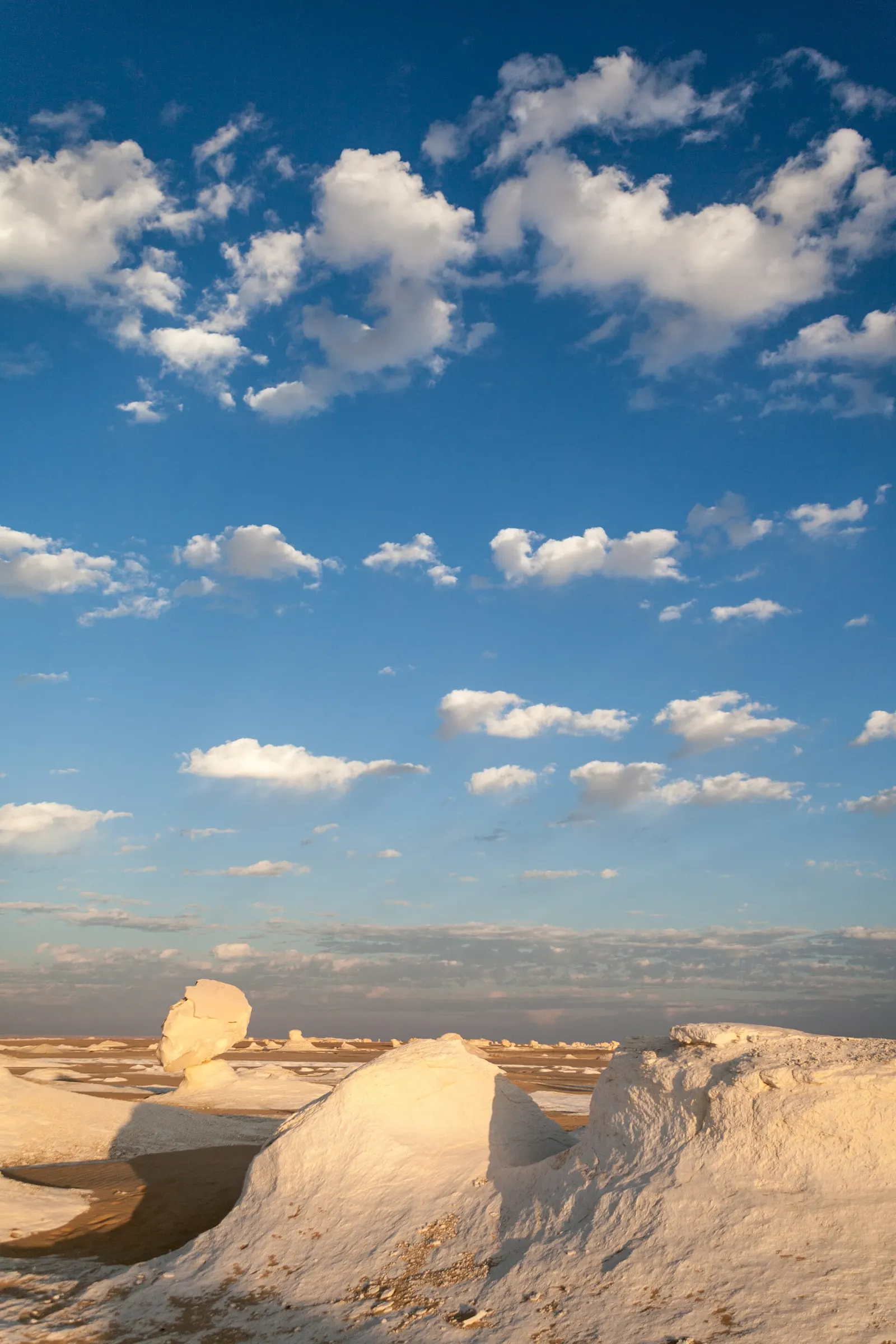
The short answer
In February the White Desert typically sees days of 21–23°C and nights of 4–8°C. Farafra's long-term averages are 22.4°C and 6.0°C, so nights are still cold but less sharp than January. It is one of the quietest good months, with few groups outside Egyptian school breaks.
Ask us on WhatsAppWhat February is like
Short answer: Days of 21–23°C, nights of 4–8°C (colder in the open desert), sunrise around 06:45 and sunset around 17:58 in mid-February.
February feels like the turning point of the desert winter. The days lengthen by more than half an hour over the month, and the midday sun has proper warmth again. The nights are still cold, especially in the first half, but by the end of the month the edge has gone. Wind is rare, the light is clear, and the groups that fill the desert at New Year have gone home.
| Typical in February | |
|---|---|
| Day high | 21–23°C |
| Night low | 4–8°C |
| Sunrise (15 February) | ~06:45 |
| Sunset (15 February) | ~17:58 |
| Daylight | about 11.2 hours |
| Rain | Practically none; well under 1 day a year |
Checked November 2026, from long-term climate normals:
| Station | Feb average high | Feb average low |
|---|---|---|
| Farafra (nearest to the chalk) | 22.4°C | 6.0°C |
| Bahariya (Bawiti) | 21.8°C | 6.6°C |
| Farafra, for comparison: January | 20.0°C | 4.1°C |
| Farafra, for comparison: March | 26.2°C | 9.2°C |
Town stations sit in the oasis; camps in the open desert lose heat faster, so plan for a few degrees below the station figure before dawn. Our weather and night temperatures guide puts a typical February night at camp at about 2–6°C.
Times are Egypt time for the White Desert, worked out for the 15th of the month. See sunrise and sunset and the sun and moon calendar for other dates.
Typical values for the White Desert and Bahariya, matching our month guides. Open desert nights can be a few degrees colder; individual days vary.
Early, mid and late February
Short answer: The month gains about 40 minutes of daylight. Early February is the colder, busier end; late February is milder and quieter.
At Farafra in 2027, the sun sets at 17:49 on 1 February and 18:08 on 28 February, and rises at 06:53 and 06:33 on the same days, according to timeanddate (checked 19 November 2026). Daylight grows from about 10 hours 56 minutes to about 11 hours 35 minutes. The formations lie north of Farafra, so times there differ by a minute or two.
| Early February (1–10) | Mid February (11–20) | Late February (21–28) | |
|---|---|---|---|
| Sunset, 2027 | about 17:49–17:56 | about 17:57–18:03 | about 18:03–18:08 |
| Nights | Coldest of the month, close to January | Cold, often mild by the fire | Softer before dawn |
| Crowds (2027) | University break to 4 February; Ramadan from about 9 February | Quiet; Ramadan | Quiet; Ramadan continues |
| Moon (2027) | New moon 6 February | Moon waxing | Full moon 21 February |
| Pack | As for January | As for January | One layer less; still a warm jacket |
The sunset ranges are read from the same timeanddate page. The night and crowd notes are our general guide, not forecasts.
Holidays and crowds
Short answer: One of the quietest good months, usually without major public holidays; Ramadan starts in February in 2027, and in 2028 Eid al-Fitr falls in late February.
In most years February has no major Egyptian public holidays, and it's one of the quietest good months; 2028 is the exception, when the Eid holiday at the end of the month will bring more domestic groups. timeanddate's Egypt holiday list for 2027 (checked 19 November 2026) shows Ramadan starting on 9 February (tentative) and Eid al-Fitr from 10 to 12 March. The 2028 list (checked 19 November 2026) shows Ramadan from about 29 January and Eid al-Fitr from 27 to 29 February, all tentative. Islamic dates depend on the moon sighting and can move by a day.
During Ramadan the crews still run trips, Bahariya is quieter by day and livelier after sunset, and your meals at camp are unaffected. Our Ramadan guide covers what changes in the oasis.
The other thing to watch is the student calendar. Egypt's Supreme Council of Universities has set the 2026–27 mid-year break from 23 January to 4 February 2027, with the second semester starting on 6 February (checked 19 November 2026). That can make the first days of February livelier than the rest of the month.
The sky in February
Short answer: Orion and Sirius in the evening, the summer Milky Way rising before dawn by the end of the month.
Orion and Sirius dominate the evening sky, and the stars are still crisp. Late in the month, early risers see the first of the summer Milky Way climbing before dawn. There's no major meteor shower, so the moon is the main thing to plan around.
| Year | New moon (darkest sky) | Full moon (chalk lit at night) |
|---|---|---|
| 2027 | 6 February | 21 February |
| 2028 | 25 February | 10 February |
timeanddate's moon phases for Cairo give the new moon at 17:56 on 6 February 2027 and the full moon at 01:23 on 21 February 2027, Egypt time (checked 19 November 2026). For 2028, the same source gives the full moon at 17:03 on 10 February and the new moon at 12:37 on 25 February (checked 19 November 2026).
Pick nights near the new moon for the darkest sky and the most stars. Pick the full moon if you want to see the formations glowing white at night; read stargazing and full-moon camping.
A small extra in 2027. On the night of 20–21 February there is a penumbral lunar eclipse, visible from Cairo with the moon above the horizon throughout. It peaks at about 01:13 Egypt time on 21 February, according to timeanddate's eclipse page (checked 19 November 2026). Be realistic: the moon passes only through Earth's outer shadow and dims slightly. It's a curiosity if you're awake, not a reason to book. The big event of 2027 is the total solar eclipse on 2 August; see the 2027 eclipse.
A typical overnight trip in February
Short answer: The day is timed around a sunset of about 17:58.
| Time | What happens |
|---|---|
| 06:00 to 06:30 | Pick-up from your hotel in Cairo or Giza |
| about 11:30 | Lunch in Bawiti, then into the 4x4 |
| about 13:30 | Black Desert, Crystal Mountain and Agabat |
| about 16:00 | Into the White Desert, walk among the formations |
| about 18:00 | Sunset; the crew lights the fire and starts dinner |
| from 19:00 | Dinner, tea by the fire, stars |
| about 06:45 | Sunrise over the chalk, then breakfast |
Times shift with traffic and the group's pace. Cairo to Bawiti is about 370 km by car, 4.5–5 hours from central Cairo with a stop; see the Cairo to Bahariya drive. A private trip lets you adjust everything; see the overnight trip.
In early February the margin before sunset is tighter, so the stops at the Black Desert and Crystal Mountain stay short. By late February the extra 20 minutes of evening light lets you linger in the formations before camp.
Day trip or overnight in February
Short answer: The overnight trip is the better choice in February. The night is cold but manageable, and a day trip reaches the chalk around midday, in flat light.
| Day trip from Cairo | Overnight camping | |
|---|---|---|
| Time in the White Desert | A few hours around midday | Afternoon, sunset, night and sunrise |
| Light | High sun, flat light | Low golden light at both ends of the day |
| Cold | You avoid the night | Nights of about 2–6°C at camp |
| Stars and moon | None | The main event |
| Price per person | About US$220–280 for two, private | About US$185–230 shared, US$360–460 private |
Prices are the 2026–27 ranges on our day trip and overnight trip pages and on cost. The White Desert has a government protected-area fee for foreign visitors, collected through the operator and shown as its own line in your quote. If you visit Bahariya's archaeological sites, the ticket is about EGP 400 for foreigners since 1 October 2026 (was about EGP 100); check on the day. The full comparison is in day trip or overnight.
February, January or March?
Short answer: February is the balance point: milder nights than January, calmer air and fewer crowds than March.
| January | February | March | |
|---|---|---|---|
| Farafra average high | 20.0°C | 22.4°C | 26.2°C |
| Farafra average low | 4.1°C | 6.0°C | 9.2°C |
| Night at camp | 0–4°C, frost possible | 2–6°C | 6–10°C |
| Wind and dust | Low; cold north wind some days | Low to moderate | Moderate; khamsin season begins |
| Crowds (2027) | Busy first week; university break from 23 January | Quiet after 4 February | Busy at Eid (about 10–12 March) |
Camp temperatures and wind ratings are from our weather and night temperatures guide. The honest trade-off: if you dislike the cold, March is easier at night but busier and windier; if you want the quietest desert, February wins. Compare in January and March.
What to pack for February
Short answer: Dress for the night temperature of 4–8°C, not just the daytime high.
Pack as for January, with one layer less if you travel at the end of the month:
- A warm jacket and a fleece for the evening
- Thermals and warm socks to sleep in
- A hat and light gloves
- A long-sleeved shirt and light trousers for the day
- Closed walking shoes for the Black Desert and Crystal Mountain
- Sun cream and sunglasses: the white ground reflects strongly
- A head torch and a power bank
- Lip balm and hand cream: the air is very dry
Cold drains batteries fast, so on February nights keep your phone, camera batteries and power bank inside your sleeping bag or jacket. See what to wear and the full packing list.
How February feels on the ground
Short answer: Warm, still middays for walking, a sharp drop in temperature within an hour of sunset, and a long, cold, very clear night.
The pattern is the same most days. By late morning on the drive south from Bawiti you'll be in a shirt, and the Black Desert climb is pleasant rather than punishing. In the White Desert, the afternoon is the best walking time of the year: warm enough to linger among the formations, not so hot that you look for shade. Then the sun drops behind the chalk and the temperature falls fast. What catches people out is how quickly: within an hour of sunset you'll want the fleece, the jacket and the hat.
That's when the fire matters. Our cook starts dinner as the light goes, and the evening happens around the fire: grilled chicken, rice, vegetables, then sweet tea. Guests are often surprised by how warm a fire and a windbreak make the camp even on a 5°C night. Desert foxes often come close after dinner, attracted by the smells; enjoy them, but don't feed them. By dawn the chalk is cold to the touch, and the first sun on the formations is worth the effort of getting out of the sleeping bag.
Sleeping warm: standard camp or more comfort
Short answer: The standard camp is fine in February if you sleep in thermals and a hat. If cold nights worry you, a comfort set-up or a second night in the oasis softens the trip.
The standard camp is a carpet windbreak hung from the 4x4s, mattresses and blankets, with the fire close by; sleeping bags and tents are on request. Read camping. If you feel the cold badly, the private comfort camping trip and our glamping guide explain the warmer set-ups. The exact kit on your date, including how warm our sleeping bags are rated and how many spare blankets come along, is something to ask us when you book.
Three things make more difference than any tent:
- Dry clothes at bedtime. Change into dry thermals and socks; the clothes you walked in hold sweat and chill you.
- Something under you. The cold ground draws heat away, so a thick mattress or an extra blanket underneath helps as much as a warmer bag.
- Warm up before bed. Sit by the fire or walk for a few minutes, then get into the bag warm.
Our advice for a February trip
Short answer: Go early in the week, pick your night by the moon, bring a proper sleeping bag or ask for ours, and allow two nights if you can.
- Avoid Friday nights if you want solitude. Egyptian weekend groups are smaller in February than in December, but Thursday and Friday nights are still the busiest.
- Choose your moon. The new moon on 6 February 2027 gives the darkest skies; the full moon around 21 February lights the chalk at night. Read full-moon camping.
- Sleep warm. Thermals, socks and a hat inside a sleeping bag rated to about 0°C. Sleeping bags and spare blankets are available on request; ask when you book, or bring your own.
- Two nights changes the trip. With a second night you can add Farafra's springs or the dunes without racing the sunset. See how many days, hot springs and Farafra Oasis.
- Ramadan 2027. If you travel after about 9 February, lunch in Bawiti may be at a hotel; nothing changes at camp.
- First days of February 2027. The university break runs to 4 February, so ask early if you want those dates.
The best trip for February
Short answer: Any trip works; February is ideal for the three-day loop or the Djara Cave trip.
Any of our trips works in February. It's a good month for a longer journey: a three-day loop through Bahariya, the White Desert and Farafra, or the four-day trip to Djara Cave, when the days are comfortable for walking and the nights quiet. Couples who want the formations to themselves often choose February. Compare all months in the best time to visit, or message us on WhatsApp with your dates and we'll tell you what to expect.
Questions people ask
Is February a good time to visit the White Desert?+
Yes, it's one of the best: comfortable days, cold but manageable nights, clear skies and fewer visitors than December or March.
Is the White Desert busy in February?+
No. Outside school breaks and holiday weekends it's one of the quietest months of the good season, and on private trips we always camp away from other groups.
What time is sunset in February?+
About 17:50 at the start of the month and just after 18:00 by the end, Egypt time, with sunrise moving from about 06:55 to 06:35.
How cold is the White Desert at night in February?+
Long-term averages for Farafra give February lows of about 6°C, and the open desert away from the oasis often feels colder, around 3–5°C before dawn early in the month. Sleep in thermals inside a good sleeping bag and keep a hat on.
Is Ramadan a problem for a February trip in 2027?+
No. Ramadan is expected to start around 9 February 2027 (the exact date depends on the moon sighting). We still run trips and you eat normally at camp. Bawiti is quieter by day and some cafés open only after sunset, so lunch may be at a hotel restaurant.
Are there sandstorms in February?+
They are uncommon. The hot, dusty khamsin wind typically blows from March to May. February can bring the odd breezy afternoon, which makes evenings feel colder, but full dust storms that force a camp change are rare this early.
Is early or late February better?+
Late February is a little milder at night and has about 40 minutes more daylight than 1 February. Early February has the coldest nights of the month and, in 2027, the tail end of Egypt's university mid-year break, which runs to 4 February. If you can choose, the second half of the month is easier camping.
Is there anything special in the sky in February 2027?+
The new moon on 6 February gives the darkest skies of the month. The full moon on 21 February comes with a penumbral lunar eclipse, peaking at about 01:13 Egypt time, but the moon only dims slightly, so most people won't notice it unless they know to look.
How much does a White Desert trip cost in February?+
The 2026–27 ranges on our cost page apply: roughly US$185–230 per person shared or US$360–460 private for an overnight trip from Cairo. The park fee is its own line in the quote, and Bahariya's antiquities ticket is extra if you visit the sites.
Should I do a day trip instead, to avoid the cold night?+
You can, but February nights are manageable with the right layers, and the night is what gives you the sunset, the stars and the sunrise. A day trip from Cairo is long and reaches the formations around the middle of the day.
Go with us
Trips that include this

2 days, 1 night
White Desert overnight camping trip from Cairo (2 days, 1 night)About US$185 to 230 shared · US$360 to 460 private, per person
Check dates
3 days, 2 nights
3-day White Desert tour: Bahariya, the White Desert and two nights outAbout US$495 to 660 per person for two travellers, private
Check dates