
The short answer
In January the White Desert typically sees days of 19–21°C and nights of 2–6°C. January is the coldest month in the White Desert, and also one of the clearest. Days are bright and pleasant for walking among the formations; nights regularly fall to a few degrees above freezing and can dip below it in the open desert.
Ask us on WhatsAppWhat January is like
Short answer: Days of 19–21°C, nights of 2–6°C, sunrise around 06:58 and sunset around 17:34 in mid-January.
January days are short and bright. The sun stays low, so the chalk keeps a warm, soft light for most of the afternoon, and the shadows between the formations are long and deep. The air is usually still and very dry. That's what makes the nights so clear, and so cold: once the sun drops behind the horizon at about half past five, the temperature falls fast. By midnight you're close to the overnight low, and on the coldest, stillest nights a light frost on your bedding at dawn is possible.
| Typical in January | |
|---|---|
| Day high | 19–21°C |
| Night low | 2–6°C |
| Sunrise (15 January) | ~06:58 |
| Sunset (15 January) | ~17:34 |
| Daylight | about 10.6 hours |
Times are Egypt time for the White Desert, worked out for the 15th of the month. See sunrise and sunset and the sun and moon calendar for other dates.
Typical values for the White Desert and Bahariya, matching our month guides. Open desert nights can be a few degrees colder; individual days vary.
Holidays and crowds
Short answer: Busy in the first week with New Year and Coptic Christmas on 7 January, then one of the quietest spells of the winter.
New Year's Day and the first week of January are still busy with visitors from Europe and Cairo. Coptic Christmas on 7 January is a public holiday in Egypt, so the long weekend around it brings Egyptian groups. 25 January is also a public holiday. After the second week, the desert goes quiet, and the last two weeks of January are among the calmest of the whole winter. In 2028, Ramadan is expected to begin at the very end of January; our Ramadan in the White Desert guide covers what changes.
Early, mid and late January
Short answer: The first week is the busiest, the middle two weeks are the quietest, and the last ten days gain a little light and warmth as the month turns towards February.
The days lengthen slowly through January. Sunrise barely moves, but sunset gets later by about 20 minutes over the month. At Farafra, the sun sets at 17:25 on 1 January and 17:48 on 31 January 2027, according to timeanddate (checked 19 November 2026). The formations sit north of Farafra, so times there differ by a minute or two.
| 1–9 January | 10–20 January | 21–31 January | |
|---|---|---|---|
| Sunset (Farafra, 2027) | about 17:25–17:32 | about 17:32–17:40 | about 17:40–17:48 |
| Daylight | about 10.5 hours | about 10.6 hours | about 10.7–10.9 hours |
| Nights at camp | Cold, frost possible | The coldest stretch | Still cold; slowly milder |
| Groups | New Year and Coptic Christmas | Few | Few, apart from the 25 January long weekend |
| Worth knowing | Quadrantids on 3–4 January 2027 | New moon on 7 January 2027 | Full moon on 22 January 2027 |
In 2027, 25 January (Revolution Day) is a Monday, and the official day off has been moved to Thursday 28 January, according to timeanddate's Egypt holiday list (checked 19 November 2026). Those dates can bring a short wave of Cairo groups. The same list shows Ramadan 2027 starting on 9 February (tentative), so January is the last full month before it. In 2028, Ramadan is expected to start around 29 January (checked 19 November 2026); Islamic dates depend on the moon sighting and may shift by a day.
The sky in January
Short answer: Crisp winter stars, Orion high in the evening and the Quadrantid meteors around 3 to 4 January.
This is the month of the winter constellations: Orion, the Pleiades, Sirius and Taurus are high in the evening, and the stars look sharp and steady in the cold air. The Quadrantid meteor shower peaks around 3 to 4 January, a short, intense peak that's best after midnight. The bright core of the Milky Way isn't visible in January; the fainter winter Milky Way runs through Orion and Gemini.
| Year | New moon (darkest sky) | Full moon (chalk lit at night) |
|---|---|---|
| 2027 | 7 January | 22 January |
| 2028 | 26 January | 12 January |
Pick nights near the new moon for the darkest sky and the most stars; we also check a light-pollution map when we choose the camp spot. Pick the full moon if you want to see the formations glowing white at night; read stargazing and full-moon camping.
A typical overnight trip in January
Short answer: The day is timed around a sunset of about 17:34.
| Time | What happens |
|---|---|
| 06:00 to 06:30 | Pick-up from your hotel in Cairo or Giza |
| about 11:30 | Lunch in Bawiti, then into the 4x4 |
| about 13:00 | Black Desert, Crystal Mountain and Agabat |
| about 15:30 | Into the White Desert, walk among the formations |
| about 17:35 | Sunset; the crew lights the fire and starts dinner |
| from 19:00 | Dinner, tea by the fire, stars |
| about 06:55 | Sunrise over the chalk, then breakfast |
Times shift with traffic and the group's pace. A private trip lets you adjust everything; see the overnight trip.
Day trip or overnight in January
Short answer: January days are among the shortest of the year, so a day trip leaves the chalk before sunset and drives home in the dark; stay a night if you can.
Cairo to Bawiti is about 370 km and 4.5–5 hours by car, from central Cairo with a stop. From Bawiti, the 4x4 still needs time to reach the chalk. On a day trip that means two or three hours among the formations around the middle of the day, then turning back. In January the sun sets at about half past five, so the return to Cairo is mostly after dark; the day trip page gives a usual return to your hotel of around 20:00 to 21:00. You lose the long shadows and the warm late light, which is the best of a winter day.
| Day trip in January | Overnight in January | |
|---|---|---|
| Time among the formations | About 2–3 hours, around midday | Afternoon, sunset, night and sunrise |
| Light | High, flatter winter sun | Low, warm light and long shadows |
| Cold | Not an issue; you leave before dark | A night of 2–6°C to plan for |
| Driving after dark | Most of the way home | None on day one |
| Price per person | About US$220–280 for two, private | About US$185–230 shared, US$360–460 private |
Prices are the ranges on our day trip and overnight trip pages. The full comparison is in day trip or overnight. The honest trade-off in January is simple: the day trip avoids the cold night, but the cold night is what buys you the sunset, the stars and the sunrise.
Cairo and the desert in January: not the same weather
Short answer: Cairo's January nights average about 10°C; the open desert is several degrees colder, so pack for camp, not for your Cairo hotel.
Many visitors spend a few days in Cairo before the desert and judge the cold from there. That is a mistake in January. The table puts the two side by side.
| Cairo (airport) | Farafra station | Open desert at camp | |
|---|---|---|---|
| Average high | about 19°C | about 20°C | Similar to Farafra |
| Average low | about 10°C | about 4°C | 0–4°C, frost possible |
| Where you spend the night | Indoors | Indoors | Outside or in a tent |
The Cairo figures are the Cairo International Airport normals for 1991–2020, as given on Wikipedia's Cairo page (checked 19 November 2026): a mean daily maximum of 18.9°C and minimum of 10.1°C. The Farafra and camp figures are from our weather and night temperatures guide. Days feel much the same in both places. The difference is the night: Cairo's evening is a light-jacket evening, while the desert's is a down-jacket one, and you spend it outdoors.
What to pack for January
Short answer: Dress for the night temperature of 2–6°C, not just the daytime high.
Pack for a cold night, not a cold day. Bring a down or synthetic jacket, a fleece, thermal leggings and top to sleep in, a wool hat, gloves and thick socks. In the daytime a long-sleeved shirt and a light layer are enough. A hot-water bottle is a luxury worth packing. See what to wear and the packing list; our camping in winter guide has the full sleep system.
Checked November 2026: January 2027 at a glance
Short answer: Expect about 20°C by day and 4°C at night on average, a Quadrantid peak before dawn on 4 January, a new moon on 7 January and a full moon on 22 January.
| January 2027 | |
|---|---|
| Average high / low (Farafra normals) | about 20°C / 4°C |
| Record low at Farafra | −3.3°C |
| Rain | effectively none |
| Quadrantids | peak about 05:25 Egypt time, 4 January |
| New moon | 7 January |
| Full moon | 22 January |
| Public holidays | 7 January (Coptic Christmas), 25 January |
Meteor timings are from the International Meteor Organization's 2027 calendar; climate figures are long-term normals. The Quadrantids' radiant sits lower in the sky at our latitude than in Europe, so rates are modest; think of it as a bonus on a starry night rather than a show to travel for. For the full season, see meteor showers and weather and night temperatures.
Our advice: what January guests tell us
Short answer: The cold before dawn surprises almost everyone, the quiet after the first week delights them, and nobody regrets getting up for sunrise.
What catches people out in January is how fast the temperature falls once the sun drops. At 16:30 you are walking in a shirt. By 18:00 you want a down jacket. The trick is to put the warm layer on before you feel cold, eat a hot dinner, and go to bed in dry clothes. Our crew keeps the fire going later in January, spare blankets and sleeping bags are on request, and we suggest a tent to almost everyone; tell us if you feel the cold and we'll plan for it. Guests also tell us the quiet weeks in mid and late January are when the desert feels most like their own: fewer cars on the tracks, no other camps in sight, and very still nights. If you can choose, come after 10 January. And if you would rather sleep warm, read the three-day itinerary with a lodge night.
Sleeping warm: tent, open sky or lodge
Short answer: Sleeping in the open is the classic way and gives you the stars all night, a tent keeps off wind and frost, and a lodge night in Bawiti removes the cold altogether.
| Under the stars | Tent at camp | Lodge night in Bawiti | |
|---|---|---|---|
| Warmth | Coldest; depends on bedding and the windbreak | A few degrees warmer, out of the wind | Indoors, with a proper bed |
| Stars | All night, from your bed | Step outside to see them | Not in the chalk |
| Sunrise in the formations | Yes | Yes | Only if you camp the other night |
| Best for | People who sleep warm | Most January guests | Families with young children, light sleepers |
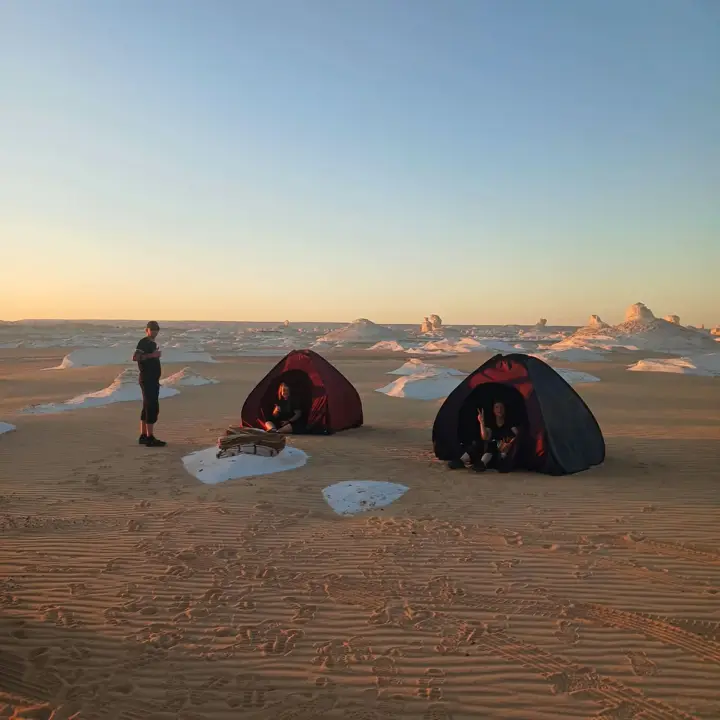
If you have a tent, you can also start the night outside and move in when it gets cold. Whatever you pick, the rules are the same: dry clothes for bed, a hat on, and tomorrow's layers inside the bag. What the crew can add on a January night, such as a tent, a sleeping bag, spare blankets, camp beds or duvets, and whether any of these cost extra, is something to ask us about when you book.
Photography in January
Short answer: January gives soft, low light in the chalk, long shadows all afternoon and clear, dry night skies; keep batteries warm.
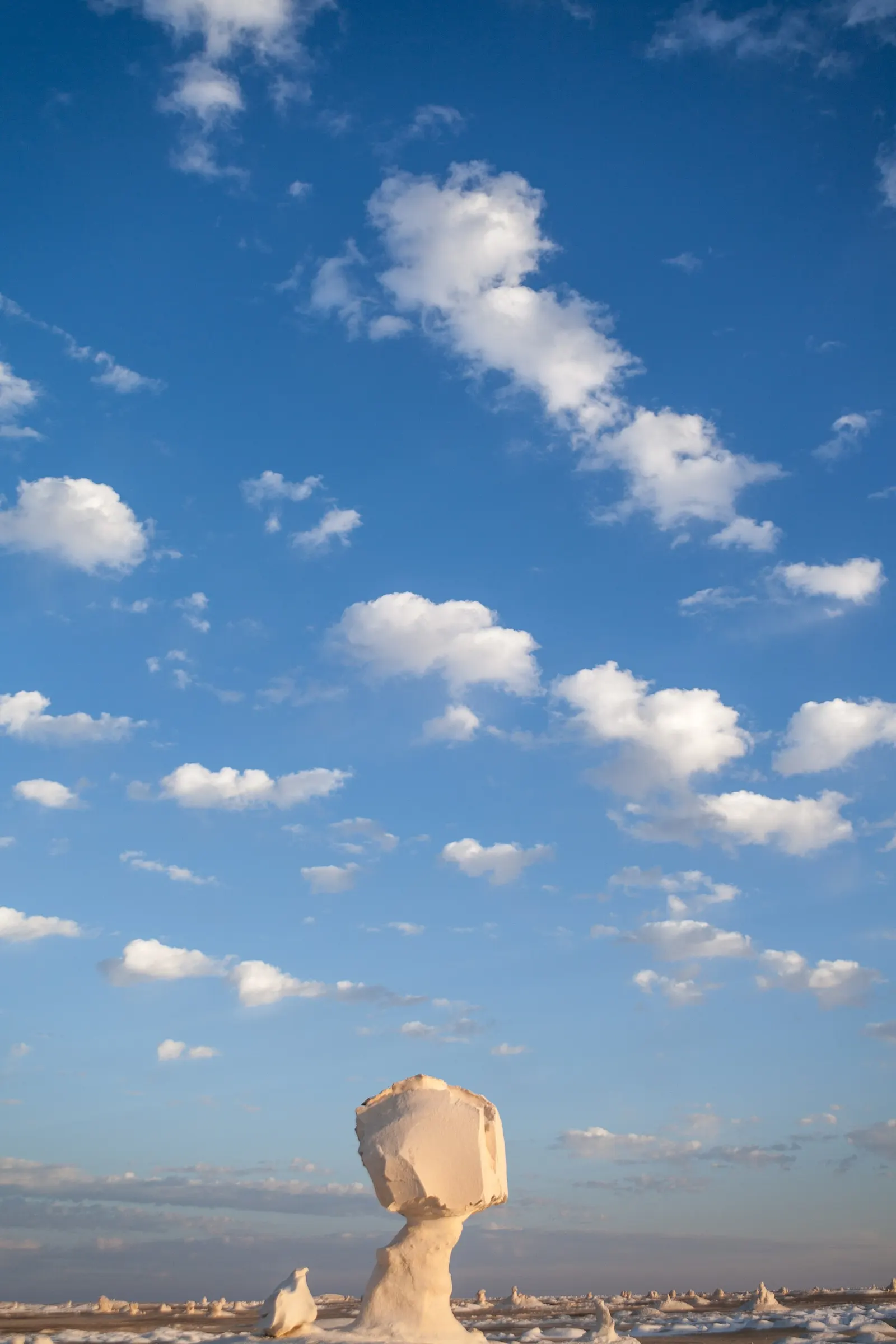
The low winter sun is kind to the formations. From mid-afternoon to sunset the chalk turns cream and pink, and the shadows show their shape. The very dry air makes night photographs sharp. Cold drains camera and phone batteries fast, so keep spares in an inside pocket and in your sleeping bag overnight. Lens condensation is common when you bring a cold camera into a warm tent; leave it in its bag for a while first. More tips are in our photography guide, and the Mushroom and Chicken is a favourite subject at sunrise.
The best trip for January
Short answer: Overnight camping with warm layers, or a three-day trip with a lodge night if you'd rather skip the cold.
An overnight camping trip is ideal in January, as long as you accept a cold night. A tent cuts the wind, and on request we add comfort extras such as camp beds and duvets. If you'd rather not sleep out in the cold, a three-day trip with a lodge night in Bahariya gives you sunset and sunrise in the chalk with a warm room in between. For families, read the White Desert with kids. Compare all months in the best time to visit, or message us on WhatsApp with your dates and we'll tell you what to expect.
Questions people ask
Is January too cold for the White Desert?+
No, as long as you pack properly. Nights are cold, around 2–6°C, but with our mattresses and blankets, a sleeping bag and tent (both on request) and warm layers, most people sleep well. Days are perfect for walking.
What time is sunset in the White Desert in January?+
About 17:25 at the start of the month and 17:45 by the end, Egypt time. Sunrise is close to 07:00 all month, so the night is long: about 13 and a half hours of darkness.
Does it ever freeze in the White Desert?+
Occasionally, on still, clear nights in January and early February, the open desert drops to around freezing just before dawn. Frost on tents and bedding is possible, which is why we provide thick blankets, offer sleeping bags and spare blankets on request, and recommend warm layers.
When are the Quadrantid meteors in January 2027?+
The peak is predicted for about 03:25 UTC on 4 January 2027, which is 05:25 in Egypt, before dawn. The best viewing is the second half of the night of 3–4 January. A thin waning crescent moon rises late, so the sky stays fairly dark, but the peak is brief.
Is January a good month for families?+
Yes for older children who are fine with a cold night, especially after the first week when the desert is quiet. For younger children, a three-day trip with a lodge night in Bawiti, or a tent with camp beds and duvets on request, takes the edge off the cold.
Is it windy in the White Desert in January?+
January is usually calm and very dry. A cold north wind sometimes blows for a day after a weather front, which is when the windbreak and a tent matter most. Dust storms belong mostly to spring, from March to May.
Is a White Desert day trip worth it in January?+
It works, but January days are short. Sunset is between about 17:25 and 17:48, so you leave the formations mid-afternoon, before the best light, and drive back to Cairo in the dark. If you have only one day, it works; if you can spare a night, the overnight trip gives you the sunset and sunrise the day trip misses.
How does January compare with December and February?+
January is the coldest of the three at night, with Farafra averaging about 4°C against about 6°C in December and February. It is quieter than late December, and February warms up a little each week. In 2027 Ramadan is expected to begin around 9 February, so January is the last month before it.
Will Cairo feel as cold as the desert?+
No. Cairo's January average low is about 10°C, so a city hotel evening needs only a light jacket. The desert night is several degrees colder and you spend it outside. Pack the warm layers you need for camp, even if Cairo feels mild.
Do the 25 January holidays make the desert busy?+
They can bring Egyptian groups for a long weekend. In 2027, 25 January is a Monday and the official day off has been moved to Thursday 28 January, so check both dates when you plan a quiet trip.
Go with us
Trips that include this
2 days, 1 night
White Desert overnight camping trip from Cairo (2 days, 1 night)About US$185 to 230 shared · US$360 to 460 private, per person
Check dates
3 days, 2 nights
3-day White Desert tour: Bahariya, the White Desert and two nights outAbout US$495 to 660 per person for two travellers, private
Check dates