
The short answer
Farafra is the smallest and quietest of Egypt's big oases, about 45 minutes south of the White Desert's main chalk fields and 180 km beyond Bawiti. Its town, Qasr Farafra, has artist Badr Abdel Moghny's mud-brick museum, a ruined medieval fortress and palm gardens, with the hot spring of Bir Sitta just outside. It fits a three-day loop.
Ask us on WhatsAppFarafra in brief
Short answer: A farming town of palms, wells and low houses on a wide desert plain, far quieter than Bahariya and the closest settlement to the White Desert.
Farafra sits in a broad depression on the road from Bahariya to Dakhla. It's around 180 km south of Bawiti and about 550 km from Cairo. For centuries it was a single fortified village, cut off by distance. Its ancient Egyptian name, Ta-iht, is usually translated "Land of the Cow" or "Land of Cattle". About 5,000 people were estimated to live in the oasis in 2002, most of them in the town (Wikipedia: Farafra). Since the 1960s, government schemes have drilled deep wells and settled new farming villages on reclaimed land, but the old town still feels like an outpost. The White Desert National Park starts just north of town, so Farafra is the natural base for the park's southern chalk fields. See White Desert National Park.
Farafra at a glance
| Where | New Valley Governorate, on the road between Bahariya and Dakhla |
| Size | About 980 km², the Western Desert's second largest depression but its smallest by population (Wikipedia: Farafra (checked 19 November 2026)) |
| People | About 5,000 (2002 estimate), mostly in Qasr Farafra |
| From Cairo | About 550 km by road via Bawiti |
| From Bawiti | About 180 km |
| To the main chalk fields | About 45 km north, around 45 minutes |
| To Mut (Dakhla) | Roughly 300 km south, about four hours |
Things to do in Farafra
Short answer: Badr's museum, the old fortress, a spring soak at Bir Sitta, a walk in the palm gardens and sunrise in the chalk.
| What | Why go | Time |
|---|---|---|
| Badr's Museum | Sculpture and painting of oasis life in a mud-brick house | 45 minutes |
| Qasr Farafra (old fortress) | Ruins of the medieval walled village | 30 minutes |
| Bir Sitta | Warm spring pool in open country | 1 hour, best at sunset |
| Ain el-Bilad and the palm gardens | The town's old spring and irrigated gardens | 45 minutes |
| White Desert at sunrise | The chalk fields 45 minutes north | 2 to 3 hours |
| Wadi el-Obeiyid (with permit) | Prehistoric rock art in a desert valley | Full day expedition |
Badr's Museum
Short answer: The town's highlight: a mud-brick house-museum full of the paintings and sculptures of local artist Badr Abdel Moghny.
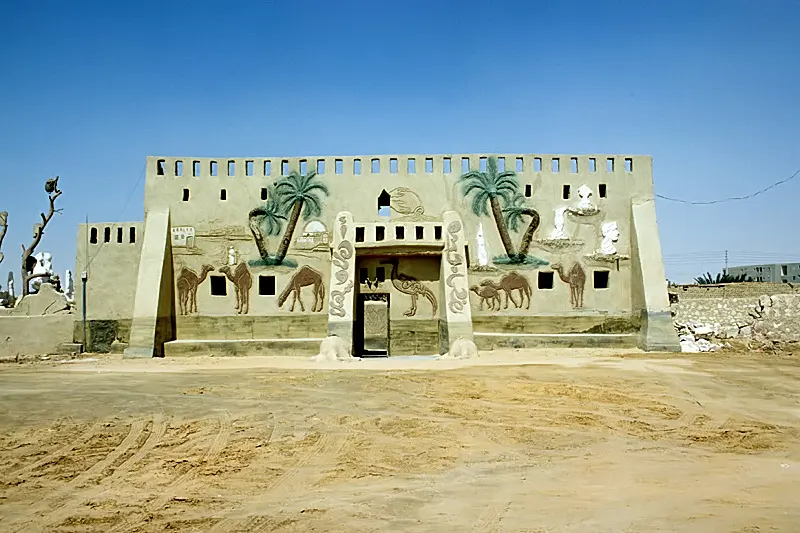
Badr Abdel Moghny grew up in Farafra and taught himself to paint and sculpt the life around him: farmers, women carrying water, camels, the desert itself. He built his own museum in the old quarter of town from mud brick, with courtyards and a sculpture garden. Inside, his canvases and clay and sand works fill the rooms, alongside traditional tools and clothes. The building is itself a fine piece of oasis architecture. If he or his family are there, they're happy to talk about it. A small entry fee is charged; we don't quote a figure because it changes, and opening times depend on who is at home, so ask us before you plan around it.
Qasr Farafra, the old fortress
Short answer: The crumbling mud-brick citadel that was once the whole town, where villagers stored grain and shut themselves in against raiders.
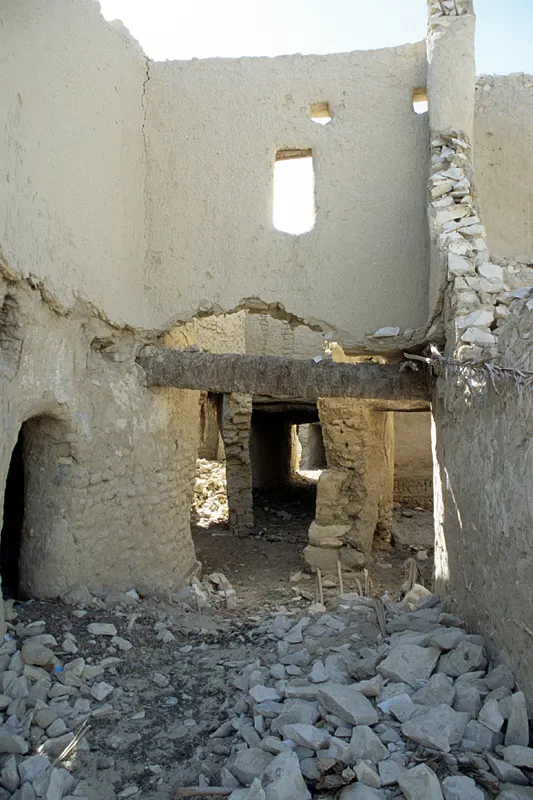
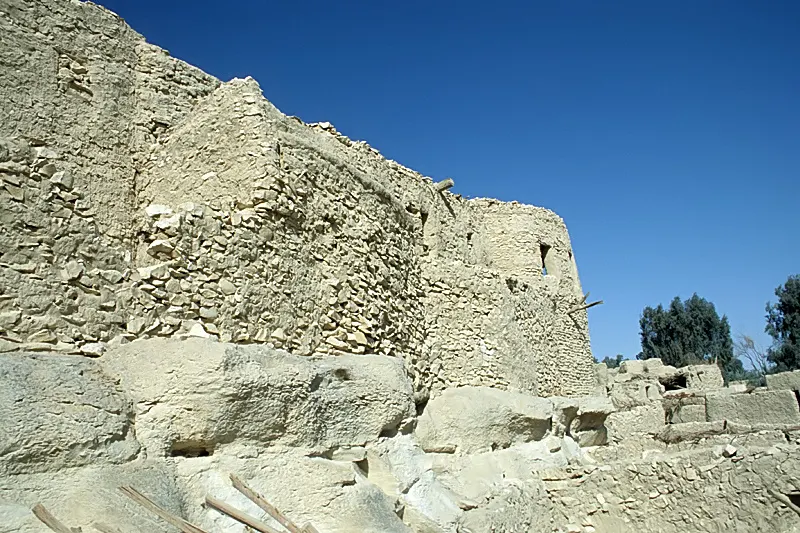
The town takes its name from its qasr, a roughly square compound of thick mud-brick walls on a low ridge at the edge of town, with a single gate, narrow alleys and storerooms. For generations the people of Farafra stored their harvests inside and sheltered there from raiders, drawing water from a cistern about 15 m deep (Wikivoyage: Farafra). It has long been uninhabited and is slowly collapsing. Families still keep some storerooms, so walk only around the edges, carefully. Sunset light on the walls and the palms below is beautiful.
A short history of Farafra
Short answer: People have lived here since prehistory; the pharaohs knew the oasis by the Middle Kingdom, the Romans tapped its springs, and until the 20th century it was one walled village.
Farafra has fewer monuments than Bahariya or Dakhla, but people lived here from the late Pleistocene. Egyptian texts know the oasis at least from the Middle Kingdom, and under the Ptolemies it was run as part of the Oxyrhynchite nome, the 19th province of Upper Egypt (Wikipedia: Farafra (checked 19 November 2026)).
North-west of town, the Roman-era spring of Ain Bishay (also written Ain Bisai) has the remains of Roman fortifications and graves (Wikivoyage: Farafra (checked 19 November 2026)).
For centuries Farafra was simply the qasr and its gardens, a long camel journey from anywhere. Few Europeans came: Gerhard Rohlfs' expedition was crossing towards Farafra in 1873 when it reached the Djara cave, and the geologist Hugh Beadnell surveyed the oasis in 1897. From the 1960s, deep wells and new farming villages changed that, and the town grew around the empty fortress.
Springs and palm gardens
Short answer: Bir Sitta is the famous hot pool; Ain el-Bilad was the old spring of the town; the palm gardens around it are made for slow walks.
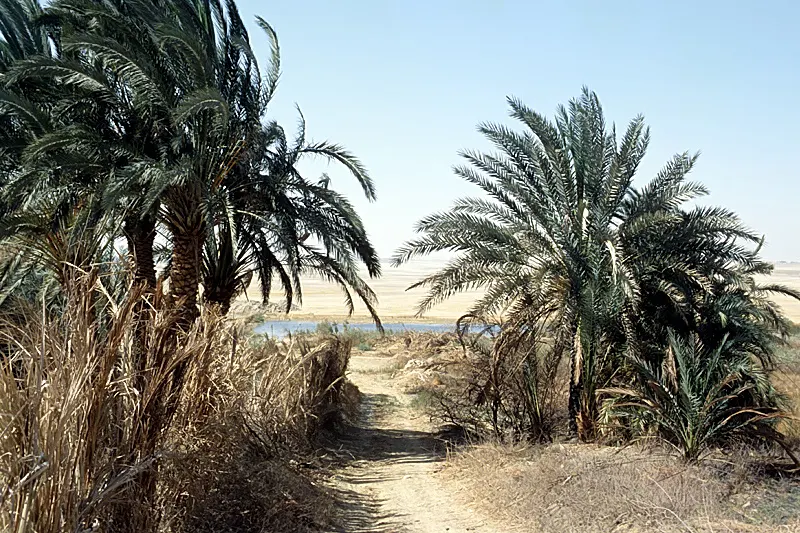
Bir Sitta ("Well Six") is a borehole about 6 km west of town. It pours hot, slightly sulphurous water, usually given as about 40°C, into a concrete pool in open country. A soak at sunset or under the stars is one of Farafra's pleasures; the Aqua Sun hotel stands beside it. Ain el-Bilad, south of the fortress, was the town's main spring for centuries until its flow dwindled in the mid-20th century; deep wells such as Bir Sitta now supply the town and its fields. The palm gardens around the old town are still worth a slow walk, on narrow paths between mud walls, date palms, olives and vegetable plots. For every spring in both oases, see hot springs.
Bir Sitta is not the only well. The oasis has more than 100 wells, many of them natural, and most feed the fields. Bir Sab'a ("Well Seven") and Bir Ithnain wa Ishrin ("Well 22") also run warm and slightly sulphurous, good for a swim, and a large lake, Abu Nus, lies about 15 km north of the edge of town (Wikipedia: Farafra (checked 19 November 2026)). Conditions change, so ask us which pool is best on your dates.
Spring etiquette
- Dress: a swimsuit with a T-shirt over it, or shorts and a T-shirt. Farafra is conservative.
- No soap or shampoo: the same water supplies the town and its fields.
- Sulphur: bring an old towel; the smell can linger.
- Facilities and privacy: the open pools are public; don't expect changing rooms. Ask us about a hotel pool if you prefer.
Beyond town: rock art and remote valleys
Short answer: With a permit and a specialist team, Farafra is the jumping-off point for Wadi el-Obeiyid, Ain Della and the deep desert.
West of Farafra lies some of the Western Desert's most remote country. Wadi el-Obeiyid, a long valley in the limestone plateau about 50 km north-west of town, has a cave with prehistoric rock carvings and traces of Neolithic camps. It needs an official permit, an escort and a sturdy 4x4. Further north-west, Ain Della, an isolated spring on the edge of the Great Sand Sea, was a staging post on old desert routes. Both sit in military zones and are only reached on deep desert expeditions arranged well in advance. The authorities decide on permits, so ask us early. Closer and easier, the villages of Sheikh Marzuq, about 30 km south, and Abu Minqar, about 70 km south by road, have farmland and older houses on the way to Dakhla.
Sunrise in the White Desert from Farafra
Short answer: Leave town before dawn and you'll be among the chalk towers as the sun rises, without camping.
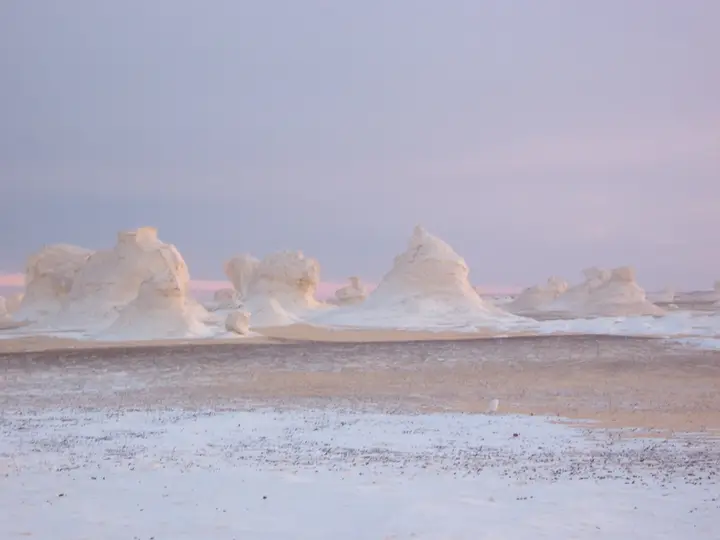
Because the main formations of the New White Desert lie less than an hour north, Farafra makes sunrise easy. Drive out in the dark, watch the light come up pink and gold over the Mushroom and Chicken and the towers around them, then return to the hotel for breakfast. It's the best way to see the chalk at its finest for travellers who would rather not sleep in a tent. If you would rather spend the night out there, our overnight from Farafra collects you in town in the afternoon. See sunrise and sunset and Old and New White Desert.
The trade-off: a very early alarm, a cold drive in the dark, and no campfire or night sky. If stars are the point, camp; see camping.
Farafra or Bahariya as your base
Short answer: Bahariya has more choice and is closer to Cairo; Farafra is quieter, closer to the main chalk fields and has the best open-air spring.
| Bahariya (Bawiti) | Farafra | |
|---|---|---|
| Distance from Cairo | About 370 km, 4.5–5 hours by car | About 550 km |
| To the main chalk fields | About two hours | About 45 minutes |
| Places to stay | The widest choice | A few simple family-run hotels |
| Sights in town | Golden Mummies, tombs, Black Desert nearby | Badr's Museum, the old qasr |
| Springs | Several, close to town | Bir Sitta in open country |
| Cash | ATMs, though not always working | A bank; don't count on a machine |
| Feel | A busy small town | A quiet farming town |
On a short trip, Bahariya usually wins: Farafra lies about 45 km beyond the main chalk fields, so a night there makes the drive home to Cairo longer. Farafra earns its place for a tent-free sunrise among the formations, or on the way south to Dakhla. See Bahariya Oasis and where to stay in Bahariya and Farafra.
When to go to Farafra
Short answer: October to April. Days at the Farafra weather station average 20°C in January and 39°C in July; nights fall to about 7°C in January.
These are averages from the Farafra weather station, from our best time to visit page.
| Season | Days in town | Nights in town | What it means |
|---|---|---|---|
| October to November | 26–32°C | 12–18°C | The easiest season; warm springs feel lovely in the evening |
| December to February | 20–22°C | 7–8°C | Crisp, clear and cold after dark; bring a warm layer for sunrise |
| March to April | 26–32°C | 10–15°C | Warm, with more wind in April |
| May to September | 35–39°C | 19–24°C | Hot; sightseeing early and late only |
Extremes are wider than the averages. NOAA normals for 1961 to 1990 give a record high of 47.8°C and a record low of −3.3°C, with about 2 mm of rain a year (Wikipedia: Farafra climate table (checked 19 November 2026)). For camp temperatures, see weather and night temperatures.
The 2027 eclipse. On 2 August 2027 Farafra town is outside the path, at about 99.7%, with no totality. For totality, head north into the White Desert; see total solar eclipse 2027.
Where to stay and eat
Short answer: A handful of simple family-run hotels, led by the Badawiya; you eat where you sleep, and the town is dry.
The Badawiya, Rahala Safari and Aqua Sun are the main hotels; we compare them in our guide to hotels in Farafra, and the wider choice is in where to stay in Bahariya and Farafra. Dinner is usually a set menu at your hotel, with a few simple cafés on the main road. Rooms are few, so book early for Christmas and New Year.
Getting to Farafra
Short answer: By road only: about 7 hours from Cairo via Bahariya, or 4 hours north from Dakhla.
Farafra is on the Western Desert highway. From Cairo it's about 550 km via Bawiti; Upper Egypt buses run from Cairo, taking about three hours beyond Bawiti, though schedules change (see bus to Bahariya). From Dakhla's main town, Mut, it's roughly 300 km north. Most visitors come on a private trip that adds Farafra to the White Desert, such as the Farafra version of our three-day trip, or on a longer oasis loop through Dakhla and Kharga. Foreign visitors need a permit and licensed guide for the desert areas, which we arrange; we need your passport details one day before the trip. See permits and safety.
Expect several police checkpoints between Cairo, Bawiti and Farafra; your driver shows the paperwork. Keep your passport with you.
Practical tips
Short answer: Bring cash, warm clothes in winter, modest dress, and patience: Farafra runs on oasis time.
- Cash: no reliable ATM; bring Egyptian pounds. See money and ATMs.
- Fuel: there's a station in town, and drivers fill up here before heading into the desert.
- Signal: good near town, fading about 20 km out.
- Health: a small hospital in town; serious cases go to Cairo or Dakhla.
- Shopping: wool hats, socks and gloves knitted from camel and sheep wool, sold in town and at hotels.
- Climate: very hot in summer, cold at night in winter. See best time to visit.
- Dress: shoulders and knees covered in town, for men and women. See what to wear.
- Photos: ask before photographing people, especially women, and never photograph checkpoints or police.
Add Farafra to your trip
Short answer: Our three-day trip can swap the Bawiti night for Farafra; private trips can add a night, a spring soak and a White Desert sunrise.
Message us on WhatsApp with "Farafra" and your dates. We'll suggest the best plan: three days through Bahariya, the Black Desert, Crystal Mountain and the White Desert with a night in Farafra, or a longer journey on to Dakhla and Kharga. Ask us what the Farafra night adds to the price, as it depends on the hotel and the extra driving.
Where it is
Schematic map, not to scale: positions are approximate, and the desert sites spread over many kilometres. The road runs about 180 km from Bawiti to Farafra; shaded areas show roughly where the black hills and the white chalk are.
Questions people ask
Is Farafra worth visiting?+
Yes, if you have three days or more. It's a calm, friendly town with a fine small museum, warm springs and the closest beds to the White Desert's heart. On a two-day trip from Cairo there usually isn't time.
How far is Farafra from the White Desert?+
The national park begins a short way north of town, and the main formations of the New White Desert are around 45 km north, about 45 minutes by road. Bawiti in Bahariya is about 180 km north of Farafra.
What is Bir Sitta?+
Farafra's best-known spring, 'Well Six', a borehole about 6 km west of town that pours hot, slightly sulphurous water into a concrete pool. It's a lovely place for a soak at sunset; wear a swimsuit with a T-shirt over it.
Can you stay in Farafra?+
Yes, there are a handful of simple, family-run hotels, the best known being the Badawiya with its domes and pool. See our guide to hotels in Farafra.
Is there an ATM in Farafra?+
Don't count on one. Bring enough Egyptian pounds from Cairo or Bawiti; hotels may change small amounts.
Should I base myself in Farafra or Bahariya?+
Bahariya for choice of lodges, food, antiquities and a shorter drive back to Cairo. Farafra for the quietest town, the Bir Sitta spring and a sunrise in the main chalk fields, about 45 minutes away, without camping. Many three-day trips sleep in Bahariya; ask us if you want the Farafra night instead.
Is Farafra in the path of the 2027 total solar eclipse?+
No. Farafra town is outside the path, with about 99.7% of the Sun covered on 2 August 2027 but no totality. Totality lasts 2 minutes 5 seconds at the Mushroom and Chicken in the White Desert, and longer further north.
Is Farafra safe to visit?+
The UK government's travel advice lists the oasis towns of Bahariya and Farafra, the White and Black Deserts and the road between Giza and Farafra as exceptions to its warning about the area west of the Nile Valley. Foreign visitors travel with a permit and a licensed guide, which we arrange.
Can I buy alcohol in Farafra?+
No. Farafra is entirely dry. If that matters to you, buy what you want in Cairo before you leave, and ask us whether your hotel is happy for you to bring it.
Go with us
Trips that include this
2 days, 1 night
White Desert overnight from Farafra: for travellers coming up from Luxor, Dakhla or the oasis roadAbout US$255 to 345 per person, private for two travellers
Check dates
3 days, 2 nights
3-day White Desert tour: Bahariya, the White Desert and two nights outAbout US$495 to 660 per person for two travellers, private
Check dates
4 days, 3 nights
4-day White Desert and Djara cave tripAbout US$605 to 825 per person for two travellers, private
Check dates