
The short answer
From Luxor there are two ways to the White Desert. The quick one is to fly or take the train to Cairo and join a trip from there. The memorable one is the oasis road west through Kharga, Dakhla and Farafra, roughly 800–900 km, reaching the White Desert from the south: allow five to seven days, with nights in the oases and the desert.
Ask us on WhatsAppMany of our guests reach us after a Nile cruise, sitting in Luxor with a few spare days and the White Desert on their list. Luxor and the White Desert are on opposite sides of Egypt's Western Desert, so the question is simply how much of the journey you want to see.
The two routes at a glance
Short answer: Via Cairo takes 3–4 days in total; the oasis road through Kharga, Dakhla and Farafra takes 5–7 days but turns the journey into the trip.
| Via Cairo | The oasis road | |
|---|---|---|
| Route | Luxor → Cairo → Bawiti → White Desert | Luxor → Kharga → Dakhla → Farafra → White Desert → Bawiti → Cairo |
| Distance by road | ~370 km Cairo–Bawiti, ~500 km Cairo–White Desert | ~800–900 km Luxor–White Desert, ~1,300–1,400 km Luxor–Cairo |
| Days needed | 3–4 including the transfer | 5–7 |
| What you see | The classic White Desert trip | Four oases, Roman forts, medieval towns, both deserts |
| Best for | Short on time | Road-trip lovers and repeat visitors to Egypt |
Option 1: via Cairo
Short answer: Fly to Cairo in about an hour or take the overnight sleeper train, then a two- or three-day trip from Cairo.
| Way | Time | Notes |
|---|---|---|
| Flight Luxor–Cairo | About 1 hour in the air | Several daily departures; fastest |
| Sleeper train | Roughly 9–10 hours overnight | Saves a hotel night, arrives early morning |
| Day train | Roughly 9–10 hours | Follows the Nile Valley |
| Private car | About 7–9 hours | Flexible but long |
Schedules, fares and train classes change, so check them close to your date. From Cairo, the overnight trip leaves early in the morning, so plan a night in Giza first unless you arrive by sleeper train at dawn. Pick-ups are flexible: we collect you from Cairo Airport, the station or your hotel, wherever you need us. A sample plan: day one, fly to Cairo; days two and three, the White Desert; day four, fly home or continue.
The drive from Cairo to Bawiti is about 370 km and takes 4.5–5 hours from central Cairo with a stop. From Cairo International Airport, allow about 5 to 5.5 hours. The formations themselves are further on, about 500 km from Cairo. See the Cairo to Bahariya drive for what the road is like.
Option 2: the oasis road
Short answer: Five to seven days west from Luxor through Kharga, Dakhla and Farafra, reaching the White Desert from the south and finishing through Bahariya in Cairo.
This is the Western Desert oasis loop run in reverse. You climb out of the Nile Valley to Kharga for the Temple of Hibis and Bagawat, spend a night or two in Dakhla for Al-Qasr, then cross to Farafra and camp in the White Desert before heading north to Bawiti and Cairo. The longest day is Dakhla to the White Desert, about 350 km, so we leave early to reach the chalk before sunset. Our guide to the Western Desert oasis loop has the full plan and lodges, and our Dakhla and Kharga guide covers the sights. If you are making your own way up the oasis road, we can meet you in Farafra instead, on our White Desert overnight from Farafra; see Farafra Oasis for the town.
A six-day plan, Luxor to Cairo
Short answer: Kharga on day one, two nights in Dakhla, a long drive to camp in the White Desert, then Bahariya and Cairo.
| Day | Leg | Approx. distance | Night |
|---|---|---|---|
| 1 | Luxor up the escarpment to Kharga | ~250–340 km, by the road taken | Kharga |
| 2 | Hibis and Bagawat in the morning, then on to Dakhla | ~190 km | Dakhla |
| 3 | Dakhla: Al-Qasr early, Deir el-Hagar, Balat | Short local drives | Dakhla |
| 4 | Dakhla to Farafra and into the White Desert | ~300–310 km plus ~40 km | Desert camp |
| 5 | North through the New White Desert and Agabat to Bawiti | ~180 km Farafra–Bawiti, plus park tracks | Bawiti |
| 6 | Bahariya's sights in the morning, then Cairo | ~370 km | Cairo |
By car, Kharga to Luxor takes about 3.5–5 hours depending on the road, Mut to Kharga about two and a half hours, and Farafra to Mut about four hours of open desert.
For five days, drop the spare day in Dakhla. For seven, add a slow day in Bawiti, or a second desert night with Crystal Mountain and the Black Desert by daylight.
What you see on the way
Short answer: A Saite temple and an early Christian cemetery in Kharga, a living mud-brick town in Dakhla, then the chalk.
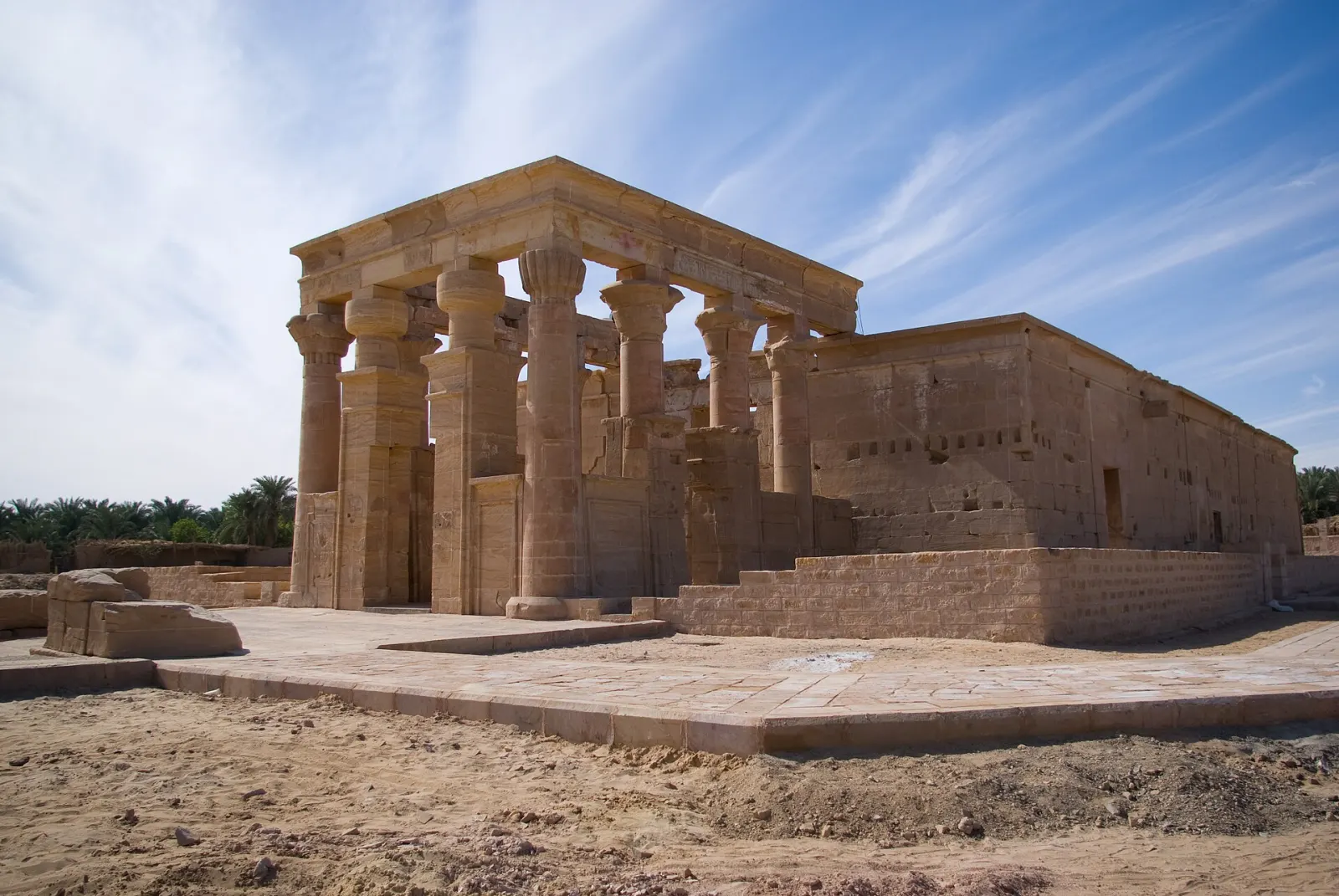
Kharga. The Temple of Hibis was founded by Psamtik II and largely built around 500 BC, and nearby El Bagawat was a Christian burial ground used from the 3rd century AD to the 7th, one of the earliest and best preserved anywhere. Kharga also sat on the Darb al-Arbain, the "Forty Days Road", a caravan route linking Sudan with Asyut, and the Romans built a chain of mud-brick forts to protect it (Wikipedia, checked 19 November 2026). Several still stand in open desert around the oasis.
Dakhla. Greener and quieter than Kharga. The medieval mud-brick town of Al-Qasr is best walked early, before the heat. The Roman temple of Deir el-Hagar and the Old Kingdom tombs at Balat fill the rest of a day.
Farafra. A small town with a hot spring outside it and the White Desert on its doorstep. See hot springs.
Bahariya. The museum and tombs on the way north; see Bahariya Oasis.
Which option fits your days
Short answer: Two to four spare days means via Cairo; six or more, and a liking for long drives, means the oasis road one way.
| Spare days after Luxor | Our suggestion |
|---|---|
| 2 | Fly to Cairo and take the overnight trip; tight but it works |
| 3–4 | Fly or sleeper train to Cairo, then a 3-day trip with Farafra and a second night |
| 5 | Via Cairo with two desert nights and a slow day in Bahariya, or a shortened oasis road skipping Kharga's sights |
| 6–8 | The oasis road one way, finishing in Cairo for your flight home |
If you're coming off a Nile cruise, count the days from the morning you disembark, not the day the cruise ends on paper. And if your flight home leaves from Luxor, you can still take the oasis road one way and fly back down from Cairo in about an hour, rather than driving the same road twice. For how the desert fits a wider trip, see how many days and Egypt itineraries with the White Desert.
The honest trade-offs
Short answer: Via Cairo is cheaper and simpler; the oasis road shows far more but costs more days, more driving and a car priced for the whole road.
| Via Cairo | The oasis road | |
|---|---|---|
| Time in a vehicle | One flight or train, then about 4.5–5 hours each way to Bawiti | Four to six hours most days, one long day of about 350 km |
| Cost | Our trips from Cairo, from about US$185–230 shared or US$360–460 private per person for one night | One quote for the whole road; ask us |
| Travel advice | Giza–Farafra road is on the UK's list of exceptions | UK exceptions cover the southern roads; Canada's advice does not |
| Comfort | Cairo hotels either side of the desert | Simple hotels in Kharga and Farafra, better lodges in Dakhla |
| Risk of a lost day | Low | Higher: one breakdown or slow checkpoint can shift the plan |
The three-day trip from Cairo with Farafra is about US$495–660 per person for two travellers, private. For a longer oasis road trip, the car with driver is quoted per car, so it suits two to four people better than a solo traveller. See what the trip costs for how group size moves the price.
Arriving from the south: what changes
Short answer: You enter the White Desert near Farafra, so the mushroom field comes first and the Black Desert last, the reverse of the usual order.
From Cairo, trips work south through the Black Desert, Crystal Mountain and Agabat before reaching the chalk. From Luxor you meet the Old White Desert first, about 40 km north of Qasr Farafra, and camp among the mushrooms that same evening. The next morning we drive north through the New White Desert and Agabat to Bawiti. It works well: the first evening in the desert is the one people remember most. See the Old and New White Desert and the Mushroom and Chicken.
Government travel advice on this route
Short answer: The UK lists the whole oasis road from Luxor to Bahariya as an exception to its Western Desert warning; Canada's advice is narrower.
Britain's Foreign Office advises against all but essential travel west of the Nile Valley, with exceptions. Its list includes the oasis towns of Bahariya, Farafra, Dakhla (Mut) and Kharga, the White and Black deserts, the road from Giza to Farafra, the road from Farafra through Dakhla to Kharga, and the roads from Kharga to Baris and from Baris to Luxor (gov.uk, checked 19 November 2026).
Canada asks travellers to avoid all travel to the Western Desert west of the Giza–Luxor–Aswan–Abu Simbel road, including Dakhla. Its exceptions are the White and Black deserts via the Oasis Road only, and Bahariya and Farafra via named roads (travel.gc.ca, checked 19 November 2026). So a Canadian traveller is better served by the route via Cairo. Other governments differ again, and insurers usually follow your own government's advice. See permits and safety.
The 2027 eclipse angle
Short answer: On 2 August 2027 both Luxor and Bawiti are inside the path of totality, so a summer trip can see it from either end.
The path of the total solar eclipse on 2 August 2027 crosses Egypt from west to east. Totality lasts 6 minutes 24 seconds in the northern Black Desert, close to the centre line, and 2 minutes 5 seconds at the Mushroom and Chicken in the White Desert, according to timeanddate's calculations for those points. Bawiti gets 6 minutes 19 seconds, and Luxor about 6 minutes 23 seconds. Farafra town is outside the path, at about 99.7%, and so is Kharga town. August days are around 37°C on both sides. Compare the sites on where to watch the eclipse in Egypt, or see our eclipse 2027 camp.
Practical notes
Short answer: Permits for foreigners, checkpoints with passport checks, driving days of four to six hours, and simple oasis hotels.
- Permits: foreigners need a permit for the White Desert, arranged in advance, and the oasis road has its own police checks; we handle the paperwork and need your passport details one day before the trip; see permits and safety.
- Checkpoints: expect several between Luxor and Bawiti. Keep your passport in the car, not in your bag in the boot.
- Driving days: four to six hours, with tea stops in small towns. Fuel stations are spread out; we fill up at every chance.
- Hotels: simple in Kharga, Dakhla and Farafra, with a few eco-lodges built from mud brick. The best lodges are in Dakhla and are small, so book ahead in winter.
- Cash: carry Egyptian pounds for two or three days. ATMs in Bawiti, Mut and Kharga can run dry; see money and ATMs.
- Phone signal: good in the towns, patchy on the open road, none at camp.
- Siwa: the UK government advises against all but essential travel on the desert road from Bahariya west to Siwa; we route via Cairo and don't use it (gov.uk). See White Desert vs Siwa.
Our advice
Short answer: With two or three spare days, go via Cairo; with a week and a love of road trips, take the oasis road one way and finish in Cairo.
Don't drive Luxor to the White Desert and back the same way. It doubles the long road and halves what you see. Instead, go one way through the oases and end in Cairo, where most international flights leave. If you're tight for time, fly to Cairo and give the desert two nights rather than one.
Two fees to know about. Bahariya's antiquities ticket is about EGP 400 for foreigners since 1 October 2026 (was about EGP 100); check on the day. White Desert National Park charges a government protected-area fee for foreign visitors, collected through the operator and shown as its own line in your quote. Message us with "from Luxor", your dates and how many days you have, and we'll send a route and one price.
Questions people ask
How far is the White Desert from Luxor?+
By the oasis road it's roughly 800–900 km to the chalk, adding up the legs Luxor–Kharga (~250–340 km, depending on the road), Kharga–Dakhla (~190 km), Dakhla–Farafra (~300–310 km) and Farafra–White Desert (~40 km). Via Cairo it's further by road, but much quicker if you fly to Cairo.
Can I do the White Desert as a day trip from Luxor?+
No. Even the shortest road route is over 800 km each way. From Luxor you either fly or take the train to Cairo and do at least an overnight trip from there, or you commit to a multi-day road journey through the oases.
Do foreigners need permits for the Luxor–Kharga–Dakhla–Farafra road?+
The White Desert needs a permit arranged in advance, and on the oasis road you pass several police checkpoints where passports are checked. The FCDO advises travelling with a licensed guide in the Western Desert. We arrange the paperwork for the route and need your passport details one day before the trip.
Is it better to start in Luxor or in Cairo?+
It depends on the rest of your trip. If you end a Nile cruise in Luxor, starting there saves backtracking. If you fly home from Cairo, starting in Luxor and finishing in Cairo makes a neat one-way journey with no repeated road.
Can I continue from the White Desert to Siwa?+
Not directly. The UK government advises against all but essential travel on the desert road from Bahariya west to Siwa; we route via Cairo and don't use it. Plan at least two extra days for the transfer, or see our Siwa and White Desert trip.
What is the best month for the oasis road from Luxor?+
October to April. Midday in Kharga and Dakhla tops 37°C from June to August, and long driving days in that heat are tiring. December and January are pleasant by day but cold at night in the desert, with lows around 4°C.
Is there a bus from Luxor to the White Desert?+
No. No public service runs on the direct road from Luxor to Kharga. By public transport you would go up the Nile to Assiut, west to Kharga, then on to Dakhla and Farafra, which takes three or four days before you see any chalk. A hired car or a flight to Cairo is the practical choice.
Does UK travel advice cover the road from Luxor to Kharga?+
Yes. In November 2026 the FCDO's exceptions to its Western Desert warning include the oasis towns of Kharga, Dakhla (Mut), Farafra and Bahariya, and the roads from Baris to Luxor, Kharga to Baris and Farafra through Dakhla to Kharga. Canada's advice is stricter and does not list those southern roads. Read your own government's advice and check your insurer follows it.
Can I do the oasis road the other way, from Cairo and ending in Luxor?+
Yes. The route works just as well north to south. You see the Black Desert, Crystal Mountain and Agabat first, camp in the White Desert, then drive on through Farafra, Dakhla and Kharga to Luxor. It suits travellers who want to finish with a Nile cruise.
How much does the oasis road from Luxor cost?+
It depends on group size, nights and lodges, so we price it as one quote. The long legs south of Farafra use a car with driver priced per car, not per person, so the cost per head falls as the group grows. Send us your dates and group size and ask us for a quote.
Go with us
Trips that include this

3 days, 2 nights
3-day White Desert tour: Bahariya, the White Desert and two nights outAbout US$495 to 660 per person for two travellers, private
Check dates