
The short answer
For the 2 August 2027 eclipse, Luxor gets about 6 minutes 23 seconds of totality, Bahariya 6 minutes 19 seconds and the nearby Black Desert up to 6 minutes 24 seconds, Siwa town 5 minutes 33 seconds, and Kharga town none at all. Luxor is easiest to reach and busiest; Bahariya is the closest desert site to Cairo with almost the longest totality.
Ask us on WhatsAppBahariya, Farafra and Luxor in one table
Short answer: The Black Desert and Luxor get the most totality, Bawiti a few seconds less, Siwa town about 45 seconds less, and both Farafra and Kharga towns none.
The 2 August 2027 shadow is a band about 255 to 258 km wide, running from the Libyan border by Siwa across Bahariya to the Nile at Luxor and on to the Red Sea. Being in the band means totality; being outside it, even at 99%, means none. We run trips from Bahariya, so this page looks at the choice from here: our oasis and the Black Desert, against Luxor, Siwa and Kharga, the other names that keep coming up. For the Siwa end of the track, and for Sohag, Asyut and Marsa Matruh, our sister site's 2027 eclipse in Egypt guide has the wider table.
Times are Egypt summer time (UTC+3), on the assumption that Egypt still uses summer time in 2027. Checked 15 November 2026.
| Where | Totality lasts | Totality, start–end | Share of Sun covered | Partial eclipse | Sun altitude |
|---|---|---|---|---|---|
| Bawiti, Bahariya | 6 min 19 s | 12:50:20–12:56:39 | 100% | 11:29:40–14:15:30 | 78.7° |
| Black Desert, north (28.18, 28.73), by the road south of Bawiti | 6 min 24 s | 12:50:13–12:56:37 | 100% | about 11:29–14:16 | about 79° |
| Mushroom and Chicken, White Desert (27.255, 28.13) | 2 min 05 s | 12:52:25–12:54:30 | 100% | 11:29:04–14:16:07 | |
| Farafra town (27.058, 27.970) | none (maximum 12:53:24) | — | about 99.7% | 11:28:57–14:16:10 | |
| Luxor | 6 min 23 s | 13:02:05–13:08:28 | 100% | 11:40:20–14:26:30 | 81.8° |
| Siwa town | 5 min 33 s | 12:42:34–12:48:07 | 100% | 11:22:17–14:08:03 | 75.5° |
| Kharga town | none (maximum 13:01:19) | — | about 99.5% | 11:36:09–14:23:27 | 82.3° |
Where the numbers come from: Eclipseando's town calculations for Bawiti, Luxor, Siwa and Kharga. For Siwa, timeanddate's "Siwa Oasis" point gives 5 min 31 s, two seconds less. For Kharga, timeanddate's calculation agrees on a partial eclipse only, magnitude 0.991. The Black Desert, Mushroom and Chicken and Farafra rows are timeanddate's calculations for the points shown: Black Desert, Mushroom and Chicken and Farafra, cross-checked with Xavier Jubier's 2027 calculator, which gives 6 min 22.3 s, 2 min 8.5 s and 99.7% for the same points. NASA's path table by Fred Espenak gives 6 min 22.1 s to 6 min 22.6 s on the centre line near Bahariya. Farafra's 99.7% is for the town; Eclipseando's 99.2% is for a point about 25 km south-west of it. Our 2027 eclipse guide has every stop from Bawiti to Farafra. All values are for a single point and drift by a few seconds as you move; different calculators can be up to about 15 seconds apart.
Two points stand out from Bahariya. Inside the band the gaps are tiny: Bawiti, the northern Black Desert and Luxor are all within about five seconds. And because the shadow travels north-west to south-east, Siwa goes dark nearly 20 minutes before Luxor with a slightly lower Sun, while we sit in between.
Bahariya and the Black Desert
Short answer: Almost the longest totality in Egypt, the closest desert site to Cairo, an empty horizon and the White Desert for the nights around it.
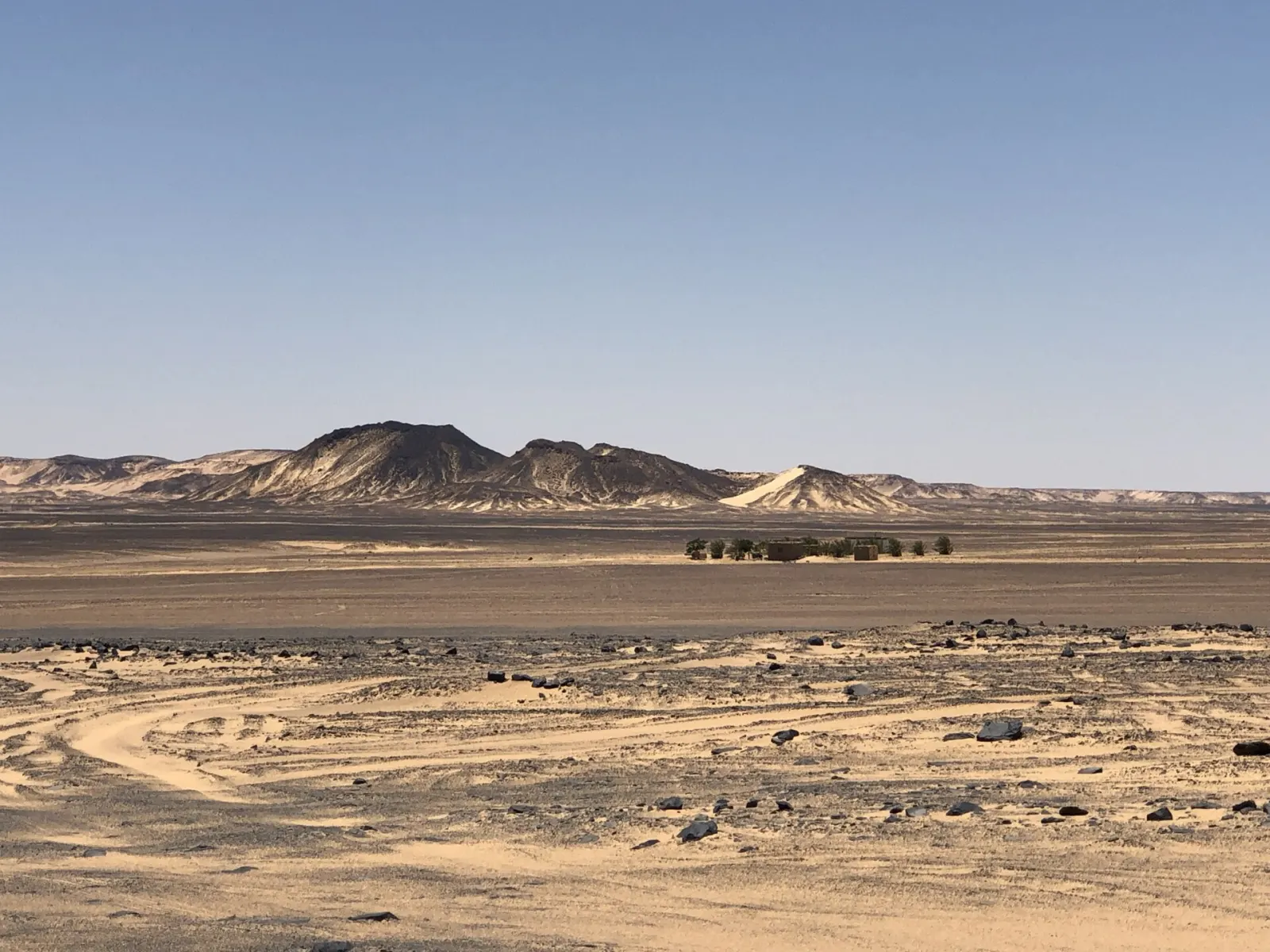
Bawiti, the oasis's main town, lies about 21 km off the centre line, which runs through the northern Black Desert along the road just south of town. There timeanddate gives 6 minutes 24 seconds and NASA's centre-line table about 6 minutes 22 seconds, close to the longest anywhere on the track. From Cairo it is roughly 370 km by road (Wikipedia), four and a half to five hours including a stop.
What you trade is comfort and room stock. Bahariya has small hotels and lodges, not resorts, and a limited number of licensed 4x4s and drivers for the desert. That's also its strength: the crowds will be far smaller than in the Nile Valley, and the Black Desert plain gives a clear view of the shadow coming in over open ground. The night before falls at new moon, so a night camped in the White Desert first is as dark as the sky gets. Eclipse groups are already on their way: a Korean astronomy society is running a week-long trip through Bahariya and the Black and White Deserts, according to an report Ahram Online published 27 October 2026.
South of us the White Desert formations remain in the band but close to its edge, so the further you drive, the shorter totality gets: 4 minutes 38 seconds at Agabat and 2 minutes 5 seconds at the Mushroom and Chicken. Farafra town falls just outside. The place-by-place table from Bawiti to Farafra is in our 2027 eclipse guide; the Black Desert and Bahariya guides cover the area itself.
Luxor
Short answer: About 6 minutes 23 seconds, the easiest access and the most beds, but the biggest crowds.
An hour's flight from Cairo, Luxor has hotels and Nile cruise boats in quantity, and its temples fill the days either side. Several organised eclipse programmes in that same Ahram Online report pair Luxor with a Nile cruise. It is the largest city in the band and has the most famous sights, so expect the busiest roads and the fullest hotels in eclipse week.
Two cautions. Luxor is the hottest of the four (see the heat table below). And if you're on a cruise, check that the boat is moored in Luxor or further north on 2 August, since Aswan is outside the band. Totality in Luxor and a night in the desert can both fit into one trip; see the White Desert from Luxor.
Siwa
Short answer: 5 minutes 33 seconds in town, more near the centre line, the quietest setting and the longest journey.
Siwa oasis is entirely in the band, but the town lies in its southern half, roughly 65 km from the centre line, which costs it about 45 seconds against Bawiti. Heading north-east towards Marsa Matruh takes you near the line, where NASA gives about 6 minutes 19 to 20 seconds. The trip from Cairo is a full day on the road, usually 9 to 10 hours via the coast, and Matruh itself lies outside the band.
What Siwa offers in return is a small, traditional oasis of mud-brick lodges and springs on the edge of the Great Sand Sea. Our sister site, linked above, covers Siwa's contact times and viewing spots. To compare the two oases as places to stay, see White Desert or Siwa.
Kharga
Short answer: Kharga town is outside the path. Visit it that week, but don't stand there on eclipse day.
Kharga appears on plenty of eclipse lists, yet the town only gets a deep partial eclipse, about 99.5% at 13:01, which leaves full daylight and no corona. Reading the southern limit in the NASA table, we place the shadow's edge roughly 30 km north-east of town. Eclipseando and timeanddate agree on a partial eclipse only, magnitude 0.991.
For a long totality from Kharga you would have to drive north up the Asyut road, well beyond the edge; the long totalities are in the Nile Valley around Asyut and Sohag. The bus from Asyut to Kharga takes 3 to 4 hours, and Kharga's airport has no scheduled flights (Wikivoyage). Kharga and Dakhla are worth seeing in their own right; see Dakhla and Kharga.
Heat, access and crowds side by side
Short answer: Every site is very hot at midday in early August. Bahariya is the coolest of the four on average and the closest desert site to Cairo.
| Bahariya | Luxor | Siwa | Kharga | |
|---|---|---|---|---|
| August mean high | 36.8°C | 41.2°C | 40.4°C | 41.2°C |
| August mean low | 21.4°C | 25.6°C | 24.6°C | 25.2°C |
| Record August high | not published | 47.0°C | 46.5°C | 46.8°C |
| From Cairo | About 370 km by road, 4.5 to 5 hours | About 1 hour by air | About 9 to 10 hours by road | By road via Asyut; bus from Asyut 3 to 4 hours |
| Beds | Small hotels, lodges and desert camps | Large hotels and cruise ships | Eco-lodges and small hotels | Small town hotels |
| Crowd outlook | Small groups | Busiest; several cruise eclipse programmes | Small groups | Few eclipse visitors (outside the path) |
Climate sources: Bahariya (FAO CLIMWAT, 1971 to 2000), Luxor (1991 to 2020), Siwa (NOAA and WMO 1991 to 2020) and Kharga (2000 to 2020). Bahariya's figures cover an older period, so the real gap is probably smaller than the table suggests. Treat it as a few degrees cooler, not a different climate.
The Sun stands 75 to 82 degrees high at these sites, so natural shade hardly exists at any of them. Wherever you go, sort out real shade at your viewing spot, carry more water than seems necessary and keep an air-conditioned room nearby. Read the White Desert in August and health and first aid.
Weather odds
Short answer: Excellent everywhere in the Egyptian path. Heat is a bigger risk than cloud.
Jay Anderson's Eclipsophile weather study for 2027 found stretches of the Western Desert track with no cloud whatever on the eclipse date across 23 years of August satellite images. He singles out Bahariya and Siwa as the sites where cloud is close to impossible and dust storms are comparatively rare. Around Luxor the main risk is thin, high cirrus that can soften photographs of the corona. Mean August dust haze along the centre line is low, with an aerosol optical depth near 0.3 all the way to Luxor. For Luxor on 2 August the study's 17-year average high is 42.0°C.
Which we'd choose
Short answer: Luxor if you want temples and easy access; Bahariya and the Black Desert if you want the eclipse in open desert with a fraction of the crowds.
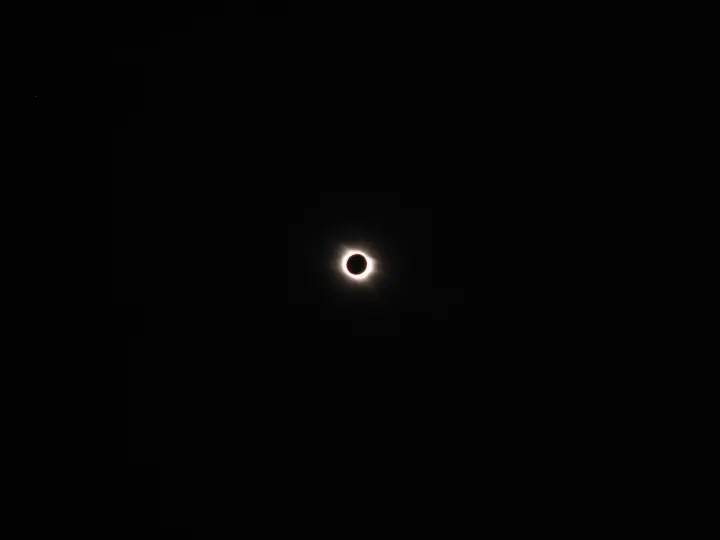
If the eclipse is the main reason for the trip and you'd rather watch from open desert than a city rooftop, we'd go to the Black Desert: up to about 6 minutes 24 seconds, a wide horizon and a moonless camp night in the White Desert beforehand. That's what our eclipse 2027 camp does, from 31 July to 2 August 2027, with certified glasses, shade and a heat plan included. Bawiti is the comfortable second choice for a hotel room nearby.
Choose Luxor if you want the temples and the shortest journey and don't mind sharing the eclipse with what will probably be the largest crowds in the country. Choose Siwa if you have more days and want the quietest oasis setting. Leave Kharga for another day of the trip.
Wherever you go, wear eclipse glasses certified to ISO 12312-2 for every minute of the partial phases, and take them off only once the Sun is completely covered. Be in place the night before: don't plan to drive from Cairo on eclipse morning.
Questions people ask
Which place in Egypt gets the longest totality in 2027?+
The record for the whole track, 6 minutes 23.2 seconds, sits on the centre line in the Nile Valley between Asyut and Sohag. Within seconds of it come Luxor at about 6 minutes 23 seconds, the northern Black Desert at 6 minutes 22 to 24 seconds depending on the calculator, and Bawiti at 6 minutes 19 seconds. Being inside the shadow matters; a handful of seconds does not.
Is Farafra in the path of totality?+
No. Qasr Farafra town lies about 20 km outside the southern edge of the path. It gets a deep partial eclipse, with about 99.7% of the Sun covered at 12:53, but no totality and no corona. The nearest totality is to the north-east, on the road through the White Desert: about 2 minutes at the Mushroom and Chicken, and longer the further north you go.
Is Kharga Oasis in the path of totality?+
Kharga town is not. It lies just beyond the southern edge, where roughly 99.5% of the Sun is covered: still daylight, no corona. Totality means driving north on the road to Asyut, well inside the shadow if you want it to last.
Bahariya or Luxor for the eclipse?+
Luxor gives about four seconds more totality, a one-hour flight from Cairo and the temples, but it is likely to be the busiest eclipse site in Egypt. Bahariya is about 370 km by road from Cairo, much quieter, with a horizon of open desert and the White Desert for the nights before and after.
Bahariya or Siwa for the eclipse?+
Bawiti has 6 minutes 19 seconds of totality; Siwa town has 5 minutes 33 seconds and is roughly twice the drive from Cairo. Siwa can win back most of the gap from a site near the centre line north-east of the oasis. Weather odds are outstanding at both.
What time is the eclipse in Bahariya and the rest of Egypt?+
In Bawiti totality runs from 12:50:20. The west of the country goes dark earlier and the Nile Valley later: 12:42:34 in Siwa town and 13:02:05 in Luxor, Egypt summer time (UTC+3). Around each of those, the partial eclipse lasts about 80 minutes on either side.
Is Cairo in the path of totality?+
No. Cairo gets a partial eclipse with about 94.7% of the Sun covered at 12:55. That is a strange, dimmed light but not totality. You have to travel south-west to Bahariya or south to the Nile Valley to stand in the shadow.
Go with us
Trips that include this
3 days, 2 nights
Eclipse 2027 camp: White Desert nights and totality in the Black Desert (3 days, 2 nights)On request (depends on group size, vehicles and lodge or camp)
Check dates
3 days, 2 nights
3-day White Desert tour: Bahariya, the White Desert and two nights outAbout US$495 to 660 per person for two travellers, private
Check dates
2 or 3 days
Private White Desert camping in comfortOn request (depends on group size and nights)
Check dates