
The short answer
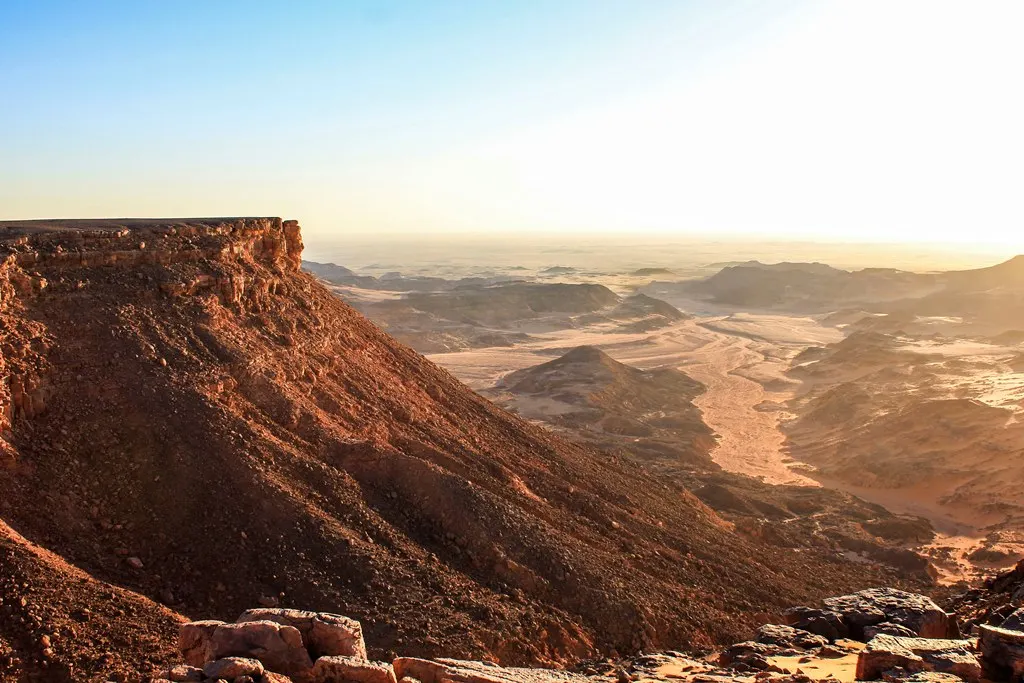
The Gilf Kebir is a sandstone plateau of about 7,770 km² in Egypt's far south-west, roughly 490 km from the White Desert in a straight line. It holds the Cave of Swimmers, recorded by László Almásy in 1933. Reaching it means an expedition of about two weeks with military permits, several 4x4s and everything carried in. It is not a weekend trip.
Ask us on WhatsAppThe Gilf Kebir is about 490 km south-west of the White Desert as the crow flies, and a world away in effort. It is a sandstone plateau of roughly 7,770 km² near the point where Egypt, Libya and Sudan meet, and it is best known for painted rock shelters, above all the Cave of Swimmers. A White Desert night takes two days from Cairo. A Gilf Kebir expedition takes about two weeks.
What's there
Short answer: A raised sandstone plateau cut by wadis, with prehistoric paintings in its rock shelters and the Uweinat mountains to the south.
The plateau rises about 300 m above the desert floor around it, and its highest point is a little over 1,000 m, according to Wikipedia's Gilf Kebir article (checked 21 November 2026). Wadis cut deep into its edges, and the Uweinat range lies at its southern end, running across into Libya and Sudan. The name, "great barrier" in Arabic, was given in 1925 by Prince Kamal el Dine Hussein, because the plateau had no local name.
This is one of the driest places on Earth. Average rainfall barely reaches 0.1 mm a year, and the area is classed as extremely hyper-arid. That is why the paintings have survived, and also why anyone who goes there must bring every litre of water with them.
Key facts at a glance
Short answer: About 7,770 km² of plateau inside a 48,524 km² national park declared in 2007.
Every figure below was checked on 21 November 2026 against the source in its row.
| Fact | Figure | Source |
|---|---|---|
| Plateau area | About 7,770 km² | Wikipedia: Gilf Kebir |
| Height above the plain | About 300 m | Wikipedia: Gilf Kebir |
| National park area | 48,524 km², New Valley Governorate | EEAA protectorate table |
| Legal basis | Prime Minister's Decree No. 10 of 2007 | EEAA protectorate table |
| Rainfall | Hardly reaching 0.1 mm a year | Wikipedia: Gilf Kebir |
| Cave of Swimmers recorded | October 1933, by László Almásy | Wikipedia: Cave of Swimmers |
| Age of the swimmer paintings | Estimated around 8000 BC | Wikipedia: Cave of Swimmers |
| Cave of the Beasts found | 2002, or January 2003 | Wikipedia: Cave of Beasts gives 2002; Wikipedia: Gilf Kebir gives January 2003 |
| Straight-line distance from the White Desert | About 490 km | Our calculation from the Wikipedia coordinates for the plateau and for White Desert National Park |
For comparison, White Desert National Park covers about 3,133.5 km² of New Valley Governorate under Prime Minister's Decree No. 1220 of 2002, according to the same EEAA protectorate table. The Gilf Kebir park is more than fifteen times larger.
The rock art
Short answer: Neolithic art from a wetter Sahara, painted and engraved on shelter walls, including the Cave of Swimmers and the Cave of the Beasts.
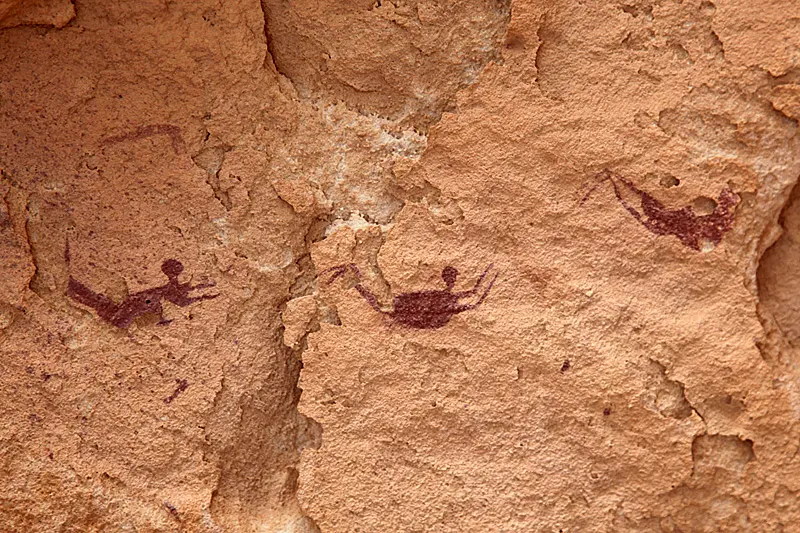
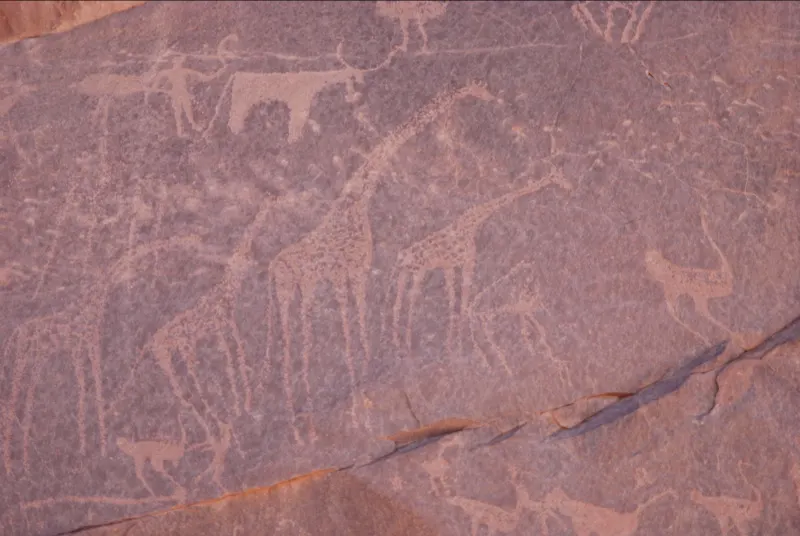
Around ten thousand years ago, at the start of what scientists call the African Humid Period, this part of the Sahara had more rain, and people lived here. They painted and engraved the walls of the plateau's rock shelters.
The Cave of Swimmers, in the Wadi Sura area of the south-western Gilf Kebir, shows small human figures that seem to swim. László Almásy recorded it in October 1933, and the paintings are estimated to date from around 8000 BC (Wikipedia: Cave of Swimmers, checked 21 November 2026). The shelter became famous through Michael Ondaatje's novel The English Patient and the 1996 film, although the cave in the film was a set made by a modern artist.
The Cave of the Beasts, also called Wadi Sura II or the Foggini-Mestikawi cave, lies about 10 km to the west. It holds more than 5,000 well-preserved figures: people, animals and the strange headless "beasts" that give it its name. Wikipedia's two articles give its discovery as 2002 and as January 2003, so we give both.
Both shelters are fragile. Visitors since the film have damaged the Cave of Swimmers by removing fragments of paint as souvenirs, wetting the walls to sharpen photographs, which cracked some surfaces, and leaving graffiti and litter. If you go, keep your hands and water bottles away from the rock.
What the UK government says, checked 21 November 2026
Short answer: The FCDO advises against all but essential travel to the Western Desert outside a list of named places, and the Gilf Kebir is not on that list.
The UK FCDO Egypt travel advice was "still current at: 21 November 2026" and last updated on 27 October 2026 when we opened it. In summary:
| Area | FCDO advice |
|---|---|
| West of the Nile Valley and Nile Delta in general | Advises against all but essential travel |
| White Desert and Black Desert | Named exception: not covered by that warning |
| Bahariya, Farafra, Dakhla (Mut) and Kharga towns | Named exceptions |
| Road from Giza to Farafra, and 50 km either side | Named exception |
| Gilf Kebir, Gebel Uweinat, the open desert between | Not named as exceptions, so the all-but-essential warning applies |
| Land within 20 km of the Libyan border | No travel at all is advised, El Salloum apart |
The same page warns that "your travel insurance could be invalidated" if you travel against FCDO advice. Read the live page before you plan, ask your insurer in writing whether you would be covered, and check your own government's advice if you are not British.
Security has been a problem here before. In September 2008, 11 European tourists (five German, five Italian and one Romanian) and eight Egyptian guides and drivers were seized while camping in the Gilf Kebir area near the Sudanese border (CBS News, 22 September 2008). They were freed after ten days (Peter Greenberg, 30 September 2008).
How an expedition works
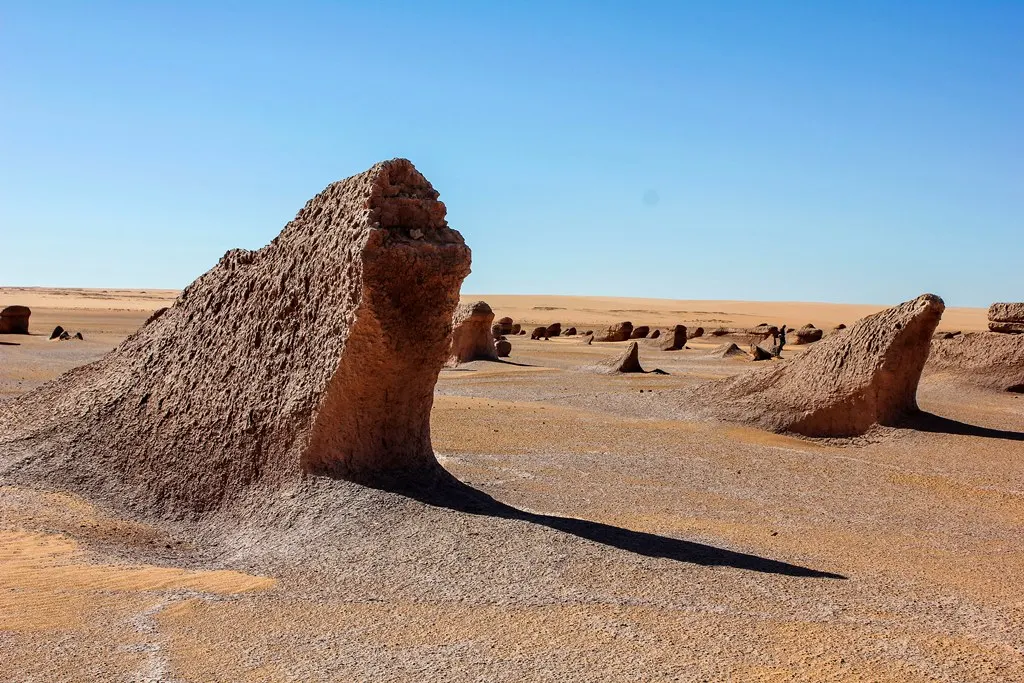
Short answer: About two weeks, several 4x4s, military permits arranged by a specialist operator, and full self-sufficiency.
Permits for the Gilf Kebir and the far Western Desert are arranged by specialist expedition operators, not by individual travellers. Military permits may or may not be granted, and expeditions usually start from Dakhla or Bahariya.
| Element | What to expect | Ask the operator |
|---|---|---|
| Length | About two weeks from Cairo | Exact days and rest days |
| Vehicles | Several 4x4s, all water and fuel carried | How many cars, and whether there is a support vehicle |
| Permits | Military permission for the whole route | How far ahead they apply and what happens if it is refused |
| Camping | Wild camping every night | Tents, toilets and water ration |
| Season | The cool months, roughly November to March | Which departures are planned this season |
We run trips in the White Desert, Bahariya and Farafra. Whether we can put you in touch with a Gilf Kebir operator, and what such an expedition costs, is something to ask us directly.
How to see it from the White Desert
Short answer: Start with a White Desert trip that includes Djara Cave's rock art; it shows you whether two weeks of deep desert would suit you.
You can't see the Gilf Kebir from the White Desert, but you can sample what an expedition feels like. The 4-day White Desert and Djara cave trip crosses dune belts off-road to Djara Cave, where prehistoric engravings of gazelles and other animals are cut into the walls, and camps in open desert on the way. It is about US$605 to 825 per person for two travellers, private.
If you have less time, the 3-day Bahariya, White Desert and Farafra tour gives you two nights out among the chalk. Its quoted range is about US$495 to 660 per person when two travellers share a private trip.
Treat either trip as a test. Ask yourself afterwards whether you enjoyed the long hours in a 4x4, the cold before dawn and the lack of facilities. In January, Farafra's station averages about 4°C at night, and open-desert camps run colder (see our weather and night temperatures guide). On a Gilf Kebir expedition you would face that for two weeks, with no hotel in between. If you come back wanting more, the far desert may be for you.
If an expedition you join starts from Bahariya, the road south to Farafra runs past the White Desert, so a night there before you head into the deep desert is easy to plan. Ask the expedition operator whether their route allows it.
Who it's for
Short answer: Fit, flexible travellers who have camped in the desert before and accept that a permit can fall through.
A Gilf Kebir trip means very long driving days, simple camps, cold nights in winter and no towns for most of the journey. It suits people who already know they like desert camping and who can absorb a change of plan, or a cancelled departure, without losing money they can't afford. If you have never slept in the Sahara, do a White Desert trip first. Our permits and safety guide explains how paperwork works on the routes we drive, and the Sahara in Egypt guide shows where the Gilf Kebir fits among Egypt's deserts.
Libyan Desert Glass
Short answer: A pale yellow natural glass, about 29 million years old, found in the Great Sand Sea; a 2023 study links it to a meteorite impact.
The Great Sand Sea covers about 72,000 km² of dunes across Egypt and Libya. Pieces of pale yellow natural glass lie scattered across it. A 1996 study put their age at about 29 million years, and a 2023 study by Elizaveta Kovaleva (University of the Western Cape) and colleagues reported zirconia minerals that form only at very high temperatures and pressures, pointing to a meteorite striking the ground rather than exploding in the air (The Conversation, 20 November 2023, checked 21 November 2026). No parent crater has been found.
Ask about the deep desert
Short answer: Message us a season ahead with your dates and we'll tell you what we know.
Message us on WhatsApp with "Gilf Kebir" and your dates. We can plan the White Desert part of your trip and answer what we can about the far south-west.
Sources (checked 21 November 2026): UK FCDO Egypt travel advice; EEAA protectorate table; Wikipedia on the Gilf Kebir, the Cave of Swimmers, the Cave of Beasts and White Desert National Park; CBS News; Peter Greenberg; The Conversation.
Questions people ask
Is the Gilf Kebir open to tourists?+
Only on permitted expeditions run by specialist operators. UK advice warns against all but essential travel to most of the Western Desert, and the plateau is not among the places it exempts (checked 21 November 2026). Your insurer may not cover you there.
How far is the Gilf Kebir from the White Desert?+
About 490 km in a straight line, from the coordinates Wikipedia gives for the plateau and for White Desert National Park. The tracks expeditions drive are much longer, which is why trips take about two weeks.
Who found the Cave of Swimmers?+
The Hungarian explorer László Almásy, in October 1933. The paintings are estimated to date from around 8000 BC, when the Sahara was wetter. The shelter later appeared in The English Patient, though the 1996 film used a replica set.
What is the Cave of the Beasts?+
A painted shelter about 10 km west of the Cave of Swimmers with over 5,000 figures, found in 2002 by Massimo and Jacopo Foggini with Ahmed Mestikawi. Some sources date the find to January 2003.
How big is Gilf Kebir National Park?+
48,524 km², declared under Prime Minister's Decree No. 10 of 2007 in New Valley Governorate, according to the EEAA protectorate table. The plateau itself covers about 7,770 km².
What is the best month for a Gilf Kebir expedition?+
The cool months, roughly November to March. For comparison, Farafra, the nearest station we track, averages 4°C at night and 20°C by day in January, and 38°C by day in July, far too hot for two weeks of self-sufficient travel.
Can I see rock art closer to the White Desert?+
Yes. Djara Cave, east of the White Desert, has prehistoric engravings of gazelles and other animals. Our 4-day White Desert and Djara trip is about US$605 to 825 per person for two travellers, private.
Where is Libyan Desert Glass found?+
Scattered across the Great Sand Sea, about 72,000 km² of dunes spanning Egypt and Libya. The pale yellow glass is about 29 million years old, and a 2023 study links it to a meteorite striking the ground. No parent crater has been found.
Go with us
Trips that include this
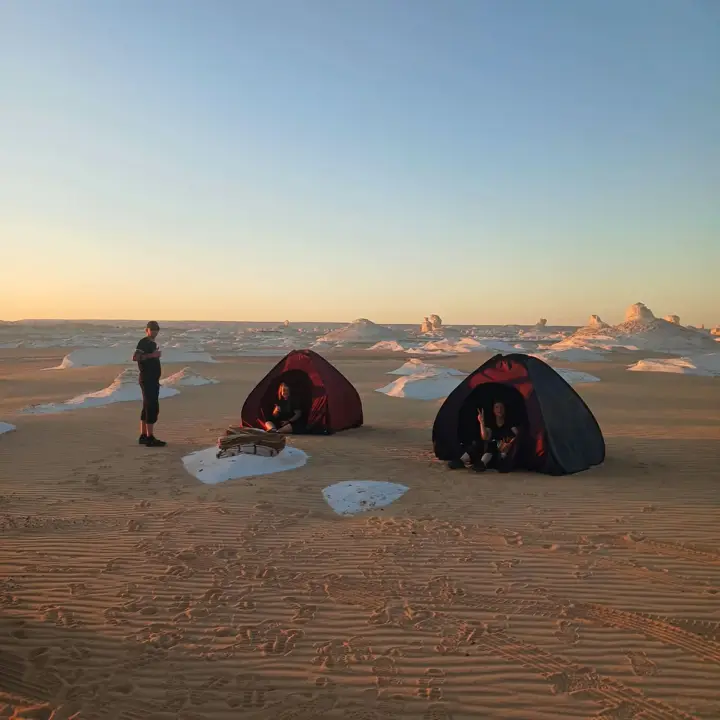
2 days, 1 night
White Desert overnight camping trip from Cairo (2 days, 1 night)About US$185 to 230 shared · US$360 to 460 private, per person
Check dates
3 days, 2 nights
3-day White Desert tour: Bahariya, the White Desert and two nights outAbout US$495 to 660 per person for two travellers, private
Check dates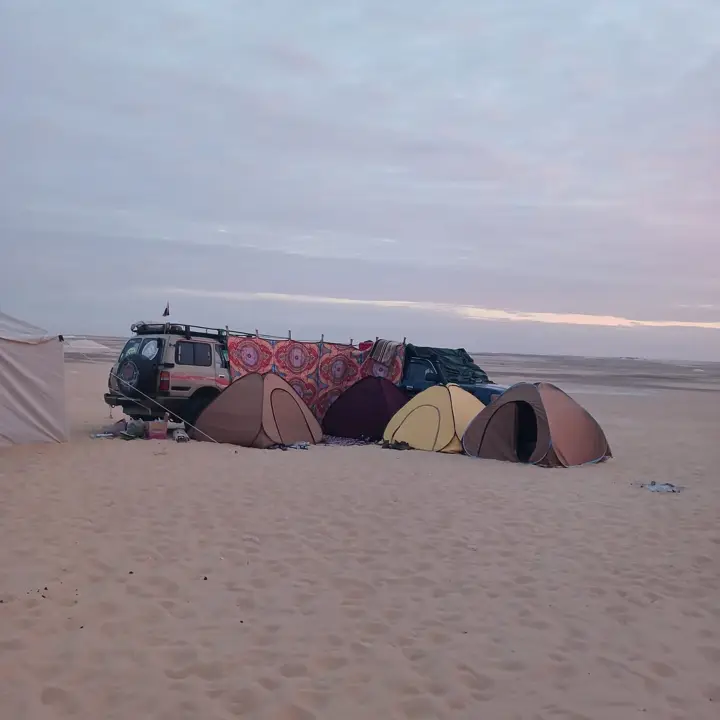
2 or 3 days
Private White Desert camping in comfortOn request (depends on group size and nights)
Check dates