
The short answer
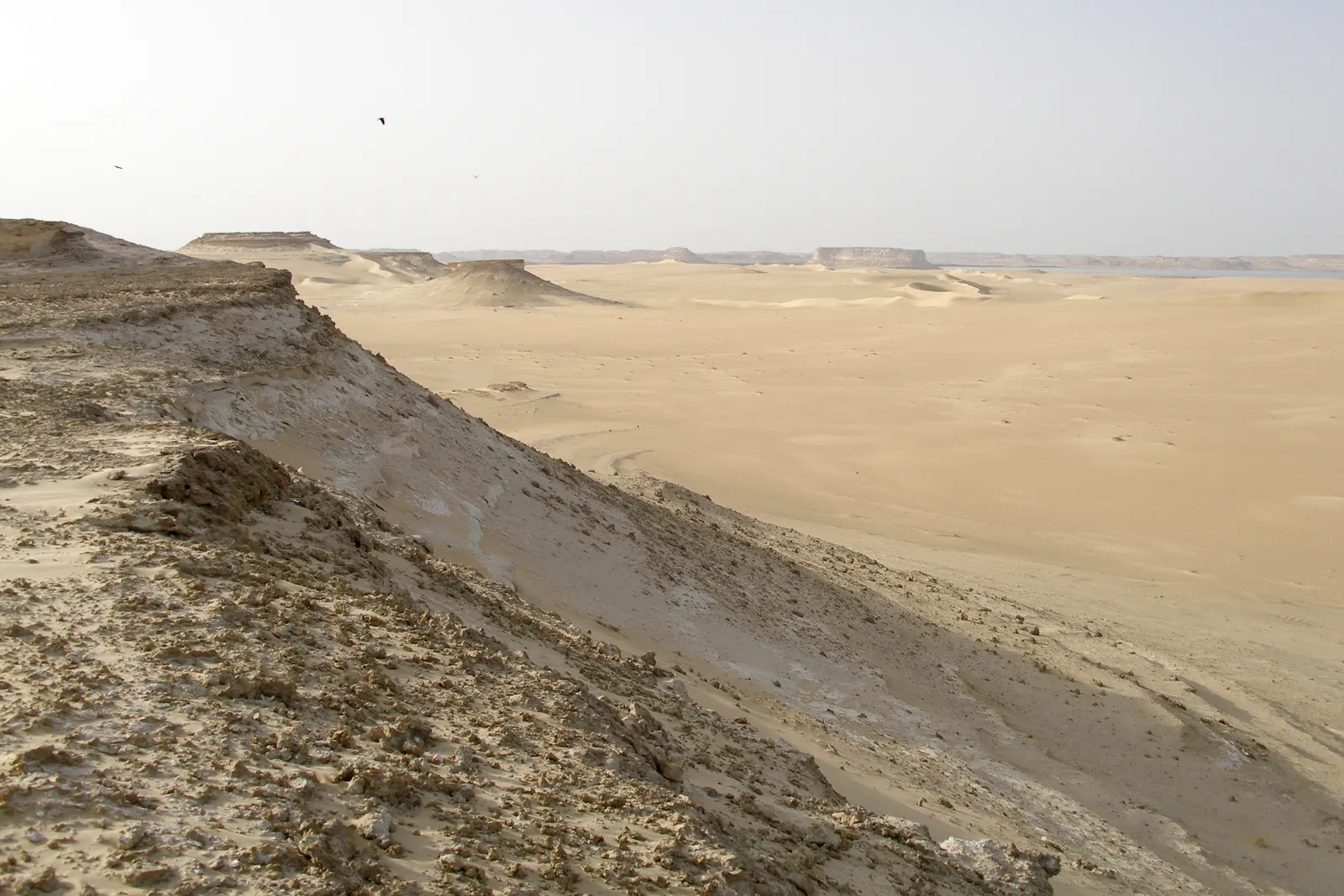
Yes, Egypt has the Sahara. The White Desert, Bahariya, Farafra, Siwa and the Great Sand Sea all sit in its eastern part, which Egyptians call the Western Desert. The Giza pyramids stand on its edge, so a camel ride there is the doorstep. The open desert starts about five hours' drive south-west of Cairo.
Ask us on WhatsAppThe short answer: where the Sahara is in Egypt
Short answer: Everything west of the Nile Valley is Sahara: the Western Desert, about two-thirds of Egypt. The White Desert, Bahariya, Farafra, Siwa and the Great Sand Sea are all in it. The Eastern Desert is the Sahara's thin eastern strip; Sinai is not Sahara at all.
The Sahara covers about 9.2 million square kilometres of North Africa, from the Atlantic to the Red Sea. In Egypt the name people search for and the name on the map are different. Egyptians and geographers call the land west of the Nile the Western Desert: about 680,650 km², roughly two-thirds of the country. It is the Egyptian part of the Libyan Desert, the Sahara's north-eastern section, which runs on into Libya and Sudan. "Sahara" itself is simply the Arabic word for desert, which is why the White Desert is Sahara el-Beida in Arabic.
So when someone asks whether the White Desert is "in the Sahara", the answer is yes, without qualification. The same goes for Bahariya, Farafra, Dakhla, Kharga, Siwa, the Great Sand Sea and the Gilf Kebir.
Two areas confuse people. The Eastern Desert, between the Nile and the Red Sea, is usually counted as the Sahara's easternmost strip, but it is a range of granite mountains and dry valleys, not sand seas, and travellers meet it on Red Sea safaris rather than from Cairo. Sinai lies across the Suez Canal, geographically in Asia, and is not counted as Sahara.
Egypt's deserts at a glance
Short answer: For the classic Sahara of sand, rock and empty horizons, go west from Cairo; the Eastern Desert and Sinai are different country reached from the Red Sea resorts.
| Desert | Part of the Sahara? | Nearest base | Time from Cairo | Typical trip |
|---|---|---|---|---|
| Western (Libyan) Desert: White Desert, Black Desert | Yes | Bawiti, Bahariya Oasis | About 4.5 to 5 hours to Bawiti, 6 to 7 to camp | 2 or 3 days, one or two nights out |
| Western Desert: Siwa and the Great Sand Sea | Yes | Siwa town | About 9 to 10 hours | 3 to 5 days, dune afternoon by 4x4 |
| Western Desert: Gilf Kebir, far south-west | Yes | Dakhla or Bahariya | Several days off-road | About two weeks, military permits |
| Giza plateau and Fayoum | The edge of it | Giza, Fayoum | 30 minutes to 3 hours | An hour's ride, or a day trip |
| Eastern (Arabian) Desert | Usually counted as its eastern strip | Hurghada, El Gouna, Marsa Alam | Fly or 5 to 6 hours to the coast | A few hours by quad or jeep |
| Sinai | No, it is in Asia | Sharm el-Sheikh, Dahab, St Catherine | Fly, or about 7 hours to Sharm | A night climb of Mount Sinai |
The map further down this page shows where the oases sit in the Western Desert, and getting there covers the road from Giza to Bahariya and on to Farafra. For a fuller comparison of trips, including Fayoum and the Red Sea, see the best desert safari in Egypt.
The "Sahara near the pyramids" rides
Short answer: A Giza quad or camel ride is an hour on the sand behind the pyramids, usually about US$20 to 60 a head. It is fun and photogenic, but it is the Sahara's edge, with the city in view.
Search for a Sahara tour from Cairo and the first results are often a quad bike or camel ride "in the Sahara" at Giza. These are real rides on real desert. The Giza plateau stands at the edge of the Western Desert, about 9 km west of the Nile, and the sand south and west of the pyramids does run on, in principle, all the way to Libya.
What you get in practice:
- Time: about an hour of riding, sometimes sold as a two-hour trip that includes the hotel pickup.
- Price: in the listings we checked in November 2026, roughly US$20 to 60 per person for an hour, more at sunset or with private transfers.
- What you see: sand, low ridges, the pyramids from the desert side, and the outskirts of Giza on the horizon.
- What you don't see: chalk formations, big dunes, a dark sky or a night out. You are never more than a few kilometres from traffic.
Who it suits: anyone with a free afternoon in Cairo and no time for more, families with young children, and people who want the classic pyramids-from-a-camel photo. It is not a substitute for the Western Desert.
Four ways into the real Sahara from Cairo
Short answer: Two days gets you a night among the White Desert's chalk; three days adds the deep White Desert; Siwa and the Great Sand Sea need three to five; the Gilf Kebir needs about two weeks.
1. White Desert overnight: 2 days, 1 night
The shortest trip that gets you properly into the Sahara. You leave Cairo at dawn, change to a 4x4 in Bawiti and drive south through the Black Desert, Crystal Mountain and the Agabat valley to camp among the chalk for sunset, dinner and the stars. You are back in Cairo the next evening. Our overnight trip from Cairo costs about US$185 to 230 per person shared, or US$360 to 460 per person private.
2. White Desert with two nights out: 3 days, 2 nights
The same road, with time to slow down. An afternoon in Bahariya for the Golden Mummies and a hot spring, then a full day off-road to the spring of Ain Khadra and the tall towers of the New White Desert, closer to Farafra. Two nights out means one full desert day without a long drive. See the 3-day Bahariya, White Desert and Farafra trip, about US$495 to 660 per person for two travellers, private.
3. Siwa and the Great Sand Sea: 3 to 5 days
For dunes on the scale people picture when they say "Sahara", go to Siwa. It is a longer drive, out along the Mediterranean coast to Marsa Matruh and then south, and the Great Sand Sea starts a short 4x4 ride south of the oasis. Our sister site covers the Great Sand Sea from Siwa and how to get to Siwa. Britain's Foreign Office advises against all but essential travel on the desert road from Bahariya to Siwa (Egypt warnings page). We don't use it, so seeing both means going back through Cairo; see White Desert vs Siwa and the Siwa and White Desert tour.
4. The deep desert: Gilf Kebir and beyond, about two weeks
The far south-west of Egypt, with the painted rock shelters of the Gilf Kebir, Gebel Uweinat and the open plains between. These are full expeditions: several 4x4s, all water and fuel carried, military permits that may or may not be granted, and wild camping every night. Read deep desert expeditions before planning one, and do a White Desert night first.
What kind of Sahara each trip shows you
Short answer: The White Desert is chalk sculpture; the Black Desert is dark-capped hills; Siwa gives you the big dunes and springs; the Gilf Kebir gives you rock art and emptiness.
| Scenery | Where | On which trip |
|---|---|---|
| White chalk towers and mushroom rocks | White Desert National Park | All White Desert trips |
| Orange hills capped with black stone | Black Desert, south of Bawiti | All White Desert trips |
| Quartz-laced rock and a small arch | Crystal Mountain | All White Desert trips |
| Small dunes for walking and sandboarding | Agabat and near Bawiti | All White Desert trips |
| Desert springs | Ain Khadra; hot springs around Bawiti | 3-day trip |
| Long linear dunes over 100 m high | Great Sand Sea | Siwa |
| Prehistoric rock art | Djara Cave; the Gilf Kebir | 4-day Djara trip; expeditions |
The White Desert's chalk is the floor of an ancient sea, carved by wind; the geology page explains how. Nothing else in the Sahara looks quite like it, which is why it suits people who have already seen dunes in Morocco or Jordan.
Sahara facts, sourced
Short answer: Egypt's Western Desert is about 680,650 km², gets almost no rain, freezes on some winter nights, and was home to Spinosaurus some 100 million years ago.
- Size: the Sahara covers about 9.2 million km² (Wikipedia); Egypt's Western Desert about 680,650 km², roughly two-thirds of the country (Wikipedia); the wider Libyan Desert about 1.3 million km² (Wikipedia).
- Rain: Farafra, the oasis nearest the White Desert, averages about 2 mm of rain a year, by NOAA's 1961 to 1990 normals (Wikipedia, citing NOAA). Dakhla's NOAA normals record 0 mm (Wikipedia).
- Night temperatures at Farafra (average lows): about 4°C in January, 6°C in December and February, 9 to 10°C in March and November, 14 to 16°C in April and October, and about 21 to 22°C from June to August. The record low is −3.3°C (Wikipedia, citing NOAA). In open desert, away from the oasis, nights can be colder; see weather and night temperatures.
- Day temperatures at Farafra (average highs): about 20°C in January, rising to about 38°C in June and July; the record high is 47.8°C (Wikipedia, citing NOAA).
- Spinosaurus: the first Spinosaurus fossils were found in Egypt in 1912 and described by Ernst Stromer in 1915; Spinosaurus lived about 100 to 94 million years ago (Wikipedia). Those Bahariya originals were destroyed in a bombing raid on Munich in 1944. See the dinosaurs of Bahariya.
- The Great Sand Sea: about 72,000 km² of dunes across western Egypt and eastern Libya (Wikipedia).
- The Eastern Desert: about 223,000 km² between the Nile and the Red Sea, described by Wikipedia as the part of the Sahara east of the Nile (Wikipedia).
Egypt's Sahara or Morocco's?
Short answer: Morocco sells the orange-dune Sahara of camel caravans; Egypt's is chalk, black hills and silence, closer to Cairo's pyramids.
Morocco's Merzouga and Erg Chebbi are the Sahara most people picture: tall orange dunes, a sunset camel ride and a permanent camp, many of them comfortable. Egypt's nearest Sahara to a big city is the White Desert, and it looks like nothing in Morocco: white chalk shapes, dark-capped hills and small mobile camps in a national park with no fixed buildings. If you want big dunes in Egypt, that means Siwa. If you are choosing between the two countries, read the White Desert or the Sahara in Morocco.
Checked November 2026
Short answer: Sizes, rainfall and temperatures come from Wikipedia and the NOAA normals it cites; travel advice from the UK Foreign Office; our prices are confirmed for your dates when you book.
- Travel advice areas: UK Foreign Office. See also permits and safety.
- Giza plateau at the edge of the Western Desert, about 9 km west of the Nile: Wikipedia.
- Giza ride prices are third-party listings checked in November 2026, given only as a guide; we do not sell them.
- Our trip prices are per person and the same as on each tour page.
Plan it with us
Short answer: Tell us how many days you have in Cairo; we will tell you how far into the Sahara that gets you.
Send us a WhatsApp message with your dates and "Sahara". If you have one night, start with the overnight trip from Cairo. If you have two, take the 3-day trip. If you want big dunes, we will point you to Siwa.
Map
Where the White Desert is
Egypt’s Western Desert, with the oases at their true positions. Tap a place to read its guide.
- The White Desert
- Towns and oases
- Desert sites
- Main desert roads
Positions are true latitude and longitude. The desert sites between Bawiti and Farafra are approximate, because they spread over many kilometres. Dashed lines are the main desert roads.
Questions people ask
Is the White Desert in the Sahara?+
Yes. The White Desert National Park lies in Egypt's Western Desert, between the oases of Bahariya and Farafra, and the Western Desert is the Egyptian part of the Libyan Desert, the north-eastern corner of the Sahara. Its chalk formations are one of the Sahara's stranger landscapes, not a separate desert.
Can I see the Sahara on a day trip from Cairo?+
You can see its edge on a day out at Giza or Fayoum. For the open Western Desert in a single day, a private White Desert day trip runs about 15 hours, at about US$220 to 280 per person for two. Most of that day is spent in the car, so we suggest one night out instead.
Do I need a permit to visit the Sahara in Egypt?+
Not to ride a camel at Giza. For the White Desert, foreign visitors need a permit arranged in advance and a licensed guide; we arrange both and need your passport details a day before. Siwa operators arrange the permits for dune trips there. The Gilf Kebir needs military permits that are granted case by case.
Is it safe to visit the Sahara in Egypt?+
The routes most travellers use are. The UK Foreign Office advises against all but essential travel west of the Nile Valley, then names exceptions, among them the White and Black deserts, Bahariya, Farafra, the road from Giza to Farafra and Siwa town. Areas near the Libyan and Sudanese borders are not excepted.
When is the Egyptian Sahara too hot to visit?+
From May to September for most people. Farafra's average daytime high is about 35 to 38°C in those months, and the sand gets much hotter than the air by midday. October to April is the comfortable season, with days of about 20 to 32°C and cold nights from December to February.
Is the Eastern Desert part of the Sahara?+
Usually, yes. Wikipedia and most geographers treat the Eastern Desert, between the Nile and the Red Sea, as the Sahara's easternmost strip, though its granite mountains look nothing like the Western Desert. Sinai is across the Suez Canal in Asia and is not counted as the Sahara.
Go with us
Trips that include this

2 days, 1 night
White Desert overnight camping trip from Cairo (2 days, 1 night)About US$185 to 230 shared · US$360 to 460 private, per person
Check dates
3 days, 2 nights
3-day White Desert tour: Bahariya, the White Desert and two nights outAbout US$495 to 660 per person for two travellers, private
Check dates