
The short answer
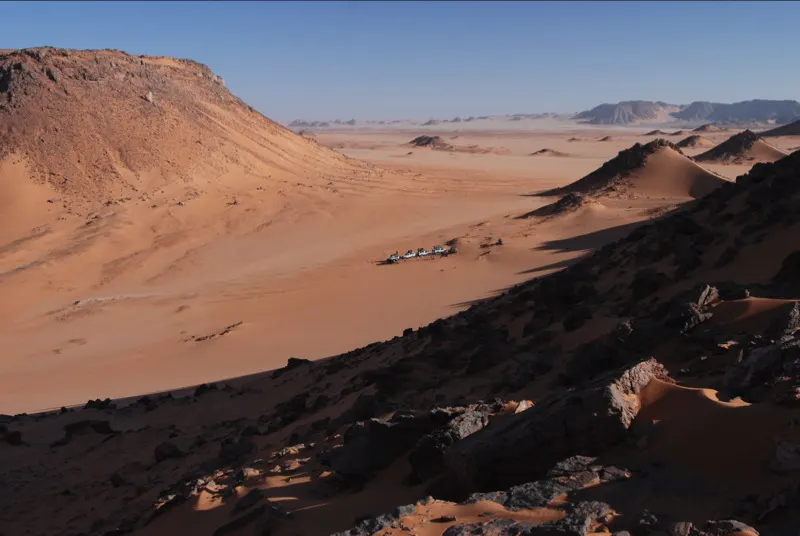
A Western Desert expedition goes beyond the roads of the White Desert into places with no tarmac, signal or help. The ladder runs from a 2-day White Desert camp to 4 days at Djara and about two weeks in the Gilf Kebir. Deep trips travel in convoys of at least two 4x4s, carry all water and fuel, and the remotest need military permits.
Ask us on WhatsAppThe White Desert is only the beginning
Short answer: Beyond the White Desert lie dune belts, caves, oases and plateaus that take days or weeks to reach, and each step further means fewer roads and more self-sufficiency.
Egypt's Western Desert covers about two-thirds of the country, and the White Desert is its most accessible corner: tarmac to Bawiti, a short drive off-road, and Bawiti or Farafra a couple of hours away if anything goes wrong. Further out, the landscape opens into seas of sand, rock plateaus, ancient lake beds and some of the remotest places on Earth. Prehistoric people left their rock art there, and 20th-century explorers left their camps. This page is about how you get there step by step, what those trips are like and what they demand. The places themselves each have their own guide.
Step by step into the desert
Short answer: From two days in the White Desert to two weeks in the Gilf Kebir, each step goes further from roads and help, and needs more vehicles, permits and time.
| Step | Typical length | Driving | Vehicles | Permits | Nights |
|---|---|---|---|---|---|
| White Desert camping | 2 to 3 days | Tarmac, then short off-road | One or two 4x4s | Standard; passport details one day before | Camp, sometimes a lodge |
| Djara cave | 4 days | Most of a day off-road over dunes | Two 4x4s | Standard, with notice | Wild camps |
| Oasis loop | 6 to 8 days | Mostly tarmac | One car or 4x4 | Standard; checkpoints | Lodges plus one desert camp |
| Great Sand Sea crossing | 1 week or more | Dune driving, no tracks | Several 4x4s in convoy | Special, often military | Wild camps every night |
| Gilf Kebir and Gebel Uweinat | 12 to 16 days | Thousands of km off-road | Several 4x4s plus a supply truck | Military permits and escort | Wild camps, total isolation |
Most people stop at the first step, and that's fine. If you want more, the honest next step is Djara: a real taste of dune driving and wild camping, with the road never more than a day away.
Where the deeper trips go
Short answer: Djara, the southern oases, the Great Sand Sea and the Gilf Kebir; each has its own guide, so here is just the outline.
- Djara and the Abu Muharrik dunes: a cave of stalactites and prehistoric engravings, first recorded by Rohlfs in 1873, reached across the long Abu Muharrik dune belt that runs south-east from north of Bahariya towards Kharga. Four days from Cairo. Read Djara cave.
- The southern oases: Dakhla and Kharga, with the medieval town of Al-Qasr, Roman temples and Bagawat. It's a road trip rather than an expedition. Read Dakhla and Kharga.
- **The Great Sand Sea, a dune field few places on the planet can match for size, west of Farafra and south of Siwa along the Libyan border, with parallel ridges over 100 metres high. Libyan Desert Glass lies in its south-west; a piece of it was carved into the scarab of a pectoral of Tutankhamun. Read the Great Sand Sea.
- The Gilf Kebir and Gebel Uweinat: a sandstone plateau in Egypt's far south-west with the Cave of Swimmers, the Cave of the Beasts and thousands of prehistoric paintings. About two weeks with a military escort. Read Gilf Kebir and desert explorers.
What a remote off-road trip is like
Short answer: Long days of driving across sand and gravel, a simple camp every night, no signal or shops, and every litre of water and fuel carried with you.
Guests who have done the White Desert are often surprised by how different a deep trip feels. There's no camp at a familiar spot, no Bawiti lunch, no road noise on the horizon. The rhythm is simple: break camp after sunrise, drive most of the day with stops for tea, walks and navigation, and set up again before dark.
- Driving: the vehicles leave the tracks entirely. Crossing dunes means letting tyre pressure down, climbing crests at an angle and sometimes digging out with shovels and sand ladders. Expect to get out and walk while drivers scout a crest.
- Camping: wild camps every night, chosen for shelter from the wind. Tents or sleeping in the open, a camp kitchen and a fire when there's wood carried for it. Toilets are a spade and a walk behind a dune, or a toilet tent on request.
- Water: it all comes with you, in jerrycans or on a supply truck. Drinking and cooking come first. Washing is a basin and wet wipes; you'll go days without a shower.
- Food: the crew cooks; fresh food goes first, then tins, rice, pasta, bread and dates. Tell us about special diets at least two days before, because there's no shop to fix a gap.
- Communication: no phone signal beyond the oases. Convoys carry satellite communication and agree on a check-in plan before leaving.
- Cold: November to February nights in open desert can drop close to 0°C. A warm sleeping bag matters more than anything else you pack.
Vehicles and convoys
Short answer: Never one car alone off-road: at least two 4x4s for Djara, several for the Sand Sea and the Gilf, with spares, recovery kit and a mechanic-minded crew.
The rule is simple: one vehicle off-road is a risk; two is a plan. If one breaks down or gets stuck, the other tows it, fetches parts or carries everyone out. On the longest expeditions a supply truck follows with fuel and water, because the 4x4s can't carry enough for thousands of kilometres. Each vehicle carries spare tyres, a jack, a tool kit, sand ladders, a shovel, a compressor for re-inflating tyres, a first-aid kit and extra water beyond what the plan needs in case you have to wait. Desert drivers are mechanics by necessity. Ask any operator, us included, how old their vehicles are and what they carry; a vague answer is an answer.
Permits and safety in remote areas
Short answer: Every trip beyond the main roads needs permits; the Great Sand Sea, Gilf Kebir and Uweinat need military approval and an escort, take weeks or months, and can change at short notice.
All desert trips in Egypt for foreign visitors need permits and a licensed guide, which we arrange from your passport details. For the White Desert they're routine, and we need your passport details one day before the trip. For the Great Sand Sea, the Gilf Kebir and Uweinat they come from the military, take weeks or months and depend on security conditions near the Libyan and Sudanese borders; an escort travels with the group. Approval can be withdrawn at short notice, so keep your plans flexible and your flights changeable.
Government travel advice for the border regions is stricter than for Bahariya and Farafra, so read your own government's current advice before you commit. Check that your insurance covers remote areas and evacuation, and read the wording rather than the summary. We'll tell you honestly what's possible on your dates. Read permits and safety.
Checked November 2026
Short answer: White Desert and Djara permits are routine; deep expeditions depend on each season's military approval, and not every season sees them run.
- White Desert and Djara: permits are routine; for the White Desert we need your passport details one day before the trip. White Desert National Park (protected area since 2002) charges a park entry fee, listed in your quote.
- Great Sand Sea, Gilf Kebir, Uweinat: possible only on permitted expeditions with an escort; ask us for the current position before planning around a specific date.
- Siwa: the UK advises against all but essential travel on the Bawiti–Siwa desert road and we don't use it, so expeditions don't link the White Desert and Siwa directly.
Is it for you?
Short answer: Start with Djara; go further if you love basic camping for many nights and can live with plans that change.
If you loved the White Desert and want more, start with a four-day trip to Djara. The oasis loop adds comfortable hotels and ancient towns without the hardship. The great expeditions are for travellers who are comfortable with basic camping for a week or more, cold nights, long days in a vehicle and no signal, and who accept that permits decide the route.
Our advice
Short answer: Use a shorter trip as your test run, plan the long ones months ahead, and pack for cold nights.
- Do the White Desert or Djara first. If two nights of wild camping feel good, a week will too.
- Plan the Gilf Kebir or a Sand Sea crossing several months ahead, and book flights you can change.
- Bring a sleeping bag rated for near-freezing nights (or ask us for one), a head torch, wet wipes and a power bank.
- Ask every operator about vehicles, spares and how they call for help without signal.
Message us on WhatsApp with "deep desert" and your dates, and we'll suggest the right next step.
Questions people ask
Can tourists visit the Gilf Kebir?+
Yes, on organised expeditions with military permits and escorts, which take time to obtain and add significant cost. Trips usually last around two weeks and run in the cooler months, and not every season sees expeditions, because permits depend on security conditions near the borders.
When is the best time for a deep desert expedition?+
From November to February. The days are cool enough for long drives and walking, and the nights, though cold, are manageable with the right gear. Summer expeditions are not advisable, because heat multiplies water needs and makes breakdowns dangerous.
How far ahead do I need to plan?+
For Djara or the oasis loop, a few weeks is usually enough. For the Great Sand Sea, the Gilf Kebir or Uweinat, plan several months ahead, because permits take time and expeditions run on fixed dates.
How many vehicles does a deep desert trip need?+
At least two 4x4s for anything off the main road, so one can tow or carry people if the other fails. Djara trips use two. Great Sand Sea crossings and Gilf Kebir expeditions use several 4x4s, and the longest add a supply truck for fuel and water.
Can I shower on a desert expedition?+
Rarely. Every litre is carried in, so water goes to drinking and cooking first. Expect wet wipes, a basin wash and days between proper showers. In the White Desert a warm shower is available on request; on deep expeditions there usually isn't the water for one.
Do I need experience or special fitness?+
You don't need to drive, but you should be comfortable with long days in a car, basic camping for a week or more, cold nights and no signal. Walks to rock art are short but rough. A White Desert or Djara trip first is the best test of how you cope.
Go with us
Trips that include this
2 days, 1 night
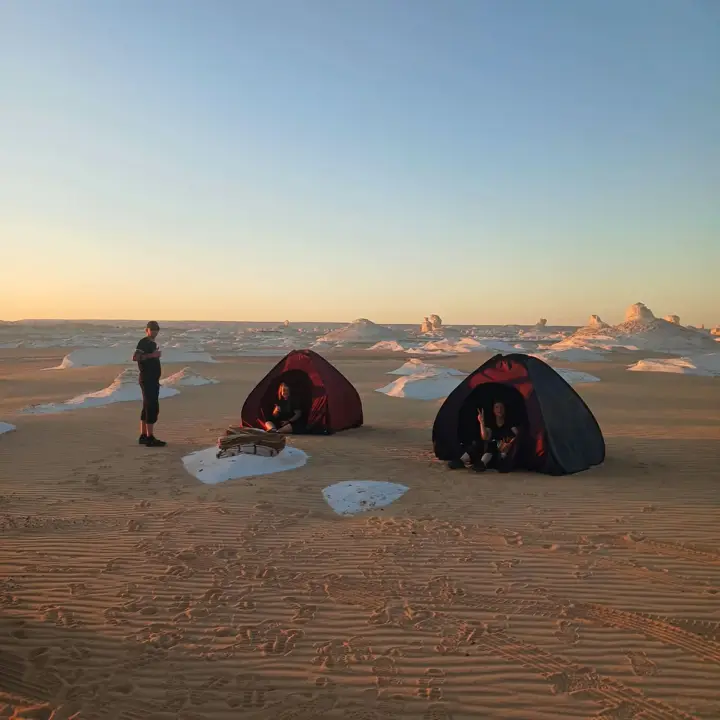
White Desert overnight camping trip from Cairo (2 days, 1 night)About US$185 to 230 shared · US$360 to 460 private, per person
Check dates
3 days, 2 nights
3-day White Desert tour: Bahariya, the White Desert and two nights outAbout US$495 to 660 per person for two travellers, private
Check dates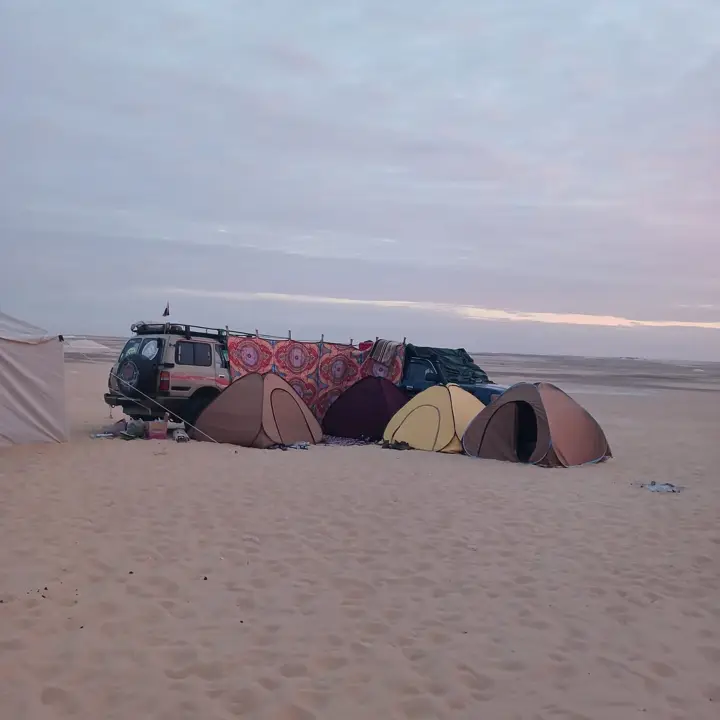
2 or 3 days
Private White Desert camping in comfortOn request (depends on group size and nights)
Check dates