
The short answer
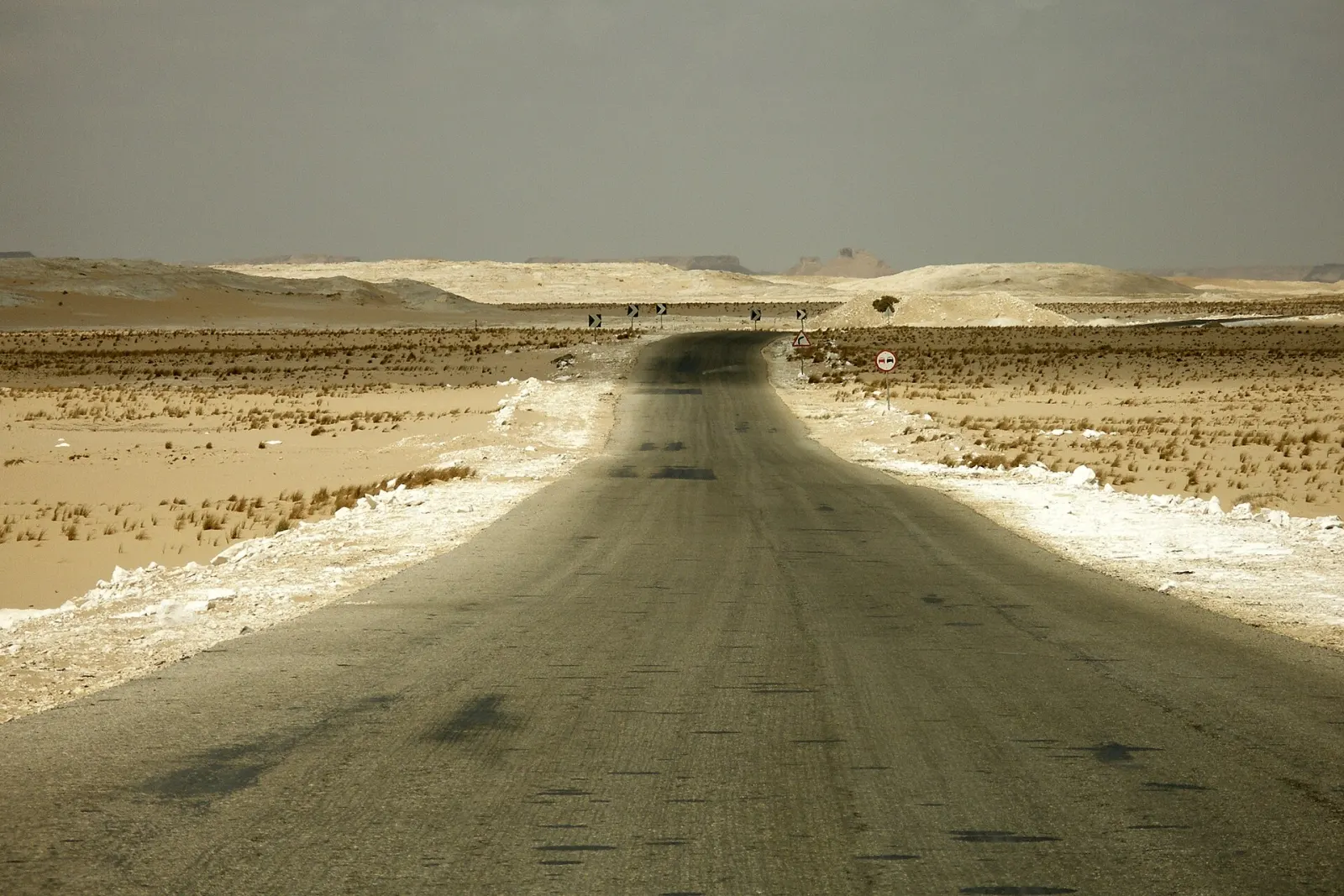
The oasis loop is a road trip of roughly 1,300–1,400 km from Cairo through Bahariya, the Black and White deserts, Farafra, Dakhla and Kharga, ending in Luxor. Seven days is the comfortable length, with one night camping among the chalk, two in Dakhla and the rest in oasis lodges. It also runs in reverse from Luxor, or as a round trip from Cairo.
Ask us on WhatsAppA typical 7-day loop
Short answer: Seven days from Cairo to Luxor: Bahariya, one desert night, Farafra, two nights in Dakhla, Kharga, then the Nile.
| Day | Route | Approx. distance | Highlights | Night |
|---|---|---|---|---|
| 1 | Cairo to Bawiti, Bahariya | ~370 km | Lunch in Bawiti, a hot spring at sunset | Lodge, Bawiti |
| 2 | Bawiti to the White Desert | ~130 km | Black Desert, Crystal Mountain, Agabat, sunset in the chalk | Desert camp |
| 3 | White Desert to Farafra and Dakhla | ~340 km | Sunrise among the formations, Qasr Farafra, the long road south | Lodge, Dakhla |
| 4 | Dakhla | local | Al-Qasr, Deir el-Hagar, Balat, the dunes at sunset | Lodge, Dakhla |
| 5 | Dakhla to Kharga | ~190 km | Open desert, the first of the Roman forts | Hotel, Kharga |
| 6 | Kharga | local | Bagawat necropolis, Temple of Hibis, Qasr el-Labeka or Qasr Dush | Hotel, Kharga |
| 7 | Kharga to Luxor | ~250–340 km | Down the escarpment to the Nile Valley |
Day two is the one guests talk about most: the drive south through the Black Desert, a stop at Crystal Mountain, the view down into Agabat, then camp among the chalk with dinner by the fire. Day three starts with sunrise in the White Desert and ends in Dakhla, which makes it the longest day on the road. That's why day four stays put: a slow morning, then Al-Qasr's covered lanes in the late light. Kharga gets a full day because Bagawat and the forts are best seen early or late, when the heat is gentle. For what each oasis holds, read Dakhla and Kharga and Bahariya Oasis.
Distances and drive times
Short answer: Roughly 1,300–1,400 km from Cairo round to Luxor, all on tarmac, in daily stints of about two to five hours.
| Leg | Distance (approx.) | Drive |
|---|---|---|
| Cairo to Bawiti (Bahariya) | ~370 km | 4.5–5 hours |
| Bawiti to the White Desert | ~130 km | About 2 hours with stops |
| White Desert to Qasr Farafra | ~40 km | 40–45 minutes |
| Farafra to Mut (Dakhla) | ~300–310 km | About 4 hours |
| Mut to Kharga | ~190 km | About 2.5 hours |
| Kharga to Luxor | ~250–340 km, depending on the road used | About 3.5–5 hours |
| Whole loop, Cairo to Luxor | ~1,300–1,400 km | 6 to 8 days with stops |
These are the figures we plan around, from our own route notes, and they include a short tea stop but not sightseeing. Fuel stations are far apart between Farafra and Mut, so our drivers fill up at every chance. We prefer to drive the open stretches in daylight, which is easier and more pleasant with trucks and no street lights, so we plan timings around it where we can. If you're comparing this with going via Cairo from the south, see from Luxor.
Why do the loop
Short answer: Four oases, two deserts, Roman forts, medieval towns and empty roads: Egypt without the crowds.
The Western Desert covers two-thirds of Egypt, yet few visitors see more than the pyramids' edge. The oasis loop crosses it on good tarmac. You link Bahariya, Farafra, Dakhla and Kharga, each with its own character, and spend a night among the chalk of White Desert National Park (protected area since 2002). Along the way you'll see the Golden Mummies, painted tombs, Crystal Mountain, the medieval town of Al-Qasr, Roman temples and forts, and one of the oldest Christian cemeteries in the world. You'll often have the sites to yourself.
Highlights by oasis
Short answer: Bahariya for antiquities and springs, the White Desert for the night, Farafra for calm, Dakhla for Al-Qasr, Kharga for Bagawat and the forts.
- Bahariya: the Golden Mummies, 26th-dynasty tombs, Temple of Alexander, English Mountain, hot springs. See Bahariya Oasis and the Golden Mummies.
- Black Desert, Crystal Mountain, Agabat: the drive south. See the Black Desert and Crystal Mountain.
- White Desert: sunset, camp and sunrise among the formations, including Mushroom and Chicken.
- Farafra: Badr's museum, the old fortress, Bir Sitta spring. See Farafra.
- Dakhla and Kharga: Al-Qasr, Deir el-Hagar and Balat; then the Temple of Hibis, Bagawat and the Roman forts. The sights are described in full in Dakhla and Kharga.
Where to sleep
Short answer: A Bahariya lodge, a desert camp, Al Tarfa or Desert Lodge in Dakhla, and a town hotel in Kharga.
| Night | Where | Our usual choices |
|---|---|---|
| Bahariya | Bawiti | Qasr El Bawity or Tzila, or a simpler lodge near a spring |
| White Desert | Camp among the formations | Our standard camp, with camp beds, a toilet tent and other comfort extras on request |
| Dakhla (2 nights) | Near Al-Qasr or Mut | Al Tarfa Desert Sanctuary for luxury, Desert Lodge above Al-Qasr for character |
| Kharga | Kharga town | A practical town hotel |
Choose by style and budget, and book Dakhla early for Christmas and New Year, when its few good rooms fill. Bahariya and Farafra options are compared in where to stay in Bahariya and Farafra; the Dakhla lodges are described in Dakhla and Kharga.
When
Short answer: October to March, with November and February the sweet spots; avoid May to September.
In December and January, open-desert nights in the White Desert can fall close to 0°C while Kharga, further south, stays a little milder by day. From April the spring khamsin winds can bring dust, and by June days pass 37°C across the whole route; Kharga's summer days are often near 40°C. See weather and night temperatures.
Variations
Short answer: Run it in reverse from Luxor, return to Cairo from Dakhla, add Djara Cave, or slow down with extra nights.
| Plan | Days | Route |
|---|---|---|
| White Desert plus Dakhla | 5 | Cairo, Bahariya, White Desert, Farafra, Dakhla (2 nights), back north |
| Full loop to Luxor | 6 to 8 | Cairo, Bahariya, White Desert, Farafra, Dakhla, Kharga, Luxor |
| Reverse from Luxor | 6 to 8 | Luxor, Kharga, Dakhla, Farafra, White Desert, Bahariya, Cairo |
| Loop plus Djara | 8 to 10 | Adds a day off-road to the cave between Bahariya and Farafra |
- Reverse, starting in Luxor: day 1 Luxor to Kharga (Hibis); day 2 Bagawat in the morning, then west to Dakhla; day 3 Al-Qasr and Deir el-Hagar; day 4 Dakhla to Farafra and camp in the White Desert (~350 km, an early start); day 5 north through Agabat, Crystal Mountain and the Black Desert to Bawiti; day 6 the Golden Mummies, then Cairo. Coming from the south, you meet the mushrooms first; see from Luxor. Doing the southern legs by bus or hired car? Our overnight from Farafra picks you up in town for the desert night.
- Round trip from Cairo: return north from Dakhla via Farafra, or via Assiut on the Nile.
- By public transport: possible in parts, with cars for the gaps; see buses between the oases.
- Add Djara Cave: a detour off-road between Bahariya and Farafra. See Djara Cave.
- Slower pace: add a second desert night, or a third night in Dakhla.
- Siwa: not on the loop; it's a separate leg via Cairo or the coast. See our Siwa and White Desert trip.
Practicalities
Short answer: Permits for foreigners, checkpoints, cash, simple food, and October to March for comfortable temperatures.
We arrange the permits and a licensed guide-driver. Keep your passport in the car rather than in a bag in the boot: checkpoints copy details and sometimes ask where you're sleeping. Bring cash; ATMs are found in Bawiti, Mut and Kharga but can be empty or out of order. Food is simple and good. Phone signal is fine in the towns, patchy on the open road and absent at camp. See permits and safety.
Checked November 2026: things that have changed
Short answer: Bahariya's antiquities tickets for foreigners rose in October 2026, and we still don't use the Bawiti–Siwa road.
- Tickets: foreigner tickets for Bahariya's archaeological sites are about EGP 400 since October 2026 (check on the day). Sites in Dakhla and Kharga have their own tickets, paid at the gate in Egyptian pounds.
- Park fee: White Desert National Park charges a park entry fee, listed in your quote.
- Siwa: Britain advises against all but essential travel on the Bawiti to Siwa track (gov.uk). Siwa town and the Marsa Matruh–Siwa road are exceptions, so a loop plus Siwa goes back through Cairo or via the coast.
- Travel advice: the UK FCDO's exceptions cover Bahariya, Farafra, the White and Black deserts, the Giza–Farafra road, Dakhla (Mut) and Kharga towns, and the roads from Farafra through Dakhla and Kharga to Baris and Luxor. Check your own government's current advice and your insurance wording.
Our advice
Short answer: Don't rush it, put the desert night early, carry cash, and keep one flexible day.
- Put the White Desert night on day two, when you're fresh; it's the night guests talk about most.
- Keep the long Farafra–Dakhla leg for a morning start, so you arrive with light for Al-Qasr.
- Plan one long driving day at most between rest stops. On a map the oases look close; on the road they aren't.
- Carry enough Egyptian pounds for two or three days at a time. See money and ATMs.
- Leave one buffer day for a checkpoint delay, a dusty day or simply a slow morning in Dakhla.
- If you end in Luxor, book the onward train or flight only once the route dates are fixed.
- Pack for two climates: warm days on the road and cold nights in camp.
Plan your loop
Short answer: Message us with "oasis loop", your dates and your style; we'll build it.
Tell us how many days you have, whether you'd like to finish in Luxor or Cairo, and how you like to sleep. We'll send a day-by-day plan with lodges and one clear price, with permits and the park entry fee listed, and antiquities tickets and anything else not included spelled out.
Map
Where the White Desert is
Egypt’s Western Desert, with the oases at their true positions. Tap a place to read its guide.
- The White Desert
- Towns and oases
- Desert sites
- Main desert roads
Positions are true latitude and longitude. The desert sites between Bawiti and Farafra are approximate, because they spread over many kilometres. Dashed lines are the main desert roads.

Questions people ask
Do I need permits for the oasis loop?+
Yes. Foreigners need permits arranged in advance for the desert sections and should travel with a licensed operator and guide; checkpoints are frequent. We arrange the paperwork with your passport details, which we need one day before the trip.
How many days do I need for the oasis loop?+
Seven days is the comfortable minimum from Cairo to Luxor, with one night in the White Desert. Six is possible if you skip a rest day in Dakhla. Eight to ten lets you add Djara Cave, a second desert night or slower mornings.
Can I include Siwa in the oasis loop?+
Not directly. The UK advises against all but essential travel on the desert road between Bawiti and Siwa, and we don't use it. Siwa has to be reached separately via Cairo or the Mediterranean coast at Marsa Matruh. Many travellers do the loop, return to Cairo, then fly or drive to Siwa.
Is the oasis loop safe?+
Bahariya, the Black and White deserts and Farafra are visited every week with permits and a licensed guide. The UK FCDO lists Farafra, Dakhla (Mut) and Kharga towns and the roads linking Farafra, Dakhla, Kharga, Baris and Luxor as exceptions to its Western Desert warning, so check your own government's advice and your insurance before you commit.
Can I do the oasis loop by public transport?+
Partly. Buses link Cairo with Bawiti and some oasis towns, but the White Desert night needs a 4x4, a permit and a licensed guide, and connections between oases are slow. Most travellers book a private car and driver for the whole loop.
What is the best month for the oasis loop?+
November and February are ideal: days of about 21–26°C and nights cold but manageable. December and January are fine with warm clothes for the desert camp. Avoid May to September, when long drives and Kharga's heat are tiring.
Which is the longest driving day on the loop?+
Farafra to Mut in Dakhla, about 300–310 km and four hours of open desert with few fuel stops. Done the other way, Dakhla to the White Desert is about 340 km, so we leave early to reach camp before sunset. Every other leg is shorter.
Go with us
Trips that include this

3 days, 2 nights
3-day White Desert tour: Bahariya, the White Desert and two nights outAbout US$495 to 660 per person for two travellers, private
Check dates