
The short answer
The White Desert is wonderful on foot. Our usual trips include short walks: up a Black Desert hill, among the chalk formations at sunset and around camp at dawn. On a private trip you can add a longer guided walk of two to four hours through the formations while the car meets you further on, which is the best way to feel the silence and scale.
Ask us on WhatsAppEasy walks
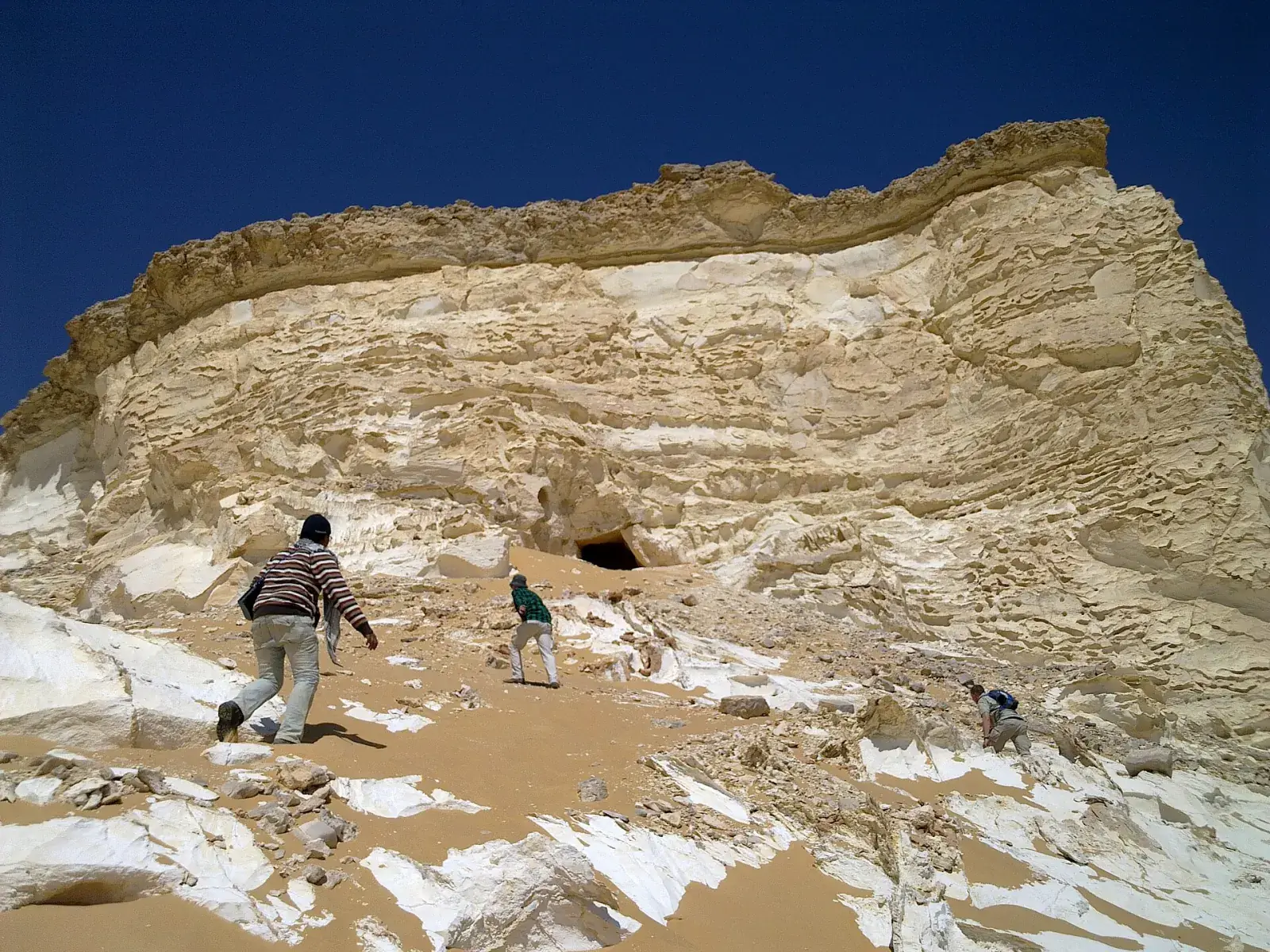
Short answer: Our usual White Desert trips include three short walks: a 15 to 30 minute Black Desert climb, about an hour among the formations at sunset and a dawn stroll around camp.
- Black Desert hill: 15 to 30 minutes up loose stone for the view.
- Sunset among the formations: an hour wandering between the mushrooms.
- Dawn around camp: reading fox tracks in the sand.
Longer walks
Short answer: On private or three-day trips the driver can drop you at one end of a band of formations and meet you at the other, after about three hours on foot.
On a private or three-day trip, the driver can drop you at one end of a stretch of formations and wait at the other. Three hours on foot through the New White Desert, with only the crunch of chalk and the wind, is the walk guests talk about most.
The best walks in the White Desert
Short answer: The best walks are sunset among the New White Desert's mushrooms, a dawn loop around camp, the Old White Desert's cliffs and the sand slopes of Agabat.
| Walk | Where | Length | Difficulty | Best time |
|---|---|---|---|---|
| Black Desert hill | Gebel el-Marsus and nearby cones | 15 to 30 minutes | Steep on loose stone | Afternoon |
| Crystal Mountain ridge | On the road south | 15 minutes | Easy, rocky | Any time |
| Agabat sand descent | Agabat valley | 20 to 40 minutes | Easy on soft sand | Afternoon |
| Old White Desert cliffs | Below the escarpment | 1 to 2 hours | Easy to moderate | Late afternoon |
| New White Desert mushrooms | Around the Mushroom and Chicken | 1 to 3 hours | Easy, flat | Sunrise, sunset |
| Formation traverse | Car drop-off and pick-up | 3 to 4 hours | Moderate | Early morning in winter |
Walking among the formations
Short answer: Flat chalk plains make the White Desert easy walking; the challenge is the sun and the scale, not the terrain.
The New White Desert is a wide, mostly flat plain, so walking is easy underfoot. The formations stand scattered across it like sculptures in a gallery, each one changing as you walk around it. A sunset walk lets you see the shadows lengthen and the colours shift. A sunrise walk, when the air is cool and the light gentle, is the best of all. See Old and New White Desert.
Longer hikes and multi-day walks
Short answer: Multi-day walks with a support 4x4 are possible on private trips, best from November to February.
For keen walkers, we can plan two- or three-day walking trips. You walk through the formations and along the escarpments by day, and the 4x4 carries water, food and camp to a meeting point each evening. The best season is November to February, when daytime temperatures suit long walks. You'll need good fitness, sturdy shoes and a sense of adventure. Tell us your experience and we'll suggest a route.
Safety on foot
Short answer: On any White Desert walk, carry water, cover up from the sun, keep a landmark in view, and tell the crew where you are going.
- Carry at least 1.5 litres of water for every two hours of walking, more in warm months.
- Wear a hat, sunglasses and sun cream; the chalk reflects sunlight.
- Wear closed shoes; chalk edges and stones can cut.
- The formations look alike from a distance, so keep a landmark in view and walk with a guide on long hikes.
- Don't climb the formations; they're fragile and can break.
- Tell your crew where you're going and when you'll be back.
Respecting the park
Short answer: Walk around fragile chalk crust, leave fossils where they are and carry out all rubbish.
The White Desert's thin chalk crust and formations are easily damaged. Stick to sand or firm ground where you can. Fossils and crystals belong to the park; photograph them and leave them. See White Desert National Park and fossils.
Walking weather, month by month
Short answer: Long walks work from November to February; spring and autumn suit dawn and dusk walks; summer limits you to an hour at each end of the day.
| Months | Average day high (Farafra) | What we suggest |
|---|---|---|
| December to February | about 20 to 22°C | Long traverses through the middle of the day |
| November and March | about 25 to 26°C | Walk mornings and late afternoons; rest at midday |
| October and April | about 31°C | Sunrise and sunset walks only; April can bring khamsin dust |
| May to September | about 35 to 38°C | Short walks at first and last light |
Checked November 2026 against long-term Farafra normals. The White Desert has almost no rain, about 2 mm a year, so you will not need waterproofs, but wind is common in spring. See sandstorms and wind.
Our advice: a sample walking day
Short answer: Start at sunrise, walk three hours while it is cool, rest through midday in the car's shade, then walk again for the last two hours of light.
On a private walking trip from Bawiti, a winter day might look like this. Breakfast at camp at 06:45, then the driver drops you at the northern end of a band of formations. You walk south for about 8 to 10 km, at an easy pace with stops for photos and fossils, and meet the car at around 10:30 for tea, fruit and shade. Lunch is slow. In the afternoon you walk into the Old White Desert's cliffs, about 5 km, and reach the camp the crew has set up in time for sunset at about 17:15. Dinner is by the fire. Guests are often surprised by how tired the light and the space make them; you sleep well. Read first-time desert camping and the packing list before you go.
Plan a walking trip
Short answer: Message us on WhatsApp with "hiking", your dates and your fitness level, and we will suggest walks that fit your trip.
We'll suggest the best walks for your dates and arrange a private trip with a support vehicle if you want to walk further.
Questions people ask
Can I walk alone in the White Desert?+
Short walks near camp are fine, but take a torch at night and keep the camp in sight; formations look alike and it's easy to lose your bearings. Longer walks should be guided.
How hard is the Black Desert climb?+
Short but steep: about 15 to 30 minutes up loose, dark stones to the top of a cone such as Gebel el-Marsus. The stones heat up in the sun and roll underfoot. Wear trainers rather than sandals, go slowly, and skip it on very hot afternoons if you feel dizzy.
What is the best month for hiking in the White Desert?+
November to February. Farafra's average highs are about 20 to 25°C, ideal for walking several hours. March and October work for early-morning walks. From May to September highs of 35 to 38°C make anything longer than an hour at dawn or dusk unwise.
How much water should I carry on a walk?+
At least 1.5 litres for every two hours in winter and double that in warm months. On longer guided walks the 4x4 meets you with more water, fruit and shade; we carry plenty and never run out. Add rehydration salts if you are walking in heat; the dry air dehydrates you before you feel thirsty.
Is there phone signal for navigation?+
Patchy at best. There is some coverage near the main road and in Bawiti and Farafra, but often none among the formations. Download offline maps before you leave Cairo, but on long walks rely on your guide, who knows the landmarks and agrees meeting points with the driver.
Can children do the walks?+
Yes, the short ones. Most children who are happy walking for an hour love the sunset wander among the formations, the Agabat sand slopes and looking for fox tracks at dawn. The Black Desert climb is fine with a hand on the steep part. Longer traverses suit teenagers and fit adults.
Go with us
Trips that include this

3 days, 2 nights
3-day White Desert tour: Bahariya, the White Desert and two nights outAbout US$495 to 660 per person for two travellers, private
Check dates
2 or 3 days
Private White Desert camping in comfortOn request (depends on group size and nights)
Check dates